
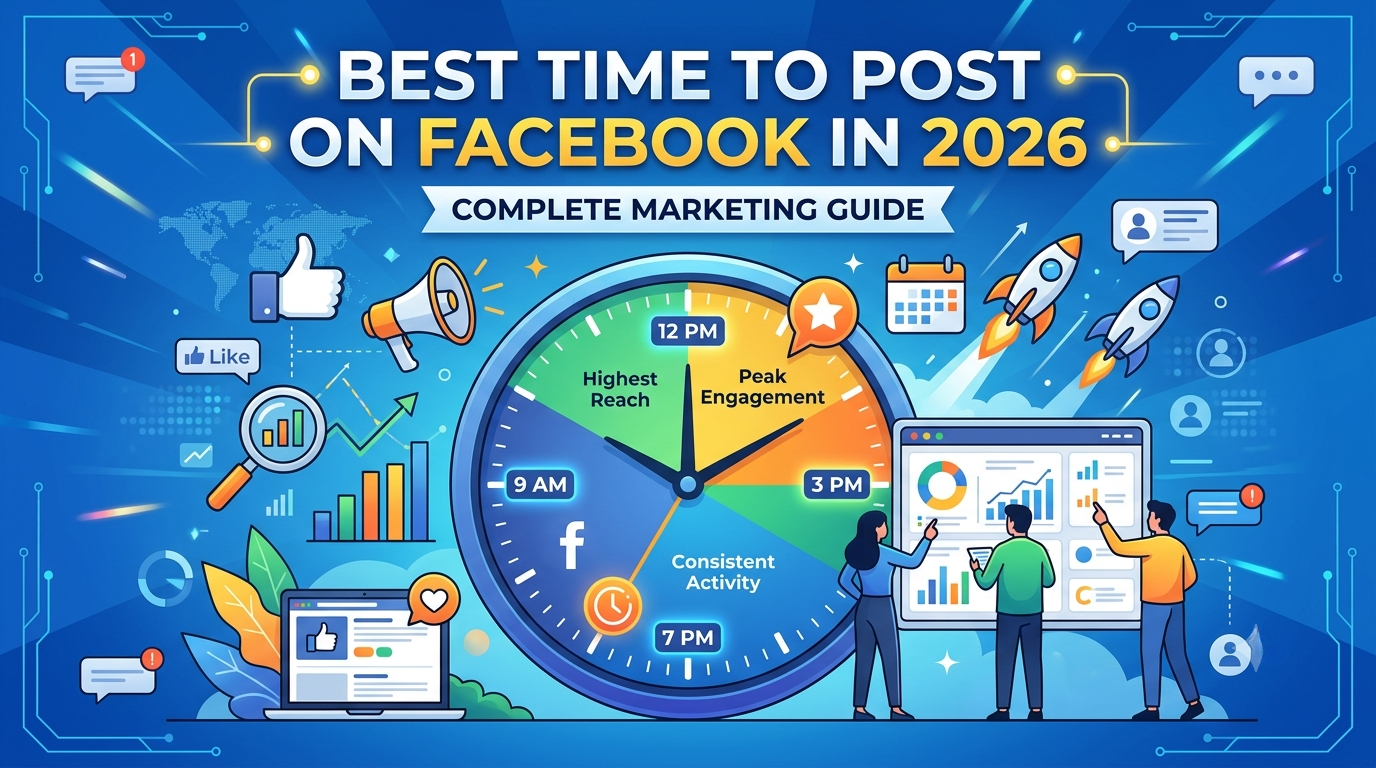
Tuesday and Wednesday between 9 AM and 3 PM local time is the best time to post on Facebook in 2026 for marketers targeting audiences in the USA, UK, Australia, Canada, and Europe. These 2 days consistently deliver the highest organic reach, brand engagement, and content distribution across every major English-speaking market.
This marketing guide covers the exact posting windows for every day of the week, 5 regions, 6 industries, Facebook Reels, and a 5-step process to identify your brand’s specific peak posting time using Facebook Insights — so your social media marketing strategy stops guessing and starts converting.
Why Facebook Posting Time Is a Core Marketing Decision
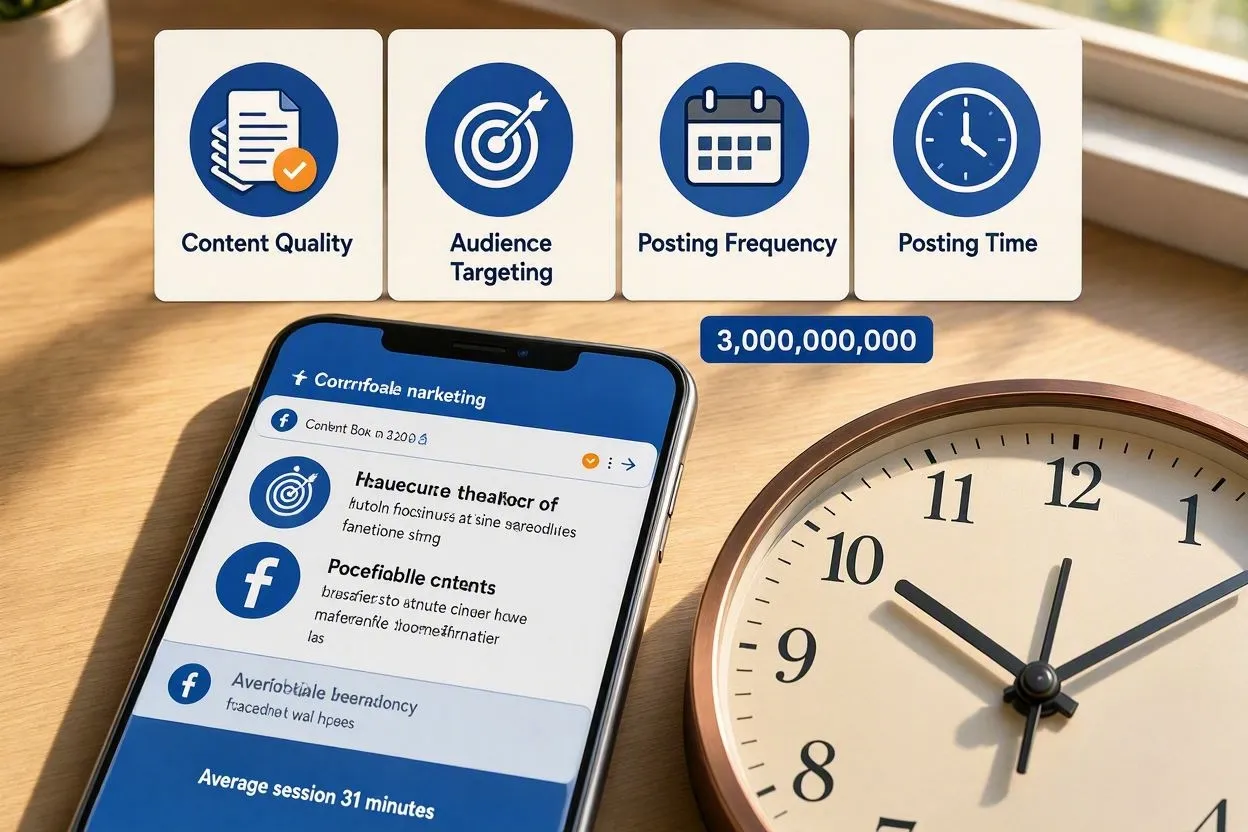
Yes — posting time is one of the 4 controllable variables in every Facebook marketing strategy. The other 3 are content quality, audience targeting, and posting frequency. Marketers who optimise all 4 variables simultaneously generate 2x to 3x more organic reach than brands that focus on content alone and ignore distribution timing.
Facebook has over 3 billion monthly active users in 2026. The average user spends 31 minutes per day on the platform — but those 31 minutes are not evenly distributed across 24 hours. User activity concentrates into 3 to 4 predictable daily windows, and every social media marketer needs to publish inside those windows to activate Facebook’s content distribution engine.
Marketers publishing content during peak activity windows capture early engagement — likes, comments, shares, and saves — within the critical first 30 minutes. That early engagement signals content quality to Facebook’s algorithm, which then amplifies distribution to a wider audience automatically. Content published outside peak windows collects no early engagement signal, stalls in the distribution queue, and reaches a fraction of the intended audience — wasting creative budget, production time, and campaign momentum.
Timing is the lowest-cost lever in any Facebook marketing plan. Shifting a brand post from 11 PM to 10 AM on Wednesday costs nothing and can increase organic reach by 18% to 34%, based on Buffer’s analysis of 14 million Facebook posts. No additional ad spend. No new creative assets. Pure marketing efficiency.
How the Facebook Algorithm Impacts Marketing Content Distribution
The Facebook algorithm applies 4 ranking signals to every piece of marketing content the moment it publishes: recency, engagement probability, content type affinity, and page-audience relationship strength. Recency is the trigger that activates the remaining 3.
Marketing content published during a peak activity window reaches real users immediately. Those users interact — they click, comment, share, or save the post. Facebook’s engagement probability model reads those interactions as proof that the content is relevant and valuable, then expands distribution to a larger segment of the brand’s audience and to new prospective customers in connected networks.
Every marketing post has a 30-minute momentum window to collect that early engagement signal. Miss the window by scheduling content during off-peak hours and the algorithm assigns a low engagement probability score — even to high-quality creative content. The post gets suppressed before most followers ever see it, regardless of how strong the brand message or marketing offer is.
Content type also affects distribution timing. Facebook Reels receive algorithmic marketing distribution for up to 48 hours — giving social media marketers more scheduling flexibility with video content than with static image posts or link-based marketing content. Standard image posts have a 4 to 6-hour active distribution window. Link posts — the primary format for driving marketing traffic to landing pages, product pages, and blog content — perform best when published during morning engagement windows when audiences click with intent rather than passive scrolling behaviour.
Understanding these algorithm mechanics allows social media marketing teams to build content calendars that align content type, posting time, and audience activity into a single coordinated marketing distribution strategy.
Best Time to Post on Facebook in 2026 — Day-by-Day Marketing Schedule
Tuesday and Wednesday, 9 AM to 3 PM local time, produce the highest marketing engagement across all 5 regions. The table below applies to your audience’s local timezone — Eastern Standard Time (EST, UTC-5) for USA and Canada East, Greenwich Mean Time (GMT, UTC+0) for the UK, Australian Eastern Standard Time (AEST, UTC+10), and Central European Time (CET, UTC+1) for Europe.
| Day | Best Local Time | Marketing Value | Best Content Type |
| Monday | 9 AM – 12 PM | Strong | Brand awareness posts, weekly campaign launches |
| Tuesday | 9 AM – 3 PM | Very High | Product marketing, lead generation content |
| Wednesday | 9 AM – 3 PM | Very High | Video marketing, educational brand content |
| Thursday | 9 AM – 11 AM, 8 PM | Strong | B2B marketing content, brand storytelling |
| Friday | 9 AM – 1 PM | Moderate | Promotional offers, weekend event marketing |
| Saturday | 10 AM – 11 AM | Low | Lifestyle brand content only |
| Sunday | 9 AM – 11 AM | Lowest | Avoid for most marketing campaigns |
Monday: 9 AM – 12 PM
9 AM to 12 PM is Monday’s only reliable engagement window. Users across USA, UK, Canada, Australia, and Europe follow a similar Monday pattern — they arrive at work, spend the first 30 to 60 minutes on email and admin, then check Facebook during short breaks from 9 AM onward. The 12 PM lunch hour produces a secondary spike. Posts published before 8 AM on Monday are 3 to 4 hours old by the time the audience becomes active — the recency signal has already expired.
Tuesday: 9 AM – 3 PM
Tuesday delivers 6 continuous hours of elevated Facebook engagement — the most consistent single-day window of the week across all 5 regions. Users are past the Monday catch-up phase and fully settled into their weekly rhythm. The 10 AM mid-morning break and the 12 PM to 1 PM lunch hour are the 2 sharpest engagement spikes within Tuesday’s block. Business-to-Consumer (B2C) brands posting product content on Tuesday mornings consistently generate higher share rates than any other weekday slot.
Wednesday: 9 AM – 3 PM
Wednesday matches Tuesday in total engagement duration and outperforms Tuesday for video content. Midweek is the psychological centre of user attention — neither distracted by Monday’s backlog nor mentally checking out ahead of the weekend. Facebook Reels and carousel posts published Wednesday between 10 AM and 1 PM local time receive the highest average view counts of the week across USA, UK, Canadian, and Australian audiences. European users peak slightly later — 11 AM to 2 PM CET is the strongest local slot on Wednesdays.
Thursday: 9 AM – 11 AM and 8 PM
Thursday produces 2 distinct engagement spikes rather than a continuous block. The first runs from 9 AM to 11 AM — the single strongest window for Business-to-Business (B2B) content, professional announcements, and industry news across all 5 regions. The second spike hits at 8 PM local time across USA, UK, Canada, and Australia as users scroll after dinner. European users show their Thursday evening peak slightly earlier at 7 PM CET.
Friday: 9 AM – 1 PM
Friday’s engagement window is narrow — 9 AM to 1 PM only. Across every region, Facebook engagement drops sharply after 1 PM Friday as users mentally transition into weekend mode. Posts published on Friday afternoon or evening receive 22% lower engagement than equivalent content published on Tuesday or Wednesday. Use the Friday morning window for time-sensitive announcements, weekend event promotions, or Facebook Reels that benefit from a 48-hour distribution tail running into Saturday.
Saturday and Sunday
Saturday and Sunday produce the lowest Facebook engagement of the week across all 5 regions. Users in the USA, UK, Australia, Canada, and Europe disconnect from structured digital routines at weekends. Sunday morning between 9 AM and 11 AM is a partial exception — users check social media during the quiet window before the day begins. For most brands, this window still underperforms any weekday morning slot by 25% to 40% in engagement rate.
Best Time to Post on Facebook by Region — Marketing Timezone Guide

United States — Marketing Times (EST and PST)
The strongest Facebook marketing window in the USA is Tuesday and Wednesday, 9 AM to 3 PM Eastern Standard Time (EST, UTC-5). American social media marketers running national campaigns should anchor their publishing schedule to EST, which aligns with the USA’s highest-concentration Facebook marketing audience in New York, Chicago, and the East Coast. For brand marketing campaigns targeting West Coast audiences in Pacific Standard Time (PST, UTC-8), schedule a dedicated post at 9 AM to 3 PM PST using Meta Business Suite — this captures Pacific region marketing audiences without republishing duplicate brand content.
| Day | EST — East Coast Marketing | PST — West Coast Marketing |
| Monday | 9 AM – 12 PM EST | 9 AM – 12 PM PST |
| Tuesday | 9 AM – 3 PM EST | 9 AM – 3 PM PST |
| Wednesday | 9 AM – 3 PM EST | 9 AM – 3 PM PST |
| Thursday | 9 AM – 11 AM, 8 PM EST | 9 AM – 11 AM, 8 PM PST |
| Friday | 9 AM – 1 PM EST | 9 AM – 1 PM PST |
American Facebook marketing audiences show a consistent lunch-hour engagement spike at 12 PM to 1 PM EST — making this the highest-performing single hour for product marketing posts, promotional campaign content, and brand engagement initiatives targeting USA consumers. The Tuesday and Wednesday evening window (7 PM to 9 PM EST) is the second-best marketing slot for B2C brand content, lifestyle marketing campaigns, and consumer product advertising targeting American Facebook audiences specifically.
United Kingdom — Marketing Times (GMT and BST)
The best Facebook marketing window in the UK is Tuesday and Wednesday, 8 AM to 2 PM Greenwich Mean Time (GMT, UTC+0). During British Summer Time (BST, UTC+1) from late March to late October, UK social media marketers shift all campaign scheduling one hour forward — 9 AM to 3 PM BST.
| Day | GMT — Winter Marketing | BST — Summer Marketing |
| Monday | 8 AM – 12 PM GMT | 9 AM – 1 PM BST |
| Tuesday | 8 AM – 2 PM GMT | 9 AM – 3 PM BST |
| Wednesday | 8 AM – 2 PM GMT | 9 AM – 3 PM BST |
| Thursday | 8 AM – 11 AM, 7 PM GMT | 9 AM – 12 PM, 8 PM BST |
| Friday | 8 AM – 12 PM GMT | 9 AM – 1 PM BST |
UK brand marketers benefit from 2 high-value daily windows — the morning commute (7 AM to 9 AM GMT) and the lunch break (12 PM to 1 PM GMT). Marketing content published at 9 AM GMT on Tuesday captures both early commuters checking social feeds on public transport and desk-based professionals during their first morning break. The post-work marketing window from 5 PM to 7 PM GMT also shows above-average brand engagement for news-adjacent marketing content, lifestyle brand campaigns, and consumer product marketing targeting UK audiences. Social media marketers managing UK brand accounts should front-load campaign content in the 9 AM to 11 AM GMT window for maximum organic content distribution.
Australia — Marketing Times (AEST and AEDT)
The best Facebook marketing window in Australia is Tuesday and Wednesday, 9 AM to 2 PM Australian Eastern Standard Time (AEST, UTC+10). During Australian Eastern Daylight Time (AEDT, UTC+11) from October to April, Australian marketing teams shift all campaign scheduling one hour forward.
| Day | AEST — Standard Marketing | AEDT — Daylight Marketing |
| Monday | 9 AM – 12 PM AEST | 10 AM – 1 PM AEDT |
| Tuesday | 9 AM – 2 PM AEST | 10 AM – 3 PM AEDT |
| Wednesday | 9 AM – 2 PM AEST | 10 AM – 3 PM AEDT |
| Thursday | 9 AM – 11 AM, 7 PM AEST | 10 AM – 12 PM, 8 PM AEDT |
| Friday | 9 AM – 1 PM AEST | 10 AM – 2 PM AEDT |
Australian Facebook marketing audiences are notably active during the pre-work commute (7 AM to 9 AM AEST) — particularly in Sydney, Melbourne, and Brisbane where public transport ridership is high. Brand marketers targeting Australian consumers should test 7 AM AEST Tuesday and Wednesday posts as a pre-peak marketing slot alongside the standard morning campaign window. Evening brand engagement in Australia peaks between 7 PM and 9 PM AEST — making Wednesday and Thursday evenings a strong secondary marketing window for consumer lifestyle brands, retail marketing campaigns, and entertainment content targeting Australian audiences.
Canada — Marketing Times (EST, CST, and PST)
The best Facebook marketing window in Canada is Tuesday and Wednesday, 9 AM to 3 PM in each audience’s local timezone. Canada spans 6 time zones — social media marketing teams running national Canadian brand campaigns should anchor their publishing calendar to Eastern Standard Time (EST, UTC-5), which covers Toronto, Ottawa, and Montreal — Canada’s 3 largest Facebook marketing audience concentrations.
| Day | EST — Toronto/Montreal | CST — Winnipeg | PST — Vancouver |
| Monday | 9 AM – 12 PM EST | 8 AM – 11 AM CST | 6 AM – 9 AM PST |
| Tuesday | 9 AM – 3 PM EST | 8 AM – 2 PM CST | 6 AM – 12 PM PST |
| Wednesday | 9 AM – 3 PM EST | 8 AM – 2 PM CST | 6 AM – 12 PM PST |
| Thursday | 9 AM – 11 AM, 8 PM EST | 8 AM – 10 AM, 7 PM CST | 6 AM – 8 AM, 5 PM PST |
| Friday | 9 AM – 1 PM EST | 8 AM – 12 PM CST | 6 AM – 10 AM PST |
Canadian Facebook marketing audience behaviour mirrors the USA East Coast pattern — the Tuesday and Wednesday morning marketing windows are the strongest recurring campaign slots, and the 12 PM to 1 PM EST lunch spike is consistent across national marketing campaigns. Brand marketers specifically targeting British Columbia consumers should schedule content at 9 AM PST (Pacific Standard Time, UTC-8) on Tuesday and Wednesday, aligning with Vancouver’s Pacific morning marketing window that peaks later than Eastern Canadian audiences.
Europe — Marketing Times (CET and CEST)
The best Facebook marketing window in Europe is Tuesday and Wednesday, 11 AM to 2 PM Central European Time (CET, UTC+1). During Central European Summer Time (CEST, UTC+2) from late March to late October, European marketing teams maintain the 11 AM to 2 PM scheduling window in CEST.
| Day | CET — Winter Marketing | CEST — Summer Marketing |
| Monday | 10 AM – 1 PM CET | 10 AM – 1 PM CEST |
| Tuesday | 11 AM – 2 PM CET | 11 AM – 2 PM CEST |
| Wednesday | 11 AM – 2 PM CET | 11 AM – 2 PM CEST |
| Thursday | 10 AM – 12 PM, 7 PM CET | 10 AM – 12 PM, 7 PM CEST |
| Friday | 10 AM – 12 PM CET | 10 AM – 12 PM CEST |
European Facebook marketing audiences behave distinctly from North American and Australian brand audiences — European consumers are less active on social media in the early morning and significantly more active in the evening between 7 PM and 9 PM CET. Brand marketers running campaigns targeting Germany, France, Spain, Italy, or the Netherlands should treat the 7 PM to 9 PM CET Tuesday-and-Wednesday evening window as a primary marketing publishing slot — not a secondary fallback. The 12 PM to 2 PM CET lunchtime window is the strongest daytime marketing slot, but European evening brand engagement frequently matches or exceeds lunchtime performance for entertainment marketing, lifestyle brand content, and consumer product campaigns targeting continental European audiences.
Facebook Marketing Performance by Industry — 6 Sectors
Marketing timing strategy varies significantly by industry because each sector’s target audience uses Facebook for different commercial purposes at different points in the day.
1. Retail and E-commerce Marketing
Best marketing times: Tuesday through Thursday, 9 AM – 2 PM local time. Retail marketing audiences browse Facebook product content during work breaks and lunch hours when purchase intent and consumer buying decisions peak. Tuesday at 10 AM local time is the strongest single marketing slot for product promotion posts, sale campaign announcements, new product launches, and retail brand content across all 5 regions. Social commerce marketing teams in retail should avoid Friday afternoon and weekend campaign scheduling — consumer purchase intent drops sharply outside of structured workweek routines. E-commerce brand marketers running Facebook advertising campaigns alongside organic content should align paid ad scheduling with the same Tuesday and Wednesday morning windows for maximum combined marketing reach and conversion performance.
2. Food and Beverage Marketing
Best marketing times: Monday through Friday, 10 AM – 12 PM and 4 PM – 6 PM local time. Food and beverage brand marketing content performs strongest when published during meal planning windows — the pre-lunch period (10 AM to 12 PM) and the pre-dinner decision window (4 PM to 6 PM). Restaurant marketing teams, food brand content managers, and beverage product marketers targeting USA, UK, Canada, and Australian audiences generate the highest brand engagement and content shares during these 2 daily marketing windows. In European markets, the pre-dinner food marketing window shifts to 5 PM to 7 PM CET. Australian food and beverage brand marketers see meaningful Saturday morning marketing engagement at 10 AM AEST — making food and beverage one of only 2 industries where weekend social media marketing investment returns measurable brand value.
3. Healthcare Marketing
Best marketing times: Monday through Friday, 9 AM – 1 PM local time. Healthcare brand marketing and patient communication content performs best during structured weekday hours when healthcare audiences — patients, caregivers, and health-conscious consumers — access social media as part of morning and work-break routines. Wednesday morning (9 AM to 12 PM local time) is the single strongest marketing window across all 5 regions for health tips, wellness brand content, appointment reminder campaigns, and healthcare service marketing. Healthcare marketing teams publishing post-7 PM content underperform in every region — health information is not leisure content for most consumer audiences, and after-hours healthcare marketing content receives 35% to 45% lower click-through rates than equivalent morning marketing content.
4. Financial Services Marketing
Best marketing times: Weekdays, 9 AM – 11 AM and 3 PM – 5 PM local time. Financial services marketing targets professional audiences — investors, business owners, and working professionals — who engage with brand content during structured daily work breaks. The post-lunch marketing window from 3 PM to 5 PM local time shows the strongest engagement for investment content marketing, financial product promotions, market update campaigns, and financial education brand content across USA, UK, Canada, and Australia. European financial marketing audiences favour the morning window (9 AM to 11 AM CET) over the afternoon. Financial services marketing campaigns should avoid all weekend scheduling — this industry shows the steepest weekend marketing performance drop of all 6 sectors, with Saturday and Sunday content generating 40% to 50% lower engagement than Tuesday and Wednesday campaign content.
5. Education Marketing
Best marketing times: Weekdays, 9 AM – 12 PM and 3 PM – 5 PM local time. Education sector marketing — including university enrolment campaigns, online course marketing, and school event promotion — peaks around class transition times when the primary decision-making audiences (parents and adult learners) are active. The post-school marketing window from 3 PM to 5 PM local time drives the highest parent engagement with educational brand content across USA, UK, Canada, and Australia. Tuesday and Wednesday at 10 AM local time are the strongest single marketing slots for educational institutions running enrolment marketing campaigns, event promotion content, and institutional brand awareness initiatives.
6. Travel and Tourism Marketing
Best marketing times: Tuesday through Thursday, 11 AM – 2 PM local time, plus Sunday 9 AM – 11 AM. Travel brand marketing is one of only 2 industry categories where Sunday morning posts hold genuine marketing value — consumers actively browse travel content, research destinations, and make booking decisions while relaxed on Sunday mornings. Wednesday at 12 PM local time is the strongest weekday travel marketing slot across all 5 regions for destination campaign content, travel deal promotions, and tourism brand storytelling. UK and Australian travel marketing teams also see strong brand engagement on Thursday evenings (7 PM to 9 PM GMT / 7 PM to 9 PM AEST) as consumers browse weekend travel options and plan upcoming trip bookings.
Facebook Content Marketing Format Timing — Reels vs. Image vs. Link Posts
3 Facebook content marketing formats each require different optimal scheduling because Facebook’s algorithm distributes each format across a different time horizon, affecting marketing reach, brand visibility, and audience engagement differently.
Facebook Reels Marketing: Tuesday – Thursday, 12 PM – 3 PM Local Time
Facebook Reels receive algorithmic content marketing distribution for up to 48 hours after publishing — making Reels the highest-value content marketing format for brand awareness campaigns that need sustained reach beyond a single peak hour. The strongest initial Reels marketing engagement runs Tuesday through Thursday between 12 PM and 3 PM local time across all 5 regions. Social media marketing teams using Facebook Reels for brand storytelling, product demonstrations, or awareness campaign content should schedule Reels to go live 30 to 60 minutes before the peak window opens — at 11 AM to 11:30 AM — to capture the full rising audience curve. Reels also generate strong marketing brand engagement on Friday evenings between 6 PM and 9 PM local time — a marketing window where standard posts dramatically underperform but video content marketing continues attracting passive brand audiences browsing entertainment content.
Image Post Marketing: Wednesday, 9 AM – 11 AM Local Time
Static image posts — product photography, brand graphics, infographics, and promotional creative — carry the shortest distribution window of 4 to 6 hours. Social media marketing teams should publish image-based marketing content at the beginning of a peak window, not midway through it. A Wednesday 9 AM image post reaches the 10 AM to 12 PM break-period marketing audience at full scrolling intensity and maximum brand content receptivity. An image post published at 2 PM Wednesday has already missed the morning organic marketing push by the time the afternoon audience arrives. For USA marketing campaigns, Tuesday at 10 AM EST delivers equally strong image marketing performance. UK brand marketers achieve maximum image post marketing reach at 9 AM GMT on both Tuesday and Wednesday.
Link Post Marketing: Tuesday or Wednesday, 8 AM – 10 AM Local Time
Link posts — the primary Facebook content marketing format for driving traffic to landing pages, product pages, blog content, and lead generation forms — perform best in the pre-peak morning marketing window. Marketing audiences click external links when they are in an active, decision-making mindset at the start of their day, not during rapid scroll sessions when passive content consumption dominates behaviour. Tuesday and Wednesday at 8 AM to 10 AM local time capture audiences in their highest-intent morning marketing moment — before the midday social media scroll shifts attention toward visual entertainment content. Marketing teams using Facebook to drive website traffic, generate marketing qualified leads (MQLs), or push audiences into sales funnels should prioritise the 8 AM to 10 AM link post window and avoid scheduling link-based marketing content after 6 PM in any region.
3 Worst Times for Facebook Marketing Content
3 scheduling windows consistently destroy Facebook marketing content performance — regardless of region, industry, campaign budget, or creative quality:
- Before 7 AM on any day. Marketing content published before 7 AM reaches audiences that are asleep, waking up, or not yet in social media browsing mode. By the time active marketing engagement begins at 9 AM to 10 AM local time, the post is already 2 to 3 hours old — the algorithmic recency signal has expired, suppressing brand content distribution before the primary marketing day even begins. Early morning scheduling wastes high-value marketing creative on the platform’s lowest-activity window.
- After 9 PM on weekdays. Facebook marketing engagement drops sharply after 9 PM Sunday through Thursday across all 5 regions. Late-night social media users engage passively — they scroll and view without interacting with marketing content. Posts collect impressions but not the comments, shares, and link clicks that activate Facebook’s content distribution engine and drive marketing campaign results. Marketing teams measuring cost per engagement, brand reach, and content amplification rates see their worst performance numbers from content published after 9 PM.
- All day Saturday and Sunday for most marketing categories. Weekend marketing content scheduling is the most common source of wasted social media marketing budget across all 5 English-speaking regions. Saturday and Sunday posts generate 25% to 40% lower engagement than equivalent Tuesday or Wednesday marketing content — meaning the same creative asset, the same brand message, and the same campaign targeting produce dramatically inferior marketing results when published on weekends. Social media marketing teams should schedule only travel, food, lifestyle, and entertainment brand content on weekends, and only during the Sunday 9 AM to 11 AM local time window.
How to Build Your Brand’s Facebook Marketing Schedule — 5 Steps Using Facebook Insights
Global and regional marketing benchmarks provide a strategic starting point. To build a data-specific Facebook marketing schedule for your brand and audience, follow these 5 steps using Facebook Insights:
Step 1: Access your marketing audience activity data. Open your Facebook Business Page and navigate to “Professional Dashboard,” then “Insights,” then “Posts.” Facebook displays a “When Your Fans Are Online” graph showing your specific marketing audience’s activity by hour and day of the week — based on actual page follower behaviour, not global averages.
Step 2: Identify your top 3 peak marketing hours per key day. Examine the hourly audience activity graph for Tuesday, Wednesday, and Thursday separately. Note the 3 hours showing the highest activity bars on each day. These represent the actual peak marketing windows for your brand’s specific follower base — which may confirm or differ from the regional benchmarks in this guide depending on your audience demographics and content niche.
Step 3: Cross-reference with your 5 highest-performing marketing posts. Navigate to “All Posts Published” and sort by engagement rate. Check the publish time of your top 5 brand content posts. If your highest-performing marketing content clusters between 10 AM and 12 PM local time, your page data confirms the regional marketing benchmark. If your top marketing posts cluster at a different hour, prioritise that hour in your content marketing calendar.
Step 4: Run a 4-week marketing content split test. Select 3 candidate marketing posting times — for example, 9 AM, 12 PM, and 3 PM local time. Publish equivalent marketing content at each time slot across 4 weeks, producing a minimum of 12 brand posts per slot. Track engagement rate, organic marketing reach, link click-through rate (CTR), and brand page reach separately for each time slot to identify which window delivers the strongest marketing return on content investment.
Step 5: Standardise and automate your marketing publishing schedule. After 4 weeks of split testing, compare average engagement rate and organic reach per time slot. Commit to your top 2 confirmed marketing windows as your permanent brand publishing schedule. Use Meta Business Suite (free), Buffer, Hootsuite, or Sprout Social to automate content marketing publication at those exact times every week — eliminating manual scheduling while maintaining consistent brand content distribution across all 5 regions.
Facebook Marketing Posting Frequency — 2026 Best Practice
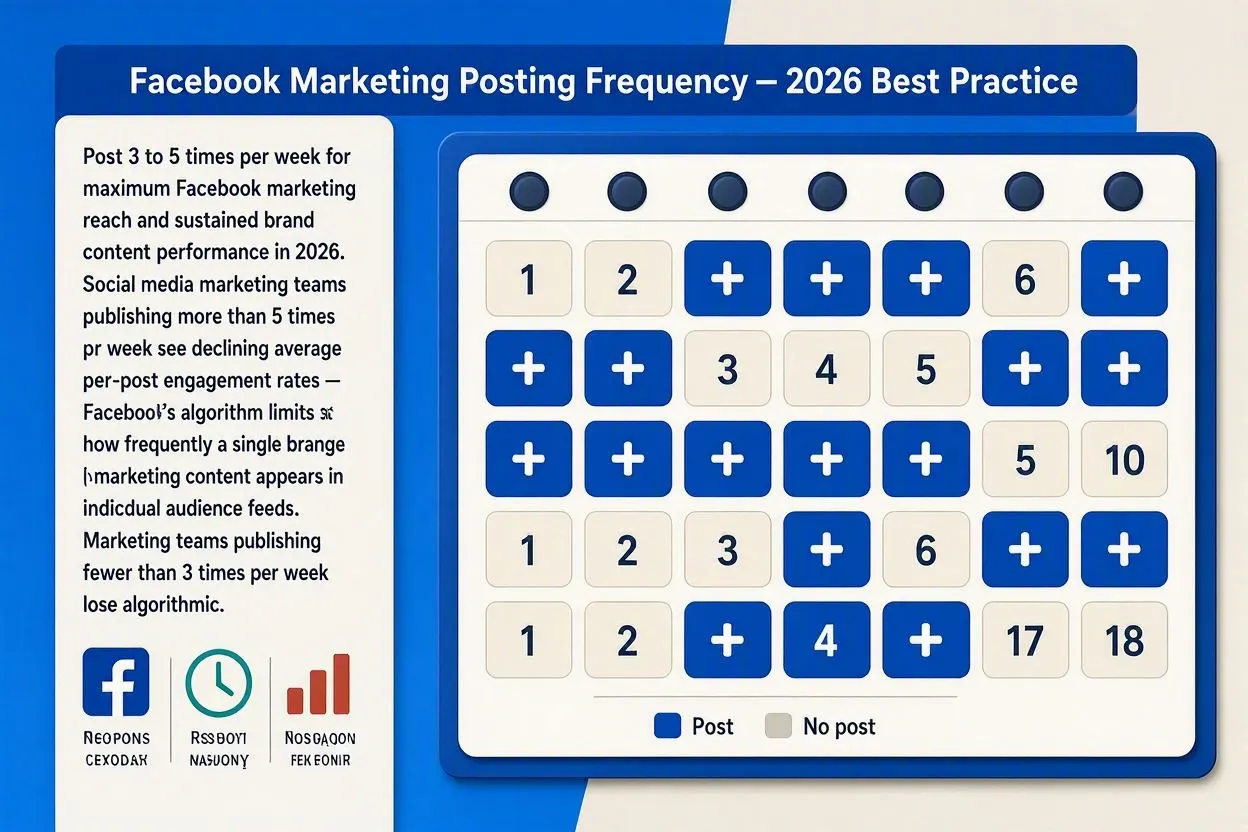
Post 3 to 5 times per week for maximum Facebook marketing reach and sustained brand content performance in 2026. Social media marketing teams publishing more than 5 times per week see declining average per-post engagement rates — Facebook’s algorithm limits how frequently a single brand page’s marketing content appears in individual audience feeds. Marketing teams publishing fewer than 3 times per week lose algorithmic content distribution momentum, resulting in lower baseline brand reach scores that take weeks to rebuild.
The optimal weekly content marketing calendar for brands targeting USA, UK, Australia, Canada, or Europe:
- Tuesday: 1 marketing post — your highest-value brand content or campaign launch at your confirmed peak local marketing time
- Wednesday: 1 Facebook Reel or video marketing asset — published 30 to 60 minutes before the peak content marketing window opens
- Thursday: 1 engagement-focused brand content post — a poll, question, customer testimonial, or interactive carousel
- Monday or Friday: 1 optional marketing post — time-sensitive campaign announcements, promotional offers, or trending brand content
Consistent brand publishing outperforms high-volume burst marketing in every regional market. A Facebook brand page publishing 3 times per week on a consistent 6-month marketing schedule builds stronger algorithmic content distribution trust than a brand page running 15 posts one week then going dark the next. Facebook’s content marketing distribution model rewards predictable, consistent brand publishing with sustained organic marketing reach — even without paid media support.
Final Marketing Takeaway
The best time to post on Facebook in 2026 is Tuesday and Wednesday between 9 AM and 3 PM in your marketing audience’s local timezone — whether that is EST for USA and Canadian East Coast brand campaigns, GMT for UK marketing audiences, AEST for Australian brand content, or CET for European social media marketing teams.
Schedule Facebook Reels marketing content on Tuesday through Thursday at 12 PM to 3 PM local time for maximum algorithmic brand distribution. Publish image-based marketing creative at the start of peak windows — not midway through. Schedule link-based marketing content and lead generation posts in the 8 AM to 10 AM morning window when audiences are in their highest-intent, decision-making mindset.
For social media marketing teams managing brand audiences across multiple regions simultaneously, anchor your primary campaign schedule to your highest-value marketing audience’s local timezone. Use Meta Business Suite or a third-party social media marketing platform to queue region-specific brand content at each market’s confirmed local peak marketing time — maintaining consistent campaign delivery without manual publishing intervention.
Validate every regional marketing benchmark in this guide against your brand’s own Facebook Insights data. Run a 4-week content marketing split test, standardise your brand publishing schedule around your top 2 confirmed performance windows, and maintain a consistent 3 to 5-post weekly marketing calendar.