
Let me be honest with you — most businesses waste serious money on digital marketing simply because they chase the wrong channels.
A local bakery buying LinkedIn ads? That money is basically gone. A SaaS company that ignores email marketing? They’re quietly bleeding thousands every single month. Channel selection is where digital marketing either clicks into place or completely falls apart.
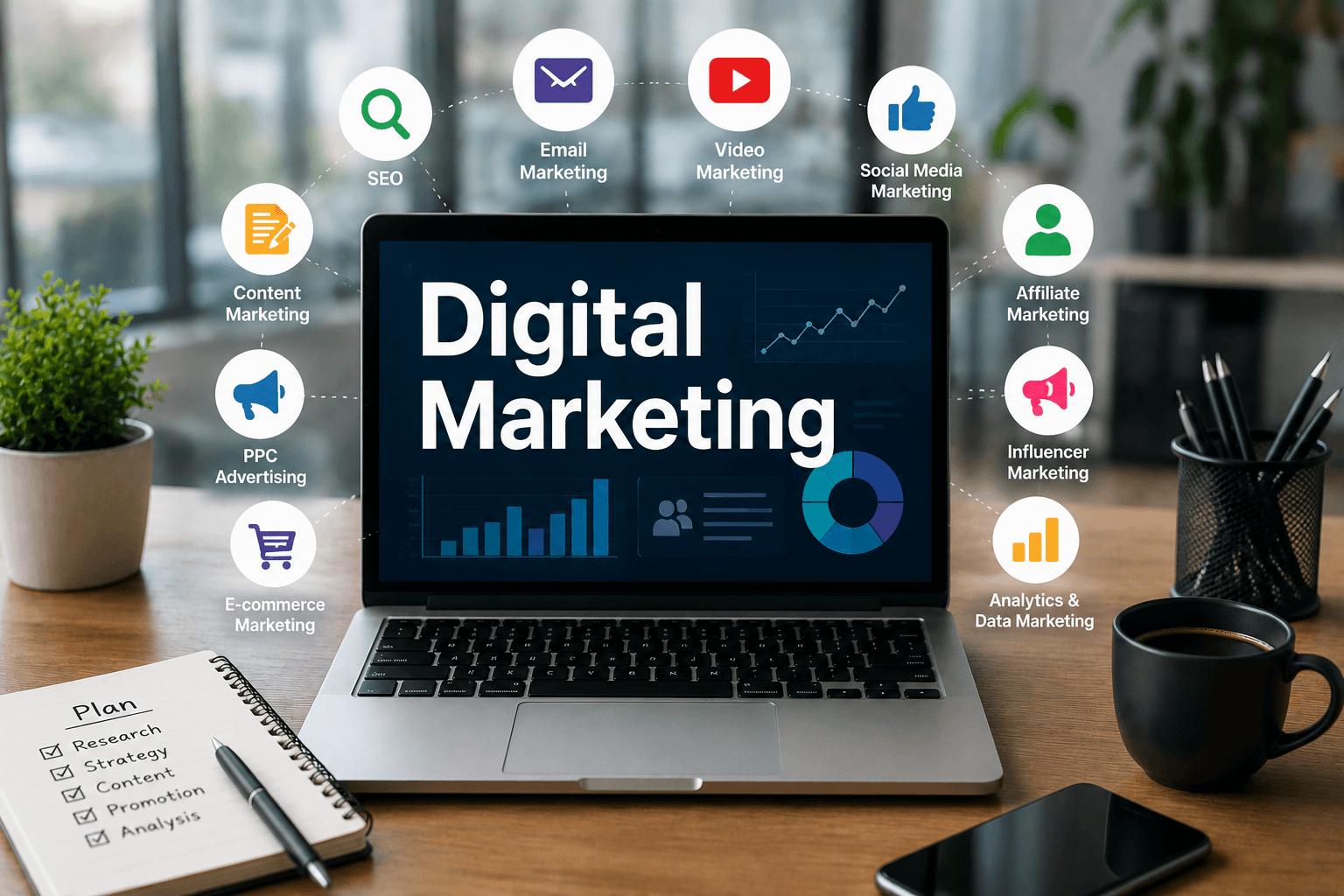
Digital marketing, at its core, is how businesses use online platforms — search engines, social media, email, paid ads — to find customers, convert them, and keep them coming back. Simple concept. Complicated execution.
I’ve pulled together all 15 types, including real ROI figures, honest pros and cons, and — something most guides skip — how each channel ties directly into guest posting and link building. Let’s get into it.
Why the Right Channel Changes Everything
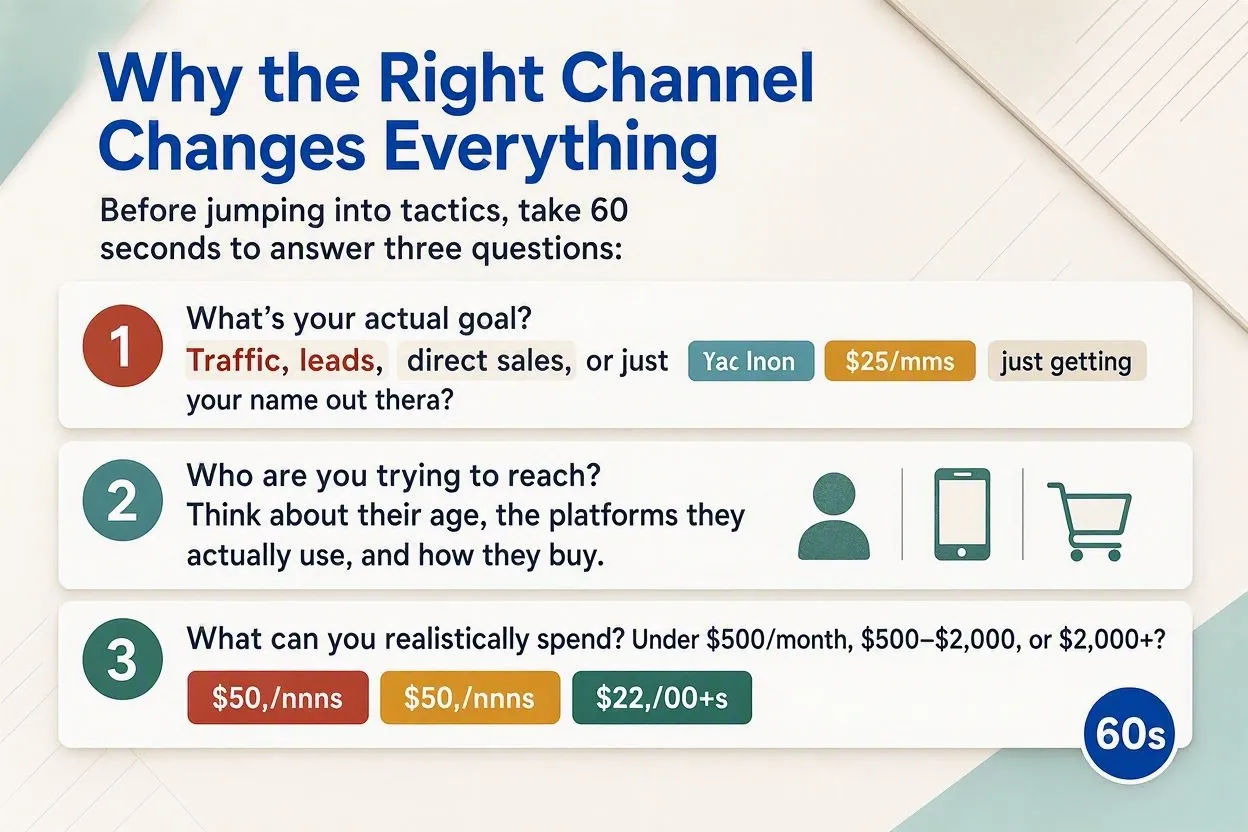
Before jumping into tactics, take 60 seconds to answer three questions:
- What’s your actual goal? Traffic, leads, direct sales, or just getting your name out there?
- Who are you trying to reach? Think about their age, the platforms they actually use, and how they buy.
- What can you realistically spend? Under $500/month, $500–$2,000, or $2,000+?
Here’s a quick reference based on goal:
| Goal | Best Channel |
| Fast leads | PPC |
| Long-term traffic | SEO |
| Brand authority | Guest Posts + Content |
| Customer retention | |
| Product launch | Influencer + Social |
| Local visibility | Mobile + Voice Search |
1. Search Engine Optimization (SEO)
SEO is the practice of getting your website to show up higher in unpaid search results on Google, Bing, and similar platforms.
Google’s ranking system, when you strip away all the complexity, comes down to three things: relevance (does your page match what someone searched?), authority (do other reputable sites link to you?), and technical health (does your site load fast, work on mobile, and pass Core Web Vitals?).
There are four main branches of SEO:
- On-page SEO — titles, content structure, headers, internal linking
- Off-page SEO — backlinks, brand mentions across the web
- Technical SEO — crawlability, site speed, schema markup
- Local SEO — showing up in Google Maps and “near me” searches
ROI: Done properly, SEO delivers 500%+ returns over 12 months. The #1 spot on Google captures roughly 27.6% of all clicks for a given query — that gap between position 1 and position 5 is enormous.
Best for: Businesses that want traffic they don’t have to keep paying for.
Pros:
- Once you rank, the traffic is essentially free
- Results compound — a page ranked today keeps earning traffic for years
- Rankings build genuine credibility with your audience
Cons:
- You won’t see meaningful results for 4–12 months
- Algorithm updates can shake rankings overnight
- Requires ongoing content creation and link acquisition
Link building connection: SEO without backlinks is a ceiling you’ll hit fast. Guest posts are the most consistent, white-hat method for earning high-authority links — which is exactly why SEO and guest posting are practically inseparable strategies.
2. Content Marketing
Content marketing is the practice of creating genuinely useful content — articles, guides, videos, case studies — that attracts an audience without directly selling to them.
The logic is straightforward: publish content that answers real questions your audience is already searching for, Google rewards helpfulness with rankings, and those rankings bring in qualified traffic that eventually converts.
The five formats that consistently perform:
- Long-form blog posts (1,500–3,500 words)
- Video tutorials and explainer content
- Infographics with original data
- Case studies with real numbers and outcomes
- Email newsletters
ROI: Content marketing generates three times more leads than traditional outbound methods, at roughly 62% less cost (Content Marketing Institute, 2024).
Best for: B2B companies, agencies, SaaS brands — essentially anyone playing the long game on authority.
Pros:
- Feeds every other channel (social, email, SEO all benefit)
- Builds E-E-A-T signals Google increasingly prioritizes
- Content you publish today keeps working indefinitely
Cons:
- Consistency matters — one piece per month won’t cut it; aim for 1–3 per week
- Competitive niches demand exceptional quality, not just adequate
- The compounding returns take 6+ months to really show up
Link building connection: Quality content earns natural backlinks. Guest posts placed on authoritative sites then funnel referral traffic back to your content hub, accelerating authority growth from two directions simultaneously
3. Guest Post Marketing
Guest post marketing means writing original articles for external websites in your niche — in exchange for a backlink to your own site.
Here’s why it works: when a reputable website publishes your article and links back to you, Google interprets that link as a trust signal. Enough trust signals from credible sources, and your domain authority rises. Higher domain authority means better rankings across every page on your site, not just the one that received the link.
There are three main variations:
- Standard guest posts — a full original article published on a relevant niche site
- Niche edits — your link inserted into an already-published, already-indexed piece
- Digital PR guest posts — placements on news sites and major media properties
ROI: A single guest post on a DA 60+ site typically contributes to a 15–30 referring domain lift over time. Brands running consistent guest post campaigns rank 43% faster than those relying on SEO tactics alone.
Best for: Agencies, SaaS companies, e-commerce brands, and anyone targeting keywords with real competition behind them.
Pros:
- Direct, measurable impact on domain authority
- Builds brand recognition beyond your own platforms
- Drives referral traffic from audiences already interested in your niche
- Widely considered the safest white-hat link building method available
Cons:
- Sites worth getting on require pitches worth reading — quality counts
- Outreach is a numbers game — expect 40–60 emails per confirmed placement
- Guest posts on low-quality or irrelevant sites can actively hurt rankings
How to evaluate a guest post site:
- DA 40+ minimum (DA 60+ if you’re in a competitive niche)
- Actual organic traffic — verify with Ahrefs or Semrush before outreach
- Topical relevance — the site’s content should overlap meaningfully with yours
- Real engagement — comments, social shares, an active readership
4. Link Building
Link building is the process of acquiring hyperlinks from external websites pointing to yours. From Google’s perspective, each backlink is a vote of confidence — and votes from respected sources carry far more weight.
The five main acquisition methods:
- Guest posts — original articles published on external sites
- Niche edits — links added to existing published content
- Resource page links — getting listed on “best tools” or “top resources” pages
- HARO — answering journalist queries to earn media mentions
- Digital PR — creating genuinely newsworthy content that earns organic coverage
ROI: Pages in Google’s top three positions have 3.8x more backlinks than pages sitting in positions 4–10 (Ahrefs, 2024). The correlation is hard to argue with.
White hat vs. black hat — the real difference:
- White hat link building earns links through quality content and genuine relationship-building. It’s slower but permanent.
- Black hat involves link farms, PBNs, and paid schemes. Google’s manual action team finds these regularly, and the penalties are severe.
Best for: Any business targeting keywords where the competition has real domain authority behind it.
Pros:
- Directly and measurably improves domain authority
- Quality links bring targeted referral traffic, not just ranking benefits
- Unlike paid ads, links don’t disappear when you stop spending
Cons:
- Real outreach takes real time — there’s no shortcut
- Cheap link building services almost always deliver toxic links
- Ranking improvements typically take 2–4 months to register
5. Pay-Per-Click Advertising (PPC)
PPC puts your ads at the top of search results pages, and you only pay when someone actually clicks. That performance-based model is what separates it from traditional advertising.
The mechanism: you bid on target keywords through Google Ads or Microsoft Ads. If your bid wins the auction, your ad appears above organic results, labeled as “Sponsored.”
Three main formats:
- Search ads — text-based, triggered by keyword searches
- Shopping ads — product images with pricing, ideal for e-commerce
- Display ads — visual banners across Google’s network of partner sites
ROI: Google’s own data shows an average $2 return for every $1 spent. E-commerce brands using Shopping Ads report up to 400% ROI in competitive categories.
Best for: Product launches, time-sensitive promotions, and any situation where you need traffic now rather than in six months.
Pros:
- Can be live and generating clicks within 24 hours
- Targeting by keyword, location, device, and audience is extremely precise
- Budgets are fully adjustable — scale up when it works, pause when it doesn’t
Cons:
- The moment your budget runs out, all traffic stops — there’s no residual benefit
- Competitive keywords in B2B or legal/finance niches regularly cost $5–$50+ per click
- Poor optimization quickly burns through budget with little to show for it
When PPC is the wrong choice: Budgets under $300/month, no dedicated landing page, or no clear definition of what a conversion actually looks like.
6. Social Media Marketing (SMM)
Social media marketing uses platforms like Instagram, LinkedIn, TikTok, and Facebook to build brand presence, engage audiences, and drive traffic.
Platform fit matters more than most people admit:
| Platform | Best For |
| B2C brands, local businesses, 25–55 age group | |
| Fashion, food, lifestyle, visual products | |
| B2B, agencies, SaaS, professional services | |
| TikTok | Gen Z audiences, viral/entertainment content |
| X (Twitter) | News, tech, finance, real-time conversation |
| YouTube | Tutorials, reviews, in-depth educational content |
Organic reach — free posting, community building — is limited by algorithm. Paid social gives you precise audience control but requires real budget.
ROI: 73% of marketers report social media has been “somewhat” or “very” effective for their business (Buffer, 2024).
Best for: Brand awareness, community building, and keeping your brand visible at the top of the funnel.
Pros:
- Two-way communication with customers at scale
- Viral content can multiply reach without multiplying spend
- Consistent presence builds loyalty over time
Cons:
- Algorithm changes routinely slash organic reach — what worked last year may not work now
- The platforms that perform best require near-daily activity
- Attribution is genuinely difficult — connecting a social post to a closed sale is messy
7. Email Marketing
Email marketing sends messages directly to a list of subscribers — people who’ve explicitly opted in to hear from you.
Three foundational email types:
- Newsletters — regular content updates, weekly or monthly
- Drip sequences — automated series triggered by specific user behaviors
- Promotional emails — sales, launches, limited-time offers
ROI: $42 back for every $1 spent — a 4,200% return. That figure, consistently reported by Litmus and similar sources, makes email the highest-ROI channel in all of digital marketing. It’s not close.
Best for: E-commerce, SaaS, agencies — essentially any business with existing customers to retain and leads to nurture.
Pros:
- Your list is an owned asset — no algorithm controls your access to it
- Segmentation and automation make personalization achievable at scale
- Open rates, click rates, and revenue are all directly trackable
Cons:
- A quality list takes consistent effort to build — buying lists doesn’t work
- Industry average open rates sit around 21.5% — weak subject lines sink below that fast
- Spam filters punish senders who cut corners on best practices
Worth knowing: Mailchimp suits beginners well. ConvertKit is preferred by content creators. Klaviyo is the standard for e-commerce. ActiveCampaign handles complex automation better than most.
8. Influencer Marketing
Influencer marketing pays creators with established audiences to promote your product or service to their followers. The power here is borrowed trust — their audience already believes in them.
How engagement typically breaks down by tier:
| Tier | Followers | Avg. Engagement Rate |
| Nano | 1K–10K | ~8% |
| Micro | 10K–100K | ~6% |
| Macro | 100K–1M | ~3% |
| Mega | 1M+ | ~1.7% |
Smaller followings often convert better. A micro-influencer with 40,000 highly engaged followers in your niche will frequently outperform a celebrity with 2 million passive ones.
ROI: Brands average $5.78 for every $1 spent on influencer campaigns (Influencer Marketing Hub, 2024).
Best for: Product launches where you need credibility fast, niche audience targeting, and generating authentic-looking social proof.
Pros:
- Immediate access to an engaged, trusting audience
- Genuine endorsements typically convert better than traditional ads
- Works across practically every niche imaginable
Cons:
- Authenticity issues arise when the partnership feels forced or misaligned
- Follower fraud is widespread — always verify with tools like HypeAuditor
- Results swing widely depending on how well the influencer and brand actually fit together
9. Affiliate Marketing
Affiliate marketing is a performance arrangement where external partners promote your products in exchange for a commission on sales they generate. You pay nothing unless a conversion actually happens.
The mechanics: you set up an affiliate program, partners receive unique tracking links, and any sale traced to a partner link earns them a commission — typically somewhere between 5% and 30% of the sale value.
ROI: Pure performance-based spend means zero upfront risk. Affiliate marketing accounts for roughly 16% of all US e-commerce sales (Forrester, 2024).
Best for: E-commerce brands, SaaS products, online courses, and any digital product with a decent margin.
Pros:
- No ad spend unless it converts
- Affiliates handle their own promotion — you provide the product and track the results
- Scales globally with relatively little overhead
Cons:
- You give up some control over how your brand is represented
- Fraudulent traffic requires ongoing monitoring to catch early
- Commission payouts compress margins on each sale
Major platforms to know: Amazon Associates, ShareASale, CJ Affiliate, Impact, and PartnerStack (which is designed specifically for SaaS companies).
10. Video Marketing
Video marketing creates and distributes video content for awareness, education, and conversion. It’s become non-optional for brands targeting mobile audiences.
Two very different categories:
- Short-form (under 60 seconds) — TikTok, Instagram Reels, YouTube Shorts — prioritized by algorithms, high share potential
- Long-form (5–30 minutes) — YouTube tutorials, webinars, product deep-dives — builds deeper engagement and lasting authority
ROI: Video earns 1,200% more shares than text and image content combined. 87% of video marketers report it directly increased their sales (Wyzowl, 2024).
Best for: Product demonstrations, brand storytelling, tutorial content, and any brand whose audience lives on their phone.
Pros:
- Consistently the highest-engagement format across platforms
- YouTube is effectively a search engine — it’s the world’s second largest
- Video creates emotional connection in a way text simply cannot replicate
Cons:
- Producing quality video takes time, equipment, and editing skill
- The first three seconds of a video determine whether people stay or scroll — hooks matter enormously
- Growing a YouTube channel from scratch realistically takes 6–12 months
11. Display Advertising
Display advertising places visual ads — static images, animated banners, video clips — across websites in Google’s Display Network, which spans more than 35 million sites.
The most powerful application is retargeting: showing ads specifically to users who have already visited your site. They looked once; retargeting brings them back.
ROI: Retargeting display ads convert 70% more visitors than standard display campaigns. Overall display click-through rates average around 0.35%, while retargeting campaigns typically achieve 0.7%–1.2%.
Best for: Brand recall campaigns, recovering visitors who left without converting, and awareness campaigns for visually compelling products.
Pros:
- Google’s Display Network reaches approximately 90% of internet users worldwide
- Retargeting specifically targets warm audiences already familiar with your brand
- Visual format communicates brand identity in a way text ads can’t
Cons:
- Banner blindness is real — most users have learned to ignore display ads
- CTRs are low compared to search ads
- Creative quality matters significantly — forgettable ads get ignored
12. Mobile Marketing
Mobile marketing delivers messages directly to smartphone users through SMS, push notifications, in-app ads, and mobile-optimized content.
Three main formats:
- SMS marketing — direct text messages with offers or alerts (98% open rate)
- Push notifications — browser or app notifications for re-engagement
- In-app advertising — ads served inside mobile applications
ROI: 60% of all global web traffic now comes from mobile. SMS messages achieve a 98% open rate compared to email’s 20% — and most are read within three minutes of delivery.
Best for: Local businesses, e-commerce flash sales, event-based promotions, and brands with dedicated mobile apps.
Pros:
- Fastest real-time reach of any channel — three-minute average read time for SMS
- Location-based targeting enables campaigns tied to physical proximity
- Mobile-first users expect mobile-first experiences
Cons:
- Overuse triggers high unsubscribe rates quickly
- TCPA compliance in the US and GDPR in Europe require strict opt-in practices
- SMS is text-only, and small screens constrain what you can visually communicate
13. Voice Search Marketing
Voice search marketing optimizes content for spoken queries through Google Assistant, Siri, Alexa, and other voice platforms.
The distinction from regular SEO: voice queries are longer and phrased more naturally. Someone might type “best digital marketing agency” but speak “what’s the best digital marketing agency near me?” Optimizing for voice means meeting people where their language actually is.
Four practical optimization tactics:
- Use conversational, question-based keyword phrasing
- Target featured snippets — voice assistants read these aloud as their answers
- Invest in local SEO — 46% of voice searches carry local intent
- Build FAQ sections with natural question-and-answer formatting
ROI: 27% of the global online population uses voice search on mobile. Voice commerce is projected to reach $80 billion annually by 2026 (OC&C Strategy Consultants).
Best for: Local businesses, FAQ-heavy content sites, and brands whose audience skews mobile-first.
Pros:
- Low competition — the majority of brands still haven’t prioritized this
- Owning a featured snippet means owning the voice result
- Future-proofs your content as voice device adoption keeps growing
Cons:
- Attribution is murky — voice searches don’t always generate trackable clicks
- Existing content often needs structural changes to perform well
- ROI measurement tools are still catching up to the format
14. AI-Powered Marketing
AI-powered marketing uses artificial intelligence to automate, personalize, and scale marketing work — from drafting content to optimizing ad bids in real time.
Four primary applications in practice:
- Content creation — tools like ChatGPT, Jasper, and Claude generate first drafts at a pace no human team can match
- SEO optimization — platforms like Surfer SEO and Clearscope analyze top-ranking pages and identify content gaps
- Personalization — AI analyzes behavioral data to serve personalized product recommendations at scale
- Ad optimization — Google’s Smart Bidding and Meta’s Advantage+ manage PPC bids more efficiently than manual management
ROI: Companies using AI marketing tools report 37% faster content output and 23% higher conversion rates (Salesforce State of Marketing, 2024).
Best for: Teams looking to scale content operations, sharpen ad performance, and deliver personalized experiences across a large customer base.
Pros:
- Cuts content production time by 60–70% in practice
- Machine learning improves ad targeting accuracy continuously
- Enables personalization that would be impossible to execute manually
Cons:
- Google penalizes purely AI-generated content that skips human editing — oversight is not optional
- The output quality depends heavily on input quality — garbage prompts produce garbage drafts
- Over-reliance on AI tools tends to flatten brand voice over time
15. WhatsApp and Messenger Marketing
WhatsApp and Messenger marketing sends personalized updates, offers, and conversations through the messaging apps where your audience is most active and most responsive.
Using WhatsApp Business API, brands can send broadcast messages, set up automated responses, and hold direct conversations with customers. The key difference from email: WhatsApp messages feel personal. They land in the same app people use to message their family.
ROI: WhatsApp achieves a 98% open rate and 45–60% click-through rate. For comparison, email averages a 21% open rate and around 2.5% CTR. In South Asian, Middle Eastern, and European markets, WhatsApp is often the primary communication channel — not a secondary one.
Best for: Agencies communicating with clients, e-commerce order updates, local service businesses, and any brand operating in high-WhatsApp-usage markets.
Pros:
- The highest open rate of any marketing channel currently available
- Conversational format builds a level of personal connection email can’t replicate
- Particularly strong performance in Pakistan, India, UAE, UK, and across Europe
Cons:
- WhatsApp Business API requires Meta approval and technical integration
- Opt-in compliance is strictly mandatory — unsolicited messages will get accounts banned
- Broadcast limitations exist — this isn’t a tool for mass cold outreach
Side-by-Side Comparison: All 15 Types
| Type | Best For | Avg ROI | Speed | Cost Level |
| SEO | Long-term traffic | 500%+ | Slow (6–12 mo) | Low |
| Content Marketing | Authority + leads | 300%+ | Medium | Low–Med |
| Guest Posts | Backlinks + DA | High | Medium | Medium |
| Link Building | Rankings | 3.8× ranking boost | Medium | Medium |
| PPC | Fast leads | 200% | Instant | High |
| Social Media | Brand awareness | Variable | Medium | Low–High |
| Retention + sales | 4,200% | Fast | Low | |
| Influencer | Trust + launches | 578% | Fast | Medium–High |
| Affiliate | E-commerce sales | Performance-based | Medium | Low |
| Video | Engagement | 1,200% more shares | Medium | Medium |
| Display | Retargeting | 70% more conversions | Fast | Medium |
| Mobile/SMS | Real-time reach | 98% open rate | Instant | Low |
| Voice Search | Local + FAQ | Future-proof | Slow | Low |
| AI Marketing | Scale + speed | 37% faster output | Fast | Low–Med |
| High-open markets | 45–60% CTR | Instant | Low |
How to Choose Based on Your Budget
Under $500/month: Start with SEO, content marketing, and email. These three channels are mostly investments of time, not money — and they compound.
$500–$2,000/month: Add guest posts and link building. Domain authority growth unlocks faster ranking improvements across everything you’ve already published. Micro-influencer campaigns in your niche are worth testing at this level too.
$2,000+/month: Layer in PPC for reliable lead flow while your SEO keeps building. Video marketing, display retargeting, and social ads complete a full-funnel approach.
Before committing to any channel, ask yourself three questions honestly:
- Does this channel reach my specific audience where they actually spend time?
- Can I sustain this investment for at least six months?
- Do I have the resources to produce genuinely good content for this channel consistently?
How Guest Posts Connect Every Other Channel
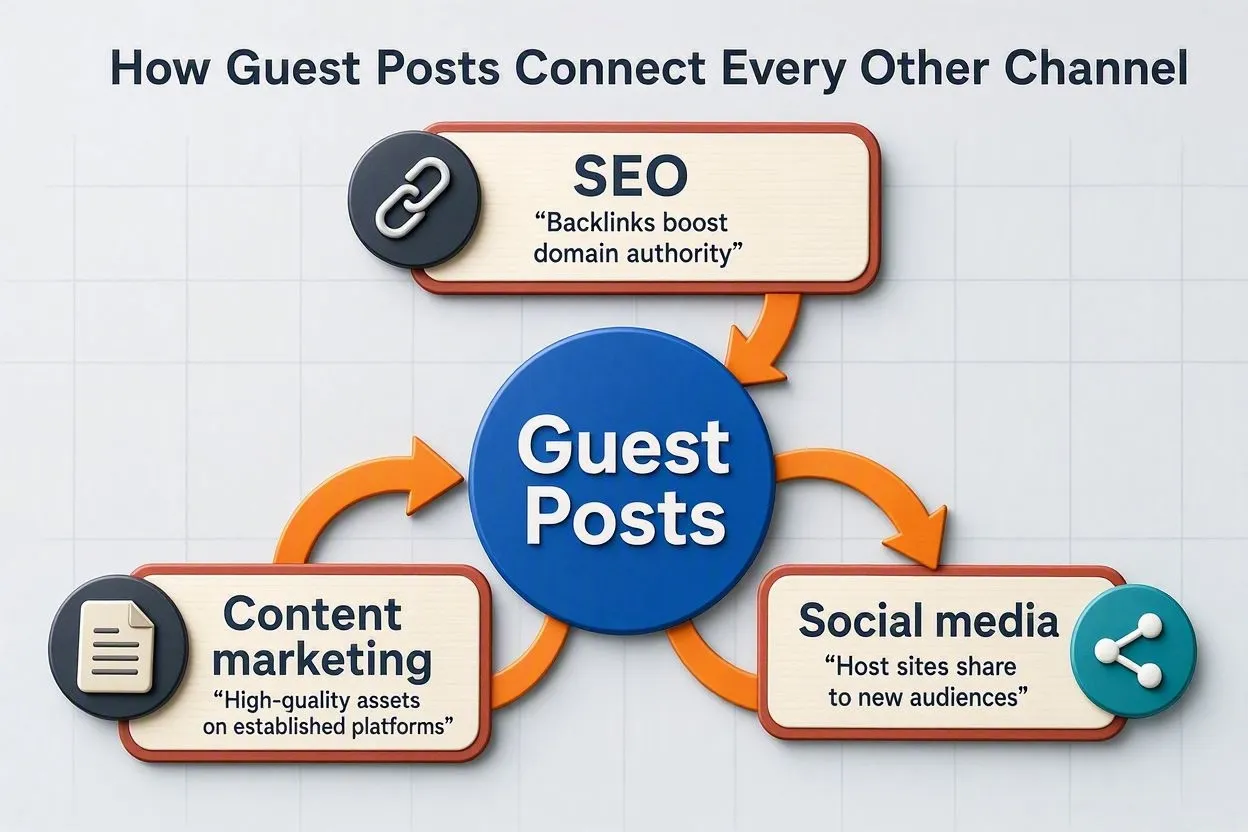
Guest posting isn’t a standalone tactic — it threads through every other type of digital marketing on this list:
- SEO: Every backlink from a guest post raises domain authority, improving ranking potential for every page you own
- Content marketing: Guest posts are high-quality content assets living on established, authoritative platforms
- Social media: Host sites share the posts they publish, extending your reach to audiences you don’t have yet
- Email marketing: Referral traffic from guest posts converts into email subscribers at meaningful rates
- Brand authority: Regular placements across respected industry publications build recognition that’s hard to manufacture any other way
- PPC: Higher domain authority improves Quality Score, which can meaningfully reduce cost-per-click
For agencies offering link building and guest post services, this interconnection is the core of your value proposition. A well-run guest post campaign doesn’t just improve one metric — it lifts performance across all 15 channels simultaneously.
Conclusion
Digital marketing in 2026 isn’t about doing everything. It’s about doing the right things in the right sequence.
Start with content and SEO to build your base. Use email to own your audience. Add guest posts and link building to accelerate domain authority. Scale with PPC, social, and video as your budget grows and your foundation holds.
For agencies in the guest post and link building space, every channel on this list is an argument for your service. What you do doesn’t just build links — it moves the needle on SEO, content authority, brand visibility, referral traffic, and conversion rates, all at the same time.