

Google Ads costs $1,000 to $10,000 per month for most small and mid-sized US businesses, with the average account spending $3,127.38 per month, or about $103 per day. New advertisers usually start between $1,000 and $2,500 monthly. Your own figure depends on 7 things: industry, keyword intent, Quality Score, campaign type, geographic targeting, device mix, and who manages the account. A dental practice and a coffee subscription brand can run identical daily budgets and end the month with completely different totals, because Google prices their clicks at $8.00 and $1.16 respectively.
How Much Does Google Ads Cost Per Month for Most Businesses?
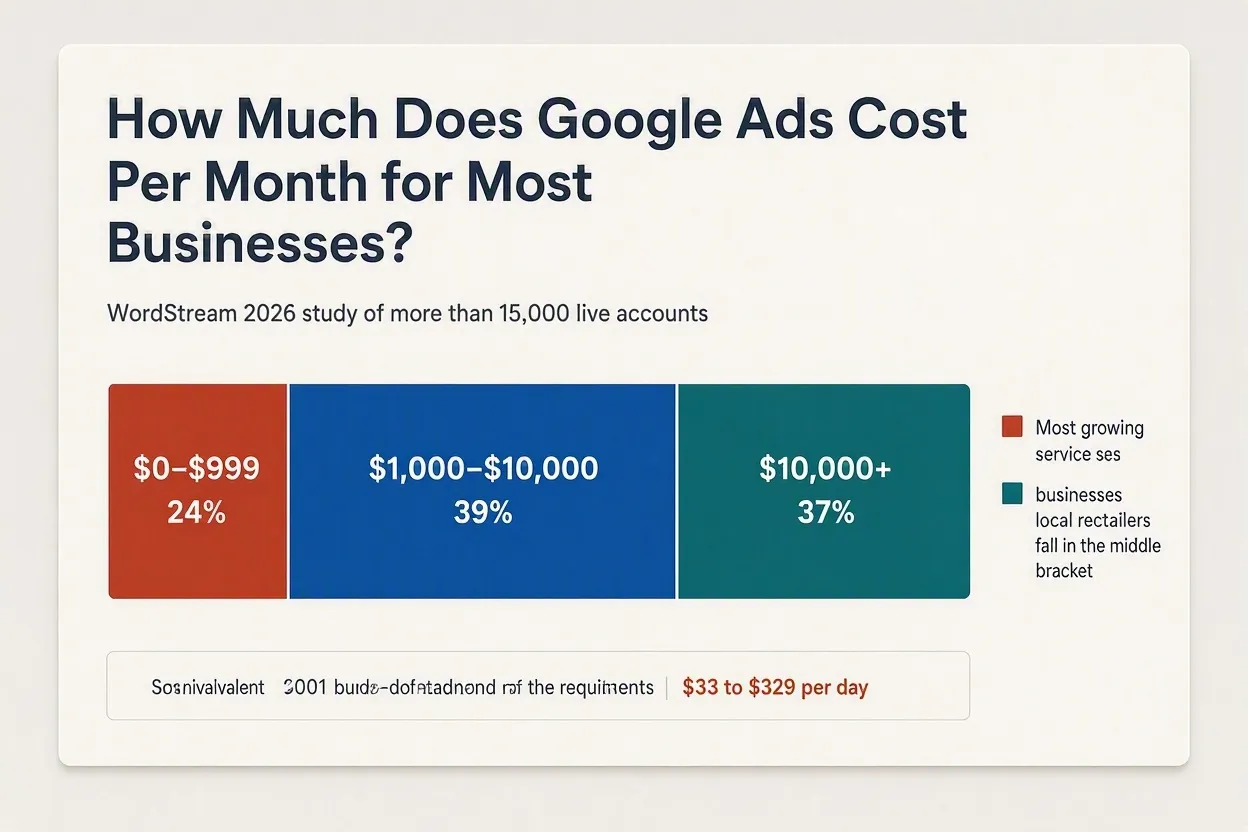
Most businesses pay between $1,000 and $10,000 per month for Google Ads, which works out to $33 to $329 per day. WordStream’s 2026 study of more than 15,000 live accounts breaks monthly spend into 3 brackets: 24% of accounts stay under $1,000, 39% land between $1,000 and $10,000, and 37% push past $10,000. The middle bracket holds the most accounts. That’s where nearly every growing service business, local retailer, and mid-market ecommerce brand ends up once the account stabilizes.
Averages hide a lot, though. A $3,127 monthly average gets pulled upward by national advertisers running six-figure budgets, so the median owner-operated account sits closer to $1,500. Google itself sets no minimum. You can fund a campaign with $150 a month and it will run, but a budget that small rarely produces enough clicks for the platform to learn anything useful about who converts.
What small businesses spend per month
Small businesses spend $1,000 to $3,000 per month on Google Ads, which buys roughly 185 to 553 clicks at the $5.42 US average cost per click (CPC). Local service businesses cluster at the lower end of that band because they geo-target a single metro and run 1 or 2 campaigns. A pest control company covering 3 zip codes might spend $1,200 monthly and pull 40 leads. Ecommerce brands with wider keyword sets tend to need $2,500 or more before the data gets reliable, since Shopping campaigns spread budget across an entire product catalog rather than a tight keyword list.
What mid-sized and enterprise accounts spend per month
Mid-sized companies spend $7,000 to $30,000 per month, and large national advertisers routinely clear $40 million per year. Multi-location businesses drive that jump. Each location needs its own geo-targeted campaign with its own budget, so a 12-location HVAC franchise running $1,500 per market spends $18,000 monthly without any single campaign looking expensive. Enterprise budgets also carry campaign types that small accounts skip entirely, including YouTube and Demand Gen.
How Google Turns Your Daily Budget Into a Monthly Bill
Google converts your average daily budget into a monthly figure by multiplying it by 30.4, the average number of days in a month. You never set a monthly number directly inside the campaign. Set $50 a day and Google treats $1,520 as your monthly ceiling for that campaign. Understanding this conversion prevents the single most common billing shock in paid search.
The 30.4-day rule
To find your monthly spend, multiply your average daily budget by 30.4. A $25 daily budget becomes $760 monthly. A $100 daily budget becomes $3,040. Run the calculation in reverse to plan: divide your intended monthly figure by 30.4 to get the number you type into the campaign settings. Someone budgeting $2,000 a month enters $65.79 per day.
Why Google can spend double your daily budget
Google can spend up to 2 times your average daily budget on any single day, though it will never exceed your monthly limit. Set $50 daily and you might see $97 spent on a Tuesday when search volume spikes. Nothing is broken. Google balances that overspend by holding back on slower days, and the monthly total still caps at your daily budget times 30.4. Advertisers who check spend daily and panic at the overage often cut budgets right when the algorithm is finding its best traffic.
How Google actually charges you (threshold billing)
Google bills you at a payment threshold or at the end of the month, whichever arrives first, with thresholds starting at $50 and climbing through $200, $350, and $500 as your payment history builds. New accounts hit the $50 threshold fast and see several small charges in the first weeks. That pattern confuses first-time advertisers who expect one clean monthly invoice. Established accounts with strong payment records move to monthly invoicing, where a single charge lands after the billing period closes.
What Your Monthly Budget Buys at 4 Spend Levels
Your monthly budget translates into clicks, leads, and customers through 3 numbers: your CPC, your conversion rate, and your close rate. The table below models a service business at a $5.42 CPC, a 4% conversion rate, and a 25% close rate, which are close to US averages across verticals.
| Monthly budget | Daily budget | Clicks per month | Leads per month | Customers per month | Realistic use case |
| $500 | $16.45 | 92 | 3 to 4 | 1 | Single keyword theme, one city, testing only |
| $1,500 | $49.34 | 277 | 11 | 2 to 3 | Local service business, 1 to 2 campaigns |
| $3,000 | $98.68 | 553 | 22 | 5 to 6 | Multi-service or multi-city, Smart Bidding viable |
| $10,000 | $328.95 | 1,845 | 74 | 18 to 19 | Regional or national, multiple campaign types |
Notice where the $500 tier lands. Three or four leads a month won’t generate enough conversion data for automated bidding to work, which is why small budgets so often underperform the averages rather than matching them proportionally. Smart Bidding strategies generally need 30 to 50 conversions in a 30 day window before the system optimizes reliably. Below that threshold you’re paying for clicks while Google guesses.
The $3,000 tier is the first point where most service businesses cross into stable performance. Enough volume, enough signal, enough room to shift budget between campaigns based on what’s actually converting.
Google Ads Cost by Industry
Industry moves your Google Ads cost per month more than any other single factor, with average CPCs ranging from $1.63 in arts and entertainment to $9.87 in legal services, a 6x spread. High-CPC industries aren’t being punished. Those verticals carry high customer values, so advertisers bid aggressively and the auction prices follow.
| Industry | Average CPC (Search) | Average CPL | $2,000/month buys |
| Attorneys and legal services | $9.87 | $131.63 | 203 clicks, 15 leads |
| Home and home improvement | $8.33 | $78.00 | 240 clicks, 26 leads |
| Dentists and dental services | $8.00 | $61.00 | 250 clicks, 33 leads |
| Personal services | $7.17 | $65.00 | 279 clicks, 31 leads |
| Health and fitness | $6.17 | $58.00 | 324 clicks, 34 leads |
| Business services | $5.87 | $93.69 | 341 clicks, 21 leads |
| Career and employment | $5.81 | $72.00 | 344 clicks, 28 leads |
| Beauty and personal care | $4.62 | $44.00 | 433 clicks, 45 leads |
| Finance and insurance | $3.39 | $62.00 | 590 clicks, 32 leads |
| Real estate | $3.22 | $102.51 | 621 clicks, 20 leads |
| Restaurants and food | $2.05 | $27.00 | 976 clicks, 74 leads |
| Arts and entertainment | $1.63 | $32.00 | 1,227 clicks, 63 leads |
CPC and CPL figures reflect US Search Network benchmarks as of Q3 2026. Display Network clicks average under $1.00 across all verticals.
Legal and rehab sit at the extreme edge. Addiction treatment keywords have historically run above $30 per click, which means a $5,000 monthly budget delivers fewer than 170 clicks. Those advertisers accept the math because a single admitted patient is worth tens of thousands of dollars.
7 Factors That Decide Your Google Ads Cost Per Month
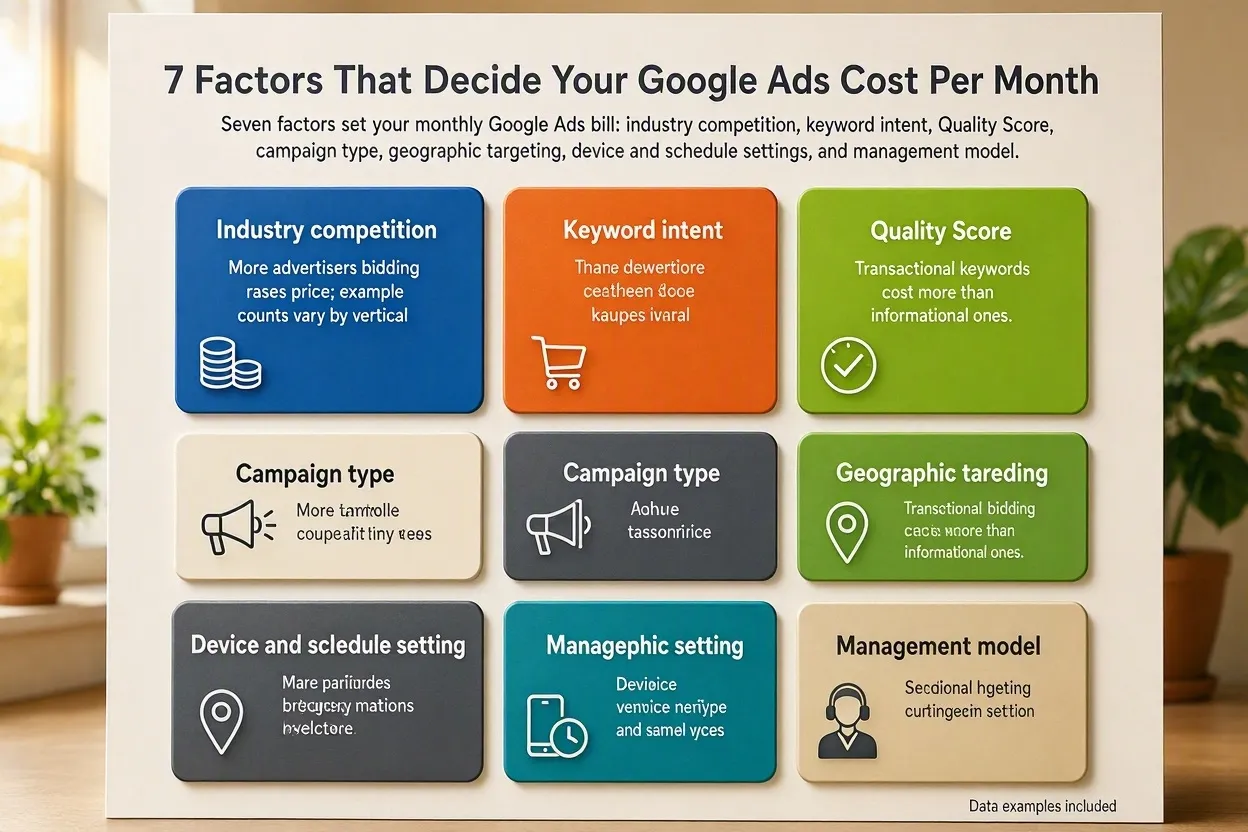
Seven factors set your monthly Google Ads bill: industry competition, keyword intent, Quality Score, campaign type, geographic targeting, device and schedule settings, and management model.
1. Industry competition. More advertisers bidding on the same keyword pushes prices up. Dental practices in Miami face roughly 40 competitors per auction. A specialty welding supplier might face 3.
2. Keyword intent. Transactional and commercial queries cost more than informational ones because buyers sit closer to the purchase. “Emergency plumber near me” runs $12 to $18 in most metros while “how to fix a leaky faucet” runs under $2. Same industry, wildly different price, driven entirely by what the searcher intends to do next.
3. Quality Score. Google grades every keyword 1 to 10 on 3 components: expected click-through rate (CTR), ad relevance, and landing page experience. Accounts averaging 8 or higher pay noticeably less per click than accounts averaging 4, sometimes 30% less for identical positions.
4. Campaign type. Search, Performance Max, Shopping, Demand Gen, and YouTube each price differently, and mixing them changes your blended monthly cost.
5. Geographic targeting. Metro areas cost more than rural ones. Advertising “personal injury attorney” in Los Angeles costs several times what the same phrase costs in Boise, so a national campaign without geo bid adjustments quietly overspends in expensive markets.
6. Device and schedule settings. Mobile clicks often convert at different rates than desktop, and running ads at 3 a.m. when nobody answers your phone burns budget with nothing to show for it. Dayparting and device bid adjustments recover meaningful spend in service businesses.
7. Management model. Running the account yourself costs time. Hiring an agency or freelancer adds a line item on top of ad spend, which changes your true monthly number.
How Google Ads Calculates Your Cost Per Click
Google calculates your CPC using this formula: the Ad Rank of the advertiser below you divided by your Quality Score, plus one cent. You almost never pay your maximum bid. The auction runs in 3 steps every time somebody searches.
Step 1: Quality Score. Google assigns each competing ad a score from 1 to 10 based on expected CTR, ad relevance, and landing page experience.
Step 2: Ad Rank. Google multiplies your maximum bid by your Quality Score. Highest Ad Rank takes the top position.
Step 3: Cost per click. Google charges the minimum needed to hold your position over the next advertiser, plus a penny.
The practical effect favors well-built accounts over well-funded ones. Bid $4.00 with a Quality Score of 9 and you can outrank a competitor bidding $6.00 with a Quality Score of 4, while paying less per click than they do. Small advertisers who optimize landing pages and keyword relevance regularly beat larger budgets on the same terms.
How Campaign Type Changes Your Monthly Spend
Campaign type shifts your effective cost per month by 40% or more, because Search, Performance Max, Shopping, Demand Gen, and YouTube deliver clicks at different prices.
| Campaign type | Typical CPC | Suggested monthly minimum | Best fit |
| Search | $2.00 to $10.00 | $1,000 | High-intent lead generation |
| Performance Max | $1.00 to $4.00 | $2,000 | Ecommerce and multi-channel goals |
| Shopping | $0.60 to $2.50 | $1,500 | Retail product catalogs |
| Demand Gen | $0.40 to $1.50 | $1,000 | Upper-funnel awareness |
| YouTube | $0.10 to $0.30 per view | $1,500 | Brand building and retargeting |
| Display | Under $1.00 | $500 | Remarketing to past visitors |
Performance Max needs more budget than the CPC alone suggests. The campaign type spreads spend across Search, Shopping, Display, YouTube, Gmail, and Discover simultaneously, so a $600 monthly budget gets diluted across 6 surfaces and none of them gather enough data. Google’s own guidance points toward funding Performance Max at a level that produces at least 30 conversions monthly.
Advertisers who run Search only and complain about cost should test Shopping or Display remarketing before increasing their Search budget. Remarketing clicks often cost 70% less and convert visitors who already know the brand.
The Costs Beyond Ad Spend
Your real Google Ads cost per month includes 5 line items beyond media spend: management fees, creative production, landing page development, tracking and call tracking tools, and wasted spend. Budget for the full picture or the first invoice cycle will surprise you.
Management fees
Google Ads management costs $500 to $10,000 per month from an agency and $1,000 to $3,000 per month from a freelancer, structured 3 ways.
- Percentage of ad spend. Agencies typically charge 10% to 20% of monthly media spend, so a $5,000 budget carries $500 to $1,000 in fees.
- Flat retainer. Fixed monthly fee regardless of spend, common at $1,000 to $3,500 for small accounts.
- Hybrid. Base retainer plus a smaller percentage above a spend threshold, which suits accounts that scale seasonally.
Percentage pricing creates an obvious tension, since the agency earns more when you spend more. Flat retainers remove that incentive but can get expensive relative to small budgets. A business spending $1,500 monthly on media and $1,500 on management is paying a 100% premium, and at that ratio, learning the platform yourself usually makes better sense.
Wasted spend
The average Google Ads account wastes $1,127.54 per month on clicks that can never convert, which is roughly 36% of the $3,127.38 average monthly spend. Irrelevant search terms cause most of it. A driveway sealing company bidding on broad match “sealing” will pay for clicks on canning jar sealing, envelope sealing, and marine hull sealing until somebody adds negative keywords. Weekly search term reviews and a maintained negative keyword list recover the majority of that loss.
How to Calculate the Minimum Budget That Pays Back
To calculate your minimum viable monthly budget, multiply your target number of customers by your close rate, conversion rate, and CPC. Work backwards from revenue instead of guessing at a number.
Start with 4 inputs:
- Average order value or customer value. What one customer is worth to you.
- Close rate. The percentage of leads that become customers.
- Conversion rate. The percentage of clicks that become leads, typically 2% to 6%.
- Average CPC. Pull it from Keyword Planner or your industry benchmark.
A landscaping company wants 10 new customers monthly. The company closes 30% of leads, so it needs 34 leads. At a 4% conversion rate, 34 leads require 850 clicks. At a $4.50 CPC, 850 clicks cost $3,825 per month.
Now check whether that spend makes sense. If each customer is worth $2,200, ten customers generate $22,000 against $3,825 in ad spend, producing a 5.75:1 return on ad spend (ROAS). Healthy. Run the same math with a $400 customer value and the campaign returns $4,000 against $3,825, which barely breaks even before management fees and delivery costs.
Your Google Ads budget works if your customer lifetime value (LTV) sits at least 3 times above your customer acquisition cost (CAC). Below 3:1, the channel technically functions while leaving no margin for the rest of the business.
What to Expect in Months 1, 2, and 3
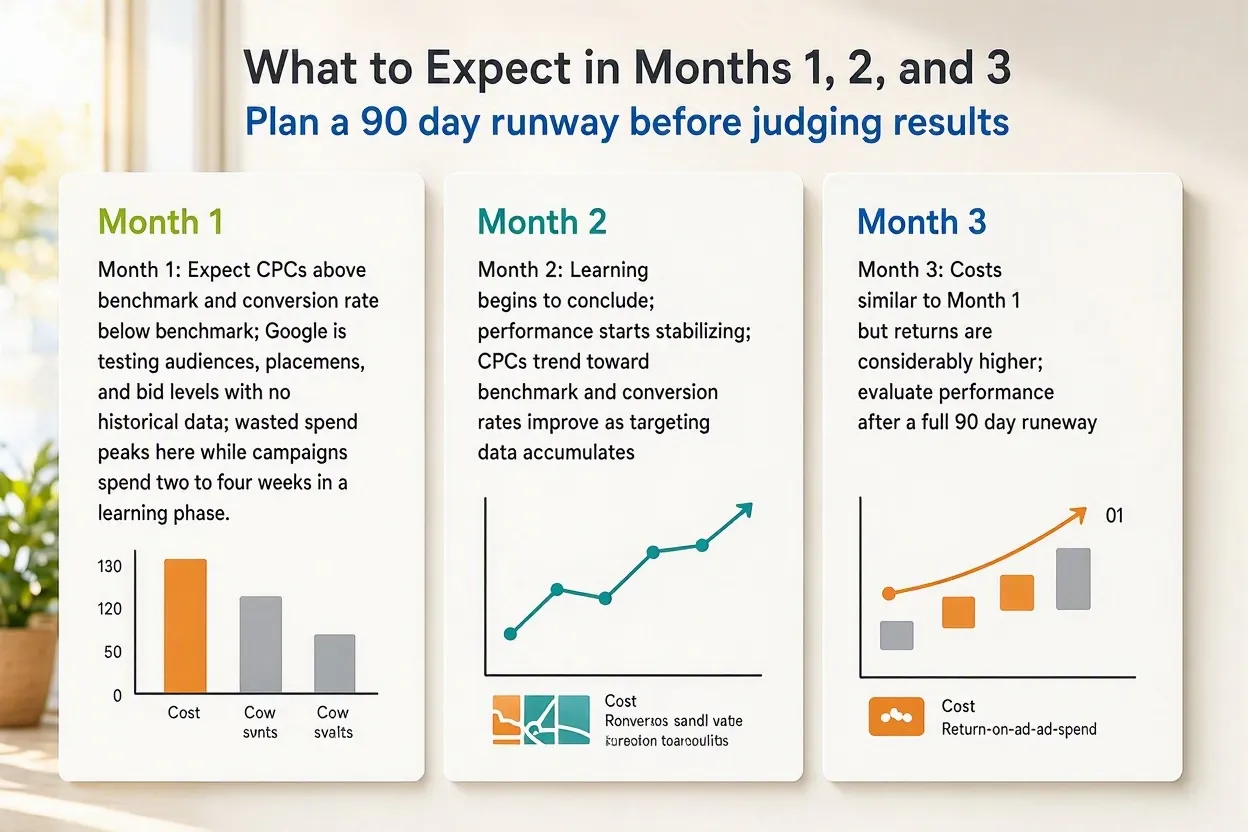
Google Ads costs the same in month 1 as month 3 but returns considerably less, because campaigns spend 2 to 4 weeks in a learning phase before performance stabilizes. Plan a 90 day runway before judging results.
Month 1. Expect CPCs above your benchmark and a conversion rate below it. Google is testing audiences, placements, and bid levels with no historical data. Wasted spend peaks here. Budget the full amount anyway, since starving month 1 extends the learning period.
Month 2. Negative keyword lists start working, Quality Scores climb as CTR history accumulates, and CPCs typically drop 10% to 20%. Conversion tracking has enough volume to show which keywords actually produce revenue.
Month 3. Performance approaches its stable state. Smart Bidding has the 30 to 50 conversions it needs. Now the account is worth scaling, and budget increases produce roughly proportional result increases rather than being absorbed by the learning process.
Accounts that get cut in week 3 almost always get cut during the most expensive, least productive stretch of their lifespan.
How to Lower Your Google Ads Cost Per Month
To lower your Google Ads cost per month, improve Quality Score, tighten targeting, and cut waste before reducing budget. Cutting budget first reduces spend and results together, which fixes nothing.
- Raise Quality Score. Match ad copy to keyword phrasing and send clicks to a page about that specific service, not your homepage. Scores moving from 5 to 8 cut CPCs meaningfully.
- Add negative keywords weekly. Pull the search terms report, flag every query that could never buy, and add it as a negative.
- Shift to long-tail keywords. “Commercial roof repair Sacramento” costs a fraction of “roofing” while carrying stronger purchase intent.
- Check impression share lost to budget. The metric sits in your campaign columns and tells you whether budget, rather than bidding, is capping your volume. Anything above 30% means you’re leaving reachable customers unserved.
- Apply bid adjustments. Reduce bids on devices, hours, and locations where conversion data shows weak performance.
- Run remarketing. Display remarketing clicks cost under $1.00 and reach people who already visited your site.
- Pause bottom keywords monthly. In most accounts, 20% of keywords consume 60% of budget while producing almost no conversions.
Conclusion
Google Ads costs $1,000 to $10,000 per month for most US businesses, with $3,127.38 as the average account figure and $1,000 to $2,500 as a sensible starting range. The number itself matters less than what sits behind it. A $2,000 budget in restaurants buys 976 clicks while the same $2,000 in legal services buys 203, so industry benchmarks should shape your expectations before your accountant does.
Build your budget from customer value backwards, fund it for a full 90 days, and watch impression share lost to budget rather than daily spend. Accounts that survive the learning phase and maintain Quality Score above 7 consistently pay less per click than better-funded competitors sitting on the same keywords.