

Post on Tuesday at 9 a.m. Wednesday at 10 a.m. is close behind. Saturday kills your brand reach — skip it.
That’s the short version. But if your marketing strategy targets audiences across the USA, UK, Australia, or Europe, “9 a.m.” solves nothing without knowing which 9 a.m. Most marketing guides ignore that. This one covers it country by country.
Why Posting Time Is a Core Part of Your X Marketing Strategy

Timing is not a minor detail in social media marketing. It is the difference between a campaign post that builds momentum and one that quietly disappears.
X’s algorithm ranks posts by engagement velocity — how many likes, replies, and reposts a post earns in its first 30 minutes. Brand marketers who publish at 3 a.m. face a dead audience. No early engagement means the algorithm scores the post as low-value content. Low-value means lower distribution. Lower distribution means your marketing message reaches a fraction of your potential audience.
Buffer’s 2026 analysis of 8.7 million tweets found that posts at peak hours consistently outperform off-peak posts by 30 to 40% in engagement rate. Sprout Social confirmed the pattern across 1.9 billion engagements from 307,000 brand accounts. Two independent marketing datasets. Same conclusion.
Timing your content correctly is not a hack. It is basic audience-first marketing — show up when your target customers are already paying attention.
The Best Time to Post on X for Maximum Marketing Reach
Tuesday at 9 a.m. is the best time to post on X in 2026 — confirmed as the top engagement slot in Buffer’s 8.7 million tweet dataset. Wednesday at 10 a.m. ranks second. Wednesday at 9 a.m. is third.
X’s marketing audience skews toward 25-to-34-year-old professionals. By Tuesday, that audience is fully back in their weekly routine — checking industry news, scrolling between client calls, and actually engaging with branded content rather than passively swiping. Monday they’re clearing backlogs. Friday afternoon their attention has already left the building.
All times in this guide are local time — always schedule for your target market’s clock, not your own.
Best Time to Post on X — Day-by-Day Marketing Breakdown
Monday — 9 a.m. or 2 p.m.
Monday delivers stronger marketing reach than most brands expect. The morning window captures professionals catching up on industry news after the weekend. Sprout Social’s 2026 brand marketing data also flagged a secondary engagement spike at 2–3 p.m. and 5 p.m. — strong windows for branded content and campaign updates.
Don’t post before 8 a.m. on Monday. Your target audience is not there yet.
Tuesday — 9 a.m. Top Marketing Day
Tuesday 9 a.m. is the single highest-performing slot of the week for brand marketers. The 10 a.m. and 11 a.m. windows also perform well. Reserve Tuesday for your most important marketing content — product launches, campaign announcements, high-production threads. This is not the day to post filler content.
Wednesday — 9 a.m. to 6 p.m. Peak Engagement Window
Wednesday is X’s highest-engagement day for marketing content overall. The morning window from 9 to 11 a.m. is strong, and unlike every other day, brand engagement stays elevated through the full afternoon right up to 6 p.m. Mid-week is when your professional target audience takes mental breaks, catches up on industry news, and actually reads marketing content rather than skipping past it.
If you can only choose two days for your content marketing calendar, make them Tuesday and Wednesday.
Thursday — 9 a.m.
Thursday holds the mid-week momentum. The 9–10 a.m. window is a reliable marketing slot. Your audience is still engaged before the Friday wind-down begins. Use Thursday for content that supports Tuesday’s main marketing push — follow-up threads, customer testimonials, data posts.
Friday — 9 a.m. Only
For marketing content, Friday is strictly a morning play. Post by 11 a.m. or not at all. After noon, your target audience’s attention drifts toward the weekend and your content marketing investment returns far less. Keep Friday posts casual and conversational — save your serious campaign content for Tuesday.
Saturday — Worst Day for Marketing on X
Saturday is the lowest-engagement day on X across every industry Sprout Social and Buffer tracked in 2026. The professional marketing audience that drives X engagement is offline. If your social media marketing team batch-creates content on weekends, schedule it forward to Tuesday — never publish it Saturday.
Sunday — 9 a.m. or 3 p.m.
Sunday is quiet but not useless. The 9 a.m. slot catches early scrollers before the day starts. The 2–6 p.m. window works for teaser marketing content — polls, sneak peeks, and questions that prime your audience for Monday. Think of Sunday as marketing prep, not marketing performance.
X Marketing: Best Posting Times at a Glance
| Day | Best Time | Marketing Value |
| Monday | 9 a.m., 2–3 p.m., 5 p.m. | Good |
| Tuesday | 9 a.m. | Peak |
| Wednesday | 9 a.m.–6 p.m. | Highest |
| Thursday | 9–10 a.m. | Strong |
| Friday | 9–11 a.m. only | Moderate |
| Saturday | Avoid | Zero ROI |
| Sunday | 9 a.m., 2–6 p.m. | Low |
Best Time to Post on X by Country — Region-Specific Marketing Guide
Most social media marketing guides say “use local time” and stop there. That works if your brand targets one country. If your digital marketing strategy covers multiple regions — USA, UK, Australia, Canada, and Europe simultaneously — you need a posting time for each market.
USA — X Marketing Posting Times
Post at 9 a.m. Eastern Standard Time (EST) on Tuesday or Wednesday to reach the US marketing audience on the East Coast. EST covers New York, Chicago, Miami, and Boston — roughly 78% of the US Twitter-active audience that brands target for marketing campaigns.
West Coast users on Pacific Standard Time (PST) are 3 hours behind. Their 9 a.m. window is 12 p.m. EST. For a single post that reaches both coasts in one marketing push, 12 p.m. EST is your answer — it hits East Coast lunch scrollers and West Coast morning professionals at the same time.
| US Market | Time Zone | Schedule At |
| East Coast | EST (UTC−5) | 9 a.m. EST |
| Central | CST (UTC−6) | 9 a.m. CST |
| West Coast | PST (UTC−8) | 9 a.m. PST |
| Full US campaign | — | 12 p.m. EST |
UK — X Marketing Posting Times
Post at 9 a.m. Greenwich Mean Time (GMT) on Tuesday or Wednesday for UK marketing reach. UK professionals follow the same morning check-in behavior as US audiences — X engagement peaks between 8 a.m. and 10 a.m. GMT before the workday gets heavy.
One scheduling detail UK marketers frequently miss: the UK switches clocks twice a year. October through March runs on GMT. April through September runs on British Summer Time (BST), which is GMT+1. A 9 a.m. BST campaign post in June is 8 a.m. GMT. Update your scheduling tool’s time zone setting at both clock changes.
| UK Season | Active Time Zone | Schedule Marketing Posts |
| Winter (Oct–Mar) | GMT (UTC+0) | 9 a.m. GMT |
| Summer (Apr–Sep) | BST (UTC+1) | 9 a.m. BST |
Australia — X Marketing Posting Times
Post at 9 a.m. Australian Eastern Standard Time (AEST) on Tuesday or Wednesday to reach the Australian marketing audience. Sydney, Melbourne, and Brisbane all sit on AEST (UTC+10). Perth runs on Australian Western Standard Time (AWST), 2 hours behind.
The cross-timezone reality for marketing teams based outside Australia: 9 a.m. AEST equals 11 p.m. GMT the night before. Your Tuesday morning campaign post for Australia goes out Monday night UK time. Use Buffer or Sprout Social and set the region to AEST — trying to track this manually across a marketing team creates errors.
| Australian Market | Time Zone | Schedule At |
| Sydney / Melbourne / Brisbane | AEST (UTC+10) | 9 a.m. AEST |
| Perth | AWST (UTC+8) | 9 a.m. AWST |
Canada — X Marketing Posting Times
Post at 9 a.m. EST on Tuesday or Wednesday for the Canadian marketing audience. Ontario and Quebec — Canada’s largest concentration of Twitter-active professionals — run on EST. British Columbia uses PST, the same 3-hour gap as the US West Coast.
12 p.m. EST catches the full Canadian market in one post — Eastern Canada at noon, Western Canada at 9 a.m. PST. For national Canadian marketing campaigns on X, this is the most efficient single scheduling window.
| Canadian Market | Time Zone | Schedule At |
| Ontario / Quebec | EST (UTC−5) | 9 a.m. EST |
| Alberta | MST (UTC−7) | 9 a.m. MST |
| British Columbia | PST (UTC−8) | 9 a.m. PST |
| National campaign | — | 12 p.m. EST |
Europe — X Marketing Posting Times
Post at 9 a.m. Central European Time (CET) on Tuesday or Wednesday for Western European marketing reach. France, Germany, Spain, Italy, and the Netherlands all run on CET (UTC+1) in winter, shifting to Central European Summer Time (CEST, UTC+2) in summer.
Eastern European markets — Poland, Romania, and Greece — sit on Eastern European Time (EET, UTC+2). For a pan-European marketing campaign on X, 9 a.m. CET is the anchor time. It hits Western Europe at 9 a.m. and Eastern Europe at 10 a.m. — both in their morning engagement window.
| European Market | Time Zone | Schedule At |
| Western Europe | CET (UTC+1) / CEST (UTC+2) summer | 9 a.m. local |
| Eastern Europe | EET (UTC+2) | 9 a.m. EET |
| Pan-European campaign | — | 9 a.m. CET |
Best Time to Post on X by Industry — Marketing Breakdown
Audience behavior varies by industry. A financial services marketing team targeting fund managers has a completely different audience schedule than a retail brand targeting weekend shoppers. Here are the 7 most relevant industries with exact marketing windows.
Financial Services Marketing — 8 a.m. to 1 p.m., Tuesday–Thursday
Finance professionals check X before markets open. The 8–9 a.m. pre-market window on Tuesday and Wednesday generates the highest engagement for financial services marketing content — market commentary, investment insights, and brand authority posts. Skip weekends entirely. This audience treats X as a professional tool and logs off on Saturday.
SaaS and Technology Marketing — 11 a.m. to 4 p.m., Tuesday–Thursday
Tech buyers and developers engage between focused work sessions, not first thing in the morning. The 11 a.m. to 2 p.m. window on Wednesday is the strongest marketing slot for SaaS brands. Product updates, feature announcements, and thought leadership content all perform well here. Tuesday and Thursday mornings are solid secondary options.
Retail and E-commerce Marketing — Wednesday, 10 a.m. to 5 p.m.
Retail marketing on X peaks on Wednesday afternoon when shoppers are in their mid-week browse mode — looking for something to buy without actively searching for it. Post product drops, promotional offers, and visual content in this window. Weekend retail marketing on X consistently underperforms because the X audience shops differently than Instagram or Pinterest users.
Healthcare Marketing — Tuesday and Wednesday, 11 a.m. to 3 p.m.
Healthcare marketing content — patient education, provider updates, wellness campaigns — performs best during the lunch window when both professionals and patients have a few minutes. Tuesday and Wednesday at 11 a.m. to 1 p.m. are the strongest slots. Sunday sees the lowest healthcare engagement of the week.
Travel and Hospitality Marketing — Tuesday and Wednesday, 11 a.m. to 5 p.m.
Travel marketing peaks mid-week because that’s when the target audience is most over their routine and mentally planning an escape. Post destination campaigns, travel deals, and visual content between 11 a.m. and 5 p.m. on Tuesday and Wednesday. Saturday is counterintuitive but genuinely bad for travel marketing on X — your audience is out traveling, not planning the next trip.
Education Marketing — Saturday Afternoons and Weekday Evenings After 6 p.m.
Education is the one industry that breaks the standard marketing schedule. Schools, universities, and EdTech brands get their best X engagement on Saturday between 1 and 11 p.m., plus weekday evenings after 6 p.m. Students and parents engage outside school hours. Running an education marketing campaign at 9 a.m. Tuesday wastes the budget — that’s when your audience is in class.
Nonprofit Marketing — Tuesday through Thursday, 9 a.m. to 6 p.m.
Nonprofit marketing on X performs best during professional business hours. Donors, advocates, and volunteers engage on weekdays. Wednesday consistently delivers the highest engagement for nonprofit awareness campaigns and fundraising content. Weekend posts for nonprofits show weak performance across both Buffer and Sprout Social’s 2026 datasets.
Best Time to Post Different Content Types for X Marketing
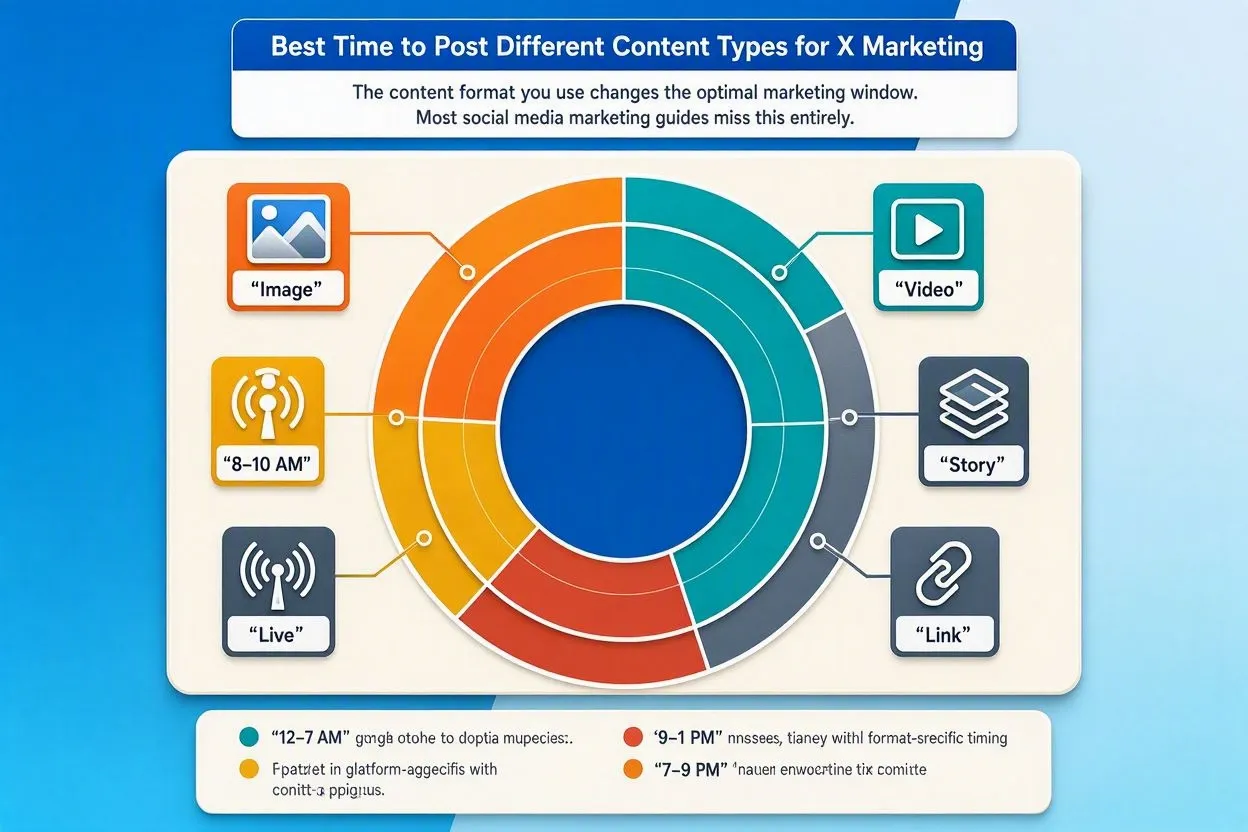
The content format you use changes the optimal marketing window. Most social media marketing guides miss this entirely.
Video Marketing Content (Under 60 Seconds) — 12 p.m. to 3 p.m., Tuesday or Wednesday
Video marketing requires active attention — a viewer has to stop and watch, not just read a sentence on a scroll. The post-lunch window gives your target audience time to actually engage with a video rather than skip past it. Sprout Social’s 2026 Social Media Content Strategy Report found short-form video is the top-performing format on X, with 37% of users most likely to interact with it. Post your video marketing campaigns between noon and 3 p.m. for maximum view completion.
Text-Based Marketing and Thought Leadership Threads — 9 a.m., Tuesday or Wednesday
Long-form text content and brand positioning threads perform best during the morning scroll. The 9 a.m. window on Tuesday or Wednesday is when your professional target audience has fresh attention and will actually read a full thread. A thought leadership post opening with a sharp industry observation at 9 a.m. Tuesday will outperform the same post at 4 p.m. Friday by a significant margin.
Audience Engagement Polls — 12 p.m. to 2 p.m., Wednesday or Thursday
Marketing polls need a runway — they require enough active traffic to generate statistically useful data. Post a poll at noon on Wednesday and it has 5 to 6 hours of peak traffic to collect responses. Post it at 6 p.m. and participation drops sharply by 8 p.m. Use polls for audience research, product feedback, and campaign engagement — and always post them at noon or earlier.
Visual Marketing Content and Campaign Graphics — 9 a.m. to 12 p.m., Tuesday or Wednesday
Image-based marketing content catches attention fastest during the morning scroll before the X feed gets dense with afternoon posts. Brand campaign graphics, infographics, and product visuals all generate higher impressions when published before noon on Tuesday or Wednesday.
How to Find the Best Posting Time for Your Specific Marketing Audience
Industry data is the starting point. Your own audience analytics is the real answer. These 4 steps take under 30 minutes and give you a personalized marketing window based on actual follower behavior.
Step 1: Open X Analytics. Log in on desktop. Click “More” in the left navigation, then select “Analytics.” Full analytics access requires an X Premium subscription. If your marketing team doesn’t have Premium yet, Buffer’s analytics dashboard provides posting time performance data on its free plan.
Step 2: Pull performance data from your last 30 posts. Filter by engagement rate in the Posts tab. Write down the exact day and time your top 10 posts went live. Your memory of when things performed well is almost always wrong — look at the actual data.
Step 3: Identify the pattern. If 7 of your top 10 marketing posts published between 9 and 11 a.m. on weekdays, that is your audience’s window. Your specific followers may engage slightly earlier or later than the general benchmarks. Personal data beats industry averages every time.
Step 4: Run a 4-week controlled test. Pick one posting time. Publish every weekday at that exact time for 4 weeks. Compare the average engagement rate against the 4 weeks before the test. A genuine improvement confirms you’ve found your peak marketing window. No improvement means test the next window.
Buffer’s marketing scheduler automates the analysis — it builds a personalized recommended posting schedule based on your specific audience’s historical engagement patterns.
7-Day X Content Marketing Schedule
Copy this directly into your social media marketing calendar. All times are local time for your primary target market.
| Day | Post 1 | Post 2 | Post 3 | Marketing Content Type |
| Monday | 9 a.m. | 2 p.m. | 5 p.m. | Industry news + brand opinion |
| Tuesday | 9 a.m. | 12 p.m. | 5 p.m. | Lead campaign content |
| Wednesday | 9 a.m. | 12 p.m. | 3 p.m. | Video or thread campaign |
| Thursday | 9 a.m. | 12 p.m. | — | Customer proof + engagement |
| Friday | 9 a.m. | 11 a.m. | — | Light, conversational |
| Saturday | — | — | — | No marketing posts |
| Sunday | 9 a.m. | 3 p.m. | — | Teaser or audience poll |
Three posts per day on Tuesday and Wednesday is the right marketing volume for most brands. More than 5 posts per day creates audience fatigue and later posts cannibalize the reach of earlier campaign content rather than adding to it.
Build Your X Marketing Schedule Around Peak Hours
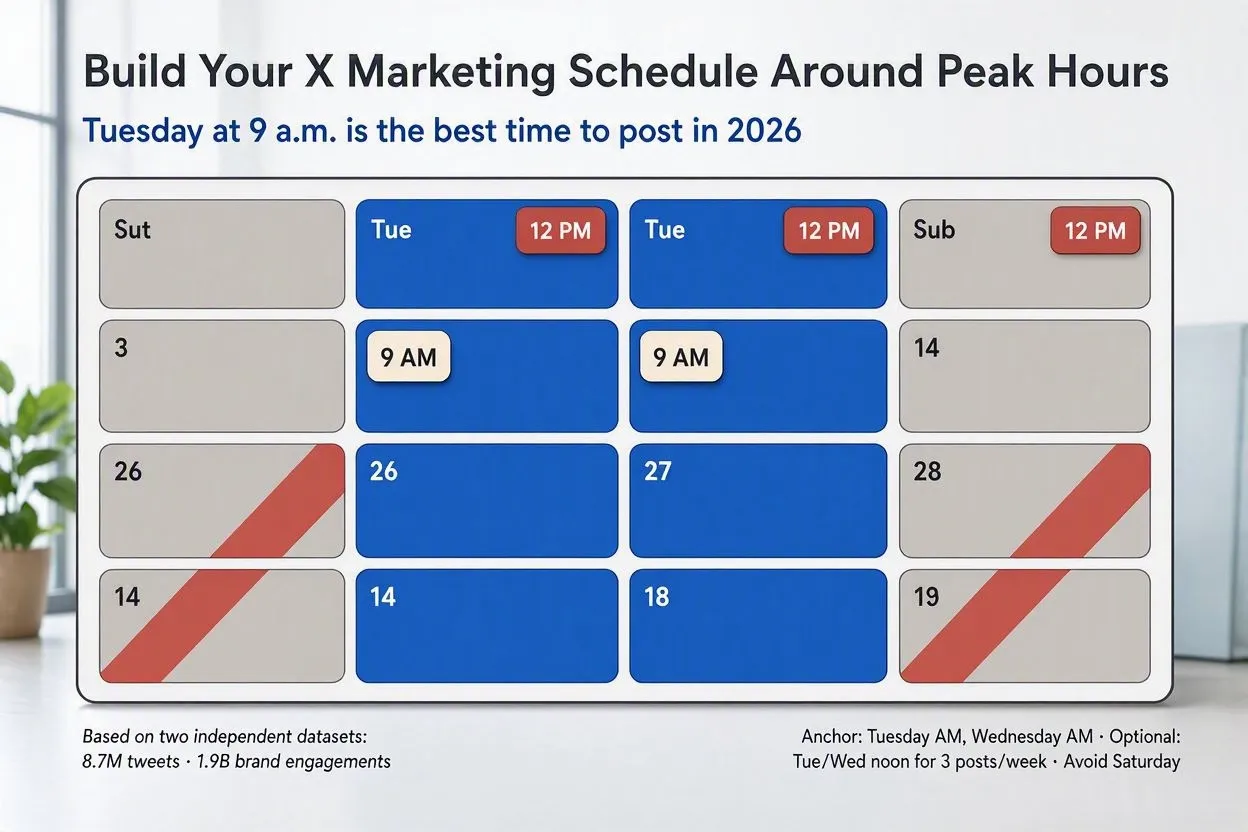
Tuesday at 9 a.m. is the best time to post on X in 2026 — the top-ranked marketing window across two independent datasets covering 8.7 million tweets and 1.9 billion brand engagements.
Lock Tuesday and Wednesday morning into your social media marketing calendar as your two anchor publishing slots. Add a noon post on both days if your content marketing volume allows for 3 posts per week. Don’t touch Saturday.
Run that schedule for 4 weeks. Pull your X Analytics or Buffer dashboard. Compare the average engagement rate against your previous month. The data will show you whether your specific marketing audience engages slightly earlier or later than the benchmark — and that adjusted window is the one you commit to.
Timing your marketing content right is a 10-minute calendar change with measurable ROI. Start with Tuesday 9 a.m.