

The best time to post on Pinterest is generally 8 PM to 9 PM in your audience’s local time zone, on Sunday, Monday, or Tuesday, with a smaller secondary window from 2 PM to 4 PM. Wednesday breaks that pattern with a midday spike between 11 AM and 1 PM. These windows are a starting point, not a rule. Pinterest keeps a pin searchable for months, so a late post doesn’t ruin it. It just gets a slower start.
Why Posting Time Still Matters on Pinterest

Pinterest doesn’t behave like a typical social feed, and that trips up a lot of marketers who treat it like one. A tweet or an Instagram post is functionally dead within a couple of days. A pin can keep showing up in search and recommendations for months, sometimes years, after you publish it. That long tail is exactly why some marketers assume timing barely matters here. It’s a fair instinct, but it’s only half right, because Pinterest still runs every new pin through an early test before deciding how far to distribute it:
- A small slice of your most engaged followers sees the pin first.
- If they save it, click it, or spend time on it, Pinterest widens distribution and shows it to more people.
- If that first group scrolls past without engaging, the pin quietly stalls.
- This test plays out in the first 24 to 48 hours, the window where posting time genuinely earns or costs you reach.
- After that window closes, quality, keywords, and board relevance take over as the bigger drivers.
So the honest answer to “does the best time to post on Pinterest matter” is yes, but only for how fast a pin gets off the ground, not whether it eventually finds an audience. A gardening pin published at 2:30 PM on a Wednesday, right as midweek planners are researching weekend projects, tends to clear that early test faster than the same pin dropped at 4 AM. Give it a good design and a clear, keyword-rich title, and it’ll likely find its footing either way. Post it at a smart hour, and it finds that footing sooner, with less wasted reach in the meantime.
Best Time to Post on Pinterest by Day of the Week
Sunday, Monday, and Tuesday consistently rank as the strongest days across most niches. Thursday, Friday, and Saturday tend to underperform, though Saturday picks up again late at night as weekend plans wind down.
| Day | Best Time | Why |
| Sunday | 8 PM to 9 PM | Users plan the week ahead; the single strongest day overall |
| Monday | 8 PM, secondary window at 4 PM | Evening wind-down after the first workday back |
| Tuesday | 8 PM to 9 PM | Second-strongest day; strong for business and planning content |
| Wednesday | 11 AM to 1 PM, plus 2 PM to 4 PM | Breaks the evening pattern with a midday research spike |
| Thursday | 8 PM | Noticeably softer than Sunday through Tuesday |
| Friday | 2 PM to 6 PM | The weakest weekday for engagement |
| Saturday | 6 PM to 7 PM, then 11 PM | Late-night browsing as the weekend settles in |
Wednesday is the day most guides get wrong, because they assume every weekday follows the same evening curve. It doesn’t. Midweek browsers are already thinking about the weekend, researching a recipe for Saturday’s dinner party or a DIY project for Sunday afternoon, and that research happens over lunch, not after dinner. A raised bed tutorial or a meal prep pin posted at noon on a Wednesday often beats the same pin posted at 8 PM.
None of this means Thursday, Friday, and Saturday afternoon are dead zones. Treat them as lower-priority slots. Save a product launch or a seasonal collection for the Sunday through Tuesday stretch, and use the softer days for evergreen content that doesn’t need a fast start.
Best Time to Post on Pinterest by Hour
Across days, five hours show up again and again as the strongest windows: 8 PM, 4 PM, 9 PM, 3 PM, and 2 PM, all in the audience’s local time. These cluster around two natural breaks in a typical day: the midafternoon lull and the post-dinner wind-down.
The weakest hours fall overnight, roughly 12 AM to 6 AM. That said, “overnight” is relative to whichever time zone your audience actually lives in. A US account with a growing following in the UK, India, or Australia can find that an early-morning Eastern slot lands right in someone else’s evening peak. Before writing off any hour, check the location breakdown in Pinterest Analytics. What looks like a dead hour on paper might be a genuine opportunity for part of your audience.
Best Time to Post on Pinterest on Weekends
Weekend performance is where you’ll see the most disagreement across different data sets, and honestly, that’s because weekend behavior varies more by audience than weekday behavior does. Sunday evening is close to universally strong, since it’s the last planning window before the week starts. Saturday is murkier. Some accounts see a late-night spike around 11 PM as people wind down from weekend activities. Others see stronger engagement in the late morning, when people are browsing over coffee before heading out.
If your audience skews toward parents, remote workers, or anyone with a flexible schedule, test a Saturday morning slot alongside the traditional evening windows. Weekend routines vary enough between audiences that a general rule matters less here than it does on weekdays.
Best Time to Post on Pinterest by Industry
Industry shapes what content resonates more than it shapes exactly when to post, but a handful of categories deviate enough from the general pattern to plan around:
- Food and beverage: Around 5 PM, right before dinner searches ramp up, plus Sunday afternoon for weekly meal prep content.
- Travel: Evenings and weekends, when browsing shifts from quick tips to longer, aspirational planning sessions.
- Health and wellness: Both morning and evening, since workout and meditation searches cluster at the start and end of the day.
- Beauty: Morning and evening, mirroring the routines people build their skincare and makeup habits around.
- Fashion: Thursday through Saturday afternoon, tied to weekend outfit planning.
A fitness coach posting a quick morning workout at 7 AM is tapping the same routine-driven instinct that drives food searches up at dinnertime. Matching the pin to the moment someone actually needs it beats chasing one universal hour across every vertical.
Best Time to Post on Pinterest for International Audiences
For accounts with followers spread across multiple countries, the 8 PM rule still applies, but it has to apply separately to each region rather than once for the whole account. A brand marketing to the US, UK, India, Australia, and the UAE can’t rely on a single publish time, since US Eastern and Indian Standard Time sit close to ten hours apart depending on daylight saving.
- United States: 8 PM Eastern or 8 PM Pacific, depending on where the bulk of your US audience lives.
- United Kingdom: 8 PM GMT or BST captures the evening wind-down.
- India: 8 PM to 9 PM IST lines up with post-dinner scrolling, strong for lifestyle and recipe content.
- Australia: 8 PM AEST mirrors the same pattern seen everywhere else.
- UAE: 9 PM to 10 PM GST, since evenings run a little later in the region.
If you can’t produce enough content to stagger five separate posts across a 24-hour window, prioritize whichever region drives the most saves and clicks in Analytics, and build the rest of the schedule around that core audience. Timing alone won’t fix a content mismatch either. A pin written in US English with dollar pricing won’t land the same way with a UK or Australian audience, even if it publishes at their exact 8 PM peak. Regional spelling, currency, and imagery all feed into Pinterest’s relevance signals alongside the clock.
How the Pinterest Algorithm Decides When to Show Your Pins
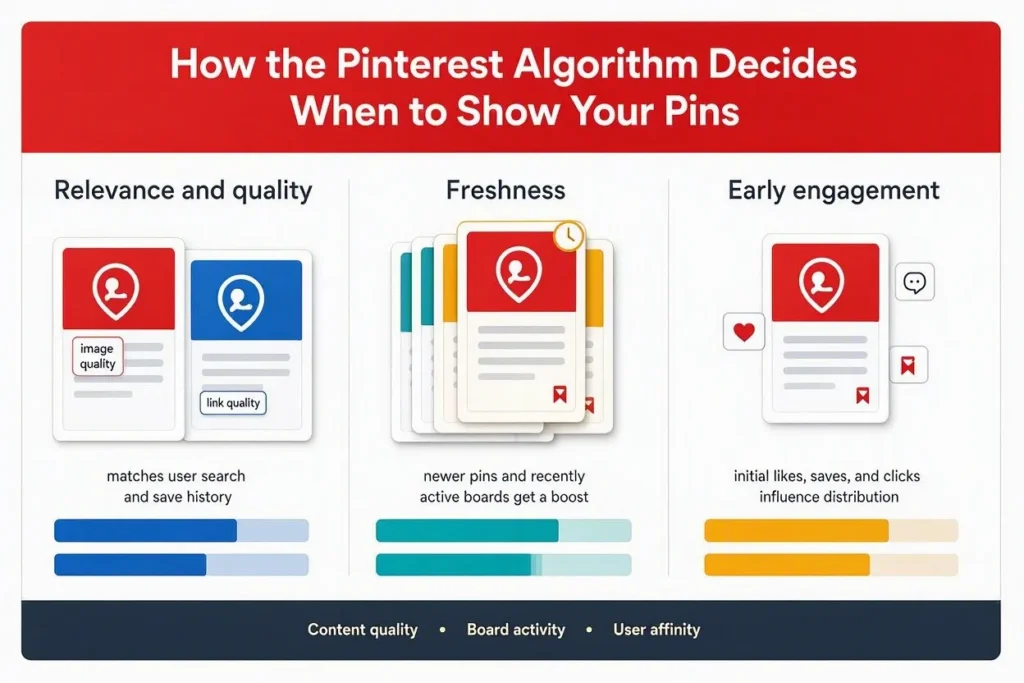
Pinterest’s ranking system, often called the Smart Feed, weighs a handful of signals before deciding how widely to distribute a pin:
- Relevance and quality. It reads image quality, link quality, and how closely a pin matches a user’s search and save history.
- Freshness. Newer pins and recently active boards tend to get a boost over older content that hasn’t been touched in a while.
- Early engagement. This one carries the most weight. A pin that earns saves, clicks, or close-ups within its first hour signals to the algorithm that it deserves a wider audience, and distribution expands. A quiet first hour signals the opposite, and reach flattens quickly. This is the actual mechanism behind why the best time to post on Pinterest matters: publishing when your audience is online gives that first hour a real shot at generating strong signals instead of going out to an empty room.
- Board relevance. A pin added to a board with a clear, consistent theme tends to outperform the same pin dropped into a mixed, unfocused board, since Pinterest has a harder time matching unclear signals to the right searchers.
One detail that surprises a lot of new users: pin freshness resets more often than expected. Re-saving an old pin to a new board, or designing a new pin image that points to the same underlying link, can trigger a fresh round of testing. A three-year-old recipe that’s stopped getting traffic can get a second life with a new design published at 8 PM on a Sunday. Pinterest treats it as a new candidate, complete with its own test group and its own shot at wider reach, rather than writing it off as permanently plateaued.
Best Time to Post Pinterest Video Pins and Idea Pins
Video pins and Idea Pins follow the same evening pattern as static pins, but each format has its own quirks worth knowing before you schedule anything.
| Format | Best Time | Why It Works |
| Video pins | 7 PM to 9 PM, or 6:30 PM on weekdays | Video takes longer to build traction since Pinterest weighs watch time and completion rate alongside saves and clicks. Posting at 6:30 PM instead of 8 PM buys roughly 90 extra minutes before the evening rush of new content starts competing for attention. |
| Idea Pins | A fixed slot, repeated weekly (for example, Tuesday and Thursday at 7 PM) | These reward consistency over precise timing. Posting three a week at a set time builds a pattern the algorithm recognizes. Five one week and none the next resets momentum every time engagement has to rebuild from scratch. |
Captions carry more weight for video content than for static pins, since Pinterest reads on-screen text and voiceover transcripts as ranking signals. A recipe video with spoken ingredient names and matching on-screen text gives the algorithm more to work with than a silent video that relies on visuals alone.
How to Find Your Best Time to Post on Pinterest Using Analytics
General benchmarks are a reasonable starting point, but they’re still averages pulled from thousands of unrelated accounts. Once you have enough posting history, your own data will outperform any industry guideline, including this one. Pinterest Analytics, inside the business account dashboard, shows exactly when your followers are active through the Engaged Audience report.
- Open Pinterest Analytics and go to Audience Insights.
- Review the Engaged Audience section for daily and hourly activity patterns.
- Cross-reference those peak hours against the pins you’ve published over the last 90 days.
- Track saves, clicks, and impressions for pins published inside versus outside those windows.
- Shift your default schedule toward whichever hours show the highest save-to-impression ratio.
Run this check every quarter rather than once and forget it. Audience behavior shifts with seasons, holidays, and follower growth. An account that picks up several thousand new followers from a different region can see its peak hours move by two or three hours within a single quarter, and a schedule set back in January can be noticeably stale by summer.
When to Post Seasonal Pinterest Content
Seasonal content needs a longer runway than most marketers plan for. Pinterest users start searching and saving for a season or holiday 30 to 45 days before it arrives, well ahead of the actual date. A Halloween costume pin published in early September catches that planning phase while saves are still climbing. Publish it the first week of October and you’re catching the tail end of demand instead, competing against pins that have already built weeks of momentum.
Pinterest Predicts, the platform’s annual trends report, is a useful reference point for this lead time. Reviewing which themes Pinterest is spotlighting each year helps you plan both the topic and the publish date ahead of the search spike, rather than reacting once demand has already leveled off.
How Often You Should Post on Pinterest
Posting time only matters if there’s enough fresh content going out regularly for it to apply to. Pinterest recommends somewhere between 4 and 15 pins a day for active accounts, though the exact number matters less than consistency across the full week. Five pins dumped in one sitting on Monday and nothing for the rest of the week performs worse than one pin a day spread across staggered evening slots, even at a lower total volume. The algorithm rewards ongoing activity over concentrated bursts followed by silence.
Common Mistakes That Hurt Your Pinterest Posting Schedule
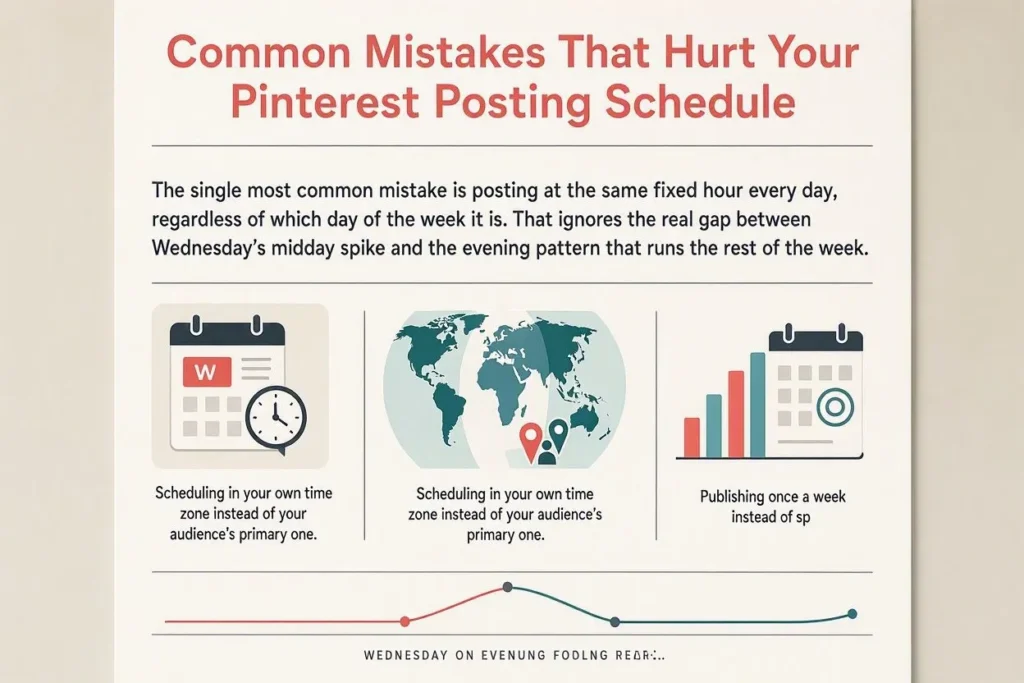
The single most common mistake is posting at the same fixed hour every day, regardless of which day of the week it is. That ignores the real gap between Wednesday’s midday spike and the evening pattern that runs the rest of the week. A handful of other mistakes show up repeatedly on underperforming accounts:
- Scheduling in your own time zone instead of your audience’s primary one.
- Publishing once a week instead of spreading pins across the week at the recommended daily volume.
- Leaning on generic, industry-wide benchmarks instead of checking your own Analytics data.
- Launching seasonal campaigns on the holiday itself instead of 30 to 45 days ahead.
- Assuming Pinterest’s long content lifespan means timing doesn’t matter at all.
Most of these trace back to treating Pinterest as an afterthought rather than a channel with real ownership. Assigning someone, whether that’s a dedicated social media manager or a shared task on the content calendar, tends to catch scheduling gaps before they cost a month of reach.
Turning the Best Time to Post on Pinterest Into a Real Strategy
None of these windows do much in isolation. They only pay off once someone treats Pinterest as a managed channel with a schedule, an owner, and a feedback loop back to actual performance data, the same way a paid search campaign or an email send calendar gets managed.
In practice, that means posting times get set from Analytics rather than guesswork, seasonal content gets planned 30 to 45 days ahead, and results get reviewed quarterly so attention shifts toward whatever’s actually driving saves and clicks. Pinterest rewards that kind of ongoing management. It doesn’t reward an account that posts inconsistently and hopes the algorithm sorts it out on its own.
Conclusion
There’s no single magic hour that works for every Pinterest account, but the pattern holds up well enough to build a schedule around: aim for 8 PM to 9 PM on Sunday, Monday, or Tuesday, watch for Wednesday’s midday spike, and adjust everything to your audience’s actual time zone rather than your own. After about 90 days of consistent posting, pull up Pinterest Analytics and let your own data start overriding these general benchmarks. International accounts need staggered times across regions instead of one fixed slot, and industry-specific content, whether that’s food, fitness, or fashion, performs best when it lands at the exact moment someone’s actually looking for it. Get the best time to post on Pinterest right, back it with steady volume and real ownership, and timing stops being a guess and starts being part of a working marketing strategy.