
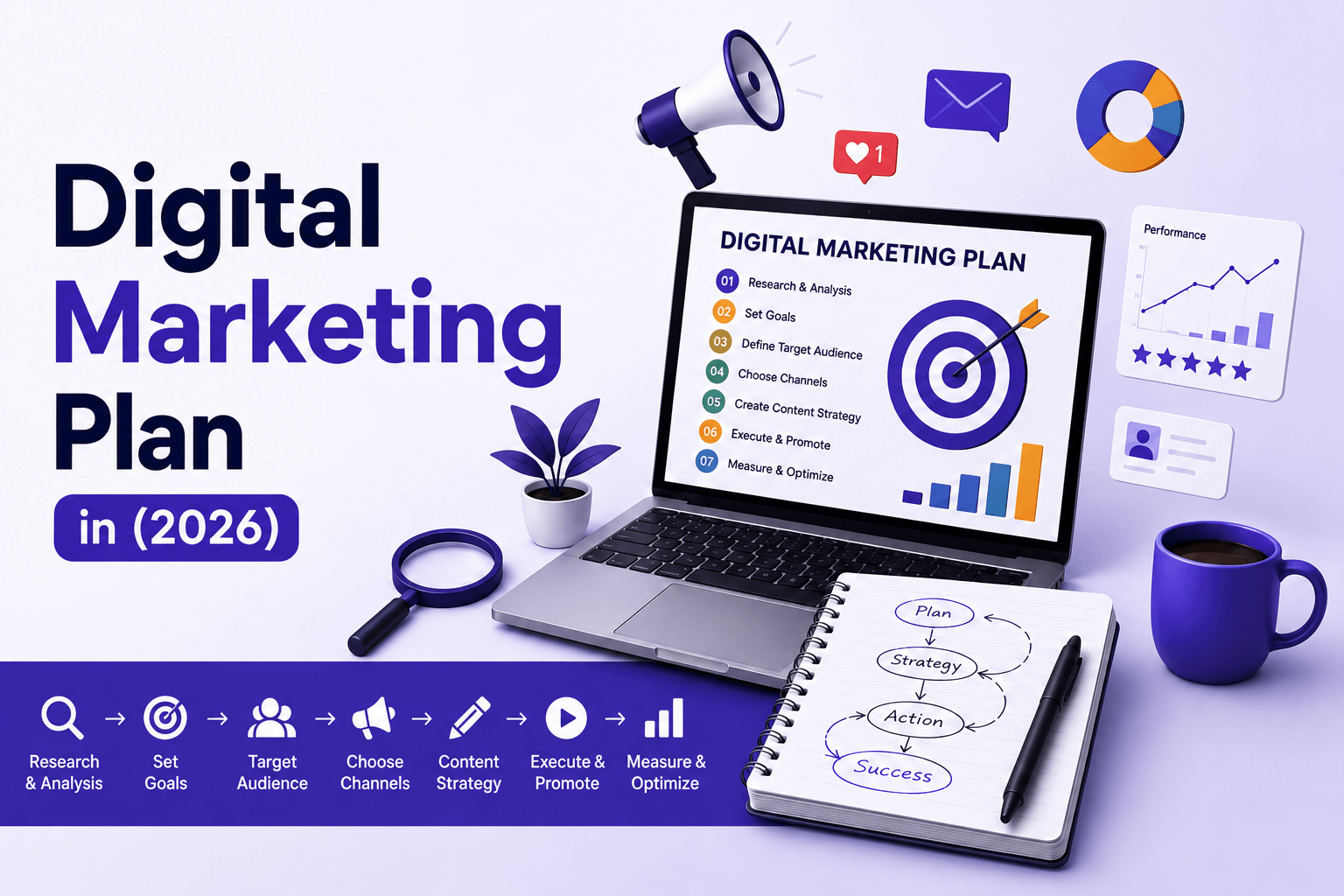
A digital marketing plan is a strategic marketing management document that defines your advertising objectives, target market, marketing channels, promotional budget, and KPIs in one place. It is the core tool that marketing managers, CMOs, and business owners use to execute advertising campaigns, manage marketing operations, and measure return on marketing investment.
Marketing teams use a digital marketing plan to align advertising strategy with business objectives, coordinate multichannel marketing campaigns, allocate promotional spend across channels, and report marketing performance to senior management. Without a documented plan, advertising budgets get wasted on disconnected campaigns with no market positioning, no audience segmentation, and no marketing accountability.
Only 17% of businesses document their digital marketing strategy. The other 83% run uncoordinated advertising campaigns with no brand management framework and no customer acquisition targets. This guide gives marketing managers and business owners a proven 6-step marketing management framework to build a plan that drives measurable advertising results in 2025.
What Is a Digital Marketing Plan?
A digital marketing plan is a formal marketing management document that outlines how a business will use digital advertising channels — search engine marketing (SEM), content marketing, email marketing campaigns, paid media advertising, and social media marketing — to achieve specific business revenue targets. It defines brand positioning, promotional mix strategy, customer acquisition approach, and marketing budget allocation in one structured place.
Marketing directors and CMOs use a digital marketing plan to:
- Set measurable advertising objectives aligned to quarterly business targets
- Define market segmentation and buyer personas for precise audience targeting
- Allocate marketing budget across advertising channels with clear ROAS expectations
- Manage campaign workflows and marketing team accountability
- Track KPIs and report marketing performance to the C-suite
It answers 3 questions every marketing manager and business owner needs answered:
- Where are you now? (market position, brand awareness, current traffic, backlink authority)
- Where do you want to go? (marketing goals, KPIs, revenue targets, market share, customer lifetime value)
- How will you get there? (advertising channels, promotional budget, market segmentation, campaign tactics)

Digital Marketing Plan vs Strategy vs Campaigns
Most competitors blur these 3 terms. Here is the clear difference:
| Term | Scope | Timeframe | Owner | Example |
| Plan | Full business roadmap | 6–12 months | CMO / Marketing Director | “Grow organic traffic by 40% in 12 months” |
| Strategy | How you’ll compete | Ongoing | Marketing Manager | “Target low-competition keywords in the finance niche” |
| Campaign | Single initiative | 4–8 weeks | Campaign Manager | “Run a guest post campaign to build 20 backlinks in Q2” |
| Tactic | One specific action | Days | Content / SEO Specialist | “Publish 3 guest posts on DA 50+ sites this week” |
Your plan contains strategies. Strategies contain campaigns. Campaigns contain tactics. Assigning an owner to each level prevents execution gaps and keeps management accountable for deliverables.
The 4 Ps of Marketing Inside Your Digital Plan
A complete digital marketing plan operationalizes the 4 Ps of marketing — Product, Price, Place, Promotion — across digital channels:
| Marketing Mix Element | Digital Application | Example |
| Product | Landing page copy, feature positioning, USP | “Our link building service delivers DA 50+ placements in 14 days” |
| Price | Pricing pages, PPC bid strategy, discount campaigns | Tiered packages at $299, $599, $999/month |
| Place | Distribution channels — SEO, social, email, paid search | Guest posts on industry blogs + Google Ads for bottom-funnel |
| Promotion | Advertising campaigns, content marketing, outreach | 3 guest posts/week + monthly email newsletter + retargeting ads |
Brands that map digital tactics to the 4 Ps run more coherent advertising campaigns and achieve 23% higher brand recall than those running isolated channel campaigns.
In small businesses, the founder or marketing manager owns the plan. In mid-size companies, the Chief Marketing Officer (CMO) owns it with input from department heads — SEO, paid media, content, and sales. In large enterprises, the plan integrates into the broader business operations management cycle, reviewed quarterly alongside financial planning.
Regardless of company size, 1 person must own the plan. Shared ownership creates zero accountability.
Why Every Business Needs a Documented Digital Marketing Plan
Businesses without a documented digital marketing plan face 5 direct marketing management failures:
- Advertising budget waste — spend goes to channels that don’t convert; marketing managers have no data to reallocate
- No marketing performance measurement — teams cannot report ROI; management cannot make data-driven budget decisions
- Inconsistent brand messaging — brand voice differs across advertising channels; no brand governance framework
- Poor market segmentation — advertising campaigns reach the wrong audience; customer acquisition cost (CAC) rises unchecked
- Zero competitive marketing advantage — competitors with documented marketing plans outrank, outspend, and out-convert you systematically
A documented digital marketing plan solves all 5 failures. It gives marketing managers a structured framework to align advertising campaigns with business objectives and report measurable marketing ROI to senior management every quarter.
6-Step Marketing Management Framework: How to Build a Digital Marketing Plan
Step 1 — Set Advertising Objectives and SMART Marketing Goals
Every digital marketing plan starts with advertising objectives tied directly to business revenue targets. Marketing managers who set vague goals produce vague results. Use the SMART framework — Specific, Measurable, Attainable, Relevant, Timely — to define objectives that senior management can hold the marketing team accountable for delivering.
Weak marketing goal: “Get more website traffic” SMART marketing objective: “Increase organic traffic by 35% in 6 months through SEO and guest posting to support Q3 revenue target of $500K”
Set goals for each stage of the customer journey:
- Awareness: impressions, organic reach, backlinks acquired
- Consideration: time on site, email signups, content downloads
- Decision: conversion rate, cost per lead, sales qualified leads (SQLs)
Pick 2–3 primary KPIs per stage. Tracking 20 metrics means tracking nothing. Marketing managers who track fewer metrics make faster, better budget decisions.
Goal alignment framework for management teams:
| Business Objective | Marketing Goal | Responsible Team |
| Increase revenue by 30% | Generate 100 leads/month | SEO + Paid Media |
| Expand to new market | Build brand awareness in target niche | Content + Guest Posting |
| Reduce churn | Improve customer retention by 20% | Email Marketing |
| Strengthen online authority | Acquire 30 backlinks/month from DA 40+ sites | Link Building Team |
Step 2 — Define Market Segmentation and Build Buyer Personas
Market segmentation is the process of dividing your total addressable market (TAM) into groups with shared characteristics so advertising campaigns reach the right audience with the right message. Marketing managers who skip segmentation waste 35% of their advertising budget reaching people outside the target market.
Collect consumer behavior data from 3 sources:
- Google Analytics 4 — age, location, device, behavior flow, purchase intent signals
- Customer interviews — 5–10 calls with your best clients to capture psychographic data
- Competitor audience research — Ahrefs, SparkToro, Reddit threads, social listening tools
4 segmentation types for digital marketing:
| Segmentation Type | Data Points | Marketing Use |
| Demographic | Age, gender, income, job title | Ad targeting, messaging tone |
| Geographic | Country, city, region | Local SEO, geo-targeted PPC ads |
| Psychographic | Values, interests, lifestyle, pain points | Content themes, brand voice |
| Behavioral | Purchase history, search behavior, brand interactions | Retargeting, email segmentation |
Each buyer persona needs:
- Demographics: age, job title, income range, location
- Psychographics: values, motivations, content preferences
- Pain points: 3 specific problems they need solved
- Consumer journey stage: awareness, consideration, or decision
- Preferred channels: where they consume marketing content (LinkedIn, YouTube, Google search)
Example persona for a link building agency:
“Sarah, 34, SEO Manager at a mid-size e-commerce brand. She needs 15–20 quality backlinks per month but has no time for outreach. She searches Google for ‘buy guest posts’ and ‘link building agency pricing.’ She cares about DA, niche relevance, and dofollow status. She is in the commercial investigation stage of the consumer journey.”
Effective market segmentation reduces wasted advertising spend by 35% — your ads reach people already predisposed to buy.
Step 3 — Audit Your Current Digital Assets
Before adding new channels, audit what you already have. Categorize every asset as Owned, Earned, or Paid:
| Asset Type | Examples | Action |
| Owned | Website, blog, email list, social profiles | Audit performance, fix gaps |
| Earned | Backlinks, press mentions, reviews, guest posts | Measure DA impact, build more |
| Paid | Google Ads, Facebook Ads, sponsored content | Check ROAS, cut underperformers |
Run a content audit on your site:
- Crawl all URLs using Screaming Frog (free up to 500 URLs)
- Tag each page: performing, underperforming, or orphaned
- Check backlink profile in Ahrefs or SEMrush — count referring domains, average DA, anchor text distribution
Your backlink audit reveals 3 things: which pages attract links naturally, which need a guest posting push, and which toxic links need disavowing.
Step 4 — Build Your Multichannel Marketing Mix and Advertising Channel Strategy
Marketing channel selection is a strategic management decision. Pick advertising channels based on where your target market spends time and where your brand has the weakest competitive presence. New marketing plans start with 2 channels maximum — spreading advertising budget across 7 channels produces mediocre results in all of them.
4 core channels for most businesses in 2025:
- SEO + Content Marketing Targets informational and commercial search intent. Builds long-term organic traffic and brand authority without ongoing advertising spend. Requires 6–12 months for full market penetration. Combine on-page optimization with a backlink acquisition strategy to accelerate ranking velocity.
- Guest Posting & Link Building Increases domain authority (DA), improves keyword rankings, and drives referral traffic simultaneously. A single guest post on a DA 60+ site can shift rankings within 30–60 days for mid-competition keywords. Guest posting is also a brand awareness channel — your brand name appears on authoritative industry publications, building consumer trust before a prospect ever visits your site. Target niche-relevant sites — a backlink from a DA 40 site in your exact niche outperforms a DA 70 general news site.
- Email Marketing Highest return on advertising spend (ROAS) of any digital channel at $36 per $1 spent. Use for lead nurture sequences, promotional campaigns, upsell offers, and customer retention. Segment email lists by buyer persona and consumer journey stage — generic broadcast emails kill open rates and destroy brand reputation with subscribers.
- Paid Search Advertising (PPC) Use PPC (pay-per-click) advertising to capture transactional intent immediately while SEO builds organic authority. Run search ads on high-intent keywords like “link building agency,” “buy guest posts,” “digital marketing plan template.” Monitor cost per acquisition (CPA) weekly — PPC advertising spend without CPA tracking wastes budget fast.
Multichannel marketing attribution: Each channel plays a different role in the advertising funnel. SEO and guest posting build awareness and consideration. Email marketing and retargeting ads convert warm prospects. PPC captures ready-to-buy users. Attribute revenue correctly across all touchpoints using Google Analytics 4 data-driven attribution model — last-click attribution undervalues SEO and content marketing by 40–60%.
Step 5 — Marketing Budget Management and Resource Allocation
Marketing budget management is a core business operations responsibility. The CMO or marketing director sets total advertising spend. Finance approves it. Marketing managers allocate it across channels based on expected ROAS per channel. Every dollar of advertising spend must map to a measurable marketing objective.
Allocate budget across channels based on your primary goal:
| Goal | Recommended Budget Split |
| Brand awareness | 50% content/SEO, 30% social, 20% PR/guest posts |
| Lead generation | 40% PPC, 30% SEO/content, 20% email, 10% link building |
| Organic growth | 40% content creation, 35% link building/guest posts, 25% technical SEO |
Industry benchmark: B2B companies spend 2–5% of revenue on marketing. SaaS companies spend 15–25%. Agencies typically reinvest 10–15% of revenue into their own SEO and link acquisition.
For link building specifically: budget $300–$800 (approx. £240–£640) per guest post on DA 40–70 sites. Budget $150–$400 (£120–£320) per niche edit. High-DA placements (DA 70+) cost $800–$2,000+ (£640–£1,600+) per placement.
Resource allocation beyond budget:
Management teams overlook non-financial resources. A complete resource plan includes:
- Human resources: in-house writers, SEO specialists, outreach managers vs. outsourced agency
- Technology stack: SEO tools (Ahrefs $99–$399/month), CRM, email platform, analytics
- Time allocation: content production takes 4–8 hours per article; outreach takes 2–3 hours per link placement
- Vendor management: guest post agencies, freelance writers, link building specialists
Businesses that document resource requirements alongside budget reduce operational bottlenecks by 40% compared to those that plan budget alone.
Step 6 — Marketing Performance Measurement: Track KPIs and Report ROI to Management
Marketing performance measurement converts advertising spend into business intelligence. Set up all tracking before publishing content or launching any advertising campaign. Marketing managers who measure results make better budget decisions. Marketing managers who skip measurement cannot justify spend to the C-suite.
| KPI | Tool | Target | Management Report Frequency |
| Organic traffic | Google Analytics 4 | +20–40% in 6 months | Monthly |
| Keyword rankings | Ahrefs / SEMrush | Top 10 for primary keyword | Monthly |
| Domain Authority | Moz / Ahrefs DR | +5–10 points in 6 months | Quarterly |
| Referring domains | Ahrefs | +10–20 new domains/month | Monthly |
| Conversion rate | GA4 + heatmaps | 2–5% for landing pages | Monthly |
| Cost per lead (CPL) | CRM + Ad dashboards | Varies by industry | Monthly |
| Email open rate | Mailchimp / Klaviyo | 25–35% | Monthly |
| Backlinks acquired | Ahrefs | Match guest post targets | Monthly |
Review KPIs monthly at team level. Present quarterly summaries to senior management with revenue impact, not just traffic numbers. Adjust budget quarterly based on performance data. Do not wait 12 months to see if a strategy failed.
Management dashboard structure:
Present 3 numbers to the C-suite every quarter: (1) total leads generated, (2) cost per lead by channel, (3) revenue attributed to marketing. Everything else is operational detail.

Brand Strategy, Market Positioning, and Advertising Campaign Planning
Most digital marketing plan guides skip brand strategy entirely. That gap costs businesses market share.
Brand positioning defines how your target market perceives your brand relative to competitors. Without a clear position, your advertising campaigns send mixed signals — high spend, low brand recall.
Define your brand positioning using this 3-step framework:
- Identify your competitive differentiator What does your brand offer that no direct competitor offers at the same price point? For a link building agency: “niche-relevant guest posts delivered in 7 days with full placement reports.”
- Write your positioning statement Use this format: For [target segment], [Brand] is the only [category] that [unique benefit] because [reason to believe].
Example: “For SEO managers at e-commerce brands, our agency is the only link building service that guarantees DA 40+ niche-relevant placements within 14 days, backed by a full refund policy.”
- Apply positioning consistently across all marketing channels Your website headline, PPC ad copy, email subject lines, and guest post author bios all communicate the same brand positioning. Inconsistent messaging across channels reduces advertising effectiveness by 31% — consumers receive conflicting brand signals.
Market penetration strategy:
Your digital marketing plan should specify your market penetration approach — how you will increase market share in your target segment:
| Penetration Strategy | Tactic | Channel |
| New customer acquisition | Target competitor keywords with PPC | Paid search advertising |
| Brand awareness expansion | Publish on high-DA industry sites | Guest posting |
| Customer retention | Monthly value-add email campaigns | Email marketing |
| Market share growth | Outrank competitors for primary keywords | SEO + link building |
A digital marketing plan is a living management document. Treating it as a one-time exercise is the fastest way to make it irrelevant.
4-point management cycle:
- Monthly operational review Marketing team reviews all 8 KPIs. Identifies underperforming channels. Reallocates budget or content resources where needed. Takes 60–90 minutes per session.
- Quarterly strategic review Management team evaluates whether goals are on track. Adjusts strategy if market conditions change — new Google algorithm update, competitor moves, or budget changes. Takes half a day.
- Six-month plan update Update buyer personas, channel mix, and KPI baselines based on 6 months of real data. Replace assumptions with evidence.
- Annual plan rebuild Start fresh. Use the previous year’s data to set more accurate targets. Align with the company’s annual business plan and revenue targets approved by leadership.
Signs your plan needs immediate revision:
- Organic traffic drops 15%+ month-over-month for 2 consecutive months
- Cost per lead increases 30%+ without a corresponding increase in lead quality
- A new Google core update changes keyword rankings by more than 20 positions
- A direct competitor launches a major content or link building campaign
Digital Marketing Plan for Different Business Sizes
Small business (1–10 employees) Focus on 2 channels: SEO + email marketing. Budget: $1,000–$3,000/month. Build 5–10 backlinks per month through guest posting. One person manages the full plan.
Mid-size business (11–100 employees) Use 3–4 channels: SEO, content, PPC, email. Budget: $5,000–$20,000/month. Dedicated marketing manager owns the plan. Build 15–30 backlinks per month. Quarterly management reviews with department heads.
Enterprise (100+ employees) Full channel mix with dedicated teams per channel. Budget: $50,000+/month. CMO owns the plan. Marketing operations manager tracks KPIs. Monthly C-suite reporting. 30–50 backlinks per month from DA 50+ sites.
How to Do SEO Inside Your Digital Marketing Plan
Search engine optimization (SEO) and search engine marketing (SEM) are the 2 most measurable channels in any digital marketing plan. Every other channel depends on a website search engines can crawl, index, and rank.
How to Do On-Page SEO: 7-Point Checklist
To optimize every page you publish, complete these 7 steps:
- Write your title tag — include primary keyword in first 60 characters. Example: “Digital Marketing Plan: Step-by-Step Guide (2025)”
- Write your meta description — 150–160 characters, include keyword and a clear CTA
- Set one H1 tag — matches search intent exactly, one per page only
- Structure your URL — short, keyword-rich, no stop words. Use /digital-marketing-plan not /blog/post?id=4521
- Add internal links — link to 3–5 related pages using descriptive anchor text
- Write image alt text — describe each image using relevant keywords
- Check page speed — target under 2.5 seconds (Google Core Web Vitals LCP threshold)
How to Do Keyword Research for Your Digital Marketing Plan
To find the right keywords in 4 steps:
Step 1 — Enter your seed keyword into Ahrefs Keywords Explorer or Google Keyword Planner. “Digital marketing plan” has 18,000+ monthly global searches at KD 68.
Step 2 — Filter for long-tail keywords with KD below 30. Fast-ranking targets for new sites: “digital marketing plan template” (KD 22), “how to create a digital marketing plan” (KD 19), “digital marketing plan example” (KD 25).
Step 3 — Classify search intent for each keyword — informational, commercial, transactional, or navigational. Match your content format to the dominant intent Google shows in the top 10 results.
Step 4 — Run a competitor keyword gap analysis in Ahrefs Site Explorer. Filter for keywords where competitors rank positions 4–20 — these are fastest to overtake with 3–5 targeted backlinks.
Technical SEO Requirements: 5-Point Audit
To run a technical SEO audit, check these 5 factors:
| Technical Factor | Tool | Target Benchmark |
| Core Web Vitals (LCP) | Google Search Console | Under 2.5 seconds |
| Mobile usability | Google Mobile-Friendly Test | Zero errors |
| Crawl errors | Screaming Frog | Zero 4xx / 5xx errors |
| XML sitemap | Screaming Frog | Submitted to Google Search Console |
| Schema markup | Google Rich Results Test | FAQ + Article schema active |
Sites with clean technical SEO rank 40% faster after a guest posting campaign than sites with unresolved crawl errors.
How to Integrate SEM (Search Engine Marketing) with Your Plan
To do SEM correctly inside your digital marketing plan, follow 4 steps:
- Run Google Search Ads on high-intent keywords while SEO builds organic rankings — covers the 6–12 month organic lag
- Mine PPC search query reports to identify new organic keyword targets — queries that convert in paid search also convert organically
- Add negative keywords weekly to stop ad spend waste on irrelevant search queries
- Target Quality Score 7+ on all ad groups — this reduces cost per click (CPC) by 16–50% and improves ad rank
Connect Google Search Console (GSC) to Google Analytics 4. Use GSC performance data to find pages ranking in positions 8–20 — each needs 3–5 additional backlinks to break into the top 5.
Guest Posting and Backlinks: The Missing Section in Most Digital Marketing Plans
Most digital marketing plan guides — including HBS and Adobe — skip this entirely. That is a direct ranking gap.
Backlinks are Google’s #1 off-page ranking factor. Without a link acquisition strategy in your plan, your content will not rank no matter how well it is written or optimized.
How to Build Backlinks: 4 Proven Methods
To acquire backlinks systematically, use these 4 tactics:
- Guest Posting To do guest posting: identify niche-relevant sites with DA 30+, pitch an original article idea, write 1,000–1,500 words of expert content, and earn 1–2 dofollow backlinks to your target pages. Guest posting builds brand authority and referral traffic simultaneously.
- Niche Edits (Link Insertions) To do niche edits: contact site owners of existing, indexed articles and pay to insert your link contextually. Faster than guest posts. Lower cost per placement. High impact when the host article already ranks on Google page 1.
- Broken Link Building To do broken link building: use Ahrefs to find broken outbound links on high-DA sites in your niche. Email the site owner with your working content as a replacement. Zero cash cost — only outreach time investment.
- Competitor Backlink Replication To replicate competitor backlinks: export your top competitor’s backlink profile from Ahrefs. Contact the same referring domains. Sites that linked to your competitor respond positively to similar pitches — they already accept guest content in your niche.
Anchor text distribution target for a healthy backlink profile:
- Branded anchors: 40–50% (e.g., “YourAgencyName”)
- Naked URL: 20–25% (e.g., “youragency.com”)
- Partial match: 15–20% (e.g., “link building service”)
- Exact match: 5–10% (e.g., “buy guest posts”) — keep this low
- Generic: 5–10% (e.g., “click here,” “read more”)
How to Plan Advertising Campaigns Within Your Digital Marketing Plan
Your digital marketing plan sets the annual direction. Individual advertising campaigns execute it in 4–8 week sprints. Each campaign needs 5 elements:
- Campaign objective — tied to one funnel stage (awareness, consideration, or conversion) 2. Target audience segment — which buyer persona this campaign reaches 3. Advertising channels — where the campaign runs (Google Ads, email, guest posts, social) 4. Creative and messaging — ad copy, content format, brand voice guidelines 5. Campaign KPIs — impressions, click-through rate (CTR), cost per acquisition (CPA), conversions
Campaign calendar example for a link building agency:
| Month | Campaign | Channel | Objective | KPI |
| Jan | “New Year SEO Audit” | Email + PPC | Lead generation | 50 leads |
| Feb | “Guest Post Guide 2025” | SEO + Guest posting | Brand awareness | 5,000 organic visits |
| Mar | “Link Building ROI Calculator” | SEO + Social | Consideration | 500 tool uses |
| Apr | “Spring Package Discount” | Email + Retargeting ads | Conversion | 20 new clients |
| Q2 | Authority building | Guest posting | Market penetration | 60 new backlinks |
Plan 12 months of campaigns in advance. Allocate advertising budget per campaign, not per channel. This approach prevents overspending on a single channel when a campaign underperforms.
- No documented plan A plan in your head is not a plan. Document every goal, channel, budget, and KPI. Teams without documentation misalign within 60 days.
- Ignoring consumer search intent Writing content for keywords without matching consumer search intent fails. “Digital marketing plan” = informational intent. “Digital marketing agency pricing” = commercial intent. Match content format and advertising message to intent type for every campaign.
- Skipping the backlink and brand authority strategy Publishing 50 blog posts with zero backlinks produces zero rankings. Backlinks are both an SEO signal and a brand authority signal — every guest post placement puts your brand in front of a new audience. Allocate 25–35% of your SEO advertising budget to link acquisition from day one.
- Targeting high-competition keywords before building market authority New sites cannot rank for “digital marketing” (KD 90+). Target long-tail keywords with keyword difficulty (KD) below 30 for the first 6 months. Build domain authority through guest posting and content marketing, then expand into competitive market positions.
- Measuring vanity metrics instead of marketing ROI Social media likes and raw traffic numbers do not pay invoices. Measure marketing ROI per channel: leads generated, CPL, customer acquisition cost (CAC), conversion rate, and revenue per advertising dollar spent.
Digital Marketing Plan Template (Free)
Use this table to build your plan in one hour. Every row has a designated owner — marketing accountability built in:
| Section | What to Fill In | Owner |
| Business Goal | e.g., “Generate 50 leads/month by December 2025” | CMO / Business Owner |
| Brand Positioning Statement | Target segment + unique benefit + reason to believe | CMO + Marketing Manager |
| Primary Buyer Persona | Name, demographics, psychographics, consumer journey stage | Marketing Manager |
| Market Segmentation | Demographic / geographic / psychographic / behavioral | Marketing Manager |
| Current Assets | List owned, earned, paid assets + advertising performance | SEO Specialist |
| Promotional Mix | SEO / PPC / Email / Guest Posting / Social — pick 2–3 | Marketing Manager |
| Advertising Budget | Total + split per channel + ROAS target | CMO / Finance |
| Campaign Calendar | 12 monthly campaigns with objectives and KPIs | Campaign Manager |
| Content Calendar | Topics, formats, publish dates, target keywords | Content Manager |
| Link Building Target | X guest posts per month, target DA range, anchor text | SEO / Link Building Team |
| Primary KPIs | 3–5 metrics with baseline + 6-month targets | Marketing Manager |
| Review Schedule | Monthly KPI review, quarterly strategy adjustment | CMO |
Fill in each row, assign owners, and share with your marketing team before starting any advertising campaign. A plan without owners is a wish list.