
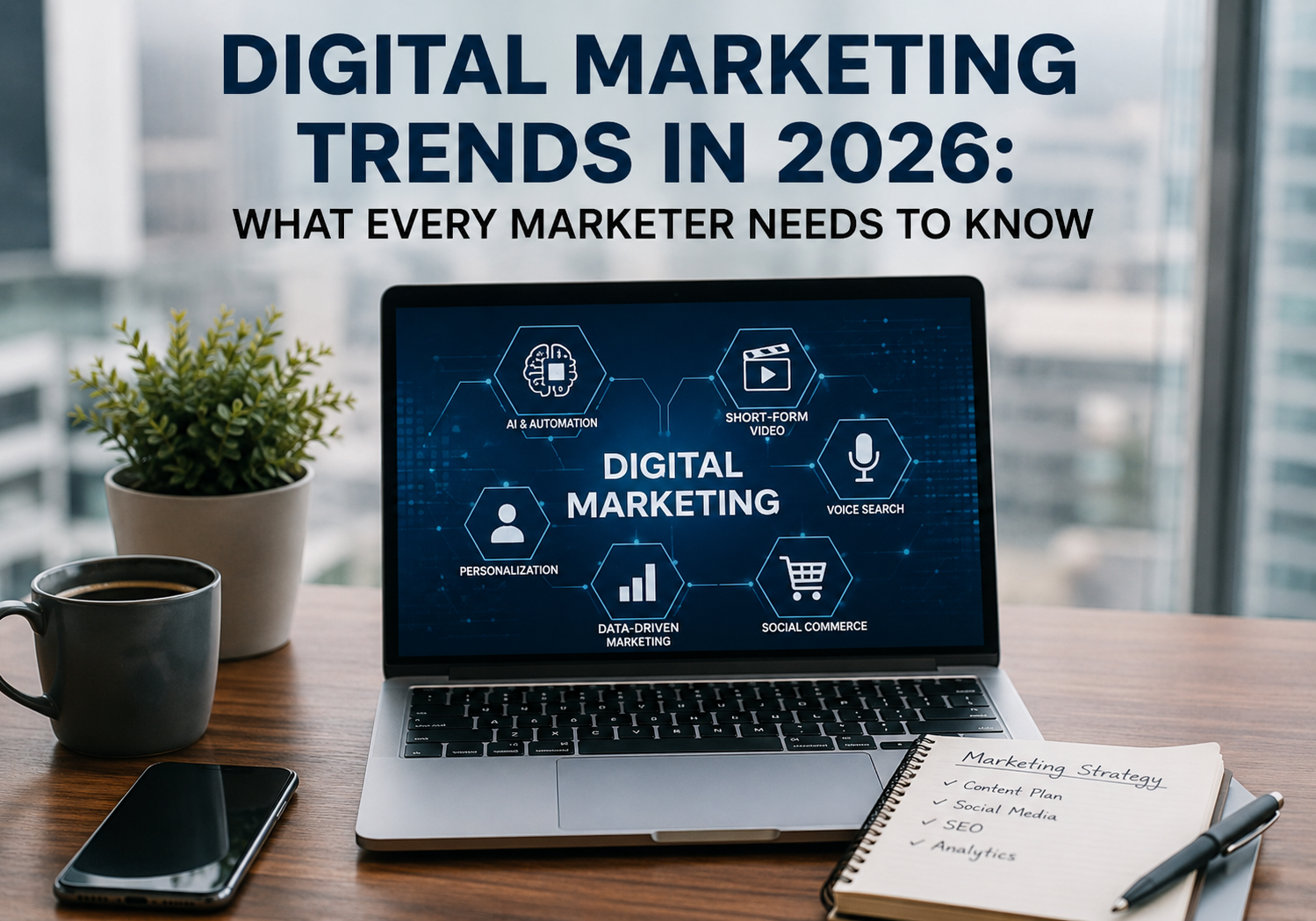
The digital marketing realm moves fast, and 2026 looks to be as dynamic as any other year.
To keep up, marketers need to know which digital marketing trends to leverage this year — to stay ahead of the competition, create impactful campaigns, and deliver real results for their brands and clients.
Artificial intelligence is now embedded into the systems, platforms, and processes that digital marketers use every day. As a result, marketing professionals need to know how to leverage AI to optimize and elevate every marketing initiative and campaign they run.
AI is no longer a nice skill to have as a marketer. It is a must-have to succeed and advance your career in digital marketing.
So, what are the key digital marketing trends to know in 2026? Here is what the data, the experts, and real campaign results show.
What Are the AI Trends to Look Out for in 2026?
Last year the conversation many marketing professionals were having was: “what AI tools do we need and what can we do with them?”
In 2026, that conversation is evolving. The focus now is how to leverage AI at scale to make a real impact — from boosting customer retention and campaign performance to increasing revenue and return on investment (ROI) across every marketing channel.
AI Agents
While many marketers are already using AI, it is often limited to one or two platforms — ChatGPT for copy, Gemini for research. In 2026, that is changing. More marketing teams and businesses are looking to optimize their AI use through AI agents.
AI agents are systems that do not just follow instructions. They make decisions, take actions, and continuously optimize campaigns without the need for human intervention at every step.
A digital marketing team can use an AI agent to manage customer service interactions, troubleshoot product issues, reschedule orders, and handle subscription changes — all automatically. For paid marketing campaigns, AI agents monitor ad performance, reallocate budget across underperforming ad sets, and rewrite ad creative based on click-through rate data.
Clark Boyd, CEO and founder of marketing simulations company Novela, frames the commercial reality for digital marketers: AI agents are now doing the searching, clicking, filtering, and basket-building on behalf of consumers — asking for human approval only at the final stage. For any eCommerce marketing operation, that has obvious ramifications for how product pages, advertising copy, and pricing strategies need to be structured.
Expert Tip: Think about the fact that it may be an AI agent accessing your marketing content. The language you use, the way you frame your value proposition, and the balance between images and text may all need to change to serve machine readers as effectively as human ones.
From AI Automation to AI Elevation
The widespread adoption of AI means that marketing functions — campaign execution, content creation, audience targeting, performance monitoring — are increasingly aided by the technology.
McKinsey research shows organizations using AI in at least one business function increased from 78% to 88% in a single year. Approximately one-third of those companies report they have begun to scale their AI programs across marketing and other departments.
Automation helps marketers handle campaign execution, data analysis, content personalization, cross-channel coordination, and performance monitoring more efficiently. But the leading marketing teams in 2026 are moving beyond automation toward elevation.
Jim Lecinski, Clinical Professor of Marketing at Northwestern University’s Kellogg School of Management, identifies the shift: 2026 is the year marketing stops focusing on using AI to make more stuff and starts using AI to make better stuff. The transition is from tonnage to curation — from volume to value.
Expert Tip: Start learning basic marketing automations now. Tools like Make.com offer a straightforward starting point. As your understanding of what AI automation can and cannot do improves, progress to more complex marketing workflows and agent-building tools like n8n.
Hyper-Personalization and Conversational eCommerce
AI gives digital marketers the power to drive personalization at scale and engage consumers across every channel with messaging matched to their specific stage in the buying journey.
AI agents are becoming the primary interface between consumers and brands — transforming how people interact with products and services online. McKinsey describes it as a transformation comparable to the original eCommerce revolution, but likely to happen significantly faster.
Derek Liddy, Head of Marketing at UK innovation agency Nesta, describes how search itself is changing: intelligent search bars now determine what a searcher is looking for and route them directly to the right page — bypassing the traditional browse-and-filter journey that digital marketers spent years optimizing for.
Luxury resale platform Vestiaire Collective launched an AI-powered search engine that translates keyword queries into image pattern recognition, delivering highly relevant results. The platform is adding AI-powered price recommendations and image-upload search so consumers can find the same or similar items by uploading a photo.
Jim Lecinski predicts that in 2026, mobile AI becomes an indispensable shopping companion — consumers using AI chatbots on their smartphones as in-store purchase advisors, comparing prices, reading reviews, and requesting product recommendations in real time from any retail environment.
Expert Tip: Map search queries to intent stages, not just keywords. Treat AI prompts and search inputs as signals of where someone is in their purchase journey. Provide content, offers, and comparisons based on that stage — not based on keyword match alone.
What Are the Key SEO Trends in 2026?
The way people search for content and find information continues to evolve — especially as AI becomes integral to search engines and the wider search ecosystem.
Traditional SEO tactics like keyword optimization alone are no longer enough. AI-driven search algorithms now focus on understanding the intent behind queries, which means marketers must create content that provides genuinely useful answers and real value to the audience searching for it.
Technical SEO elements that improve user experience — Core Web Vitals, page speed, mobile usability — remain essential. Google’s E-E-A-T signals (Experience, Expertise, Authoritativeness, Trustworthiness) are now central to how marketing content is evaluated and ranked. Search everywhere optimization — being discoverable across social platforms, AI assistants, and traditional search — is a standard requirement for brands that want to stay visible online.
Brand Voice as a Ranking Signal
Zero-click searches — queries answered directly on the search engine results page without a click to any website — are rising. For marketers, this means organic traffic from informational queries is declining. The response is not to abandon content marketing but to build a brand presence strong enough that audiences search for you by name.
A cohesive, consistent, and distinctive brand voice strengthens recognition, builds audience trust, and makes every piece of marketing content work harder across both search and social channels.
Clark Boyd, CEO of Novela, states the SEO reality directly: if marketing content sounds generic and like everyone else’s, search engines treat it as noise. They need a specific reason to fetch and cite your content — because AI systems are synthesizing information from multiple sources into one answer. Generic marketing content earns no place in that synthesis.
Innocent Drinks shows what consistent brand voice looks like in practice. The brand’s humorous, direct communication style is instantly recognizable across Instagram, packaging, advertising, and website content. That brand consistency drives branded search volume — a signal Google uses to assess brand authority and trustworthiness.
Expert Tip: Think about the marketing topics your brand is uniquely positioned to cover. Make your content distinctive by including original research, expert quotes, proprietary data, or video content that no competitor can replicate.
Understanding Search Intent Is Crucial
Search intent has always been a cornerstone of effective SEO — but marketers now need to factor AI into how intent is evaluated and served.
Cathal Melinn, commercial analyst and eCommerce specialist, identifies the mindset shift: it is no longer just about what the customer is searching for. It is about what the AI bot is searching for on behalf of that customer. The intermediary changed. The content requirements changed with it.
3 intent principles every digital marketer needs to apply in 2026:
- Search engines prioritize relevance: Algorithms match results to user behavior — not keyword frequency. Content that fails to reflect what people are actually looking for will not rank, even with the right keywords present.
- Intent determines content format: Whether a blog post, how-to guide, comparison table, or video performs depends entirely on what the user is trying to accomplish. Mismatched format suppresses ranking potential regardless of content quality.
- Intent evolves: User behavior shifts as market conditions and competitor content change. Marketing teams that review intent alignment quarterly maintain rankings that teams reviewing annually consistently lose.
Expert Tip: First-party data is the most accurate source of search intent insight available to marketers. Maximize collection through optimized lead generation forms, re-engaging lapsed customers, and active participation on platforms like Reddit and Twitch where your audience discusses their real challenges.
Focus on Schema Markup
In 2026, schema markup — structured data embedded in page HTML — is essential infrastructure for digital marketing visibility in AI-driven search.
Research by Schema App shows pages with proper schema markup achieve 20–82% higher click-through rates from search results and jump from 0% to 40% visibility in Google’s AI Overviews within weeks of correct implementation.
Clark Boyd explains what schema does for marketing brands: it explicitly communicates to search engines who your founders are, what your logo looks like, what your address is, what your services cost — everything that defines your brand’s architecture online. Schema has a direct impact on click-through rate and is the clearest signal marketers can send to help machines understand exactly what their brand offers.
5 schema types every digital marketing site needs in 2026:
- Organization schema — name, logo, founder, address, social media profiles
- Article schema — author credentials, publish date, modified date, headline
- FAQ schema — question-and-answer pairs that feed directly into AI Overview boxes
- Product/Service schema — pricing, availability, aggregate review ratings
- Breadcrumb schema — site architecture for crawl efficiency and indexing
Expert Tip: Use Claude or ChatGPT to generate schema markup for your marketing pages. Describe your content — “I need Organization schema for a digital marketing agency based in Rawalpindi that provides guest posting and link building services” — and ask it to produce the JSON-LD code. Paste it into your site’s head tag and validate with Google’s Rich Results Test.
What Are the Top Content Marketing Trends in 2026?
Content marketing remains one of the highest-ROI investments a digital marketing team can make. Forbes Advisor reports the average content marketing ROI is $2.77 for every $1 spent — a 177% return. And 92% of marketers describe content as a valuable long-term business asset.
But content marketing success in 2026 requires prioritizing quality over quantity. Marketers who publish less but publish better consistently outperform those chasing volume.
Overload of AI-Generated Content
“AI slop” entered the Cambridge Dictionary in 2025. It describes the growing volume of low-quality content generated by AI that floods search results, social media feeds, and content marketing channels.
AI-generated content — particularly images and short-form video — earns high algorithmic engagement because platforms optimize for interaction, not quality. Research by Kapwing found that over 20% of videos YouTube recommends to new users are AI-generated, with the most-subscribed AI content channels accumulating 63 billion views and generating an estimated $117 million annually.
Alison Battisby, Founder of social media marketing agency Avocado Social, identifies the risk for digital marketers: 2026 will see a significant rise in AI video that games recommendation algorithms, potentially spreads misinformation, and erodes consumer trust in content broadly. Distinguishing authentic brand content from manufactured AI output is becoming harder for audiences to do.
The marketing opportunity is clear. Google’s helpful content ranking system specifically rewards people-first, experience-backed content. Marketers who publish original, expert-driven content with a genuine human perspective earn stronger rankings and higher audience trust than those relying entirely on AI generation.
Alison Battisby makes the point directly: the best marketing campaigns she has seen use AI in partnership with human creative direction — not as a replacement for marketing judgment and brand expertise. Invest in human oversight. Test content before publishing. Identify what would genuinely resonate with your audience, not just what AI produces at volume.
Expert Tip: Be transparent about when and how AI is used in your marketing content. Label AI-generated pieces appropriately. Ensure a human marketer reviews every piece for accuracy, brand alignment, and audience relevance before it goes live.
Optimize Content for AI Search and Discovery
Digital marketers are dealing with fewer clicks on content across every channel. This is not just an SEO problem — it is happening across social media, paid search, and content distribution platforms simultaneously.
Clark Boyd frames the content marketing challenge directly: for years, marketing content looked the same because everyone was optimizing for the same keywords. In 2026, keyword optimization alone no longer differentiates content. Marketers need something distinctive — a unique perspective, original research, or expert insight that no competitor can replicate.
7 ways to optimize marketing content for AI search and discovery in 2026:
- Include direct quotes from named marketing professionals or industry experts your team has interviewed
- Invest in E-E-A-T — demonstrate Experience, Expertise, Authoritativeness, and Trustworthiness across every page
- Create expert-led content with attributed citations, verifiable statistics, and named primary sources
- Write in natural language that answers questions the way knowledgeable marketing professionals speak
- Craft concise introductions of 50–80 words that immediately state what the content covers — these feed directly into Google’s AI Overview extraction
- Build semantic relationships between related marketing content through internal linking and topic cluster architecture
- Use structured data on every page to explicitly communicate content purpose to search engine systems
McKinsey projects that 50% of Google searches already include AI-generated summaries, rising to 75% by 2028. Marketing teams structuring content for AI extraction now hold a growing competitive advantage as that percentage increases.
Expert Tip: Branded searches produce 18% higher click-through rates in AI Overview results than non-branded queries, according to Amsive research. Combine your brand name with service categories in your content marketing strategy and invest in brand awareness campaigns. Branded visibility in AI search delivers measurable click-through rate advantages.
What Are the Key Paid Marketing Trends for 2026?
Paid digital marketing is being reshaped by AI-driven discovery, evolving consumer behavior, and search experiences that function less like link directories and more like decision-making engines.
McKinsey data shows 44% of users who have tried AI-powered search — through ChatGPT, Gemini, Claude, or Google’s AI Overviews — now consider it their primary preferred search method, versus 31% who still prefer traditional search. For paid marketing teams, this changes where advertising budget delivers the strongest return on investment.
Focus on Ad Creative
In competitive paid marketing channels, standing out is difficult even with precise audience targeting and defined campaign parameters. As AI automates more advertising functions — bid management, audience selection, placement optimization, budget allocation — marketing teams are left with fewer direct campaign levers to control.
Ad creative is the lever that remains.
Meta’s advertising platforms plan to allow brands to fully create and target advertisements using integrated AI tools by the end of 2026 — generating personalized ad variations, automated image backgrounds, and dynamic adjustments to video ad content at scale. When AI handles every other campaign variable, creative quality becomes the primary performance differentiator between competing advertisers.
Cathal Melinn, commercial analyst and eCommerce specialist, states the paid marketing reality clearly: when you give Google or Meta your campaign objective and enter your credit card details, the remaining inputs are minimal — but creative is still one input marketers fully control. Scale creative production. It is one of the few things that will actually make a measurable difference to campaign performance.
Expert Tip: Build a minimum of 5 creative variations per campaign — different headlines, images, value propositions, and calls to action. Let AI platforms test and optimize across those variations. Review performance monthly. Replace the lowest-performing creative with new variations built on insights from the highest-performing ads.
Get to Grips with AI Max
Google’s AI Max is a one-click campaign feature suite that uses Gemini and other machine learning models to help advertisements reach searchers based on broader intent signals — expanding beyond the keyword matches traditional campaigns target.
AI Max dynamically customizes ad creative elements and improves campaign performance by connecting marketing messages to relevant search queries that standard keyword targeting misses. For digital marketing agencies managing client campaigns, AI Max offers a practical route to expanding campaign reach without expanding advertising budget.
When beauty brand L’Oréal activated AI Max, the company reported a 2x higher conversion rate at 31% lower cost-per-conversion — and unlocked new conversions from search queries the brand’s keyword strategy had not previously identified, including specific product-use questions like “what is the best cream for facial dark spots?”
Cathal Melinn recommends a specific management approach for marketing teams using AI Max: review the search terms report filtered by AI Max match type, scan for irrelevant queries, and build a negative keyword list before evaluating exact, broad, or phrase match performance. This prevents wasted advertising spend while allowing AI Max to reach genuinely relevant new query territory.
Expert Tip: Google Asset Studio now integrates the latest Gemini releases directly into the ad creation workflow. If your marketing team has not used Google Asset Studio to produce creative for paid campaigns, start now — it will become a core feature of Google Ads campaign management throughout 2026.
What Are the Top Social Media Marketing Trends in 2026?
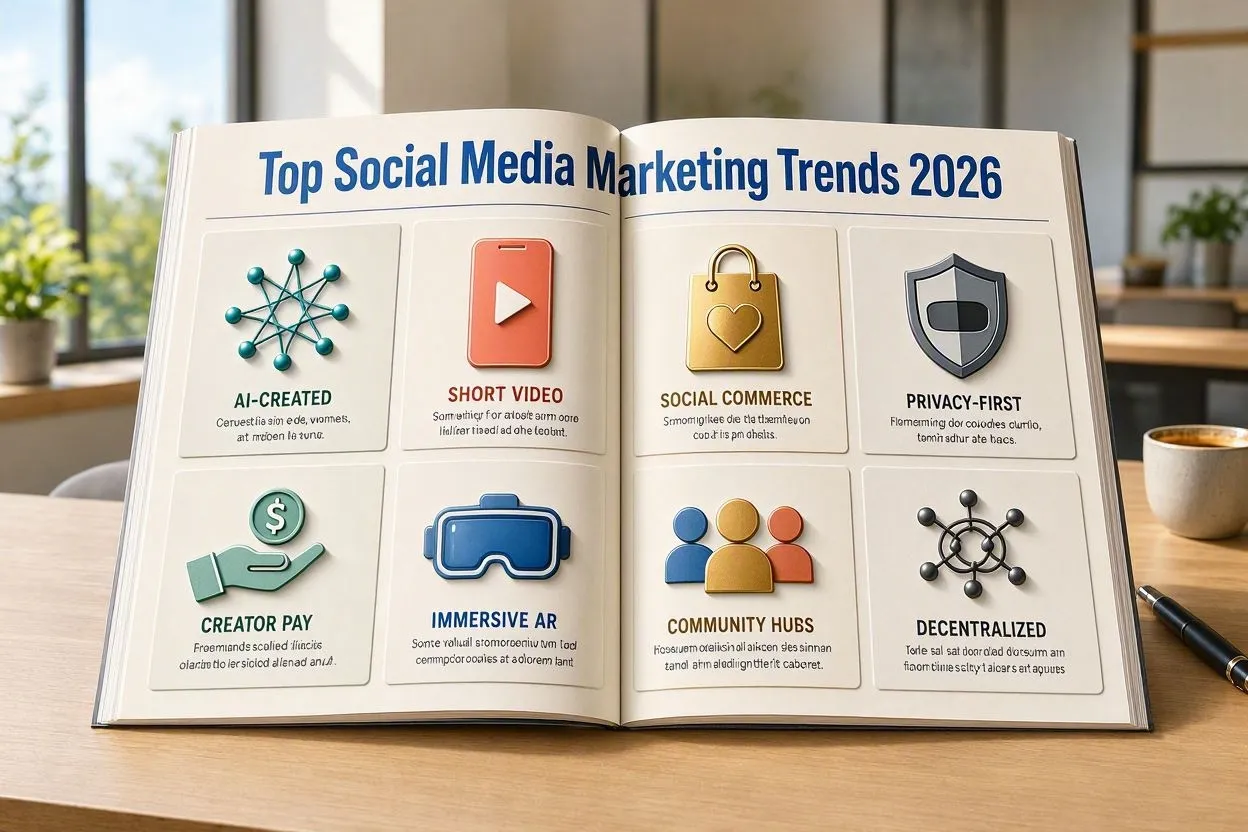
Despite ongoing controversy and public debate around social media platforms, the number of active social media users continues to grow. The Digital 2026 Global Overview Report shows global social media users increased 4.8% over the past year, reaching 5.66 billion active users — nearly 69% of the total global population.
Social media is going nowhere. For digital marketers, it remains a primary channel for building brand awareness, reaching target audiences, and driving campaign engagement at scale.
The Growth of Community-First Platforms
Social media marketing evolved through two previous phases. First, marketers used platforms to broadcast content to mass audiences. Then, they used algorithmic targeting to reach defined audience segments. In 2026, social media marketing is entering a third phase: community-first marketing.
Brands are building highly engaged niche communities — even micro-communities — to nurture deeper audience connections on platforms designed for conversation rather than content distribution.
Alison Battisby identifies the consumer behavior shift: instead of chasing viral moments and algorithmic reach, audiences are seeking genuine conversations with real people sharing real opinions. Community-first platforms saw measurable growth throughout 2025 — Reddit increased UK users by 88% and overtook TikTok as the 4th most visited social media platform. Substack crossed 5 million paid subscriptions and added 1 million new subscribers in 4 months. Discord reached 259 million monthly active users, up from 227.7 million in 2024.
Beyond dedicated community platforms, significant community marketing work is happening through WhatsApp. Instagram and TikTok are both expanding broadcast channels that allow brands to build private audience communities within their existing platforms.
Expert Tip: When participating in community-based platforms, adapt your marketing tone. Be less corporate. Participate in conversations genuinely before making any promotional ask. Lose a little control over the message — the authenticity that comes from real participation produces stronger brand trust than polished promotional content.
Social Media Fatigue and the Need for Authentic Content
People are sharing less on social media. A BBC poll found that nearly one-third of all social media users post less frequently than they did one year ago. Instead of creating, audiences are consuming — and they want to be entertained, not sold to.
For digital marketing teams, this means social media strategy in 2026 is less about creating targeted campaigns and posts and more about creating content that is genuinely entertaining, relatable, and human.
Alison Battisby points to founder-led brand content as the model worth replicating. Founders who document their work, share business decisions openly, and give audiences behind-the-scenes access build the kind of human connection that polished brand marketing cannot replicate. Stephen Bartlett and Grace Beverley both demonstrate this approach consistently — their personal social media content generates stronger engagement metrics than equivalent corporate marketing content from brands of similar size.
Employee advocacy offers brands without high-profile founders an equivalent authenticity signal. Internal content that shows the humans behind the marketing operation, shares genuine work culture, and uses humor developed from inside the brand builds credibility that external advertising campaigns consistently fail to match. Duolingo’s owl mascot content is the most cited example of employee-adjacent brand voice done at scale.
Nostalgia marketing is a measurable content opportunity in 2026. TikTok searches for “2016” surged 452% in a single week, generating over 55 million videos using the platform’s year-specific filter. Brands that understand and act on nostalgia timing cycles — identifying which cultural moments their audience wants to revisit — capture attention at significantly lower cost than competing for trending general topics.
Expert Tip: Behind-the-scenes content showing the real people inside a business performs strongly on both Instagram and TikTok right now. Create a series of posts that reveal how your marketing campaigns get made, how your team works, or what the founding story of your brand really looks like.
The Evolution of Influencers and Content Creators
Influencer marketing faced public pushback throughout 2024 and 2025. The #deinfluencing movement on TikTok reflects growing consumer skepticism toward sponsored content from large-following social media personalities. Audiences are increasingly identifying paid promotions regardless of how they are packaged.
But influencer marketing is not declining in 2026 — it is evolving. According to Influencer Marketing Hub, influencer marketing helped social media become the world’s largest advertising channel in 2025, surpassing paid search with a total spend of $266.92 billion.
The shift is from traditional influencer advertising to creator economy partnerships. Jane McDaid, Founder of creative agency Thinkhouse, identifies where marketing influence actually operates now: the creator economy — people building audiences around genuine expertise, skill, or entertainment value — is growing brand value faster than traditional influencer deals.
Unilever is deploying 10,000 content creators at the 2026 World Cup. Coca-Cola used 10,000 creators at the Paris Olympics in 2024. Both global marketing organizations moved away from celebrity endorsement toward creator ecosystem building — prioritizing authentic audience relationships and genuine brand advocacy over follower count and sponsored post reach.
Jane McDaid argues this shift places the creator economy, public relations, and creative marketing at the center of brand strategy — replacing the advertising-first approach that dominated digital marketing budgets throughout the previous decade.
Expert Tip: Public relations is moving upstream in digital marketing because AI systems pull brand data from credible media sources. A single strong PR placement now travels further and lasts longer than it did in traditional search and social environments. Invest in PR strategy alongside influencer and creator partnerships — the two amplify each other’s impact.
Conclusion: Which Digital Marketing Trends Matter Most for Your Strategy in 2026?
As these trends make clear, 2026 is shaping up to be a significant year for digital marketing professionals across every discipline — from content marketing and SEO to paid advertising, social media, and influencer campaigns.
It will come as no surprise that AI sits at the center of almost every major shift. But in 2026, the focus is not on whether to use AI — it is on how to use it to deliver genuine value, stronger campaign performance, and better ROI at scale.
The key is to treat AI as an assistant that makes your marketing better and faster — not a replacement for the human judgment, creative expertise, and audience understanding that produces campaigns people actually respond to. Human oversight remains essential at every stage.
Think about which trends from this guide resonate most with your current marketing goals. Whether it is building a distinctive brand voice, implementing schema markup, developing a community-first social media strategy, partnering with micro-creators, or scaling AI-powered ad creative — the opportunities for measurable marketing growth in 2026 are significant.