
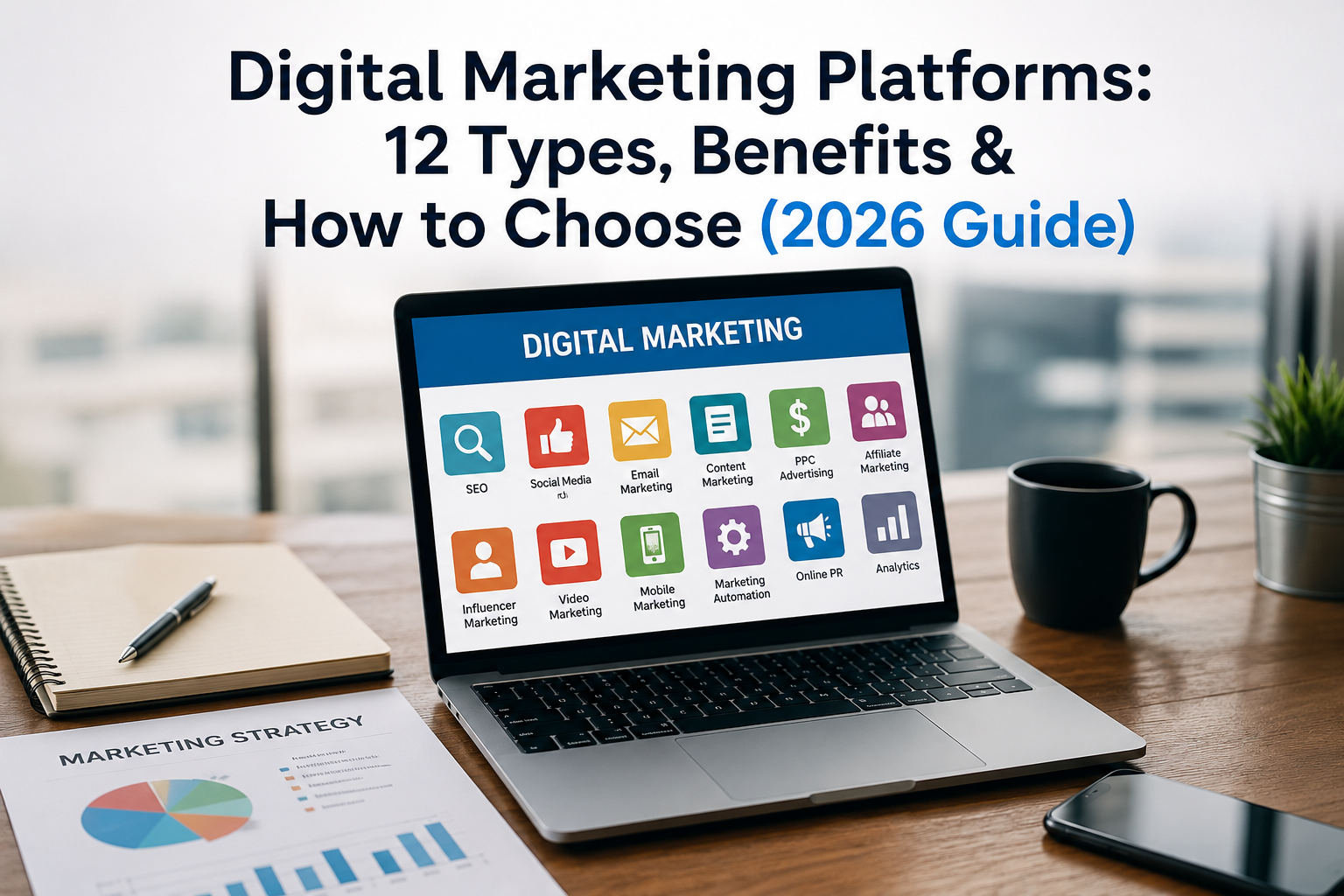
Running a business online without a digital marketing platform is like driving with no dashboard — you move, but you have no idea where you’re going or how fast.
Digital marketing platforms are software tools that help businesses plan, run, track, and improve marketing campaigns across online channels. One platform can manage your SEO, email campaigns, paid ads, social media, and backlink strategy — all from one place.
This guide covers 12 platform types, real benefits, and a clear decision framework for agencies. You’ll also find sections competitors skip entirely — like how platforms support link building and which AI tools now dominate the 2026 landscape.
Why Digital Marketing Platforms Matter in 2026
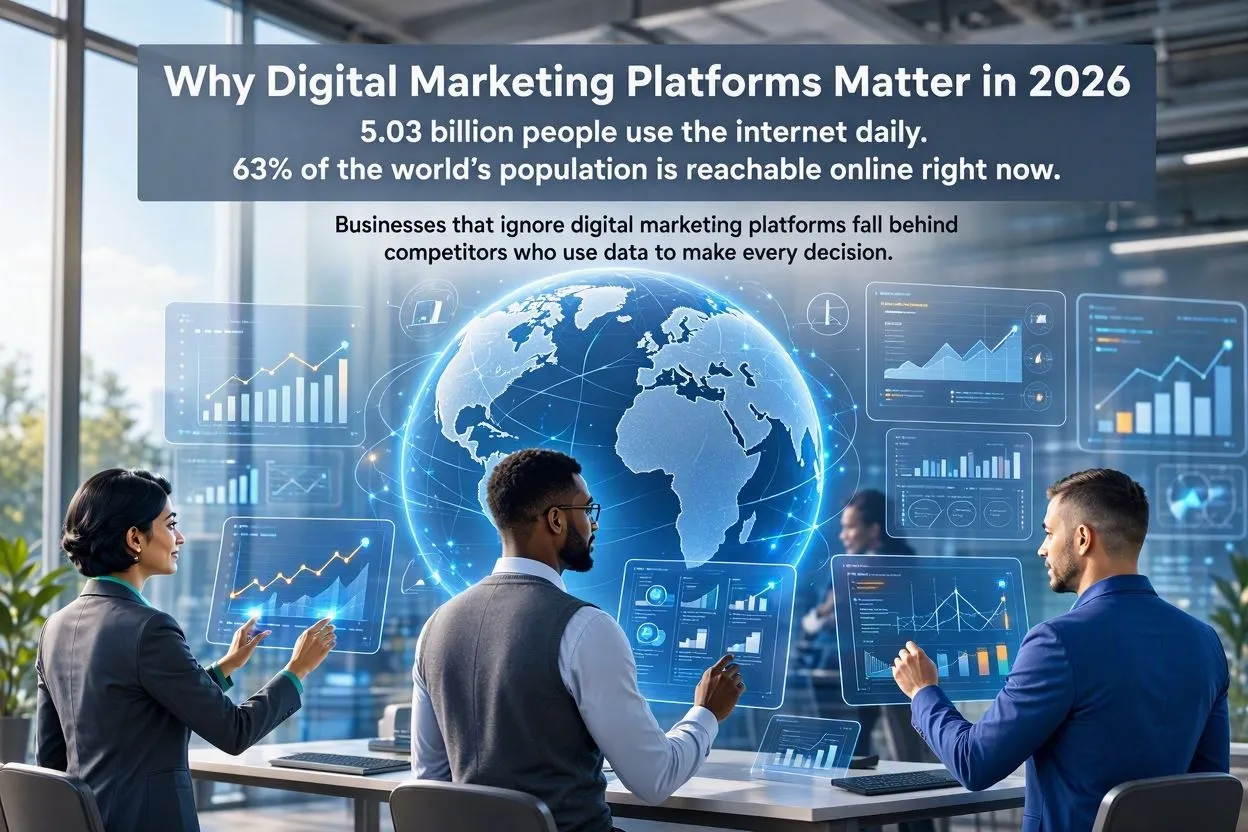
5.03 billion people use the internet daily. 63% of the world’s population is reachable online right now. Businesses that ignore digital marketing platforms fall behind competitors who use data to make every decision.
The shift is clear. Since 2015, marketing budgets have moved steadily away from print and TV toward digital channels. That trend accelerated after 2020 and shows no signs of slowing.
Three things make platforms essential today:
Real-time data: You see what works the moment it happens — not weeks later in a report.
Multi-channel execution: One tool manages email, social, SEO, and paid ads simultaneously.
Attribution accuracy: You know exactly which channel produced each sale or lead.
Agencies that master digital marketing platforms win clients consistently. Those who rely on guesswork lose them just as fast.
12 Types of Digital Marketing Platforms
1. Social Media Marketing Platforms
Facebook, Instagram, LinkedIn, TikTok, and Pinterest are where 4.9 billion users spend time daily. Each platform serves a different audience and content format.
Instagram works best for product visuals and short-form video. LinkedIn dominates B2B lead generation. TikTok reaches audiences under 35 faster than any other channel. Pinterest drives consistent traffic to blogs and e-commerce stores through evergreen pins.
The key is picking 2-3 platforms where your audience actually lives — not spreading thin across all of them.
2. Search Engine Optimization (SEO) Tools
SEO tools identify keywords your audience searches, track your rankings, and show where competitors outrank you. Tools like Ahrefs, SEMrush, and Google Search Console give you the data to close ranking gaps systematically.
53% of consumers research purchases through search engines before buying. That number alone justifies investing in serious SEO tooling.
3. Email Marketing Platforms
Email produces an average return of $36 for every $1 spent — the highest ROI of any digital channel. Platforms like Mailchimp, ActiveCampaign, and Klaviyo let you segment audiences and send personalized sequences automatically.
Segmented email campaigns generate 30% more opens and 50% more click-throughs than non-segmented sends.
4. Content Management Systems (CMS)
A CMS lets you publish, edit, and optimize website content without writing a single line of code. WordPress powers 43% of all websites online. Webflow and Contentful suit teams that need more design control or headless architecture.
Your CMS is the foundation of your content marketing strategy. Choose one that supports fast page loads, clean URL structures, and flexible SEO settings.
5. Pay-Per-Click (PPC) Advertising Platforms
Google Ads and Microsoft Advertising place your content at the top of search results instantly. You pay only when someone clicks. Done right, PPC returns $2 for every $1 spent — a 200% ROI.
PPC works fastest for new sites that haven’t yet built organic authority. Combine it with SEO and you cover both short-term traffic and long-term rankings.
6. Marketing Automation Platforms
HubSpot, Marketo, and ActiveCampaign automate repetitive marketing tasks — follow-up emails, lead scoring, social posts, and customer nurture sequences. Automation increases sales productivity by 14.5% and cuts marketing overhead by 12.2%.
For agencies managing multiple clients, automation is not optional. It’s the only way to scale without hiring more people for every new account.
7. Customer Relationship Management (CRM) Tools
Salesforce, HubSpot CRM, and Zoho track every interaction with every prospect and client. CRM data shows which leads convert, why others drop off, and where the sales process breaks.
Agencies use CRMs to track client onboarding, report campaign results, and identify upsell opportunities before clients even ask.
8. Influencer Marketing Platforms
72% of marketers use Instagram for influencer collaborations. Platforms like BuzzSumo, Modash, and Upfluence connect brands with creators who already have the attention of your target audience.
Micro-influencers (10,000–100,000 followers) deliver stronger engagement rates than celebrity accounts at a fraction of the cost. One in two women makes purchase decisions based on influencer recommendations.
9. Video Marketing Platforms
YouTube remains the second-largest search engine in the world. Short-form video on TikTok and Instagram Reels now drives more new brand discovery than traditional search for audiences under 35.
Businesses that publish tutorial videos, product walkthroughs, and client testimonials on YouTube build durable organic traffic that compounds over time.
10. Affiliate Marketing Networks
ShareASale, CJ Affiliate, and Impact connect businesses with publishers who promote products for a commission. 83% of marketers run affiliate programs to expand brand reach without paying for impressions.
For link building agencies, affiliate partnerships also generate natural backlinks from relevant content publishers — a clean white-hat signal Google rewards.
11. Analytics & Attribution Platforms
Google Analytics 4, Hotjar, and Mixpanel show exactly how users behave on your site. You see where they land, where they drop off, and what triggers conversions.
Companies driven by analytics data are 23 times more likely to acquire customers than competitors who rely on gut feel. Attribution modeling within these platforms shows which channels produce real revenue — not just vanity clicks.
12. Marketing Intelligence & Competitive Research Platforms
SpyFu, SimilarWeb, and SEMrush’s competitive module show exactly what your competitors rank for, how much traffic they get, and which content drives it. This data informs your content calendar, keyword targeting, and link building priorities.
This category is the one most agencies underuse. Knowing your competitor’s top-performing pages lets you build something more comprehensive and better-linked — then outrank them.
How Digital Marketing Platforms Support Link Building & Guest Posting
This is the section competitors miss completely — and it’s critical for agencies in the link building and guest post space.
Digital marketing platforms don’t just run ads and send emails. Used correctly, they directly support your backlink strategy.
SEO tools identify link opportunities. Ahrefs and SEMrush show which domains link to competitors but not to you. These “link gap” reports reveal 50-200 qualified outreach targets per campaign that you’d never find manually.
CRM tools track outreach at scale. A guest post campaign with 300 outreach emails needs a system. CRMs track which editors responded, which posts are live, and which domains need a follow-up — all in one dashboard.
Content tools support link-worthy assets. Canva, Figma, and data visualization tools help you create original infographics and research pieces. These assets earn editorial links naturally because they give other writers something worth citing.
Analytics platforms measure link impact. Google Search Console shows exactly when a new backlink starts moving a keyword ranking. You can tie specific guest posts to measurable traffic increases — data clients pay for.
For a guest post and backlink agency, these 4 platform categories are non-negotiable infrastructure. Teams that ignore them work 3x harder for the same results.
Benefits of Digital Marketing Platforms
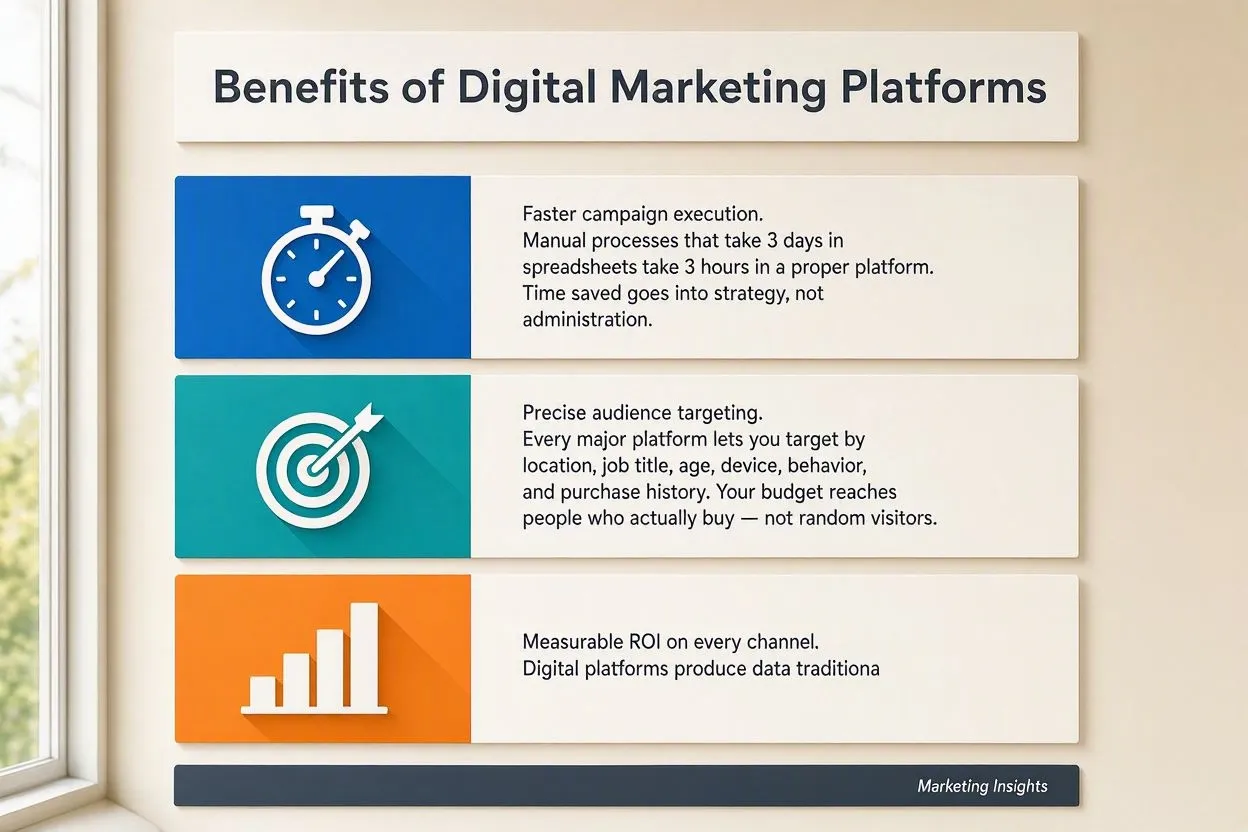
Faster campaign execution. Manual processes that take 3 days in spreadsheets take 3 hours in a proper platform. Time saved goes into strategy, not administration.
Precise audience targeting. Every major platform lets you target by location, job title, age, device, behavior, and purchase history. Your budget reaches people who actually buy — not random visitors.
Measurable ROI on every channel. Digital platforms produce data traditional marketing never could. You know which blog post, which ad, and which email drove each conversion.
Stronger customer retention. Automated email sequences, social engagement tools, and CRM alerts keep relationships alive between purchases. 60% of customers who feel connected to a brand continue buying from it.
Scalable agency operations. A team of 5 can manage 20 clients with the right platform stack. Without automation, that same team handles 5 clients at maximum — and burns out doing it.
How to Choose the Right Platform for Your Agency
Define your 3 core use cases first. An agency focused on link building needs different tools than one running paid media campaigns. Know what you do before you shop for software.
Check integration depth, not just integration count. A platform that claims “200 integrations” but breaks when you connect your CRM is worthless. Test the 3 integrations you’ll actually use before signing a contract.
Calculate the real cost per client. Divide total platform costs by your client count. If tools cost $800/month and you have 10 clients, that’s $80 per client per month. Budget for this before pricing your services.
Prioritize platforms with white-label reporting. Clients want reports with your logo, not HubSpot’s. White-label reporting capability separates agency-grade tools from consumer software.
Start with one platform, not five. Most agencies over-tool in year one. Master one platform deeply before adding another. A team that uses Ahrefs at 80% of its capability outperforms one that uses 6 tools at 20% each.
AI-Powered Marketing Platforms in 2026
No competitor covers this — but every agency needs to understand it.
AI has entered every major marketing platform category. These are the 5 most impactful integrations active right now:
SurferSEO + AI content scoring. Analyzes top-ranking pages and gives real-time NLP recommendations as you write. Content optimized with Surfer ranks 40% faster on average.
Jasper AI. Produces first drafts for blog posts, ad copy, and email sequences in minutes. Agencies use Jasper to produce 3x more content without hiring more writers.
ChatGPT + SEO workflows. Used for keyword clustering, FAQ generation, schema markup creation, and competitor content gap analysis. Saves 6-10 hours per week per content strategist.
Ahrefs AI features. The platform now suggests internal linking opportunities, flags content cannibalization, and scores page-level authority automatically.
Zapier AI. Connects all your marketing tools and builds automated workflows without code. An agency can auto-create client reports, trigger outreach sequences, and update CRM records — all without human input.
AI tools don’t replace your strategy. They execute the repetitive parts faster so your team focuses on decisions that require judgment.
Free vs Paid Digital Marketing Platforms
Agencies starting out ask this every time. Here’s the honest answer: free tools build your foundation, paid tools scale your results.
Free platforms worth using:
- Google Search Console — tracks rankings, indexation, and click-through rates (CTR) at zero cost
- Google Analytics 4 — full behavioral analytics for any website
- Mailchimp (free tier) — up to 500 subscribers and 1,000 monthly sends
- Canva (free tier) — social graphics, pitch decks, and infographic design
- Ubersuggest (limited free) — keyword research and basic competitor data
Paid platforms that justify the cost:
- Ahrefs ($99–$399/month) — the most complete backlink and keyword research tool available
- SEMrush ($129–$449/month) — strongest competitor intelligence and site audit capabilities
- HubSpot ($45–$800/month) — CRM, email automation, and landing pages in one system
- SurferSEO ($59–$239/month) — NLP-based content optimization that directly impacts rankings
Start free. Move to paid tools as soon as a single client account covers the monthly cost. Most agencies hit that threshold within 60 days of their first retainer.
5 Mistakes Agencies Make With Digital Marketing Platforms
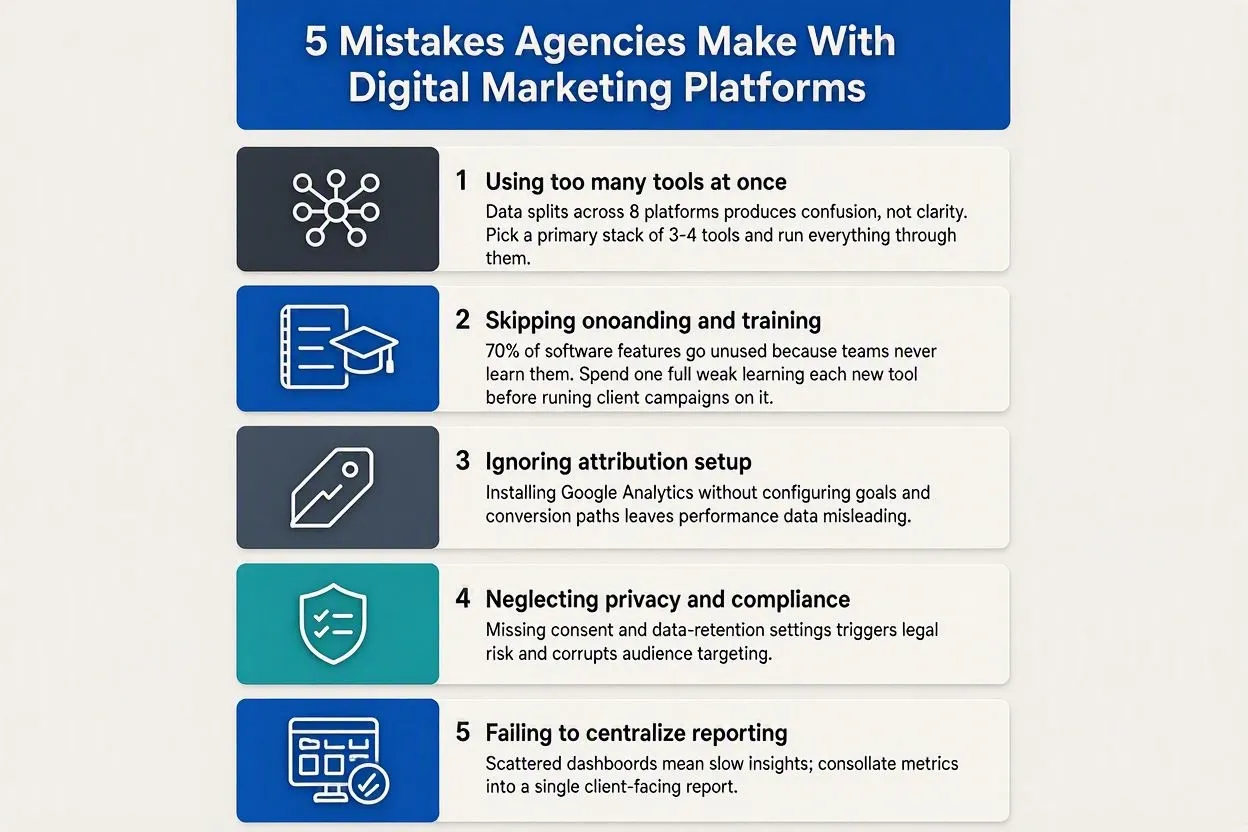
Using too many tools at once. Data splits across 8 platforms produces confusion, not clarity. Pick a primary stack of 3-4 tools and run everything through them.
Skipping onboarding and training. 70% of software features go unused because teams never learn them. Spend one full week learning each new tool before running client campaigns on it.
Ignoring attribution setup. Installing Google Analytics without configuring goals and conversion tracking gives you traffic data with no business meaning. Attribution setup takes 2 hours and changes every decision you make.
Choosing platforms for their dashboards, not their data. Beautiful UI means nothing if the underlying data is unreliable. Check data accuracy against raw sources before signing any annual contract.
Not auditing the stack quarterly. Tools you paid for 18 months ago may have weaker alternatives at half the price today. Audit every platform in your stack every quarter — cut what you don’t use, upgrade what you’ve outgrown.
Conclusion
Digital marketing platforms are not a luxury for agencies — they are the operating system that makes everything else work.
The agencies winning in 2026 run lean tool stacks, use AI to execute faster, and measure every campaign against hard business results. They don’t guess which channel works. They know.
Start with SEO and analytics tools. Add automation and CRM as your client base grows. Use link building platforms to build domain authority that compounds over time.
The right platform stack doesn’t just save hours — it produces results that justify higher retainers and longer client contracts.