
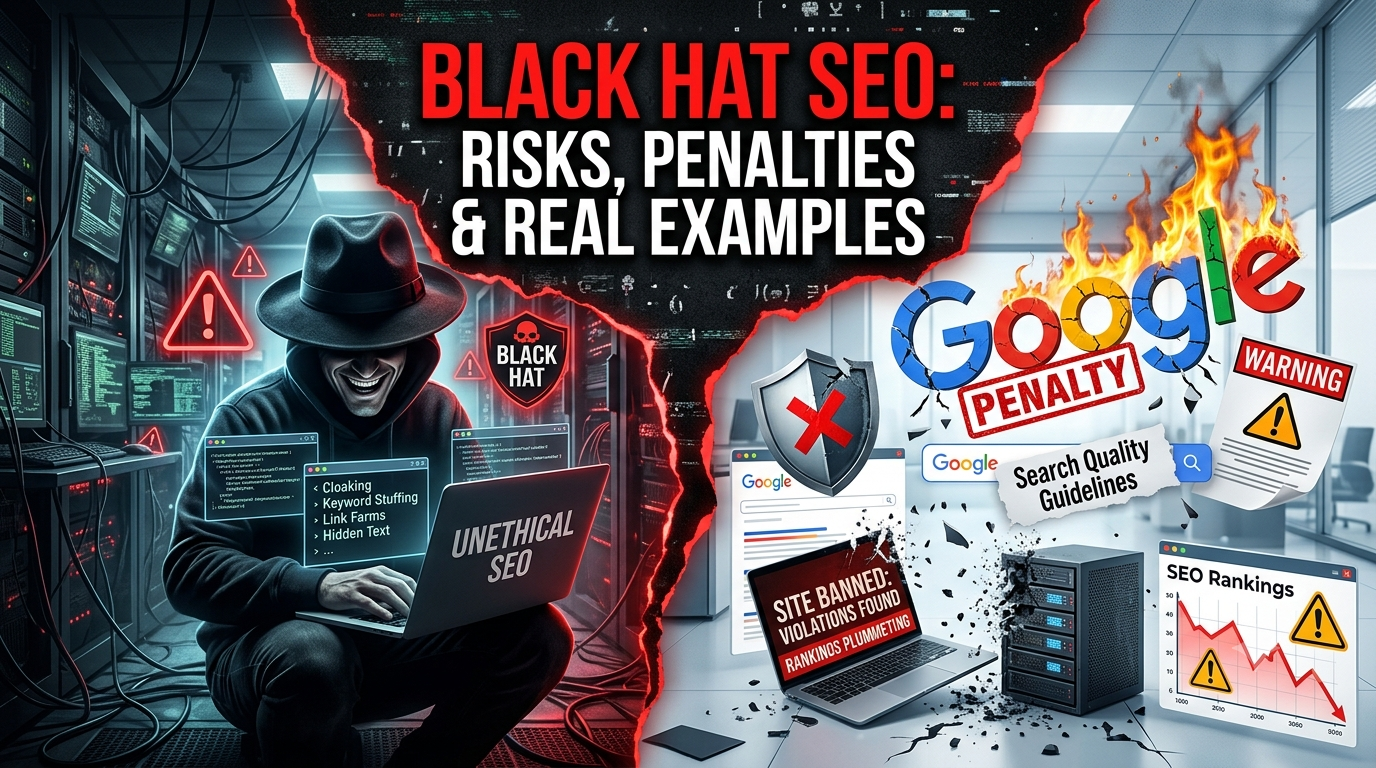
Black hat SEO refers to tactics that violate search engine guidelines to manipulate rankings. Google removes or demotes sites using these tactics, and 65% to 85% of organic visibility disappears once a site gets caught. This guide names every major tactic, shows the exact penalty each one triggers, and gives you a clear path to recovery if your site already got hit.
You will not find operational instructions here. You will find what each tactic looks like, how Google’s systems catch it, and what to do instead.
What Is Black Hat SEO?
Black hat SEO is any technique that manipulates search rankings instead of earning them through genuine content value. Google’s Search Quality team built specific systems — SpamBrain and the Helpful Content System — to detect these patterns and remove the pages from search results.
The term comes from old Western films, where villains wore black hats and heroes wore white ones. SEO borrowed the metaphor directly: black hat SEO tricks the algorithm, white hat SEO earns rankings through real value.
Black Hat vs White Hat vs Grey Hat SEO
3 categories define every SEO approach, and the difference between them determines whether your site survives an algorithm update.
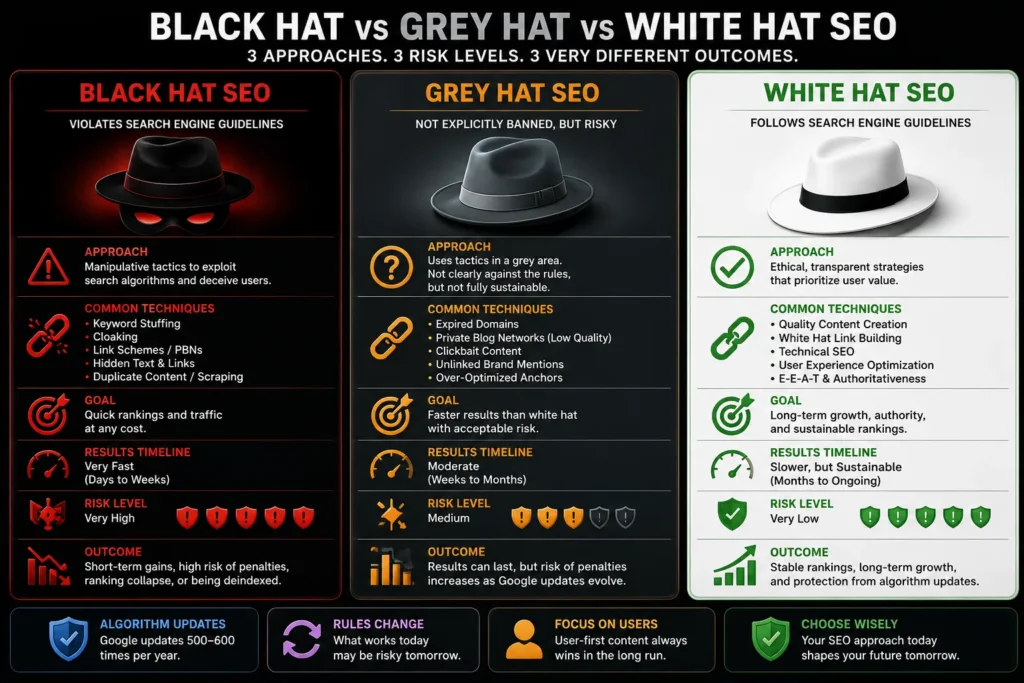
White hat SEO follows search engine guidelines and prioritizes user value. Techniques include quality content creation, legitimate white hat link building, and technical optimization. Results take longer to appear but do not disappear after an update.
Black hat SEO violates search engine guidelines directly. Techniques include keyword stuffing, cloaking, and link schemes. Results can appear within weeks, but Google’s spam systems detect and reverse them — often with a full ranking collapse.
Grey hat SEO sits in an undefined middle zone. Techniques are not explicitly banned but carry real risk because Google’s guidelines change roughly 500 to 600 times per year. A tactic tolerated in January 2026 can trigger a penalty by June 2026.
How to Identify Black Hat SEO Tactics
To identify black hat SEO tactics, check whether a technique manipulates a ranking signal directly rather than improving the page for users. 3 tactic families account for almost every penalty Google issues.
Content Manipulation Tactics
Content manipulation tactics create pages that exist to occupy search results rather than answer a real query. Common examples include keyword stuffing (unnatural keyword repetition that breaks readability), content spinning (automated synonym swapping across duplicated pages), hidden text (white text on a white background, tiny font sizes, or text positioned behind images), and scraped content (republished articles with no original value added).
Google’s Helpful Content System specifically targets pages built primarily for search engines instead of people. A site publishing 200 near-identical pages in a single week shows the exact pattern this system flags.
Link Manipulation Tactics
Link manipulation tactics build artificial backlink signals instead of earning links naturally. The 4 most common methods are buying or selling links for ranking purposes, private blog networks (PBNs) — clusters of low-quality sites built solely to link to a target site, automated link generation at abnormal velocity, and over-optimized anchor text that repeats the same exact-match phrase across hundreds of links.
SpamBrain, Google’s dedicated link-spam detection system, analyzes link velocity, anchor text distribution, and linking domain quality together. A backlink profile that grows 10 times faster than a site’s content output gets flagged automatically in most cases.
Page Manipulation Tactics
Page manipulation tactics show search engines one version of a page while showing users a different one. Cloaking delivers different content to Googlebot than to a human visitor. Doorway pages rank for a specific query, then redirect the visitor to an unrelated destination page. Deceptive redirects send users somewhere other than the page search engines indexed.
Google’s crawlers render pages the same way a browser does, comparing rendered output against what gets served to real users. A mismatch between those 2 versions is treated as deliberate deception, not a technical error.
A separate category worth naming directly: negative SEO. This involves a third party attacking someone else’s site — sending toxic backlinks to a competitor, scraping and republishing their content, or attempting to trigger a manual action against them. Google’s systems are built to recognize when a sudden spike in low-quality links does not match a site’s normal growth pattern, which limits how effective negative SEO attacks actually are. Sites targeted this way should document the anomaly with dated Search Console exports and use the disavow tool rather than assuming the attack will automatically get ignored.
Why Black Hat SEO Still Tempts Marketers in 2026
Black hat SEO tempts marketers because the top 3 search results capture roughly 75% of all clicks, and page 2 captures less than 1%. That concentration creates enormous pressure to rank fast, and black hat tactics promise speed that white hat methods cannot match in the short term.
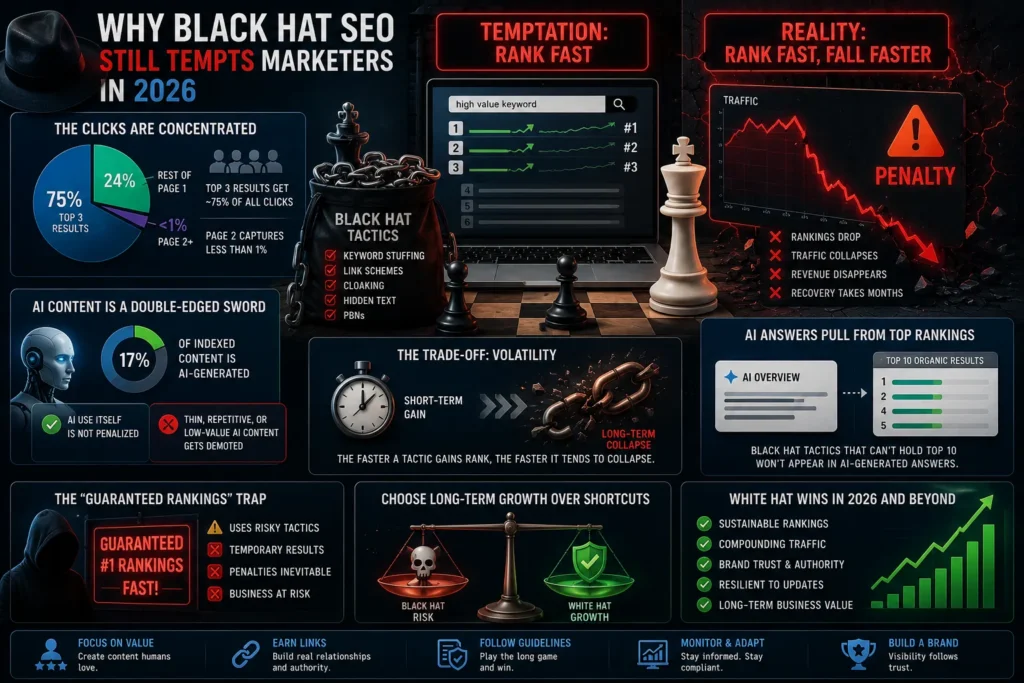
The trade-off is volatility. A page boosted through keyword stuffing or link schemes can hold its position for a few weeks before an algorithm update or manual review reverses it completely. The faster a tactic gains rank, the faster it tends to collapse.
AI-generated content adds a new layer to this pressure in 2026. Roughly 17% of indexed content is now AI-generated, and Google has confirmed that AI use itself is not penalized — only AI content that is thin, repetitive, or built without genuine editorial value gets demoted.
Search visibility also extends beyond traditional results now. AI Overviews and generative answer engines pull heavily from pages already ranking in the top 10 organically, which means a black hat tactic that fails to hold a traditional ranking also fails to appear in AI-generated answers. Manipulating one signal no longer guarantees visibility across every surface where users now find information.
A second pressure point comes from agencies and freelancers selling “guaranteed rankings” packages built on exactly these tactics. Business owners without deep SEO knowledge often cannot distinguish a legitimate white hat link building campaign from a PBN-based scheme until the penalty arrives months later.
What Penalties Does Google Issue for Black Hat SEO?
Google issues 2 distinct types of penalties for black hat SEO: algorithmic demotions and manual actions. Both reduce visibility, but they work through different mechanisms and require different fixes.
Algorithmic Demotions
An algorithmic demotion happens automatically when Google’s ranking systems detect manipulation and lower a page’s visibility without human review. Panda targets thin or duplicate content. Penguin targets manipulative link profiles. SpamBrain operates continuously across both content and links.
Algorithmic demotions arrive with no notification in Search Console. The first sign is usually a sharp drop in impressions and clicks across a broad set of queries, often coinciding with a confirmed core update.
Manual Actions
A manual action happens when a member of Google’s Search Quality team reviews a site directly and applies a penalty by hand. Manual actions appear in the Manual Actions report inside Google Search Console, naming the specific violation — for example, “Unnatural links to your site” or “Thin content with little or no added value.”
Manual actions can affect a single page, a section of a site, or the entire domain. A full-site manual action removes every page from search results until the issue is fixed and Google approves a reconsideration request.
How to Spot a Penalty Before It Destroys Your Traffic
To spot a penalty before it destroys your traffic, monitor 4 specific signals inside Google Search Console and your analytics platform on a weekly basis.
Sudden traffic drops across a wide set of queries — not just one or two keywords — usually indicate an algorithmic demotion rather than normal ranking fluctuation. Indexed page count changes — a sharp drop in indexed pages signals Google removed content it previously trusted. New, irrelevant queries appearing in Search Console performance reports can mean a site got hacked and is now ranking for spam terms it never targeted. A Manual Actions report entry confirms a human reviewer applied a penalty directly.
Recovery timelines vary by penalty type. Sites that lose visibility to a manual action typically recover within 6 to 12 months after a successful reconsideration request, assuming every violation gets fixed before resubmission.
How to Recover From a Black Hat SEO Penalty
To recover from a black hat SEO penalty, identify the exact violation first, then remove every instance of it before requesting reconsideration. Partial fixes extend the recovery timeline rather than shortening it.
Start by checking the Manual Actions report in Search Console for the specific violation type. Cross-reference any sudden ranking loss with the dates of confirmed Google core updates to separate manual actions from algorithmic demotions. Audit the site’s backlink profile for purchased links, PBN placements, or unnatural anchor text patterns, and disavow or remove every flagged link. Audit on-page content for keyword stuffing, hidden text, duplicate pages, or cloaking, and rewrite or remove every affected page.
Recovery requires consistent monitoring after the fix, not just at submission time. Track 4 metrics weekly during the recovery window: indexed page count, organic impressions across the full query set, referring domain count, and average position for previously ranking terms. A site that shows improvement in indexation but not in rankings often has a content quality issue separate from the original penalty.
Reconsideration Request Process
To submit a reconsideration request, document every fix made and explain the changes clearly inside Google Search Console. Google’s Search Quality team reviews these requests in 2 to 4 weeks on average, and a vague or incomplete request gets rejected without a detailed explanation of what was wrong.
A site working to rebuild trust after a penalty benefits from a clean link profile built through legitimate outreach. A digital PR services strategy that earns links through real journalist relationships replaces the artificial link signals that triggered the penalty in the first place.
How to Choose an SEO Provider That Won’t Risk Your Site
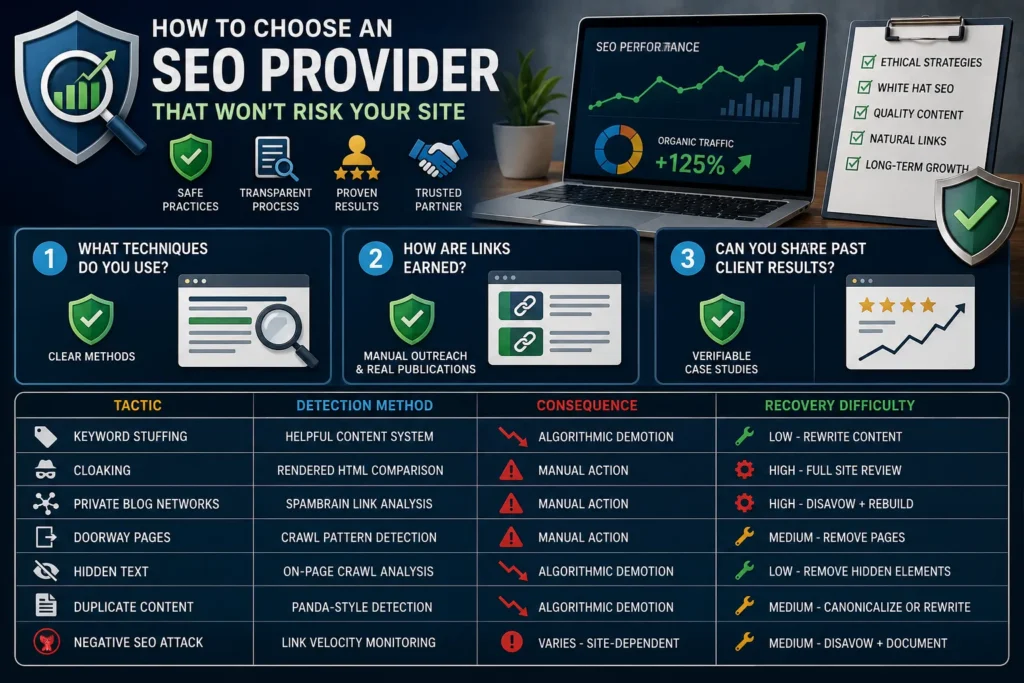
To choose an SEO provider that won’t risk your site, ask 3 direct questions before signing any contract. Ask exactly which techniques the provider uses on client sites, and reject vague answers like “proprietary methods” or “secret strategies.” Ask how link placements get earned, since manual outreach to real publications produces a fundamentally different risk profile than automated link networks. Ask for a list of past client sites and check their current rankings — a provider whose past clients lost rankings after working together is a clear warning sign.
Legitimate providers explain their process in detail and welcome scrutiny. A trustworthy SEO outreach agency documents every placement, names the publications involved, and never promises guaranteed rankings within an unrealistic timeframe.
Quick-Reference Table: Black Hat Tactics, Detection & Consequence
| Tactic | Detection Method | Consequence | Recovery Difficulty |
| Keyword stuffing | Helpful Content System | Algorithmic demotion | Low – rewrite content |
| Cloaking | Rendered HTML comparison | Manual action | High – full site review |
| Private blog networks | SpamBrain link analysis | Manual action | High – disavow + rebuild |
| Doorway pages | Crawl pattern detection | Manual action | Medium – remove pages |
| Hidden text | On-page crawl analysis | Algorithmic demotion | Low – remove hidden elements |
| Duplicate content | Panda-style detection | Algorithmic demotion | Medium – canonicalize or rewrite |
| Negative SEO attack | Link velocity monitoring | Varies – site-dependent | Medium – disavow + document |
Building Rankings That Survive Every Update
Black hat SEO trades short-term rank for long-term risk, and the gap between those 2 outcomes only grows as Google’s detection systems improve. A site built on real content value and earned links does not need to survive an algorithm update — it was never vulnerable to one in the first place.
Digital Era Innovators builds backlink profiles through manual outreach and editorial placements that hold up against every Google update. Book a free strategy call to review your current link profile and build a growth plan that never risks a penalty.