
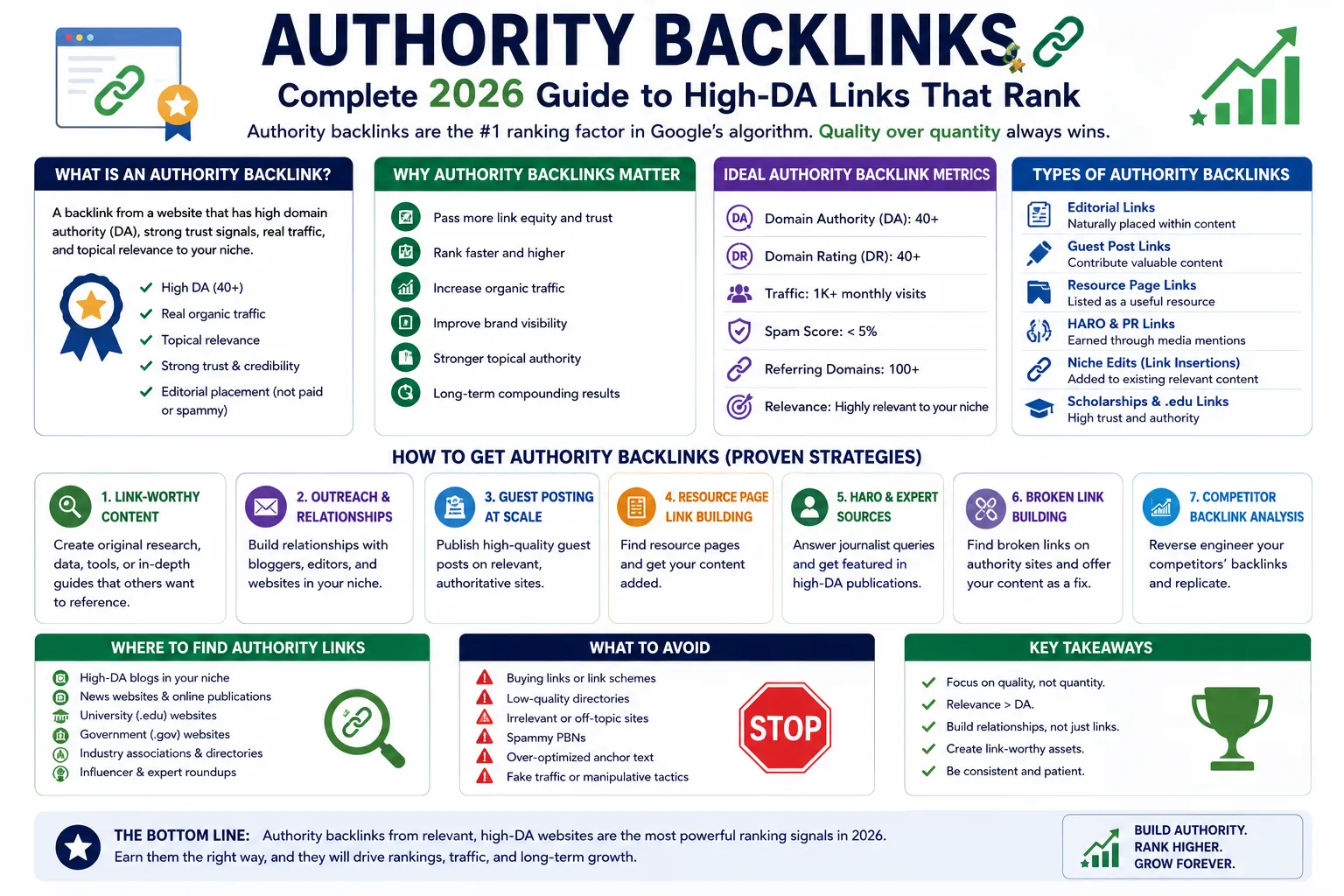
Every website owner wants rankings. Few understand what actually moves the needle. You could spend months publishing content, tweaking meta tags, and optimizing page speed — yet stay buried on page three while a competitor with half the posts dominates every keyword you care about. The difference, almost always, comes down to one thing: who is vouching for you.
Think of authority backlinks as professional references in the digital world. When a hiring manager sees that Harvard, Goldman Sachs, and the New York Times all speak highly of a candidate, the decision practically makes itself. When Google sees that Forbes, HubSpot, and Moz all link to your content, the algorithm reaches a similar conclusion — this source is worth trusting. That trust becomes rankings.
What makes 2026 different is that the stakes have never been higher. AI-powered search tools like ChatGPT, Perplexity, and Claude now pull citations from trusted domains when constructing answers. If your site carries the endorsement of authoritative sources, you show up in those AI summaries too. An authority backlink is no longer just an SEO signal — it is your ticket to the next generation of search visibility entirely.
This guide gives you the complete roadmap. No vague advice, no recycled lists. You will find five battle-tested strategies to earn high-DA links, over fifty verified sources with real data, copy-ready outreach templates, a clear penalty avoidance framework, and a 30-day action plan to put it all in motion.
What Are Authority Backlinks?
Authority backlinks are links from established websites that Google trusts — think Forbes, not forums. Think industry leaders, not blogger networks.
A link from a domain with 50+ Domain Authority that sends relevant traffic to your site. Google treats these links as editorial votes. When Forbes links to your content, Google thinks: “This is trustworthy. This creator knows their stuff.” That trust transfers directly to your rankings.
Why Domain Authority Matters
Domain Authority (DA) is a metric by Moz. Ahrefs uses Domain Rating (DR). Both measure the same thing: how much ranking power a domain carries.
- DA 90+ — Extremely trusted (years of earned authority)
- DA 60–80 — Strong authority (news sites, established blogs)
- DA 40–60 — Medium authority (newer but credible)
- DA Below 40 — Weak authority (newer or less reputable)
What DA is NOT: a page rank guarantee, a promise of rankings on its own, or the only ranking factor Google considers. What DA IS: a reliable signal of whether Google trusts the linking domain.
Real Example
A financial website has 5 links from DA 80+ sites. Same website has 50 links from DA 10–20 sites. Which ranks higher? The first one. Every time. Google sees those 5 links as editorial votes from trusted sources. The 50 links look spammy.
Why Authority Backlinks Trump Link Volume
1. Google’s E-E-A-T Framework Prioritizes Authority
E-E-A-T stands for Experience, Expertise, Authoritativeness, and Trustworthiness. When a reputable site links to you, Google interprets it as a credibility endorsement. A link from an established tech blog saying “this tutorial is the best” carries more weight than 100 links from unnamed tech sites.
2. Natural Link Patterns Look Different
Real editorial links come naturally over time. They are contextual and diverse. Unnatural patterns Google catches and penalizes:
- 100 links from forum signatures — penalty risk
- 100 links from guest posts with exact-match anchor — suspicious pattern
- 10 links from news outlets — strong trust signal
- All links from the same IP cluster — looks engineered
3. Link Juice Is Real — And Limited
A page has a finite amount of ranking power to pass. When Forbes links to you, you receive direct traffic, link juice (ranking power), trust transfer, and a semantic brand connection. When a dead blog links to you, you get almost nothing.
Benchmark Data (Verified 2026)
Top 10 ranking sites in competitive niches (finance, tech, SaaS) average 35–50 referring domains from DA 50+. If your site has 5 such links, you are underfunded for competitive keywords. At 50+ links, you are genuinely competitive.
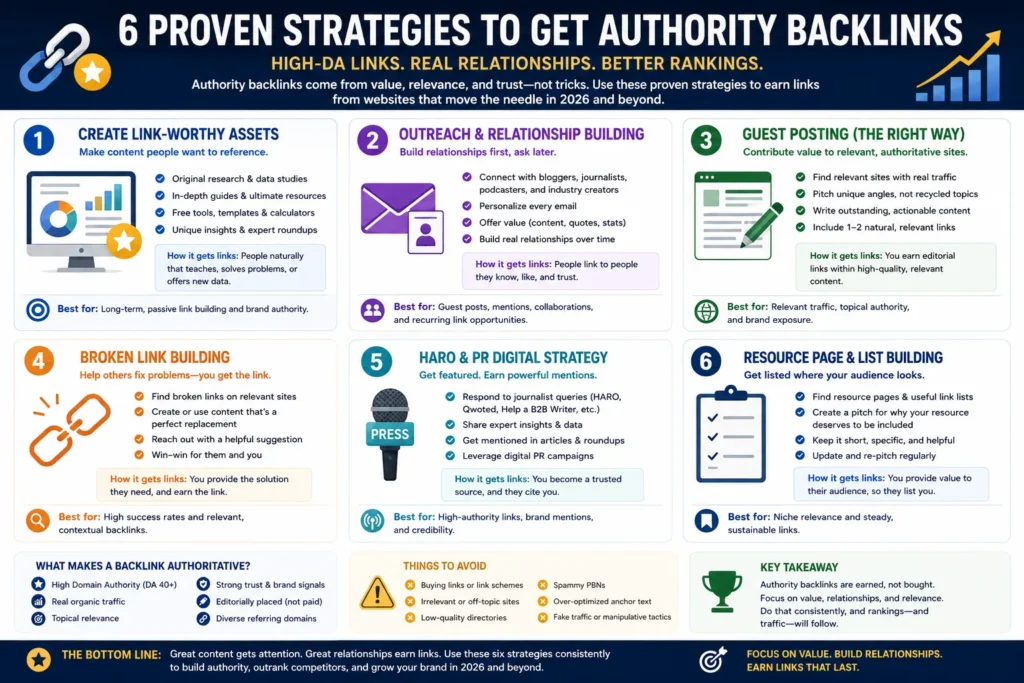
6 Proven Strategies to Get Authority Backlinks
Strategy 1: Guest Posting on High-DA Blogs
Guest posting is the most reliable authority backlink strategy. You control the narrative, the editor pre-vets the content, the link is contextual and relevant, and it sits on published, indexed content that is safe from algorithm updates.
How to Find Guest Post Opportunities
Use Google operators to surface accepting sites:
- intitle:”guest post” OR intitle:”contribute” site:medium.com your niche
- intitle:”guest author” site:blog.domain.com your industry
- “write for us” “guest post” your topic 2025 2026
Or use tools: Ahrefs (Guest Post filter) or Semrush (Content Gaps).
What Editors Actually Want
- 1500–2500 word original article relevant to their specific audience
- Original research or a unique angle not covered elsewhere
- Professional tone — no filler, no excessive enthusiasm
- Author bio: 1–2 sentences max with a link to your best page
Timeline: 2–4 weeks from pitch to published link.
| Guest Post Outreach Template |
| Subject: Guest Post Idea: [Specific Benefit] That Increased [Metric] by X% Hi [Name], I read your article on [specific recent article they published]. What caught me: [One specific insight + why it matters to their readers]. I’d like to contribute: “[Your Article Title]” This covers: – [Specific angle 1 — something new] – [Specific angle 2 — data-backed] – [Specific angle 3 — actionable] I’ve written for [2-3 credible sites]. Happy to share links. Can I send the full article? [Your name] | [Your site URL] |
Success rate: 20–30% when followed precisely. Most pitches fail because they are generic.
Strategy 2: Niche Edits (The Fastest Authority Links)
Niche edits mean finding existing published content and getting added as a link within that article. No writing required. Faster approval. Often works on DA 80+ sites that no longer accept new guest posts.
Real scenario: You sell SEO tools. You find an article titled “Best SEO Tools 2025 — 15 Top Picks.” You pitch a natural addition. They add 1–2 sentences with your link. Done in 2–3 weeks.
How to Find Niche Edit Opportunities
- Find competitor high-ranking articles in your niche
- Look for “best [X],” “top platforms,” “popular software” roundup content
- Check if your product or service fits naturally in context
- Note the site DA, publishing date, and traffic estimate
- Find the editor email via footer, LinkedIn, or contact page
| Niche Edit Template |
| Subject: Quick Addition to [Article Title] Hi [Name], Your article “[Article Title]” ranks well for “[keyword]”. Great content. I noticed you covered [Tool A] but did not mention [Tool B]. [Tool B] is now standard in [industry], especially for [specific use case]. Would a quick 1-2 sentence addition help readers? I can write the section. Takes literally 2 minutes to add. Let me know, [Your name] |
Approval rate: 40–50%. Timeline: 5–10 days average. Site owners see you as helpful, not promotional.
Strategy 3: Broken Link Building
Dead links are everywhere on high-authority sites. Find them, offer a replacement, and earn a contextual link on a trusted domain while genuinely helping the site owner.
The Process
- Find a high-DA site in your niche
- Identify broken links on their pages using Check My Links (free Chrome extension) or Ahrefs
- Find or create similar replacement content on your site
- Pitch the owner with your replacement
| Broken Link Template |
| Hi [Name], Reading your guide “[Article Title]” — helpful resource. Found a broken link in “[section name]”. Original article: [dead URL] I have a more comprehensive guide on that topic. Can I replace it? [Your link + preview] Let me know, [Your name] |
Success rate: 30–40%. Timeline: 3–4 weeks. Owners need to manually update, but the pitch is welcomed.
Strategy 4: Resource Page Placements
Resource pages — “Best tools for X,” “Top resources for Y,” “Recommended reading” — are goldmines most link builders overlook entirely. The owner is actively looking for suggestions and links are carefully curated, usually on DA 60+ domains.
How to Find Resource Pages
- “best tools for” + your niche
- “helpful resources” + your industry
- “recommended [your service type]”
- intitle:”resources” site:.edu your topic — educational authority links
| Resource Page Template |
| Hi [Name], Your resource page on [topic] helps [audience type] find [solution]. I help [specific use case] and think [Your Tool/Content] fits well with your recommendations. [One specific reason it is relevant to their readers]. Can you consider adding it? [Link + one-line description] Thanks, [Your name] |
Success rate: 25–35%. Timeline: 2–3 weeks.
Strategy 5: Unlinked Brand Mentions (Easiest Wins)
Your brand is mentioned online. Most mentions have no link. Converting existing mentions to backlinks requires zero content creation and earns the highest approval rates of any strategy.
How to Find Unlinked Mentions
- Google Alerts — set for “your company name”
- Mention.com — free plan available
- Manual: Google “your company name” -site:yoursite.com and check for missing links
| Unlinked Mention Template |
| Hi [Name], Saw you mentioned [Your Brand] in your article. Thanks for that. Just so you know, [Your Brand] has evolved — we now do [new thing]. Would a link help your readers? They could learn more about [what you do]. [Link to relevant page] Appreciate it, [Your name] |
Approval rate: 70%+ when they have actually mentioned you. Timeline: 1–2 weeks. Easiest low-hanging fruit in link building.
Strategy 6: HARO / Journalist Source Outreach (High-DA Media Links)
HARO — Help a Reporter Out — connects journalists at major publications with expert sources. When you provide a great quote or insight, they cite you with a backlink. This is one of the few strategies that can land links from DA 90+ outlets like Forbes, Business Insider, HuffPost, and Reuters without a pitch or guest post negotiation.
Since HARO rebranded and evolved, similar platforms now include Connectively (HARO’s new home), Qwoted, Terkel, and SourceBottle. All operate on the same principle: journalists post source requests, you respond with expert commentary, and they link back to your site if they use your quote.
How HARO Link Building Works
- Sign up as a source on Connectively (connectively.us), Qwoted, or SourceBottle — all free
- Set your niche categories (marketing, finance, tech, health, etc.)
- Receive daily or real-time email digests with journalist queries
- Identify queries that match your expertise — skip anything outside your lane
- Send a concise, expert response within 1–4 hours (speed matters enormously)
- Wait for publication — journalist emails when the piece goes live with your credit
What Makes a Winning HARO Response
- Answer within 2 hours — journalists work on deadline and pick the first 3–5 solid responses
- Lead with credentials in one sentence: “As a 10-year SEO consultant who has ranked 200+ SaaS sites…”
- Give a specific, quotable insight — journalists want data, personal experience, or a contrarian view
- Keep it under 200 words — concise gets used, essays get skipped
- Include your full name, title, company, and website URL at the end of every response
- Never pitch your product — offer expertise, not promotion
| HARO Response Template |
| Hi [Journalist Name], Re: [Query Title / Topic] I’m [Your Name], [Title] at [Company] — I’ve [relevant credential in one line]. [Your expert answer: 3-5 sentences, specific, data-backed if possible.] [Optional: one follow-up sentence with a unique angle or contrarian view.] Happy to provide more detail if useful. [Your Full Name] [Title] | [Company] [Website URL] [Phone — optional but increases response rate] |
Which Platforms to Use in 2026
- Connectively (connectively.us) — the renamed HARO, largest journalist network
- Qwoted (qwoted.com) — focused on finance, business, and PR sources
- SourceBottle (sourcebottle.com) — strong for lifestyle, health, and consumer topics
- Terkel (terkel.io) — tech and business focus, good for SaaS companies
- ProfNet (profnet.prnewswire.com) — premium tier, reaches AP, Reuters, and TV media
Success rate: 10–20% per response sent, but a single placement can land a DA 90+ link that outweighs 20 guest posts. Timeline: 1–6 weeks from response to publication. Best used in combination with guest posting for a consistent pipeline of both mid-tier and top-tier links.
Pro tip: Set up a Gmail filter to flag HARO digest emails and check them first thing each morning. Responses sent after 4 hours rarely get used. Speed is the single biggest variable in your conversion rate.
50+ Verified High-Authority Backlink Sites (2026 Data)
Category 1: High-Authority Guest Post Sites (DA 80+)
| Site | DA | Monthly Traffic | Link Type | Approval Time |
| Forbes.com | 96 | 450M | Dofollow | 4 weeks |
| HubSpot Blog | 92 | 85M | Dofollow | 3 weeks |
| Moz Blog | 92 | 25M | Dofollow | 3 weeks |
| Ahrefs Blog | 93 | 35M | Dofollow | 2 weeks |
| Entrepreneur.com | 89 | 42M | Dofollow | 3 weeks |
| Shopify Blog | 94 | 78M | Dofollow | 4 weeks |
| Kinsta Blog | 88 | 8M | Dofollow | 10 days |
| Search Engine Journal | 88 | 12M | Dofollow | 2 weeks |
| Sprout Social Blog | 87 | 6M | Dofollow | 2 weeks |
| Content Marketing Institute | 87 | 8M | Dofollow | 3 weeks |
| CrazyEgg Blog | 81 | 2.5M | Dofollow | 2 weeks |
| Hootsuite Blog | 86 | 9M | Dofollow | 2 weeks |
| Neil Patel | 85 | 15M | Dofollow | 3 weeks |
| ConvertKit Blog | 82 | 4M | Dofollow | 2 weeks |
| Mailchimp Blog | 85 | 6M | Dofollow | 3 weeks |
| Zapier Blog | 79 | 5M | Dofollow | 2 weeks |
| Help Scout Blog | 78 | 2M | Dofollow | 2 weeks |
Category 2: Web 2.0 & Publishing Platforms (DA 80+)
| Site | DA | Type | Best For |
| Medium.com | 94 | Publishing | Long-form content, thought leadership |
| Reddit.com | 96 | Community | SaaS, apps, niche communities |
| YouTube.com | 99 | Video | Product demos, tutorials |
| LinkedIn.com | 99 | Professional | B2B, personal branding |
| WordPress.com | 91 | Blogging | Long-form articles, SEO content |
| Tumblr.com | 96 | Microblogging | Brand content, storytelling |
| Quora.com | 92 | Q&A | Answer high-intent questions |
| Substack.com | 90 | Newsletter | Thought leadership |
Category 3: Business Directory & Listing Sites (DA 70+)
| Site | DA | Type | Best For |
| business.google.com | 99 | Google My Business | Local SEO, credibility |
| LinkedIn Company Pages | 99 | Professional | B2B authority, hiring |
| Crunchbase.com | 90 | Startup Profiles | SaaS, startups, funding |
| G2 Reviews | 91 | Review Platform | Software, SaaS reviews |
| Capterra.com | 75 | Review Platform | Software reviews, comparisons |
| Product Hunt | 91 | Product Launch | Tech product launches |
| AppAdvice.com | 77 | App Reviews | Mobile apps |
Category 4: Forum & Community Sites (DA 60+)
| Site | DA | Type | Best For |
| Stack Overflow | 89 | Developer Q&A | Technical products, dev tools |
| GitHub.com | 96 | Code Repository | Open source, developer products |
| HackerNews.com | 88 | Tech News | Tech startups, developer tools |
| ProductHunt.com | 91 | Product Forum | New products, tech launches |
Category 5: Document & Media Sharing (DA 80+)
| Site | DA | Type | Best For |
| Pinterest.com | 98 | Image Sharing | E-commerce, design, lifestyle |
| Scribd.com | 93 | Document Sharing | Whitepapers, case studies |
| SlideShare.net | 93 | Presentation Sharing | B2B content, presentations |
| Vimeo.com | 96 | Video Platform | High-quality video content |
Authority Backlinks Verification Checklist
Before you pitch or publish, run every target site through this checklist:
Site Authority
- Domain Age: 2+ years old (new domains carry zero authority)
- Google Indexing: Run site:[domain.com] — thousands of pages indexed?
- Domain Authority: 50+ verified in Moz or Ahrefs
- Traffic: 5,000+ monthly visitors (verify via SimilarWeb or Semrush)
Link Profile Quality
- No obvious spam: Check Ahrefs backlinks (avoid if 50%+ are from spammy sources)
- Content Quality: Professional writing, proper grammar, citations present
- Recent Updates: Last updated within 6 months
- No Malware: Google Safe Browsing check shows no warnings
Link Type & Relevance
- Dofollow confirmed: Right-click > Inspect > Find <a href> tag with no rel=”nofollow”
- Contextual: Link sits in article body, not footer or sidebar
- Topic Match: Site is relevant to your niche
- Natural Fit: Link looks earned, not placed
What NOT to Do — Penalties & Risks
Mistake 1: Buying Links
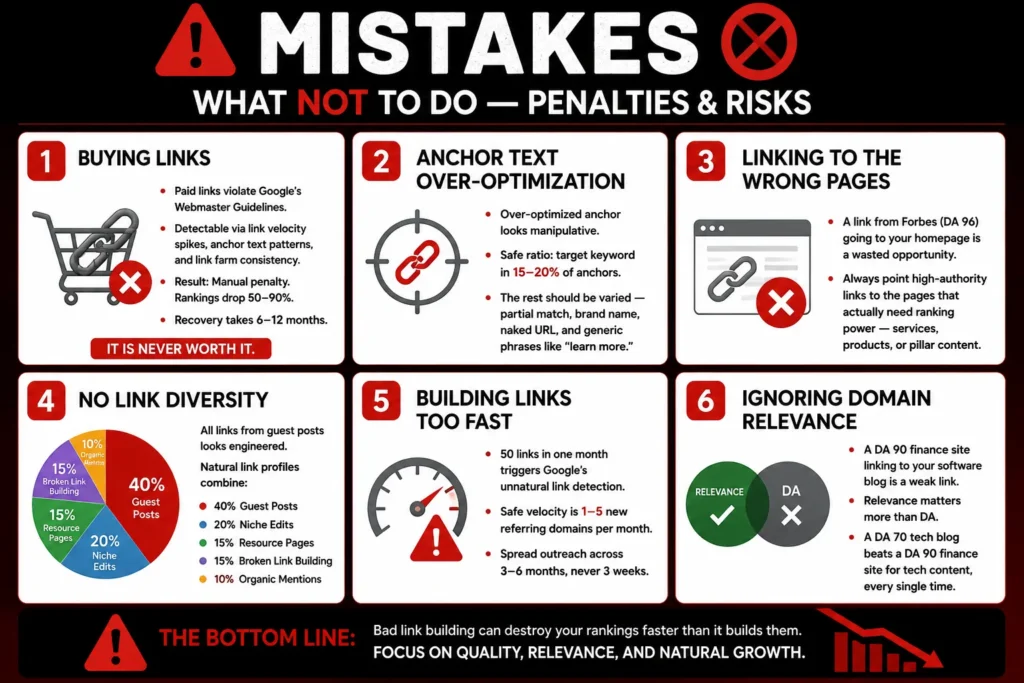
Paid links violate Google’s Webmaster Guidelines and are detectable via link velocity spikes, anchor text patterns, and link farm consistency. Result: Manual penalty. Rankings drop 50–90%. Recovery takes 6–12 months. It is never worth it.
Mistake 2: Anchor Text Over-Optimization
Over-optimized anchor looks manipulative. Safe ratio: target keyword in 15–20% of anchors. The rest should be varied — partial match, brand name, naked URL, and generic phrases like “learn more.”
Mistake 3: Linking to the Wrong Pages
A link from Forbes (DA 96) going to your homepage is a wasted opportunity. Always point high-authority links to the pages that actually need ranking power — services, products, or pillar content.
Mistake 4: No Link Diversity
All links from guest posts looks engineered. Natural link profiles combine: 40% guest posts, 20% niche edits, 15% resource pages, 15% broken link building, and 10% organic mentions.
Mistake 5: Building Links Too Fast
50 links in one month triggers Google’s unnatural link detection. Safe velocity is 1–5 new referring domains per month. Spread outreach across 3–6 months, never 3 weeks.
Mistake 6: Ignoring Domain Relevance
A DA 90 finance site linking to your software blog is a weak link. Relevance matters more than DA. A DA 70 tech blog beats a DA 90 finance site for tech content, every single time.
How to Measure Authority Backlink Results
Metric 1: Rankings (4–6 Weeks Out)
Track keyword positions 4–6 weeks after a link publishes using Google Search Console. Filter by target keywords and watch position changes week-over-week against your pre-link baseline.
- 2 weeks: Google discovers the link
- 4–6 weeks: Ranking impact becomes visible
- 8+ weeks: Full effect realized
Metric 2: Organic Traffic
Measure traffic increases from Google organic in Google Analytics. Filter by referring domain to isolate what each link is sending. Expect 5–50 visitors per month per high-DA link depending on the site’s traffic.
Metric 3: Referring Domain Growth
Track referring domain count weekly in Ahrefs or Semrush. Aim for 1 new referring domain per week during active outreach. Steady growth signals a healthy, natural profile. Spikes signal risk.
Metric 4: Link Velocity
Safe velocity: 1–5 new referring domains per month. Aggressive and risky: 20+ per month. Never sacrifice safety for speed.
Budget Breakdown: $0 to $3,000+/Month
| Tier | Monthly Cost | Links/Month | Best For | Timeline |
| DIY | $0/month | 1–2 links/month | New agencies, bootstrapped | 6–9 months |
| Hybrid | $200–500/month | 3–5 links/month | Small agencies | 3–4 months |
| Agency | $1,000–3,000/month | 8–15 links/month | Growth-focused | 6–8 weeks |
| Premium | $3,000+/month | 20–50+ links/month | Enterprise | 4–6 weeks |
Your 30-Day Action Plan
Week 1–2: Research & List Building
- Identify 5 target keywords focused on your core offering
- Use Ahrefs to find competitors’ top backlinks and reverse-engineer them
- Build a spreadsheet with 50+ target sites (DA, traffic, contact info)
- Segment targets by strategy: guest posts, niche edits, resource pages, HARO
Week 3: Pitch Preparation
- Draft 5 guest post article ideas with unique angles
- Write 3 outreach templates (guest post, niche edit, resource page)
- Find editor email addresses for 20 target sites
- Sign up for Connectively, Qwoted, and SourceBottle for HARO opportunities
Week 4: Launch Outreach
- Send 10 guest post pitches
- Send 5 niche edit pitches
- Identify 5 broken links on high-DA sites
- Set up Google Alerts for brand mentions
- Respond to 5 HARO/Connectively journalist queries per week
- Track all responses in your spreadsheet
Month 2–3: Monitor & Scale
- Track link approvals and publication dates
- Monitor ranking changes 4–6 weeks after each link goes live
- Adjust pitch messaging based on rejection patterns
- Scale to 5–10 new links per month at a steady pace
Conclusion
Authority backlinks are not a shortcut — they are the actual path. Every competitor currently sitting above you in search results got there because more trusted sources are vouching for their content than yours. That gap is closeable, but only through earned links from domains Google already respects.
The strategies in this guide — guest posting, niche edits, broken link building, resource page placements, unlinked mention recovery, and HARO journalist outreach — work precisely because they align with how Google thinks. They create natural, contextual, editorially placed links from sites with real audiences and real authority. There are no tricks here, only repeatable methods that scale when executed with consistency.
The timeline is honest: expect 4–6 weeks before a single link moves rankings, and 3–6 months before a campaign produces compounding results. Most people quit before that window opens. That impatience is your opportunity. While competitors chase shortcuts and absorb penalties, a steady outreach program built on the verification standards and templates in this guide will compound quietly in the background until one day your rankings make the gap look insurmountable from their side.
Start with one strategy. Pick guest posting if you want reliability, niche edits if you want speed, unlinked brand mentions if you want the easiest wins, and HARO if you want a shot at DA 90+ media links with zero upfront cost. Execute it properly this week. The rankings you want in six months begin with the pitch you send today.