
White hat link building earns backlinks through Google-compliant methods — guest posting, digital PR, broken link building, and 15 other techniques — without risking a manual penalty or algorithm hit.
Google’s 2024 Helpful Content Update changed the game. Sites using black hat tactics lost 30–60% of organic traffic overnight. Sites with clean, editorial backlink profiles held rankings or grew. In 2026, white hat links carry more ranking weight than at any point in SEO history.
This guide covers every proven technique, quality backlink criteria, real outreach templates, and a full FAQ — built for agencies, SEO professionals, and site owners who want sustainable rankings.
What is White Hat Link Building?
The Importance of Backlinks in SEO
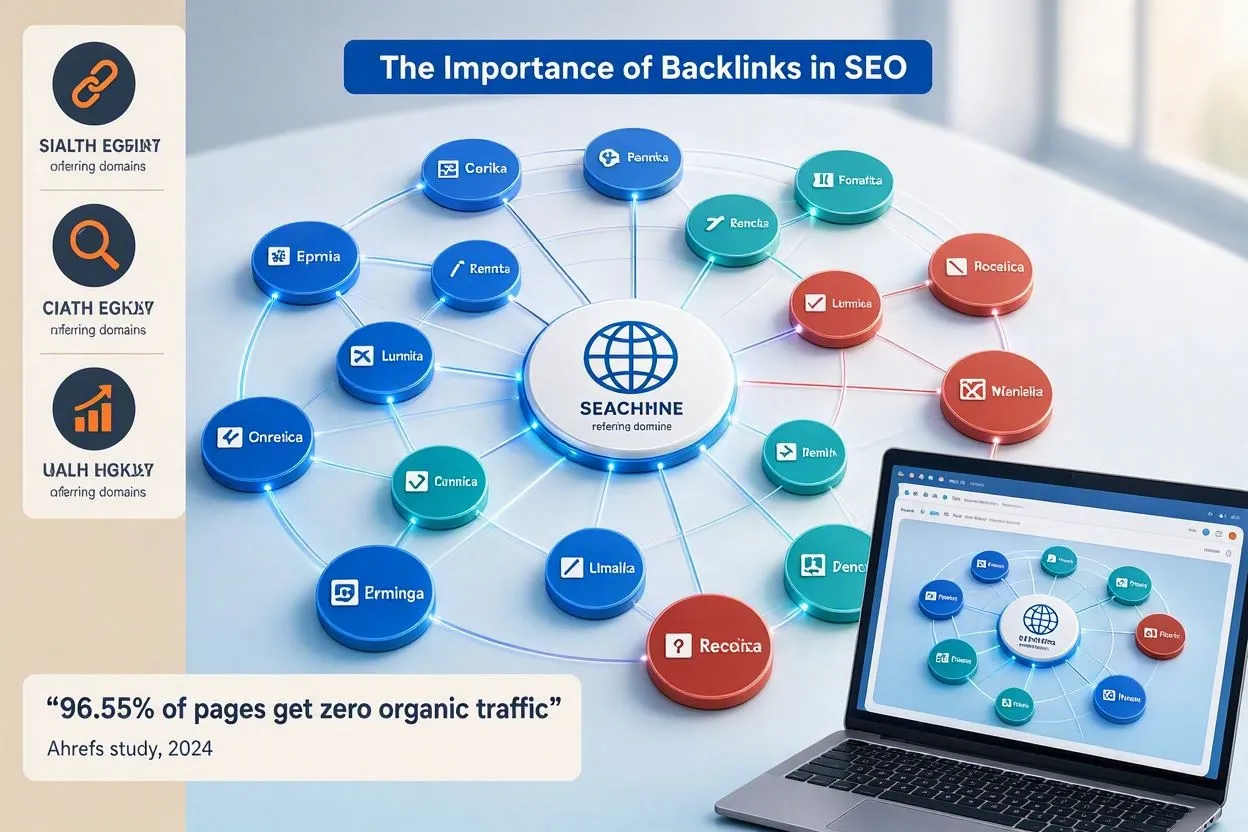
Backlinks remain 1 of Google’s top 3 ranking factors in 2026. Google’s own documentation confirms that links help Google discover new pages and determine how pages should rank relative to each other.
The data supports this. A 2024 Ahrefs study of 1 billion pages found that 96.55% of pages get zero organic traffic — and the single biggest factor separating ranking pages from non-ranking pages is the number of quality referring domains pointing to the page.
Backlinks act as votes of confidence. When a DR (Domain Rating) 70 site links to your page, Google interprets the link as an editorial endorsement — evidence that your content is credible and useful enough for another site to reference.
3 things backlinks do for SEO:
- Increase a page’s authority in Google’s ranking algorithm
- Improve crawl frequency — Google crawls linked pages faster
- Develop topical authority when links come from relevant niche sites
Defining White Hat Link Building
White hat link building earns backlinks by creating genuine value for the linking site’s readers. The link exists because it helps a human audience — not because a tool placed it automatically or money changed hands.
Google’s Link Spam policies define what crosses the line. A link passes Google’s standard when 3 conditions are met:
- Editorial placement — a human editor chose to include the link
- Topical relevance — the linking site covers your subject area
- No payment — the link was not bought, sold, or excessively exchanged
White hat link building is slower than black hat alternatives. Results take 4–9 months to compound. The difference: white hat rankings hold through every Google update. Black hat rankings disappear within 3–6 months of the next core update.
Gray Hat vs. Black Hat vs. White Hat Links
| Factor | White Hat | Gray Hat | Black Hat |
| Google approval | Full | Partial | None |
| Penalty risk | Zero | Low–Medium | High |
| Link method | Editorial | Semi-paid | Paid / automated |
| Result timeline | 4–9 months | 2–5 months | 1–3 months |
| Longevity | Permanent | Uncertain | Short-term |
| Cost per link | $0–$500 | $100–$600 | $10–$200 |
| Examples | Guest posts, HARO, digital PR | Paid guest posts, link exchanges | PBNs, link farms, comment spam |
White hat means full compliance with Google’s guidelines. Every link earned through white hat methods holds value permanently.
Gray hat sits in the middle. Tactics like paying for a guest post on a legitimate, relevant site are not explicitly banned — but they violate Google’s intent. Risk level: low to medium depending on scale.
Black hat uses methods Google explicitly prohibits: Private Blog Networks (PBNs), link farms, automated comment links, hidden links, and cloaking. Google’s spam detection improved 45% between 2023 and 2025. These tactics trigger manual penalties within weeks.
White Hat vs. Black Hat
White hat link building builds rankings that compound over time. Black hat builds rankings that collapse.
The core difference: white hat links earn editorial placement because the content deserves it. Black hat links manufacture the appearance of editorial endorsement through manipulation.
Google’s John Mueller stated in 2021 that digital PR — a core white hat technique — is “just as critical as tech SEO, probably more so in many cases.” That position has only strengthened as AI-generated content flooded the web.
Why black hat fails in 2026:
- Google’s SpamBrain (AI-powered spam detection) identifies unnatural link patterns within 30–90 days
- Manual penalty reviewers flag sites with sudden link velocity spikes
- PBN footprints — shared IP addresses, similar site structures — are detectable at scale
- A single manual penalty removes a site from Google’s index for 3–18 months
Why white hat wins in 2026:
- E-E-A-T (Experience, Expertise, Authoritativeness, Trustworthiness) signals amplify editorial link value
- AI content flood made human-curated, editorial links scarcer and more valuable
- Natural link velocity (3–15 referring domains per month) builds lasting topical authority
- White hat backlink profiles survive every Google core update
What Makes a Quality Backlink?
A quality backlink comes from a relevant, authoritative site and passes link equity through a dofollow, contextually placed text link with varied anchor text. Six factors determine backlink quality.
Topical Relevance
Topical relevance is the strongest quality signal for a backlink in 2026. A DR 90 link from a cooking site to a cybersecurity company carries less value than a DR 45 link from a cybersecurity publication.
Google’s algorithms map content topics using Natural Language Processing (NLP). Links between topically related pages carry more PageRank than links across unrelated niches. Target sites that cover your exact subject area — not just adjacent industries.
Domain Authority
Domain Authority (DA) or Domain Rating (DR) measures a site’s backlink strength on a 0–100 scale. Higher scores indicate stronger PageRank transfer.
Target distribution for a healthy backlink profile:
- 20–30% links from DR 60+ sites (high authority)
- 40–50% links from DR 30–60 sites (mid-tier)
- 20–30% links from DR 10–30 sites (entry-level authority)
A backlink profile with 100% DR 80+ links looks unnatural. Google expects organic distribution across authority levels.
Organic Traffic
A linking site’s organic traffic level predicts whether Google treats the link as a real editorial endorsement. Sites with zero organic traffic — despite high DA scores — are often PBNs or expired domain farms.
Before targeting a site for guest posting or link insertion, check monthly organic traffic in Ahrefs or Semrush. Minimum threshold: 500 organic visits per month. Sites below this level offer low link equity regardless of their DA score.
Dofollow vs. Nofollow Links
Dofollow links pass full PageRank to the linked page. Nofollow links pass no direct ranking credit.
The rel=”nofollow” tag tells Google not to associate the linking site’s authority with the destination. Nofollow links still drive referral traffic and contribute to link profile diversity — but they don’t directly improve rankings.
A natural backlink profile includes both. Target 70–80% dofollow and 20–30% nofollow. A profile with 100% dofollow links looks manipulated.
Sponsored links use rel=”sponsored”. User-generated content links use rel=”ugc”. Both tell Google the link is not an editorial endorsement.
Anchor Text
Anchor text is the clickable text in a hyperlink. Google uses anchor text to understand what the linked page is about — over-optimized anchor text is a top cause of manual penalties.
Natural anchor text distribution for a healthy backlink profile:
- 60–70% branded (your company or site name)
- 10–15% exact match (your target keyword)
- 15–20% generic (“click here”, “read more”, “this article”)
- 5–10% naked URLs (yourdomain.com)
Using exact-match anchor text on 30%+ of links triggers Google’s over-optimization filter. Vary anchor text across every link built.
Text Link Placement
Links placed within the main body content of an article pass more PageRank than links in footers, sidebars, or author bios.
Google’s algorithms weight link placement by context. A link embedded in paragraph 2 of a 1,500-word article carries more authority than the same link in a site-wide footer. Aim for contextual, in-content link placement on every outreach campaign.
Links in the first 25% of an article body pass slightly more equity than links deeper in the content — target early contextual placement when negotiating guest post link positions.
Most Effective White Hat Link Building Strategies
Content Production that Earns Links
Content earns links when it provides information no other source offers. Original research, proprietary data, comprehensive guides, and free tools attract editorial links passively — without active outreach.
3 content types that earn the most links:
- Original research and data studies — pages with unique statistics earn 3x more links than pages that aggregate existing data
- Comprehensive guides — 3,000+ word definitive guides on specific topics earn consistent links as the go-to reference
- Free tools — calculators, generators, and checkers earn links because other sites recommend useful tools to their readers
Passive link earning requires initial promotion. Publish the content, pitch it to 20–30 relevant sites in the first 2 weeks, then let the content earn links organically for 12–24 months.
Guest Posting
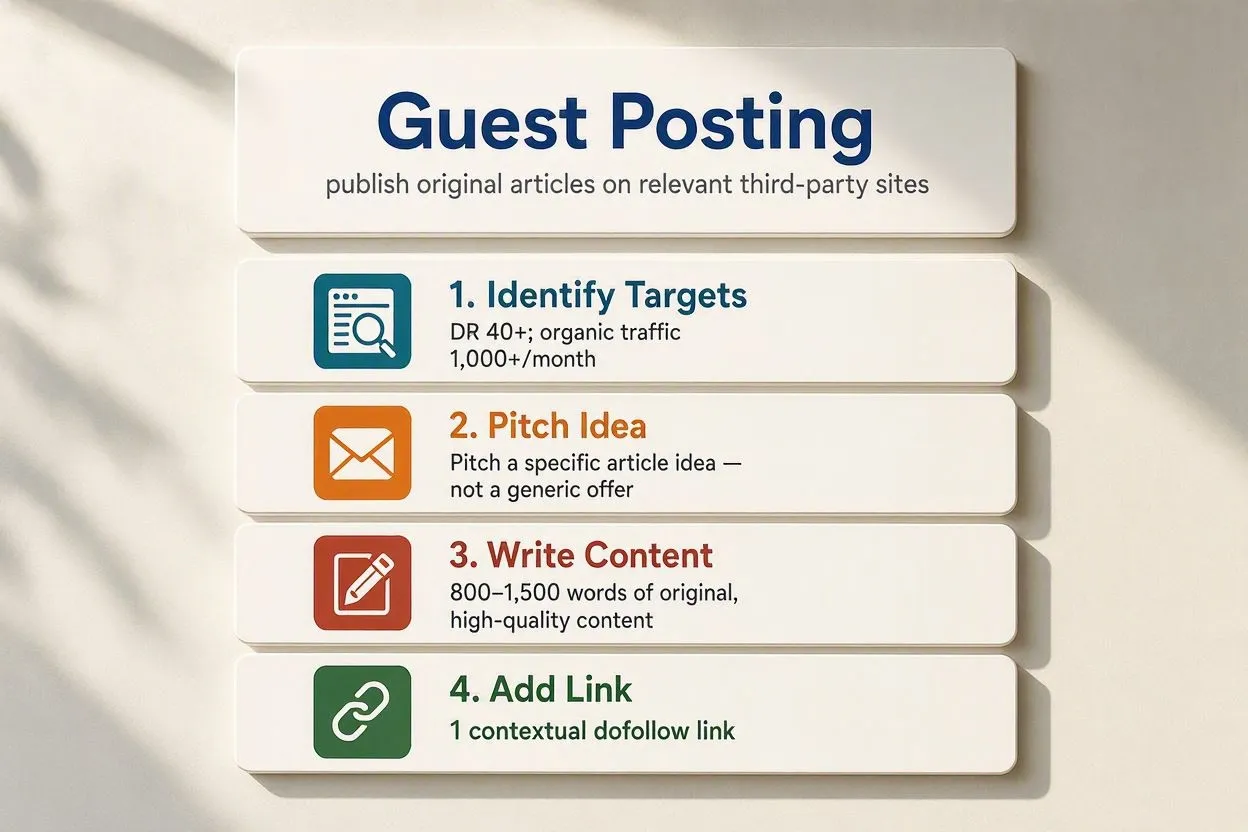
Guest posting publishes original articles on relevant third-party sites in exchange for an editorial backlink. Target sites with DR 40+ and topical overlap with your niche.
The process:
- Identify 20 target sites using Ahrefs Content Explorer (filter by DR 40+, organic traffic 1,000+/month)
- Pitch a specific article idea — not a generic “I’d like to write for you” offer
- Write 800–1,500 words of original, high-quality content
- Include 1 contextual dofollow link to your site within the article body
Cold pitch acceptance rate: 3–8%. Personalized pitches referencing a specific article on the target site improve response rates to 15–22%.
Avoid sites that publish 5+ guest posts per day, show no organic traffic, or list a “write for us” page with no editorial guidelines. These are link farms in disguise.
Broken Link Building
Broken link building finds dead links on relevant sites and offers your content as a working replacement.
The 3-step process:
- Use Ahrefs Site Explorer → Outbound Links → Broken to find pages in your niche with dead outbound links
- Create or identify existing content matching the dead page’s topic
- Email the site owner with the broken link URL, the 404 error, and your replacement page
Conversion rate: 5–10% of outreach emails produce a link replacement. The technique works because the site owner gains — dead links hurt user experience and their own SEO.
Find broken links at scale: export competitor backlink profiles in Ahrefs, filter for 404 status codes, then create content targeting those exact dead URLs.
Unlinked Brand Mentions
Unlinked brand mentions are citations of your brand name on external sites without a hyperlink. Converting these to links requires a single outreach email — the site already trusts your brand enough to mention it.
Find unlinked mentions using:
- Google Alerts (free) — set alerts for your brand name
- Ahrefs Mentions — monitors brand references across the web
- Semrush Brand Monitoring — tracks mentions with traffic data
Conversion rate: 20–35% — the highest of any white hat technique. The outreach email is simple: thank the author for the mention and ask them to add a link for readers who want to find you directly.
Content Contributions
Content contributions add your expertise to existing articles on relevant sites as a named contributor. The host site adds your quote, insight, or data point with a backlink to your site.
Pitch contributions to articles that already rank on page 1 for relevant keywords. Offer a specific data point or expert perspective the existing article lacks. The host site benefits from added credibility; you earn a contextual link on a high-traffic page.
Response rate: 10–20% when the pitch offers a specific, concrete addition rather than a generic comment.
Outreach
Link building outreach is the process of contacting website owners, editors, and journalists to earn backlinks. Outreach powers every technique in this guide — the quality of the outreach email determines results.
4 outreach principles that increase reply rates:
- Personalize the subject line — reference a specific article or data point from the target site
- Lead with value — explain what the recipient gains before asking for anything
- Keep emails under 120 words — editors receive 50–200 pitches daily; brevity wins
- Follow up once — send a follow-up 5–7 days after the first email; a single follow-up increases reply rates by 22%
Use BuzzStream or Pitchbox to manage outreach at scale, track reply rates, and avoid sending duplicate emails.
Connectively (HARO)
Connectively — formerly Help a Reporter Out (HARO) — connects journalists with expert sources. When a journalist quotes your expert input, the published article links to your site.
Connectively sends 3 emails daily with journalist requests across 20+ categories. Process:
- Subscribe at connectively.us (free tier available)
- Filter requests relevant to your expertise
- Reply within 2 hours with a concise, specific answer
- Include credentials that establish authority
Journalists receive 50–200 responses per request. Replies sent within 2 hours get chosen 3x more often than replies sent after 24 hours. Specificity beats length — lead with your strongest data point or unique insight.
Placement sites include Forbes, Business Insider, HuffPost, and niche trade publications with DR 70–95. Alternative platforms: Qwoted, SourceBottle, Featured.
Linkable Assets and Infographics
Linkable assets are content pieces designed specifically to attract links — infographics, templates, calculators, glossaries, and original research reports.
Infographic outreach process:
- Create an infographic presenting original data or a complex concept visually
- Write a 300-word companion article with the infographic embedded
- Pitch 30–50 relevant blogs with an embed code — sites that embed it link back to the original
- Conversion rate: 2–5% of outreach pitches
Infographics work best when presenting your own data (not repurposed public statistics). An infographic with a compelling, counterintuitive finding earns 3–5x more links than a generic “here are some facts” visual.
Pitch Data Studies
Data studies earn links because other sites cite statistics — and statistics need a source. Proprietary data is most valuable because no other site can replicate it.
Data sources:
- Internal analytics (customer data, platform usage stats)
- Survey platforms — SurveyMonkey, Pollfish, YouGov (minimum 500 respondents for credibility)
- Government and public databases
- Industry reports with fresh analysis
One data study earns an average of 23 referring domains within 6 months when pitched to relevant publications.
How to Pitch
Email journalists who have covered similar studies. Subject line: reference their previous coverage. Body: lead with 3 specific findings from the data, link to the full report, offer the journalist an exclusive quote from your data team.
Pitch email structure:
Subject: Study: [Specific Finding] — [Your Topic]
Hi [First Name],
I saw your article on [related topic] — the data on [specific point] was strong.
We surveyed [sample size] [audience] and found [3 bullet-point findings].
Full report here: [URL]. Happy to provide raw data or an expert quote.
[Name], [Title]
Successful Examples
Credit Karma published a study finding nearly one-third of Gen Z live at home while struggling to afford rent. The study earned 140+ linking root domains within 6 months — purely through journalist pitching.
Preply regularly publishes language trend studies earning 50–200 links per report. The data is proprietary (from Preply’s platform usage), making each study uniquely citable.
Generate Interactive Content
Interactive content — calculators, quizzes, assessments, and data visualizers — earns links because sites recommend useful tools to their audiences.
A mortgage calculator earns links from personal finance blogs. A calorie calculator earns links from health sites. A keyword difficulty tool earns links from SEO publications.
Interactive tools earn links passively for 3–5 years after launch. The upfront cost — $2,000–$10,000 in development — produces a permanent link magnet.
Pitch interactive tools to relevant resource pages, listicles (“10 best tools for X”), and comparison articles. Conversion rate: 8–15% when the tool genuinely solves a problem the target site’s audience faces.
Build Links to a Resource Page
Resource page link building identifies “best of” or “useful links” pages on relevant sites and requests inclusion.
Search operators that find resource pages:
- intitle:”useful resources” + [your topic]
- inurl:resources + [your topic]
- intitle:”best tools for” + [your topic]
- “recommended reading” + [your topic]
Pitch angle: explain specifically why your page adds value readers cannot get from the existing listed resources. Generic “please add my link” emails convert under 1%. Specific pitches — “your resources page covers X and Y but not Z, which [your URL] addresses in detail” — convert at 5–12%.
Insert Links Into External Content (aka Link Insertion)
Link insertion adds your URL into an already-published, indexed article on an external site. The target page already has authority and traffic — your link inherits both.
White hat link insertion happens when the site owner agrees the link genuinely improves the article for readers. Offer to add a specific insight, updated statistic, or resource that strengthens the existing content.
Payment for link insertion makes the tactic gray hat. Keep link insertion outreach focused on editorial value — the pitch should explain how the link helps the site’s readers, not why you want the link.
Target Keywords With High Link Intent
Keywords with high link intent attract backlinks naturally because content ranking for these terms gets cited as a reference.
High link intent keyword patterns:
- “What is [term]” — definitional content gets cited heavily
- “[Topic] statistics” — stat pages earn links from every article referencing those numbers
- “[Topic] guide” — comprehensive guides become go-to references
- “How to [process]” — tutorial content earns links from related how-to articles
- “Best [tools/methods]” — listicles earn links from comparison articles
Identify high link intent keywords using Ahrefs Keywords Explorer — filter by “Referring Domains” to see which keywords attract the most backlinks. Create content targeting these terms and build 10–15 initial links to accelerate the ranking process.
Update Existing Backlinks (aka Link Moves)
Link moves update existing backlinks to point to a new or improved URL when content moves, merges, or redirects. This technique recovers link equity lost during site migrations, URL restructures, or content consolidations.
Process:
- Identify pages with strong backlink profiles using Ahrefs
- Find backlinks pointing to outdated or redirected URLs
- Contact the linking sites and request a direct link update to the new URL
- Conversion rate: 25–40% — site owners prefer clean, direct links over redirect chains
Link moves preserve existing link equity rather than building new links. Run a link move audit after every site migration, domain change, or major URL restructure.
Reclaim Lost Links (Link Reclamation)
Link reclamation recovers backlinks that were removed, broken, or changed to nofollow after previously pointing to your site.
Find lost links in Ahrefs → Backlink Profile → Lost. Filter by “Link removed” and “404 Not Found.” Prioritize reclaiming links from DR 50+ sites.
Outreach for reclaiming removed links:
Hi [First Name],
You linked to [your URL] in your article [their article title] — the link appears to have been removed in a recent update.
The page still exists and covers [topic]. Happy to send updated content if the original no longer fits.
[Name]
Conversion rate: 15–25%. Link reclamation is the highest ROI technique for established sites with existing backlink profiles.
Highlight Brand News
Brand news — product launches, funding rounds, partnerships, awards, and milestones — generates press coverage that earns editorial backlinks.
Journalists cover newsworthy brand events without being asked. Increase coverage by distributing press releases through PR Newswire or Business Wire, pitching relevant journalists 48 hours before announcement, and sharing the news across social channels to increase visibility.
Brand news links tend to come from high-DR news sites (DR 70–95) — the highest authority backlinks available through white hat methods.
Pitch Reactive PR Content
Reactive PR (also called newsjacking) responds to breaking news or trending topics with expert commentary, data, or analysis. Journalists covering a story need sources — reactive PR positions your brand as the expert source.
3 steps to reactive PR:
- Monitor Google Trends, Twitter/X trending topics, and industry news for relevant stories
- Prepare a 2–3 paragraph expert commentary within 2–4 hours of a story breaking
- Pitch to journalists covering the story with your commentary and credentials
Speed is critical. Journalists work on 4–24 hour deadlines. A pitch arriving after the story publishes earns nothing. A pitch arriving within 2 hours of a story breaking earns coverage at DR 60–90 publications.
Get Featured on Podcasts
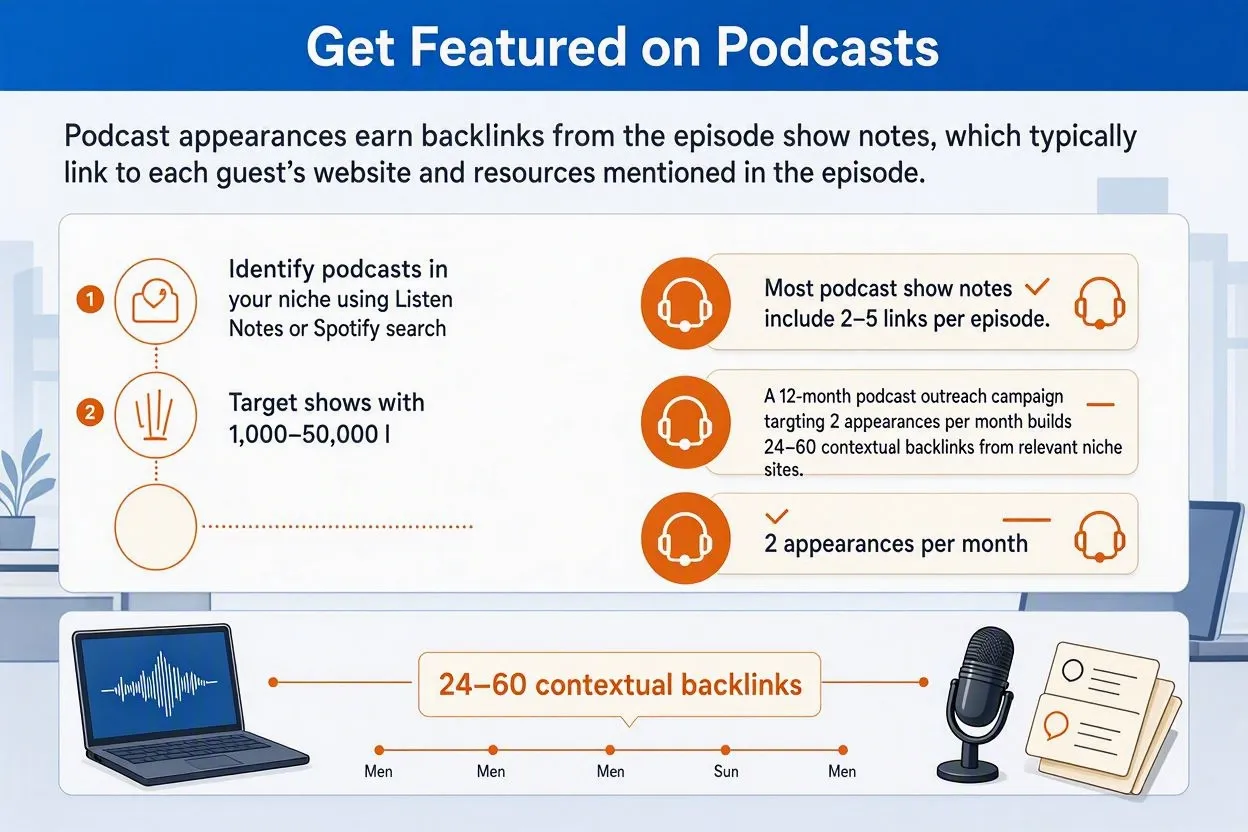
Podcast appearances earn backlinks from the episode show notes, which typically link to each guest’s website and resources mentioned in the episode.
Most podcast show notes include 2–5 links per episode. A 12-month podcast outreach campaign targeting 2 appearances per month builds 24–60 contextual backlinks from relevant niche sites.
Pitch process:
- Identify podcasts in your niche using Listen Notes or Spotify search
- Target shows with 1,000–50,000 listeners (larger shows rarely accept cold pitches)
- Pitch a specific episode topic with 3 talking points the host’s audience will find valuable
- Attach 2–3 sentences of credentials
Conversion rate: 15–40% — significantly higher than guest posting because the host benefits directly from interesting guest content.
Conclusion
White hat link building builds sustainable rankings through editorial backlinks that survive every Google update. The 18 techniques in this guide cover every major approach — from guest posting and HARO to reactive PR and link reclamation.
Start with the 3 highest-ROI techniques for your situation:
- New site: HARO outreach + broken link building + resource page pitching
- Established site: Link reclamation + unlinked mentions + digital PR
- Agency: Guest posting at scale + white label reporting + data studies
Link building compounds. The 10 referring domains built in month 1 make month 2 outreach easier — your site has more authority, editors take pitches more seriously, and journalists cite you as an existing source.
The sites ranking on page 1 for competitive keywords today started building white hat links 12–18 months ago. Start now.