
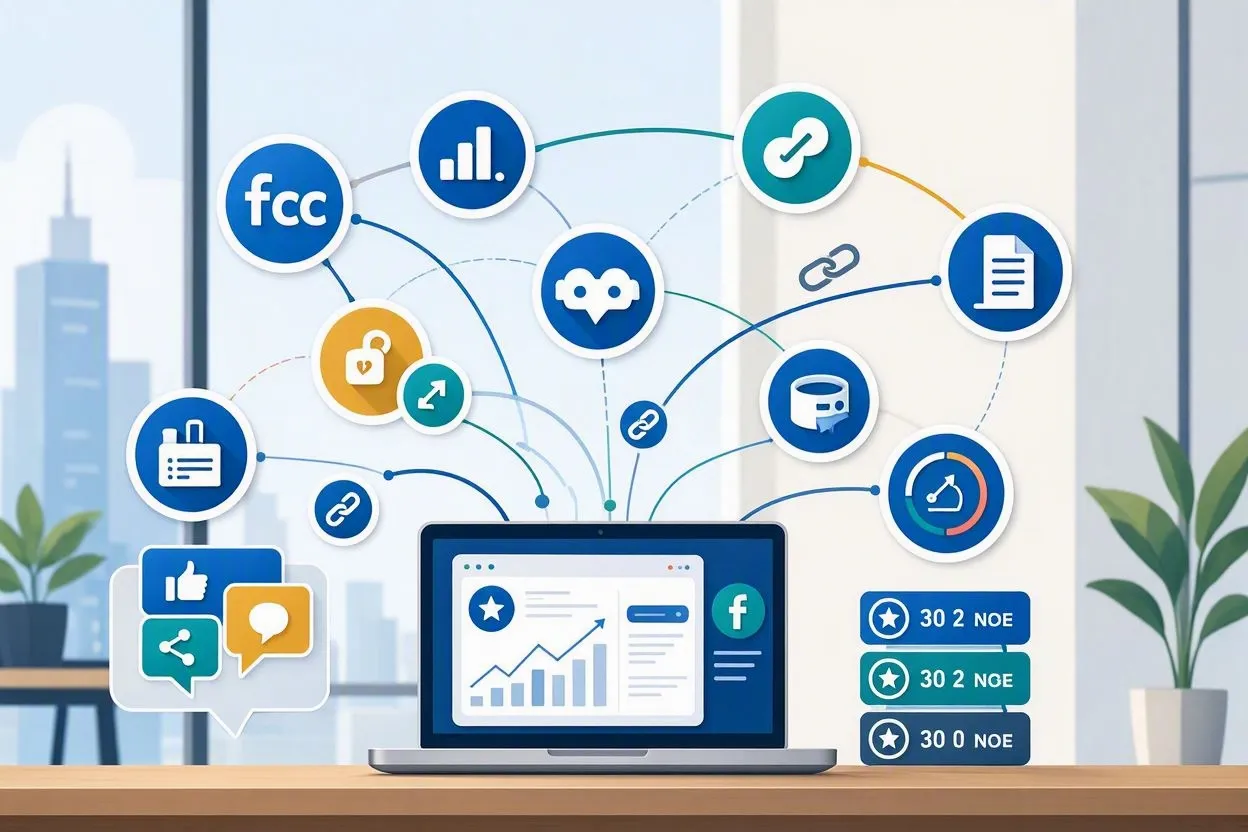
A client once asked why a competitor with worse content kept outranking them. It came down to 40 more referring domains, a dozen unlinked brand mentions nobody had bothered to claim, and a Google Business Profile that actually got updated.
That gap is what off-page SEO closes. None of it happens inside your own website. It happens in the links, mentions, reviews, and forum threads scattered across everyone else’s. The 15 tactics below cover what still moves rankings, ordered by where the effort tends to pay off first.
What Is Off-Page SEO?
Off-page SEO covers every action taken outside your own website to raise its authority, trust, and visibility in search results. Backlinks sit at the center of it, but the category also includes brand mentions, social sharing, local citations, and reviews. On-page SEO deals with what happens inside your site: headings, meta tags, internal links. Off-page SEO deals with what other sites and platforms say about yours.
A backlink from a site with a Domain Authority (DA) score of 70 carries more weight than ten backlinks from unrelated blogs sitting at DA 10. That single fact drives most of the decisions below.
Why Off-Page SEO Matters for Rankings
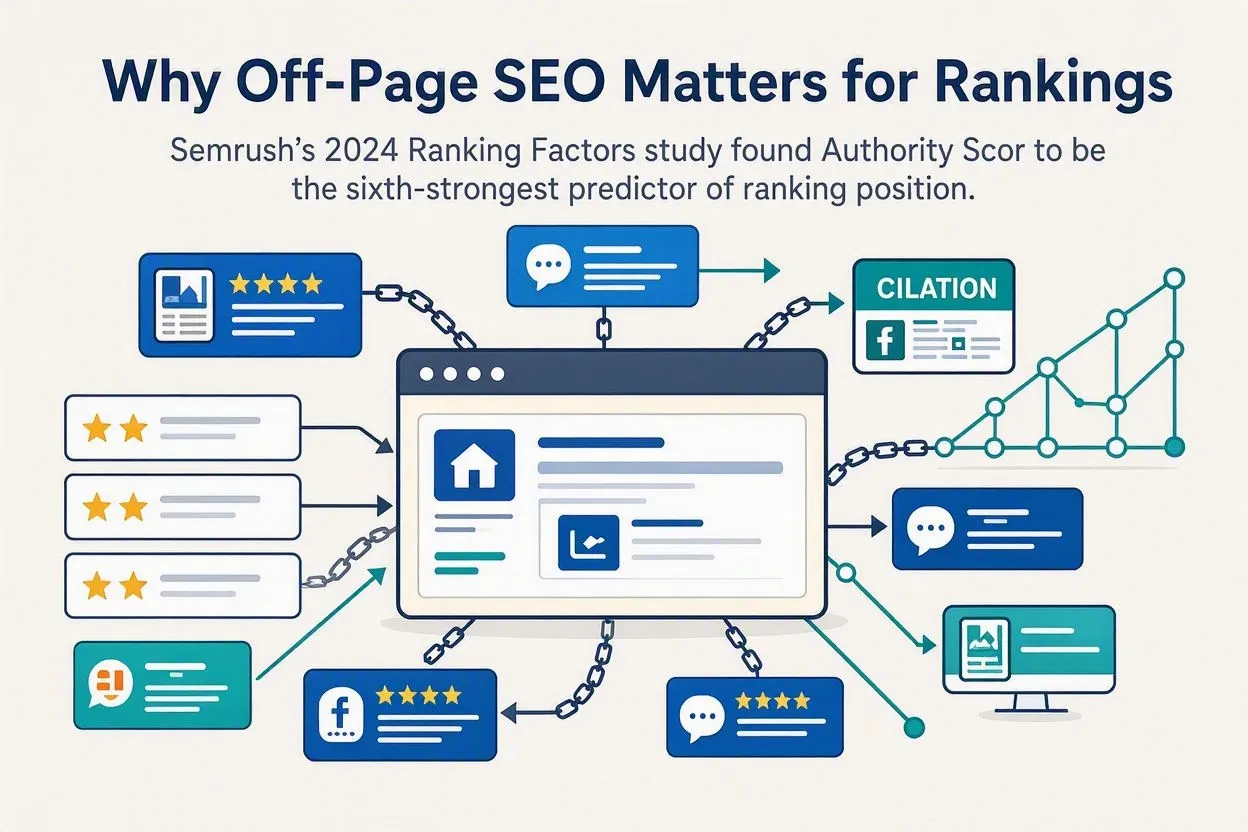
Search engines can’t judge your credibility from your own copy, so they judge it by what independent sources say about you instead. A company can write “we’re the top plumbing service in Austin” on its homepage all it wants, but Google treats that claim as unverified until other sites, reviews, or mentions back it up.
Semrush’s 2024 Ranking Factors study found Authority Score to be the sixth-strongest predictor of ranking position. That’s not a minor correlation. It places off-page signals above several on-page factors most teams obsess over.
Large language models make the gap worse. ChatGPT, Perplexity, and Google’s AI Mode can’t test your product firsthand, so they lean on what the web already says about you: reviews, forum threads, press mentions, citations. A brand with zero third-party footprint is close to invisible in AI-generated answers, no matter how polished its own site looks.
15 Off-Page SEO Methods That Work
1. Build backlinks from relevant, authoritative sites
Backlink building means earning links from other websites that point back to yours, and it’s still the single strongest off-page method available. Each link acts as a vote of confidence, but the votes aren’t weighted equally. Three factors determine value: relevance to your niche, authority of the linking domain, and whether the link uses a “follow” attribute that passes a ranking signal.
A single backlink from a DA-60 industry publication typically outperforms 20 backlinks from DA-15 directories. If you sell industrial equipment, a mention on a manufacturing trade blog will do more for rankings than a mention on a general lifestyle site with triple the traffic.
2. Audit your backlink profile every quarter
A backlink audit is a walkthrough of every link pointing to your site, done specifically to catch toxic, spammy, or irrelevant links before they drag down your rankings. Run it quarterly, not annually. Link profiles change faster than most teams expect.
Tools like Ahrefs, Moz, and Semrush’s Backlink Audit report flag an “Overall Toxicity Score,” and anything in the “Medium” or “High” range signals real risk. Toxic-link cleanups vary a lot by site, but it’s common for agencies to report meaningful traffic recovery within a few months of a disavow campaign. Treat any single case study as a data point, not a guarantee, and track what happens on your own site after you clean up.
3. Analyze competitor backlink gaps
A backlink gap analysis compares your link profile against direct competitors to surface domains that link to them but not to you. Enter your domain plus up to four competitor domains into a gap tool, then sort results by authority score to prioritize outreach targets.
If three competitors all earned links from the same industry association directory and your site didn’t, that’s an easy, high-relevance opportunity sitting right there. Skip domains under DA-20 unless they’re unusually relevant to your niche. Low-authority links rarely move the needle even when they’re free.
4. Earn unlinked brand mentions
An unlinked brand mention is any reference to your company name on another website without a clickable link, and converting one into a backlink usually takes one short email. Set up brand monitoring first, since you can’t convert what you never find.
Google Alerts works for basic tracking; Brand24, Mention, and Semrush’s Media Monitoring app catch more volume. When a mention shows up, send a two- or three-line email thanking the author and asking them to add a link to the relevant page. Response rates for this kind of outreach run higher than cold link requests, because you’re not asking someone to create new content, only to update a sentence they already wrote.
5. Publish guest posts on industry sites
Guest posting is writing an original article for another website in your niche, usually in exchange for a byline link or an author-bio backlink. Growth Limit founder Dennis Shirshikov has pointed to guest posting, blogger networking, and influencer interviews as three of the most reliable ways to build backlinks without paid placements.
Prioritize sites with engaged readers over sites with high traffic but weak relevance. A guest post on a 5,000-subscriber niche newsletter in your exact industry will often out-convert one on a 500,000-visitor general marketing blog. Cap submissions at one or two per target site. Repeated guest posts on the same domain trigger diminishing returns and can start to look manipulative to search engines.
6. Reclaim broken links
Link reclamation is the practice of finding broken external links on other websites and offering your own live page as the replacement. Every outdated resource page, dead product link, or 404 on a relevant site is a potential backlink waiting to be claimed.
Use a tool like Ahrefs’ Broken Link Checker or Check My Links (a free Chrome extension) to scan resource pages in your niche. If a competitor’s 2021 guide links to a now-defunct study, and you’ve published an updated version of that same data, that’s a direct pitch: “This link on your page returns a 404. Here’s a current replacement.”
7. Build local citations
A local citation is any online mention of your business name, address, and phone number (NAP), and consistent citations across platforms improve both local rankings and trust signals. List your business on Google Business Profile, Yelp, and industry-specific directories first, since these carry the most local search weight.
Inconsistent NAP data (a phone number that differs between Yelp and your website footer, say) confuses both search engines and customers. A 2023 BrightLocal survey found that 68% of consumers stop trusting a local business after running into inaccurate directory information. Fix formatting mismatches, like “Street” vs. “St.” or “Inc.” vs. “Incorporated,” across every listing before requesting new citations.
8. Optimize your Google Business Profile
Optimizing your Google Business Profile (GBP) comes down to filling out every available field: hours, categories, services, photos, so your listing appears prominently in Google Maps and local search. An incomplete profile ranks below a competitor’s complete one even if your website itself outranks theirs on-page.
Add real photos rather than stock images. Listings with at least 3 photos receive 42% more requests for directions, according to Google’s own published guidance for business owners. Post updates weekly on new offers, products, or events, since GBP treats posting frequency as an activity signal.
9. Participate in forums like Reddit and Quora
Forum participation is answering questions and joining discussions on platforms like Reddit and Quora with genuine, non-promotional input. Since Google’s licensing partnership with Reddit, forum threads surface more often in both standard search results and AI-generated answers. Semrush’s AI Mode Comparison Study identified Reddit as the most-cited domain across ChatGPT, Perplexity, AI Overviews, and AI modes combined.
Drop a link only when it directly answers the question asked. A link with no context reads as spam and gets removed by moderators within hours. Semrush’s own community lead, Mateah Kittle, recommends signing responses with a real name and checking relevant subreddits daily. The goal is a recognizable, consistent presence, not a one-time link drop.
10. Share content across social media platforms
Social sharing distributes your content to a wider audience, and it increases both the odds of earning organic backlinks and the odds of showing up in AI-tool citations. Videos in particular now surface inside AI chat responses. A YouTube tutorial referenced by ChatGPT sends direct traffic without any traditional ranking involved.
Match platform to audience rather than posting everywhere at once. A B2B software company gets more mileage from LinkedIn thought-leadership posts than from Pinterest boards; a home-decor retailer sees the reverse. Repurpose one long-form asset, a webinar, say, into five or six short clips instead of writing five separate pieces from scratch.
11. Partner with influencers
Influencer partnerships introduce your brand to a creator’s existing, engaged audience, generating brand searches, mentions, and backlinks that compound over time. Choose creators by audience-content fit first and follower count second. A micro-influencer with 8,000 highly relevant followers often converts better than one with 200,000 mismatched followers.
Check three things before reaching out: recent post engagement rate, audience comment quality, and whether the creator’s tone matches your brand voice. A single well-matched partnership can generate more qualified referral traffic than a $2,000 banner-ad campaign, without the recurring media spend.
12. Pursue digital PR and journalist outreach
Digital PR is pitching original data, studies, or expert commentary to journalists and publishers in exchange for coverage and backlinks. Journalist-request platforms like Qwoted and Featured let PR teams respond directly to reporter queries, often earning links from sites with DA scores above 70. (HARO went through a rocky rebrand to Connectively and a shutdown in late 2024, so check which platform is actually active before building a workflow around one.)
A single original research report, even a small one built from 200 survey responses, can generate more high-authority backlinks in one campaign than six months of manual outreach. Publishers cite data they can’t produce themselves, so numbers, not opinions, are what earn the placement.
13. Generate and respond to customer reviews
Review generation means actively asking satisfied customers to leave feedback on Google, Yelp, or industry platforms, since review volume and sentiment both factor into local and AI search visibility. Respond to every review within 48 hours, positive or negative, to show active management.
A Harvard Business School study found that a one-star increase in Yelp rating correlated with a 5% to 9% increase in revenue for the businesses studied. Ask for reviews right after a successful transaction, when satisfaction is highest, rather than waiting for a follow-up email weeks later.
14. Build authority for AI search visibility
AI search visibility depends on how often independent sources mention your brand, since large language models can’t evaluate product quality directly and instead lean on aggregated third-party signals. A Seer Interactive study found branded search volume correlates strongly with how often a brand appears in AI-generated answers.
Combine consistent brand mentions, forum presence, and structured data (schema markup) to strengthen entity recognition. A company that shows up across five independent, credible sources builds a stronger AI-visibility footprint than one relying on its own website content alone, even when that website ranks well in traditional search.
15. Track link velocity
Link velocity measures how fast your site gains or loses backlinks over time, and tracking it helps you catch both spam attacks and content that’s earning links faster than expected. Calculate a monthly baseline: new referring domains gained minus domains lost.
A sudden spike, 200 new links in one week after a piece goes viral, won’t trigger a penalty on its own. Google’s current guidance treats organic virality differently from manufactured link schemes. A steady, unexplained decline is the one to worry about; it often signals lost partnerships, expired sponsorships, or a competitor’s disavow campaign worth investigating.
How to Measure Off-Page SEO Success
Off-page SEO success comes down to four core metrics: total backlinks, referring domains, brand mention volume, and AI-tool citation frequency. Track referring domains over raw backlink count. 50 domains linking once each carry a more authoritative signal than 5 domains linking 10 times each.
Set a 90-day review cycle. Compare referring-domain growth, organic traffic movement, and keyword position changes against your baseline. A campaign that added 40 referring domains in one quarter but produced no ranking movement points to a relevance problem, not a volume problem. The links likely came from the wrong niches.
Off-Page SEO vs. On-Page SEO
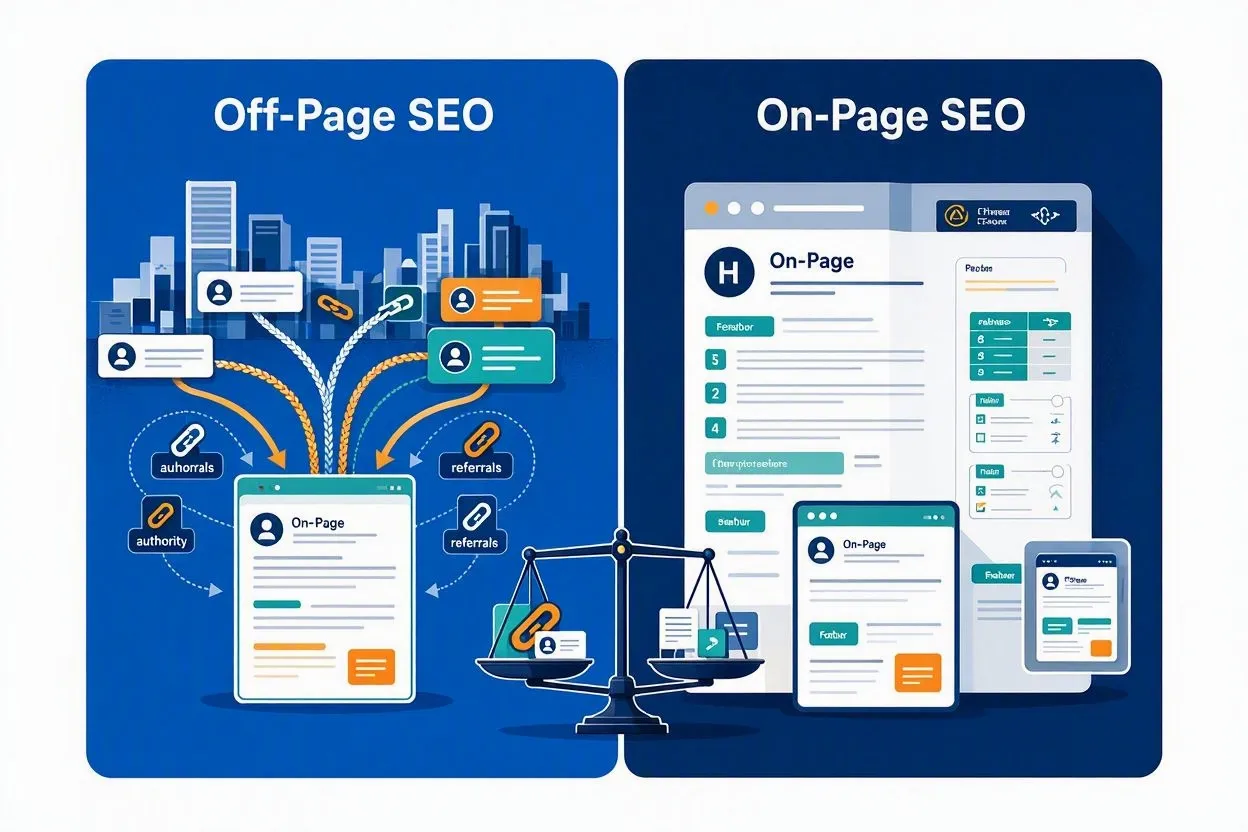
Off-page SEO builds authority and trust from outside sources; on-page SEO builds relevance and usability from inside your own site. A page with ten strong backlinks but thin, poorly structured content will lose ground to a better-optimized competitor within months. A page with excellent content but zero external validation often can’t break into competitive search results at all. Teams that pour 90% of resources into content while ignoring off-page SEO tend to plateau around page two: visible, but not clicked.
Conclusion
Off-page SEO works as a system, not a checklist to complete once. Backlinks from relevant, authoritative domains still carry the most ranking weight. But brand mentions, local citations, digital PR, and AI-search visibility now sit next to backlinks as measurable factors, not nice-to-haves.
Semrush’s 2024 data placed Authority Score as the sixth-strongest ranking predictor, ahead of several on-page tactics most teams tackle first. Start with a backlink audit, fix the toxic links dragging down trust, then move into whatever’s highest-leverage for your niche: digital PR for competitive B2B spaces, local citations and reviews for service businesses, forum participation and social sharing for consumer brands chasing AI search visibility.
Track referring domains and brand mentions on a 90-day cycle, not a one-time report. Off-page authority compounds the same way it erodes: slowly, and only with consistent input.