

SEO builds traffic you do not pay for per click. Google Ads buys traffic the moment you launch a campaign. The right choice depends on your timeline, budget, and how competitive your market is.
This guide breaks down both channels using real cost structures, ranking factors, and a semantic keyword strategy that strengthens organic results. You get a clear framework built on current data, not a generic comparison recycled from outdated SEO advice.
What Is SEO and How Does It Build Organic Visibility?
Search Engine Optimization (SEO) earns free placement in organic search results through relevance, content quality, and trust signals. You do not pay Google per visitor. You invest in content, site structure, and backlinks instead.
SEO works through 4 core levers: keyword research, on-page optimization, content depth, and link authority. Google’s algorithm evaluates all 4 before ranking a page above competitors.
Natural Language Processing (NLP) now drives how Google interprets your content. Google reads sentence structure, related terms, and topic coverage — not isolated keywords. A page about “running shoes” ranks better when it also covers cushioning, arch support, and trail terrain, because those terms signal full topic coverage to Google’s models.
Google Search Console gives you the data to measure this gap. Track which queries already bring impressions to a page, then check whether the page answers those queries in depth. A page stuck at position 8–15 for a valuable term usually needs deeper topic coverage, not a different keyword.
How Link Building and LSI Keywords Strengthen SEO
Latent Semantic Indexing (LSI) is not part of Google’s live ranking algorithm. Google has confirmed LSI plays no role in how it ranks pages, relying instead on more advanced NLP models like BERT. The term survives in SEO circles because the underlying habit — adding related, descriptive terms — produces genuinely more complete content.
To strengthen a page using semantic terms, name the specific entities your topic touches: tools, processes, locations, and related concepts. A page on “email marketing” gains relevance by naming open rates, segmentation, and autoresponders — not by stuffing the phrase “email marketing” repeatedly.
Link building adds a second authority signal. Editorial backlinks from relevant, trusted sites tell Google your page deserves trust. A single backlink from a respected industry publication carries more ranking weight than 10 links from low-quality directories, because Google weighs the linking site’s own authority and topical relevance, not just the raw link count.
What Is Google Ads and How Does It Work?
Google Ads is a pay-per-click (PPC) advertising platform where you bid on keywords to place ads above organic search results. You pay only when someone clicks your ad — not for impressions alone.
To launch a Google Ads campaign, set a daily budget, choose target keywords, and write ad copy that matches search intent. Ads go live within hours of approval, giving you immediate visibility that SEO cannot match in the same timeframe.
Google Ads runs across 4 primary formats: search ads, display ads, video ads, and shopping ads. Search ads target users actively searching a specific term. Display ads place banner creative across partner websites. Video ads run on YouTube before, during, or after content. Shopping ads show product images and prices directly in search results.
Cost per click (CPC) rises with competition. Legal, finance, and insurance keywords often cost $20–$100+ per click. Local service keywords typically range $2–$15 per click, depending on the metro area and demand.
Quality Score determines how much you actually pay per click, separate from your bid amount. Google scores each ad on 3 factors: expected click-through rate, ad relevance, and landing page experience. A Quality Score of 7–10 can cut your effective CPC by 30–50% compared to an identical bid with a Quality Score of 3–4, because Google rewards ads that match what searchers actually want.
LSI SEO vs Google Ads: 7 Key Differences
The comparison comes down to 7 measurable factors: speed, cost model, durability, targeting, trust, scalability, and risk.
- Speed of results. Google Ads delivers traffic within hours of campaign approval. SEO takes 3–6 months to show meaningful ranking movement, based on competition and domain authority.
- Cost model. Google Ads charges per click, with costs rising as competition increases. SEO has no per-click cost, but requires ongoing investment in content and link building.
- Durability. Google Ads traffic stops the moment you pause spending. SEO traffic continues without daily investment once a page ranks, often for years.
- Targeting precision. Google Ads lets you target by location, device, age, and time of day with exact control. SEO targeting is indirect — you optimize for search intent but cannot exclude specific demographics.
- User trust. Organic results carry more credibility with searchers than paid placements. Search Engine Journal reports that 70–80% of users skip paid ads and click organic listings first.
- Scalability. Google Ads scales by increasing daily spend — more budget produces more traffic immediately, capped only by auction volume for your keywords. SEO scales through content volume and authority, compounding slowly over months as each new page adds to total topical relevance.
- Primary risk. Google Ads risks wasted spend from poor targeting or weak landing pages — a 2% conversion rate on expensive clicks burns budget fast. SEO risks a slow payoff if content quality or link building falls short of competitors, leaving a page stuck on page 2 indefinitely.
| Factor | SEO | Google Ads |
| Speed to results | 3–6 months | Hours to days |
| Cost structure | Content + link building investment | Pay per click (CPC) |
| Traffic after spending stops | Continues | Stops immediately |
| Targeting control | Indirect, intent-based | Direct: location, device, demographic |
| User trust level | Higher (70–80% prefer organic) | Lower, marked as “Sponsored” |
| Best fit | Long-term authority building | Immediate lead generation |
How to Calculate ROI for SEO vs Google Ads
To calculate Google Ads ROI, divide total revenue from ad-driven conversions by total ad spend, then subtract 1. A campaign generating $4,000 from a $2,000 spend returns 100% ROI ($4,000 ÷ $2,000 − 1 = 1.0, or 100%).
To calculate SEO ROI, divide organic-driven revenue by total SEO investment — content, tools, and link building — over the same period. SEO ROI typically starts near $0 in month 1 and climbs as rankings improve, often surpassing Google Ads ROI by month 8–12 because there is no recurring per-click cost.
WordStream data shows businesses earn an average of $2 in revenue for every $1 spent on Google Ads, a 100% return. SEO returns vary more widely — strong link building campaigns and high-intent content can push organic ROI to 5x–10x over a 12-month period, since the same ranking page keeps converting without new spend.
Here is a 12-month comparison for a $3,000 monthly marketing budget. Google Ads at $3,000/month generates roughly $6,000 in monthly revenue at a 2x return, totaling $72,000 across the year — and revenue stops the day spending stops. SEO at the same $3,000/month investment generates near $0 in month 1, climbs past Google Ads revenue around month 9, and by month 12 produces $15,000–$25,000 in monthly organic revenue from pages that keep ranking with no added spend.
When to Choose SEO Over Google Ads
Choose SEO when you have 6+ months to build visibility and want traffic that does not disappear when budget pauses.
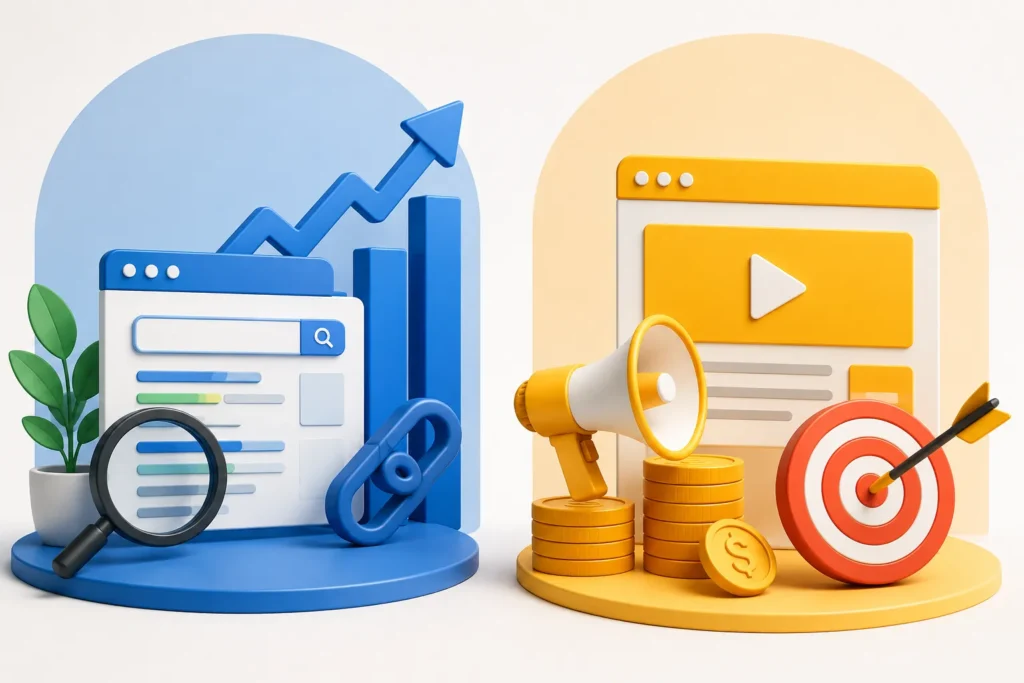
SEO fits 4 specific business situations:
- You sell a service with a long sales cycle, like B2B software or legal consulting
- Your industry has high CPC, making paid ads cost-prohibitive at scale
- You want content that builds brand authority over years, not weeks
- You have the resources for consistent content creation and link building
A link building services strategy accelerates this timeline. Editorial backlinks from relevant, high-authority sites compress the months it normally takes to outrank competitors with stronger domain authority.
When to Choose Google Ads Over SEO
Choose Google Ads when you need leads within days and have budget to sustain ongoing clicks.
Google Ads fits 4 specific business situations:
- You are launching a new product or running a time-limited promotion
- Your organic competitors have years of domain authority you cannot quickly match
- You want to test which keywords convert before committing to long-term SEO content
- Your offer has high customer lifetime value, justifying aggressive per-click bids
Google Ads data also informs future SEO priorities. Keywords that convert well in paid campaigns reveal which organic terms deserve content investment first.
How to Combine LSI SEO and Google Ads for Faster Growth
To combine both channels, run Google Ads first to identify high-converting keywords, then build SEO content around those validated terms.
This sequence removes guesswork. Paid campaigns reveal exact conversion data within weeks. SEO content built on proven keywords avoids wasted effort on terms that generate traffic but no revenue.
3 integration tactics compound results fastest:
- Use Google Ads Keyword Planner data to prioritize blog topics and service pages
- Run remarketing ads to website visitors who found you through organic search
- Combine guest posting services with paid promotion to amplify reach on the same published content
Appearing in both paid and organic listings for the same query increases total click-through rate. Users see your brand twice on one results page, which raises perceived trust before they even click.
5 Mistakes That Waste Budget on Either Channel
To avoid wasting budget, fix these 5 mistakes before scaling spend on SEO or Google Ads.
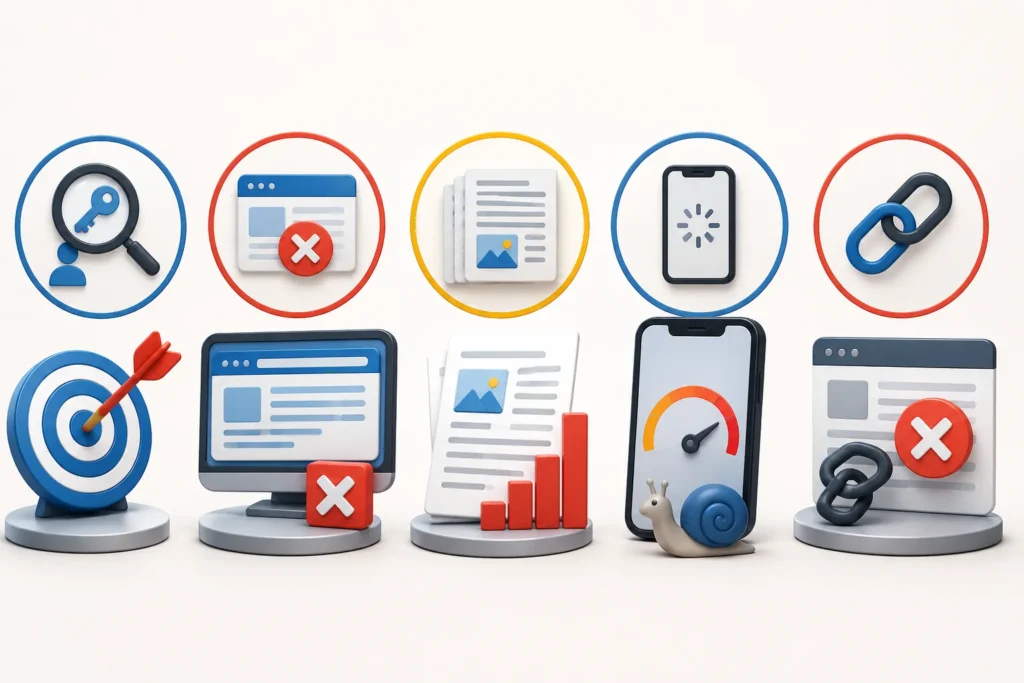
- Targeting keywords with no commercial intent. Ranking for a high-volume term that attracts researchers, not buyers, produces traffic without revenue on either channel.
- Sending paid traffic to a generic homepage. A dedicated landing page matched to the ad’s exact offer converts at 2–3x the rate of a homepage redirect.
- Publishing thin SEO content to hit a quota. A 400-word page rarely outranks competitors with 1,500+ words of focused, specific coverage on the same topic.
- Ignoring mobile page speed. Google Ads Quality Score and SEO rankings both penalize slow-loading pages, since mobile users abandon pages that take longer than 3 seconds to load.
- Building links from irrelevant or low-quality sites. A backlink from an unrelated directory adds little authority and can flag a site for manual review if the pattern repeats at scale.
Quick Reference: SEO vs Google Ads by Task
| Task | Best Channel | Timing | Difficulty |
| Launch a new product | Google Ads | 1–3 days | Low |
| Build long-term brand authority | SEO | 6–12 months | High |
| Test keyword conversion rates | Google Ads | 1–2 weeks | Low |
| Outrank an established competitor | SEO + link building | 4–9 months | High |
| Run a seasonal promotion | Google Ads | 1–5 days | Low |
| Generate steady inbound leads | SEO | 6+ months | Medium |
| Re-engage past website visitors | Google Ads (remarketing) | 1 week | Low |
Choose the Channel That Matches Your Timeline
SEO and Google Ads solve different problems. Google Ads buys attention now. SEO earns attention that compounds for years. Most growing businesses eventually use both — paid campaigns for immediate pipeline, organic content and links for lasting authority.
If your organic rankings need a faster path to page 1, our SEO outreach agency builds the editorial backlinks and content authority that compress your timeline. Book a free strategy call and get a channel plan built around your budget and goals.