

Schema markup is code added to a webpage’s HTML (HyperText Markup Language) that labels content so search engines can read it precisely instead of guessing at meaning. It’s a core technical component of search engine optimization (SEO), sitting alongside keyword research and link building as a ranking factor marketers actively manage. A product page might mention a price, a star rating, and a return policy in plain text. Schema markup tags each of those pieces so Google, Bing, and AI search tools know exactly what they’re looking at.
Marketing teams that treat schema as a one-time technical checkbox miss its ongoing role in a broader SEO and content marketing strategy. Search rankings, click-through rate, and brand visibility in AI-generated answers all connect back to how well a site’s structured data communicates with search engines.
The Vocabulary and Code Formats Behind Schema
Schema.org maintains the shared vocabulary behind this system. It currently lists 823 types and 1,529 properties, all built collaboratively by Google, Microsoft, Yahoo, and other search engines that shape modern digital marketing and search advertising ecosystems. Most sites only need a small slice of that vocabulary for their SEO campaign. A blog uses Article schema. A restaurant uses LocalBusiness schema. The trick, from a marketing strategy standpoint, is matching the type to the content, not implementing everything schema.org offers.
The code itself comes in three formats: JSON-LD (JavaScript Object Notation for Linked Data), Microdata, and RDFa (Resource Description Framework in Attributes). Google recommends JSON-LD because it sits in a single script tag, separate from the visible page content, which makes it easier for marketing and web development teams to maintain at scale.
Why schema markup types matter for SEO and AI search
Getting schema type selection right can make or break a page’s visibility across search and AI-driven discovery channels.
Why Schema Type Selection Matters to SEO
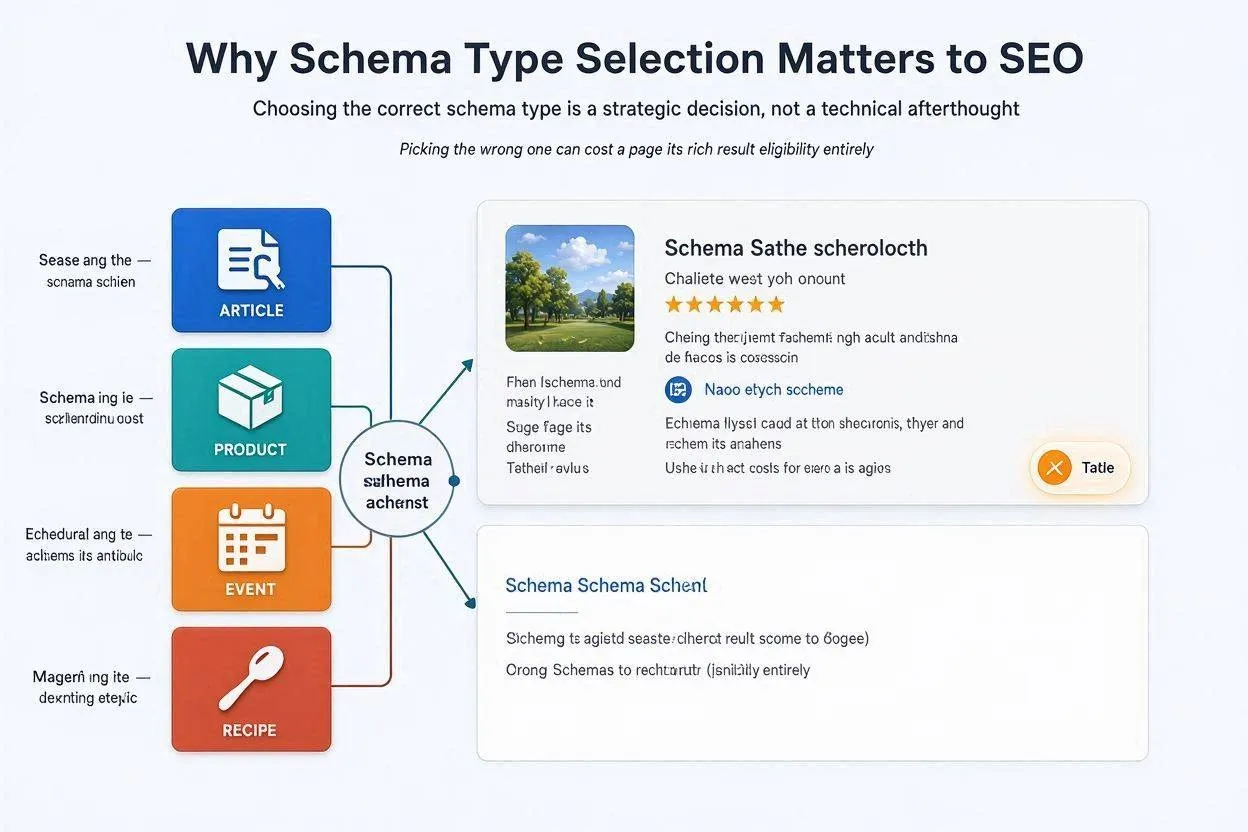
Choosing the correct schema type is a strategic decision, not a technical afterthought.
- Schema markup types matter to search engine optimization because picking the wrong one can cost a page its rich result eligibility entirely.
- Marketing teams building an SEO strategy around organic traffic growth treat schema selection as a ranking-factor decision, not a formatting detail.
- Google’s John Mueller has said the structured data on a page needs to match its primary element, not just relate to it loosely.
- A recipe blog that tags its content as Article schema instead of Recipe schema loses access to star ratings, cook times, and calorie counts in the search results.
The Measurable Stakes for Marketing Budgets
Real-world case studies show just how much revenue and traffic ride on getting schema right.
- The stakes are measurable for any search marketing budget.
- Google’s own case studies show Rotten Tomatoes gained a 25% higher click-through rate after adding structured data to 100,000 pages, and Nestlé saw an 82% CTR increase on pages that qualified for rich results.
- The Food Network converted 80% of its pages and reported a 35% traffic increase, a return on investment most marketing campaigns would envy for a purely technical SEO fix.
Beyond Rich Results: Structured Data and AI Discovery
Schema’s role now extends well past search snippets into how AI systems interpret and surface brands.
- Rich results aren’t the only reason schema matters to modern marketing teams now.
- AI search platforms, voice assistants, and shopping agents all pull from structured data to understand entities: people, places, products, organizations.
- Getting the type wrong doesn’t just cost a star rating. It can mean a brand’s information gets misread or skipped entirely by the same discovery channels that digital marketing and brand visibility strategies increasingly depend on.
How many types of schema markup exist?
Schema.org currently documents 823 schema types, though Google’s Search Central only actively supports around 30 of them for rich results. That gap matters to any marketing team allocating budget toward search engine optimization work. A site can implement dozens of valid schema.org types and see zero visual change in search results, because Google simply doesn’t build rich result features for most of the vocabulary.
The types Google does support cluster around a handful of categories that map directly to marketing use cases: content marketing (Article, Recipe, HowTo), ecommerce and product marketing (Product, Offer, Merchant listing), local marketing (LocalBusiness, Event), and site-structure marketing (Breadcrumb, Sitelinks search box). Everything below focuses on the types worth a marketing or SEO team’s time.
The main types of schema markup (with examples)
Article schema
Article schema tells search engines a page is a news story, blog post, or general article, and it’s typically implemented as one of three subtypes: Article, NewsArticle, or BlogPosting. Adding it helps Google surface better headlines, images, and publish dates in search results, and it can improve eligibility for Google News and Top Stories, a meaningful visibility win for any content marketing or editorial marketing program.
Here’s a simplified JSON-LD example a content marketing or editorial team would deploy for a blog post:
{
“@context”: “https://schema.org”,
“@type”: “BlogPosting”,
“headline”: “Types of Schema Markup Explained”,
“datePublished”: “2026-07-15”,
“author”: {
“@type”: “Person”,
“name”: “Jane Carter”
}
}
Sites publishing multiple content formats, like news articles and video recaps on the same domain, need their SEO and content marketing teams to tag each piece with the subtype that actually matches it rather than defaulting to generic Article schema across the board.
Product schema
Product schema exposes price, availability, and review data directly in search results, which is why it’s the backbone of ecommerce SEO (Search Engine Optimization) and performance marketing. A shopper searching for “wireless earbuds” can see stock status and a star rating before clicking through, which shortens the path to purchase and improves marketing funnel conversion rates.
This type has grown beyond traditional rich snippets into a full product marketing channel. Google now pulls Product schema into shopping-specific search features and product detail cards, and AI shopping agents (including ChatGPT’s shopping tools) read this data to match products against buyer queries. Incomplete schema here means incomplete visibility in the exact discovery tools that ecommerce marketing and retail marketing teams increasingly rely on.
An online furniture retailer listing a sofa should include price, currency, availability status, and aggregate rating at minimum, since these fields drive most conversion marketing outcomes for ecommerce brands. Skipping any of these fields risks disqualifying the page from rich results even if the rest of the markup is technically valid.
Local business schema

LocalBusiness schema communicates a company’s name, address, phone number, and hours to search engines, powering map listings and local pack results. Restaurants, dentists, law firms, and any business with a physical location depend on this type as the foundation of their local marketing and local SEO strategy.
A dental practice in Austin, Texas should tag its address, phone number, and opening hours using LocalBusiness schema as a baseline local marketing tactic, then layer in more specific subtypes like Dentist where schema.org offers them. Generic LocalBusiness markup works, but the more specific subtype gives search engines a sharper read on the business category, which strengthens the practice’s local SEO and marketing footprint.
FAQ schema
FAQ schema (Frequently Asked Questions schema) formats question-and-answer content so it can appear as an expandable list directly in search results. Google has scaled back where these rich results show up since 2023, limiting broad FAQ display mostly to well-known government and health sites. Smaller sites can still use FAQ schema for on-page clarity and voice search readability, a low-cost win for content marketing teams operating without guaranteed rich result placement.
A software company’s pricing page with a “Do you offer a free trial?” section benefits from FAQ schema whether or not Google renders the visual snippet, since the structured format still supports the page’s conversion marketing goals by helping voice assistants parse the answer.
HowTo schema
HowTo schema structures step-by-step instructions, showing numbered steps, images, and time estimates in search results. Like FAQ schema, Google restricted this rich result to desktop users only in recent years, reducing its mobile visibility.
A home improvement site’s guide to replacing a faucet still benefits from HowTo markup on desktop searches, even with the mobile limitation. Sites that lead with mobile traffic should weigh whether the desktop-only payoff justifies the implementation effort against the rest of their marketing budget.
Review schema
Review schema adds star ratings and review counts to search listings, which builds brand trust and social proof before a user ever clicks, a core pillar of reputation marketing. It works alongside AggregateRating schema, which summarizes multiple reviews into a single score.
A software-as-a-service company managing its customer feedback and reputation marketing for a project management tool would tag each individual review with Review schema, then roll all of them into one AggregateRating for the product page.
Event schema
Event schema displays date, location, and ticket information for upcoming events directly in search results. Concert venues, conference organizers, and webinar hosts use it as part of their event marketing and promotional marketing efforts to increase visibility for time-sensitive listings.
A marketing conference happening in Chicago in October needs Event schema populated with the exact date, venue address, and a link to ticket purchasing, since incomplete date or location fields commonly disqualify Event rich results.
Recipe schema
Recipe schema exposes ingredients, cook time, and nutrition information in search results, and it’s one of the most visually rich schema types available for food marketing and content marketing programs. A well-tagged recipe page can show a photo, star rating, and total time before a user even opens the page.
A baking blog publishing a sourdough bread recipe should tag prep time, cook time, total time, and calorie count separately as part of its content marketing checklist, since combining them into one field breaks the schema and can cause validation errors.
VideoObject schema
VideoObject schema helps Google Video Search and featured snippets understand embedded video content, including duration, upload date, and thumbnail images, supporting video marketing and content marketing distribution. It’s distinct from simply embedding a YouTube video, since the schema layer gives search engines metadata they can’t always extract from the embed alone.
Organization schema
Organization schema establishes a company as a distinct entity in Google’s Knowledge Graph, feeding in the logo, social profiles, and contact details that support a branded knowledge panel and reinforce overall brand marketing. Adding a stable @id property to this schema type is now considered a best practice for entity disambiguation, particularly for companies with common names.
Getting this wrong has real consequences. One widely discussed case involved an error in the sameAs property of a personal website’s schema, which caused Google to briefly attribute ownership of a major company’s blog to an individual employee instead of the company itself.
JobPosting schema
JobPosting schema structures job title, salary range, and location for listings that appear in Google’s job search feature. Recruitment sites and company career pages use this type as an employer branding and recruitment marketing channel, surfacing openings directly in relevant searches, often above standard organic listings.
Breadcrumb schema
Breadcrumb schema shows the page’s position within a site’s navigation hierarchy directly in the search result snippet, replacing a long URL string with a readable path like Home > Blog > SEO. It’s a low-effort, low-risk schema type that nearly every multi-page site can implement as a quick win for its technical SEO and site-structure marketing checklist.
Speakable schema
Speakable schema marks specific sections of a page as suitable for text-to-speech readout by voice assistants, and it’s frequently overlooked in schema guides despite being live and supported by Google. News publishers benefit most as part of an emerging voice search marketing strategy, since Speakable lets voice assistants read a summarized version of a story aloud rather than the full article text.
How to choose the right schema type for your page
Choose the schema type that matches your page’s primary content element, not a type that merely relates to the topic. A how-to guide with a small FAQ section at the bottom should use HowTo as the primary schema type in its content marketing plan, with FAQ schema added only as a supplement.
Three checks, standard practice in any competitive SEO audit, help confirm the right fit. First, browse Google’s Search Gallery and Rich Results documentation to see which types actually render visual features. Second, inspect what ranking competitors use in their own marketing and SEO stack with a browser’s “Inspect” tool or a crawler that filters by schema type. Third, ask whether the schema description on schema.org genuinely matches what’s on the page, since mismatched schema risks devaluing an otherwise solid listing and undermining the surrounding marketing content if the page doesn’t back up the markup’s claims.
Nested schema solves cases where one page legitimately covers two content types, a common scenario in integrated content marketing. A blog post that includes a full recipe can carry both BlogPosting and Recipe schema on the same page, as long as both accurately describe distinct sections of the content.
Does schema markup influence AI search results?
Yes, but only indirectly in most cases.
Schema Isn’t Read as Structured Data by Most LLMs
- Schema markup doesn’t get read as structured data by most large language models (LLMs).
- One documented experiment placed a fabricated business address only inside a page’s schema, leaving it out of the visible text entirely.
- Both ChatGPT and Perplexity later returned that fake address when asked about the business, which sounds like proof schema works for AI.
- It actually shows the opposite: the models were reading the schema as plain text on the page, not parsing it as structured data.
Gemini Is the Exception
Gemini is the exception. Research from SEO analyst Dan Petrovic found that Gemini uses structured data during its grounding process, the step where it queries Google’s search index to verify a response before generating an answer. Because Google’s index does parse schema properly, Gemini can indirectly benefit from well-structured markup in a way other AI models currently don’t.
The JavaScript Wrinkle
There’s a technical wrinkle worth flagging here too, and it matters for anyone running a marketing operation on AI search visibility.
- AI crawlers including GPTBot, ClaudeBot, and PerplexityBot don’t execute JavaScript.
- Schema injected through Google Tag Manager or client-side scripts stays invisible to these bots entirely.
- Marketing and web development teams that care about AI crawler visibility need static JSON-LD embedded directly in the page’s HTML.
Why the Indirect Path Matters Most
The indirect path matters more than the direct one right now for brand marketing and reputation marketing teams. Organization and Person schema feed Google’s Knowledge Graph, which shapes how a brand appears in entity cards and AI-generated answers that draw on Google’s own entity data. That pathway works today, independent of whether any individual AI model reads schema literally, and it remains one of the more durable marketing investments a company can make in its AI search presence.
How to add and test schema markup
Add schema markup by generating JSON-LD code, placing it in the page’s head or body, then validating it before publishing. This is standard practice for any technical SEO and marketing operations workflow. Most modern content management systems, including WordPress with a plugin like Yoast SEO, add basic Organization or Article schema automatically during setup. Wix and Webflow both offer built-in structured data settings for marketing teams who don’t want to touch raw code.
For custom implementations, tools like Google’s Structured Data Markup Helper or a third-party JSON-LD generator can produce the code without manual writing, keeping the task inside a marketing team’s existing SEO toolkit. Once it’s live, run the page through Google’s Rich Results Test or the Schema Validator at validator.schema.org to catch errors before they reach production and affect marketing performance.
Checking one page at a time doesn’t scale for larger sites or enterprise marketing operations. A site with thousands of product pages needs a crawler like Ahrefs’ Site Audit or an enterprise SEO and marketing platform to flag structured data issues across the entire domain at once, then prioritize fixes by organic traffic volume and marketing impact.
Common schema markup mistakes to avoid

The most common schema markup mistake is tagging content that doesn’t actually appear on the page, which violates Google’s structured data guidelines directly, can result in a manual action, and undermines the credibility of the surrounding marketing content. Schema should describe visible content, not aspirational or invisible information.
A few other patterns show up often. Combining separate time fields, like prep time and cook time, into a single value breaks Recipe schema validation. Pointing a sameAs property at the wrong URL can misattribute an entire organization’s identity, as the Ahrefs case study on this exact error demonstrated. Letting schema go stale after a content update, sometimes called schema drift, quietly breaks rich result eligibility over time without triggering any obvious error message.
Regular audits catch these issues before they cost visibility and marketing spend. A quarterly schema review, built into a broader SEO and marketing operations calendar, paired with spot-checks after any major content or product update, keeps markup aligned with what’s actually on the page.
Conclusion
Schema markup isn’t a single tool. It’s a vocabulary of over 800 types, and the right ones for any given site come down to a handful: Article, Product, LocalBusiness, FAQ, Review, and a few others that match the actual content on the page. Getting the type right matters more than adding more markup, since mismatched schema can disqualify a page from rich results entirely.
The AI search layer adds a new wrinkle without changing the fundamentals. Schema still doesn’t get parsed literally by most LLMs, but it feeds Google’s Knowledge Graph and shapes how Gemini grounds its answers. Static JSON-LD, matched precisely to page content and checked on a regular schedule, remains the safest path through both traditional search and the AI tools built on top of it.
Search engine optimization teams that fold schema selection into their broader digital marketing strategy, alongside keyword targeting and content planning, see the clearest gains in search visibility and organic traffic.