
Technical SEO (search engine optimization) is the practice of structuring a website so search engines and AI systems can find, read, and rank its pages. The discipline covers crawling, indexing, site speed, structured data, and — as of 2026 — visibility inside AI Overviews, ChatGPT, and Perplexity answers. A site with excellent content still fails to rank if search engines cannot access or understand that content, which makes technical SEO the foundation every other SEO effort sits on.
This guide walks through the full 2026 technical SEO landscape: the fundamentals that never change, the Core Web Vitals metrics that replaced older ranking signals, and the new bot-governance and structured-data rules created by the shift toward AI-driven search.
What Is Technical SEO?
Technical SEO means optimizing a website’s infrastructure so search engines can crawl, render, index, and rank its pages correctly. The scope includes site architecture, robots.txt configuration, XML sitemaps, canonical tags, page speed, mobile usability, structured data, and hreflang for international sites.
Technical SEO differs from on-page SEO and content SEO. On-page SEO focuses on keyword placement, headings, and readability within a page. Technical SEO focuses on whether that page even reaches a search engine’s index in the first place. A perfectly written article ranks zero positions if a stray noindex tag or a broken redirect keeps it out of Google’s database entirely.
Why Technical SEO Determines Whether Your Content Ranks
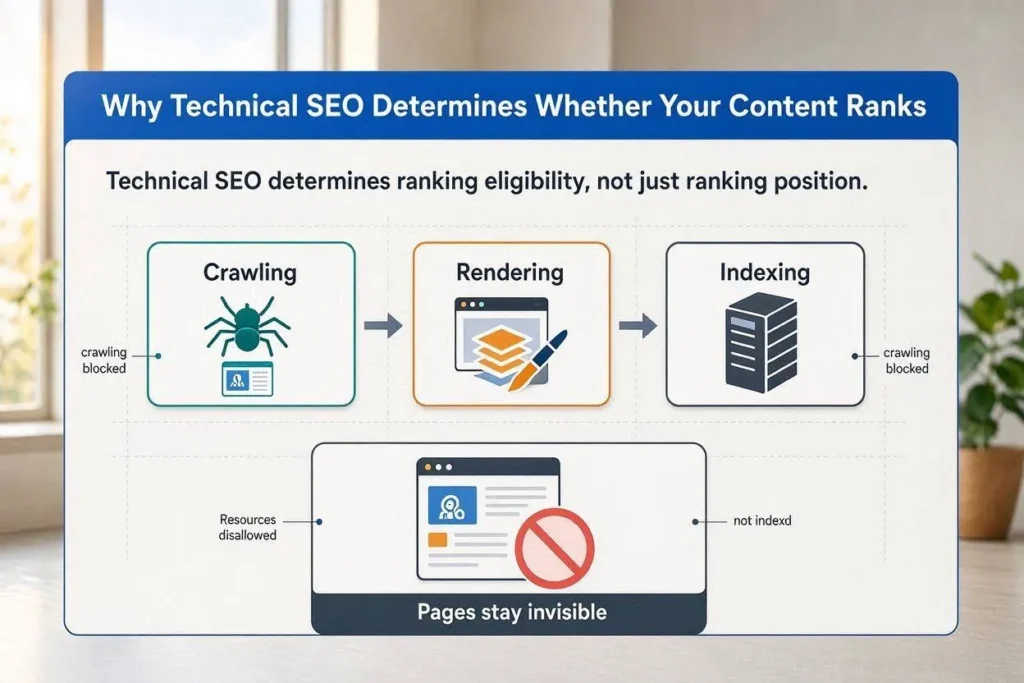
Technical SEO determines ranking eligibility, not just ranking position. Search engines run three sequential processes before any page can compete in search results: crawling, rendering, and indexing. A failure at any one of these three stages removes the page from consideration completely, regardless of content quality or backlink count.
Three consequences follow directly from poor technical SEO:
- Pages stay invisible to search engines despite having strong content and links
- Site speed and mobile usability issues lower user engagement signals, which search algorithms track
- AI search engines skip pages that load slowly, block crawlers, or hide content behind heavy client-side JavaScript
Google confirmed HTTPS (Hypertext Transfer Protocol Secure) as a ranking signal in 2014, and Core Web Vitals became part of the page experience ranking system in 2021. Both changes show a consistent pattern: infrastructure-level factors carry real ranking weight, not just theoretical importance.
How Search Engines Crawl and Index Your Website
Crawling happens when a search engine bot follows links from known pages to discover new ones. Indexing happens after crawling, when the search engine analyzes a page’s content and stores it inside a searchable database. A page must pass through both stages before it can appear in search results.
Robots.txt and Crawl Control
A robots.txt file tells search engine bots and AI crawlers which parts of a site they can access. The file sits at the root domain, formatted as yoursite.com/robots.txt, and uses simple Allow and Disallow directives per user agent.
2026 changes the stakes of robots.txt configuration substantially. Search engines now distinguish between training bots (which scrape content to train large language models) and retrieval bots (which fetch content in real time to answer live user questions). OpenAI’s GPTBot falls into the training category, while OAI-SearchBot handles retrieval for ChatGPT’s search feature. Blocking OAI-SearchBot removes a site from ChatGPT answers entirely, while blocking GPTBot only prevents future model training — a decision with no effect on current search visibility.
Google’s crawl-delay directive gets ignored by Googlebot specifically, so crawl rate for Google requires adjustment inside Google Search Console (GSC) rather than through robots.txt.
XML Sitemaps
An XML sitemap lists every important URL on a site and helps search engines discover pages that internal links might miss. Google engineers have described sitemaps as the second most important discovery source after links, which makes sitemap submission a non-negotiable step for sites launching new sections or migrating domains.
Submit a sitemap through Google Search Console under Indexing > Sitemaps, using the standard sitemap.xml or sitemap_index.xml path. Validate the sitemap regularly, because dead or redirected URLs inside a sitemap waste crawl budget and signal poor site maintenance to search engines.
Canonical Tags and Duplicate Content
A canonical tag tells search engines which version of a page to treat as the original when duplicate or near-duplicate content exists across multiple URLs. The tag uses this format inside the page’s head section: <link rel=”canonical” href=”https://example.com/original-page/” />.
Duplicate content commonly appears through URL parameters, printer-friendly page versions, or www versus non-www domain configurations. Canonical tags consolidate ranking signals onto one URL rather than splitting authority across several near-identical pages.
Core Web Vitals and Page Experience in 2026
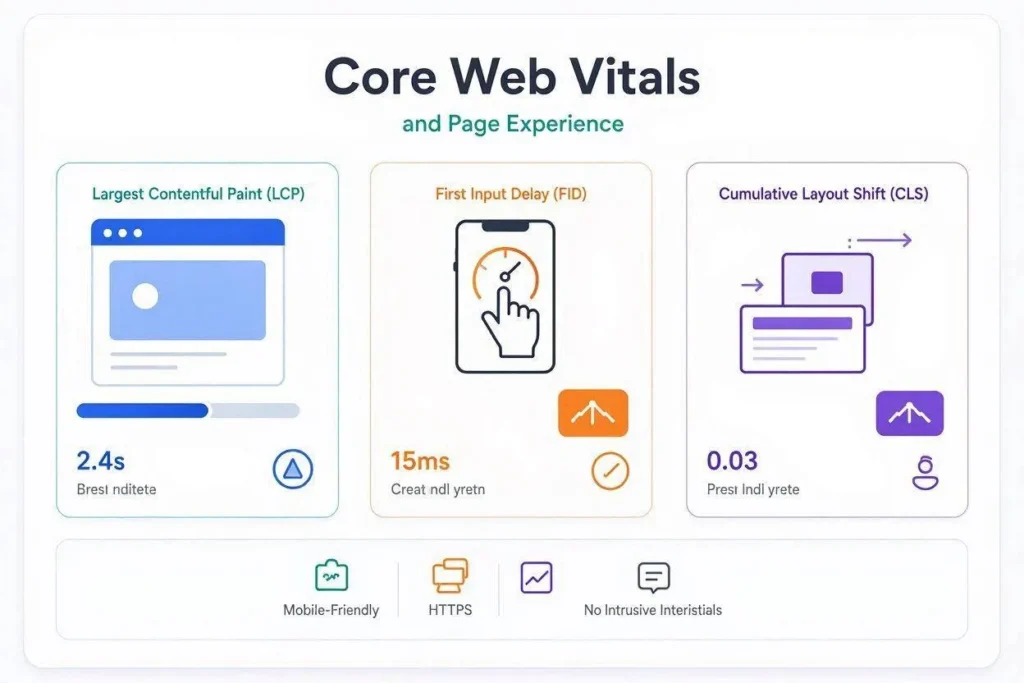
Core Web Vitals measure real-world page experience through three metrics tracked inside Google Search Console and PageSpeed Insights. The metric set changed in 2024, when Google replaced First Input Delay (FID) with Interaction to Next Paint (INP) as the official responsiveness metric.
Interaction to Next Paint (INP)
A good INP score measures 200 milliseconds (ms) or less. Scores above 500 ms count as poor and carry a negative ranking impact. INP measures the full lifespan of a page visit rather than just the first click, covering input delay, JavaScript processing time, and presentation delay for every tap, click, and keypress a user makes.
Developers reduce INP scores using the scheduler.yield() API, which lets long-running JavaScript tasks pause and hand control back to the browser’s main thread. This prevents the page from freezing during heavy background processing. Debouncing input handlers on search bars produces a similar effect by limiting how often the browser fires requests during rapid typing.
Largest Contentful Paint (LCP)
Largest Contentful Paint measures how long the largest visible element on a page takes to load, and Google recommends a target of 2.5 seconds (2,500 ms) or faster. The fetchpriority=”high” HTML attribute applied to a hero image or main product photo tells the browser to download that specific asset before other page resources, often cutting LCP by one to two seconds.
Image format choice affects LCP directly. AVIF (AV1 Image File Format) compresses more efficiently than WebP or JPEG at equivalent visual quality, though a WebP fallback remains necessary for older browsers that lack AVIF support.
JavaScript Rendering: CSR, SSR, and ISR
Rendering architecture determines how quickly search engines and AI crawlers see a page’s actual content. Three approaches dominate modern site-building: Client-Side Rendering (CSR), Server-Side Rendering (SSR), and Incremental Static Regeneration (ISR).
Client-Side Rendering forces the browser to build the page after JavaScript loads, which delays visibility for both users and search engine bots. Server-Side Rendering builds complete HTML on the server before sending it to the browser, giving bots immediate access to content at the cost of slower Time to First Byte (TTFB) under heavy server load. Incremental Static Regeneration serves pre-built static HTML for instant speed while regenerating individual pages in the background whenever underlying data changes, such as price or stock updates on an e-commerce site.
ISR has become the preferred architecture for content-heavy and e-commerce sites in 2026, because it combines static-site speed with dynamic-site freshness. Partial hydration, sometimes called island architecture, extends this efficiency further by loading JavaScript only for interactive page elements — a cart button or image carousel — instead of the entire page.
A related risk affects Single Page Applications (SPAs): Google’s December 2025 documentation update clarified that pages returning non-200 HTTP status codes may get excluded from the rendering queue entirely. A page that serves a 404 status header but relies on client-side JavaScript to display a “related products” section risks having that section go unseen by Googlebot, since the 404 header can stop the rendering process before the JavaScript executes.
Structured Data and Schema Markup
Structured data uses Schema.org vocabulary formatted as JSON-LD (JavaScript Object Notation for Linked Data) to tell search engines and AI systems exactly what a page contains. Product pages, articles, FAQs, and organization details each have dedicated schema types that unlock rich snippets in traditional search and improve the odds of citation inside AI-generated answers.
Schema Drift and How to Prevent It
Schema drift occurs when the data inside a page’s JSON-LD code contradicts the visible content on that page — a product schema stating “InStock” while the visible button reads “Sold Out,” for example. Search engines penalize this mismatch by reducing trust in a site’s structured data across the entire domain, not just the affected page.
Prevent schema drift with automated testing pipelines using tools such as Puppeteer or Cypress. These pipelines render the live page, extract the visible price or availability status, compare that value against the JSON-LD data, and fail the deployment build if the two values do not match.
Definition lists using HTML’s <dl>, <dt>, and <dd> tags improve how large language models parse specification data, since these models recognize <dt> as an entity label and <dd> as its corresponding value. Content formatted this way gets cited by AI answer engines more often than the same information written as a standard paragraph.
Technical SEO for AI Search and Generative Engine Optimization (GEO)
Generative Engine Optimization (GEO) means structuring content so AI systems can retrieve, interpret, and cite it accurately inside generated answers. GEO differs from traditional SEO in one key respect: traditional search returns a ranked list of links, while AI search returns a single synthesized answer built from retrieved content chunks — meaning there is no “position two” inside an AI Overview, only “cited” or “not cited.
AI Overviews now trigger for roughly 18.57% of commercial search queries, based on Semrush’s 2025 study, which means close to one in five product-related searches already returns an AI-generated summary instead of a traditional results list.
Bot Governance: Managing AI Crawlers
Bot governance means configuring robots.txt to allow or block specific AI crawlers based on their function. The table below shows the standard 2026 configuration for e-commerce and content sites:
| Bot | Function | Recommended Setting |
| OAI-SearchBot | Real-time retrieval for ChatGPT Search | Allow |
| GPTBot | Training data collection for future models | Optional block |
| Google-Extended | Training data for Gemini models | Strategic decision, based on Gemini visibility goals |
The BLUF Method for AI Citations
BLUF (Bottom Line Up Front) formatting places the direct answer to a question in the first sentence of a section, before any supporting explanation. AI systems using Retrieval-Augmented Generation (RAG) pull small text chunks from web pages to construct answers, and content buried inside long paragraphs rarely gets retrieved cleanly. A dedicated H2 heading followed immediately by a one-sentence direct answer increases the odds that an AI system extracts and cites that exact section.
International SEO: Hreflang and Multi-Language Sites
Hreflang is an HTML attribute that tells search engines which language and country a specific page version targets, letting Google serve the correct regional version to each searcher. A site with English, Spanish, and Portuguese homepages needs hreflang tags on every version, each pointing to itself and to every alternate version.
Two rules govern correct hreflang implementation. First, every page needs a self-referencing hreflang tag alongside tags pointing to its alternates. Second, hreflang requires a return tag: if the English page links to the German page as an alternate, the German page must link back to the English page, since a missing return tag remains the most common cause of hreflang errors inside Google Search Console. An x-default tag should also point to a language-selector page or global homepage, covering visitors whose browser language does not match any listed alternate.
Common Technical SEO Mistakes That Block Rankings
Six technical SEO mistakes appear repeatedly across audits, regardless of site size or industry:
- Blocking important pages through an overly broad robots.txt disallow rule
- Leaving orphan pages with zero internal links pointing to them
- Running both www and non-www versions of a domain without a redirect between them
- Serving a 200 OK status code on error pages, which creates soft 404s that confuse quality signals
- Allowing redirect chains of three or more hops between the original URL and its final destination
- Missing self-referencing or return hreflang tags on multi-language sites
Each mistake above wastes crawl budget, confuses search engine algorithms, or actively hides content from indexing — three outcomes that no amount of content quality can offset.
Technical SEO Checklist for 2026
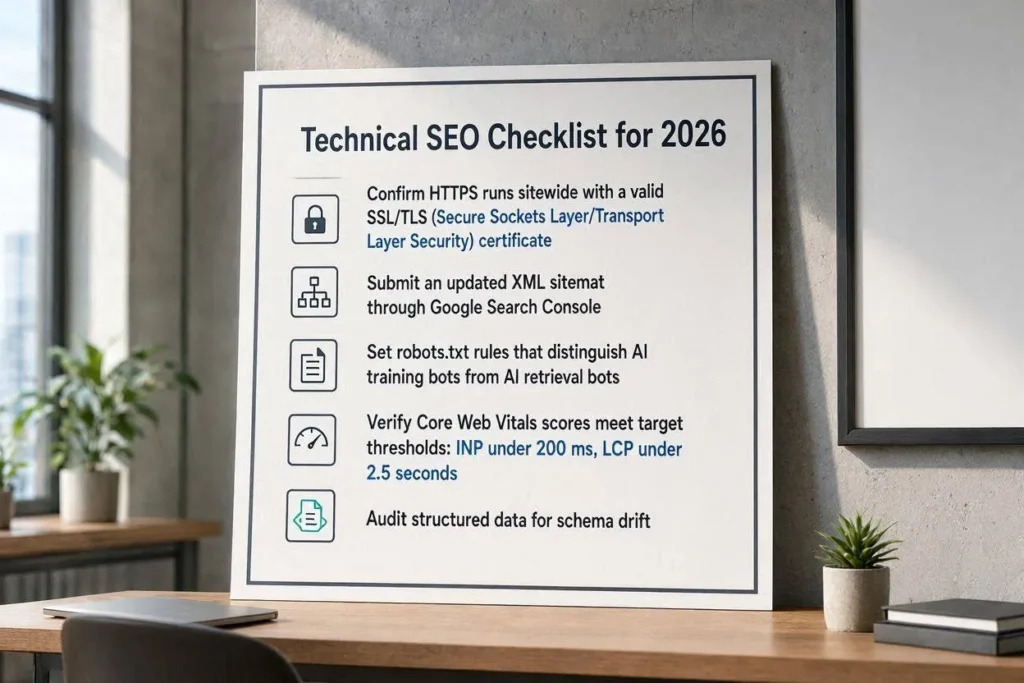
Use this checklist to audit a site’s current technical health:
- Confirm HTTPS runs sitewide with a valid SSL/TLS (Secure Sockets Layer/Transport Layer Security) certificate
- Submit an updated XML sitemap through Google Search Console
- Set robots.txt rules that distinguish AI training bots from AI retrieval bots
- Verify Core Web Vitals scores meet target thresholds: INP under 200 ms, LCP under 2.5 seconds
- Audit structured data for schema drift using automated testing
- Check hreflang tags for self-references and return tags across all language versions
- Review redirect chains and consolidate any chain longer than one hop
- Confirm faceted navigation URLs use canonical tags or noindex rules to prevent crawl waste
- Test mobile usability using the Googlebot Smartphone user agent specifically
- Format specification data using HTML definition lists to improve AI retrieval
Conclusion
Technical SEO keeps a website visible to search engines and AI tools alike. Fast pages, clean code, and accurate structured data matter as much now as crawlability and sitemaps always have.
Run through this guide’s checklist every few months. Search engines change their rules often, so a healthy site today needs regular check-ins to stay healthy tomorrow.