

Online presence management is a marketing discipline: the ongoing process of building, monitoring, and improving how a brand appears across websites, social media, search engines, and review platforms. It blends search marketing, social media marketing, reputation marketing, and content marketing into one coordinated marketing effort. A company with five different star ratings scattered across review platforms and its own website isn’t running effective brand marketing, no matter how strong the underlying product is. Get the fundamentals right, and a marketing team controls its own brand narrative instead of leaving it to chance.
What Is Online Presence Management?
Online presence management (OPM) is a marketing function: shaping and monitoring every digital touchpoint a brand controls, or doesn’t fully control, including its website, social profiles, business directories, and third-party reviews. Unlike a single marketing campaign with a start and end date, OPM never really finishes. New reviews arrive, algorithms shift, and competing marketing campaigns launch daily.
Two things give this marketing discipline its shape:
- A distinct marketing function. OPM sits within marketing and brand messaging, separate from web presence management, which sits closer to IT and technical governance. An IT team handling server uptime and data compliance is doing web presence management; a marketing team responding to reviews and running a brand awareness campaign is doing OPM. Confuse the two and a company ends up overspending on infrastructure while underinvesting in marketing.
- A repeatable marketing process. Marketing goals come first: more traffic, better reviews, stronger brand recognition. A marketing team then plans channels, monitors how the campaign lands, and adjusts the marketing strategy based on the data. Skip the monitoring step and the whole marketing cycle turns into guesswork.
Online Presence vs. Digital Presence vs. Web Presence
These three terms get used interchangeably in marketing conversations, which muddies marketing strategy discussions. Online presence covers websites, social platforms, reviews, and search results, the core surface for brand marketing. Digital presence is broader, folding in apps, paid advertising, and connected devices. Web presence narrows the focus to a single website and how it performs in search.
| Term | Scope | Example |
| Web presence | A single website and how it performs in search | A fast, well-designed site with strong technical SEO |
| Online presence | Website, social platforms, reviews, and search results | A brand’s marketing showing up consistently across Google, social media, and review sites |
| Digital presence | Everything above, plus apps, paid advertising, and connected devices | A brand’s marketing footprint across its site, social channels, a mobile app, and paid campaigns |
A small business might run a strong web presence, a fast, well-designed site, while running a weak marketing presence overall: an unclaimed Google Business Profile, no engagement on social media. Separating the terms helps a marketing team find the actual gap instead of misallocating the marketing budget.
Why Online Presence Management Matters for Marketing Teams

Most buying decisions now start with a search, a review check, or a scroll through social media before a customer ever reaches a sales team. The large majority of consumers research a business online before buying, and most read reviews before deciding, which makes online presence management a core part of any marketing strategy. Skip this and a marketing team is handing that first impression to whatever a competitor’s marketing happens to surface instead.
Four marketing outcomes make the investment worthwhile. Higher search and brand visibility, since optimized marketing content outranks unmanaged competitors. Stronger customer trust, built through consistent brand marketing and prompt review responses. Better lead quality for the sales team, because prospects arrive already familiar with the brand. And faster crisis management, since an active marketing presence lets a brand respond before a bad review spirals into a full reputation crisis.
Brand reputation carries real financial weight for marketing teams, not just goodwill. A company that treats a public complaint as a routine marketing task, responding quickly with a genuine fix rather than a defensive script, rarely ends up in a full-blown reputation crisis. One whose marketing team stays silent for even a few hours can watch a negative narrative take hold and spread faster than any single review would justify on its own.
Core Components of an Online Presence Management Strategy
| Marketing Component | What It Covers | Why It Matters |
| Website and SEO Marketing | On-site content, load speed, mobile experience | Drives the majority of organic marketing traffic |
| Social Media Marketing Strategy | Platform-specific content and engagement | Where most customers first discover a brand |
| Online Reviews and Reputation Marketing | Monitoring and response | Shapes brand perception before purchase |
| Content Marketing and Thought Leadership | Blogs, guides, webinars | Builds long-term marketing authority and ROI |
| Local Marketing and Business Listings | NAP consistency across directories | Determines if local customers can find the business |
| AI Search Marketing Visibility | Schema markup, structured data, factual clarity | Determines citation in AI-generated answers |
Website and SEO Marketing. A website is the one marketing asset a brand fully owns. Organic search remains one of the largest sources of marketing-driven website traffic, which makes keyword-optimized content, fast load times, and mobile responsiveness non-negotiable for any marketing team.
Social Media Marketing Strategy. Social platforms are the real-time layer of a brand’s marketing presence. Many consumers now discover new brands there before any other marketing channel. Posting without a marketing strategy just generates noise; each platform needs its own campaign approach, and a real plan for customer engagement rather than just a publishing schedule.
Online Reviews and Reputation Marketing. A buyer who checks three review sites and finds wildly different ratings on each will hesitate, and hesitation kills conversions. A marketing team that responds to negative feedback with information and a genuine apology converts critics into repeat customers far more often than silence or arguing does.
Content Marketing and Thought Leadership. Marketers consistently point to content marketing as one of the strongest drivers of long-term marketing ROI. For B2B marketing teams especially, thought leadership published under real names with real expertise builds more trust than generic corporate marketing copy.
Local Marketing and Business Listings. NAP (name, address, phone) consistency across directories matters more than most marketing teams realize. A mismatched phone number can quietly cost dozens of marketing-generated calls a month. Local marketing rewards consistent, verified listings with better local search rankings.
AI Search Marketing Visibility. When someone asks an AI assistant to recommend a business or compare services, that assistant pulls from indexed marketing content, schema markup, and third-party mentions, not a ranked list of links. A brand whose marketing team publishes clear, structured facts about services and pricing gets favored over one that buries the same information in vague marketing copy. Treat this the same way marketing teams once treated basic SEO: foundational, not optional.
How to Build an Online Presence Management Strategy in 5 Steps
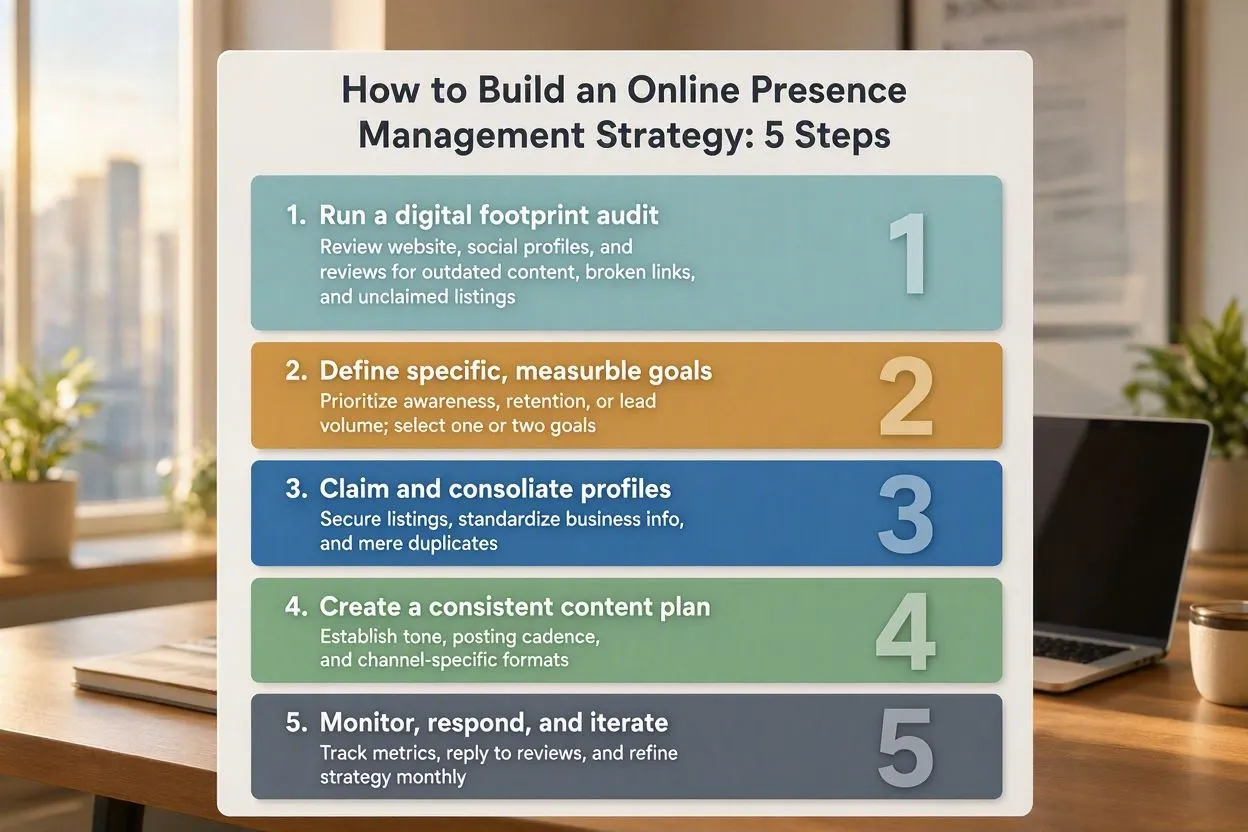
- Run a digital footprint audit. A marketing team should review the website, every social profile, and existing reviews for outdated content, broken links, and unclaimed listings.
- Define specific, measurable marketing goals. A new brand might prioritize marketing awareness; an established one focuses its marketing spend on retention or lead volume. Pick one or two marketing goals, not everything at once.
- Choose marketing channels that fit the audience. A visually driven consumer brand likely belongs on Instagram and TikTok; a B2B marketing team probably gets more from LinkedIn and industry directories.
- Optimize every touchpoint for brand consistency. Marketing voice and messaging should match across the website, social bios, and listings. Mismatched marketing details erode trust fast.
- Monitor marketing performance and adjust monthly. A marketing team should track what’s working and shift the marketing budget toward channels producing real leads, not just impressions.
Skip step one, and the marketing strategy risks solving problems that don’t exist while ignoring the ones that do.
Best Marketing Tools for Online Presence Management
| Category | Tools | Best For |
| SEO and marketing analytics | Google Analytics, Ahrefs, Semrush | Rankings, traffic, keyword gaps |
| Social media marketing management | Buffer, Hootsuite, Sprout Social | Scheduling and multi-platform campaigns |
| Local marketing and listings | Yext, BrightLocal | NAP consistency across directories |
| Reputation marketing and social listening | Brand24, Mention, Prowly | Tracking mentions and sentiment |
Budget-conscious marketing teams can start with free tools like Google Analytics and Search Console before layering in paid marketing platforms once gaps show up in the data. A solo marketer rarely needs a full enterprise suite. A brand managing dozens of locations, or one paying for full online presence management services, needs the marketing automation platforms like Yext provide.
Common Marketing Mistakes in Online Presence Management
- Ignoring negative reviews, which signals marketing indifference even if the issue gets fixed quietly
- Inconsistent brand marketing across platforms: a different logo or tone on social media versus the website
- Skipping marketing KPI tracking, leaving teams guessing at what’s working
- Treating the website as the only marketing channel that matters
- Delaying a marketing response during a reputation crisis
Most of these mistakes come from treating OPM as a one-time marketing project instead of a standing marketing habit. Fix the habit, and most of these stop recurring within a quarter or two.
How to Measure Online Presence Management Success
Marketing success here is measured through visibility metrics, engagement data, and reputation scores tracked over time. Website traffic and organic search rankings show whether the marketing strategy is paying off; social engagement shows whether marketing content resonates; review ratings and response times capture the reputation side of the marketing effort.
Share of voice (SoV), the percentage of industry conversation a brand’s marketing controls versus competitors, works well in crowded markets where raw traffic numbers tell an incomplete marketing story. Sentiment analysis adds a third layer. Review counts can climb while average sentiment quietly turns negative, a pattern raw marketing volume hides. Marketing tools like Brand24 or Mention flag that shift early, before it shows up in a falling star rating.
Brand Marketing Examples

A consumer eyewear brand built its marketing presence around a distinctive customer experience rather than advertising spend alone: a try-at-home marketing program that generated organic social sharing far beyond a typical paid marketing campaign. A B2B software company took a different marketing route, building a free resource library of guides and webinars that positioned its marketing team as a trusted industry authority long before any sales conversation started. A well-known snack brand ran a cultural tie-in marketing campaign timed to a major cultural moment, spreading through fan sharing on social media rather than paid marketing placement. None of these marketing efforts relied on a single channel; each blended a strong website, an active social marketing presence, and a consistent brand voice.
Conclusion
Get the website, social channels, reviews, and listings working together as one marketing system, and a brand’s marketing team starts controlling its own narrative instead of reacting to it. Skip any one piece of the marketing mix and the gaps show up fast, usually as customers who found a competitor’s marketing first. Start with an honest marketing audit, fix what it uncovers, and treat online presence management as routine marketing maintenance rather than emergency triage.