
Search “best time to post on LinkedIn” and you’ll get five different answers in the first five results. One marketing blog swears by 8 AM. Another says 4 PM is king. A third tells you Sunday is dead for B2B brands, while a fourth quietly recommends a Sunday evening slot for campaign teasers.
None of them are lying to you — they’re just measuring slightly different things, on different sample sizes, at different points in the marketing calendar. That inconsistency is exactly why so many marketing teams throw their hands up and just publish content whenever it’s convenient, instead of treating posting time as a real lever in their social media marketing strategy.
Here’s the clearer picture. Across four independent 2026 marketing datasets covering more than 8 million LinkedIn posts and roughly 2 billion engagements, one window shows up again and again as the strongest for brand and content marketing: Tuesday through Thursday, with Wednesday at 4 PM standing out as the single best individual slot.
That’s your starting point for building a LinkedIn content marketing calendar. Everything else in this guide is about sharpening that answer for your specific target audience, content format, and industry vertical.
Why LinkedIn Timing Actually Moves the Needle for Your Marketing Strategy

Posting time on LinkedIn isn’t a vanity detail for your content marketing team — it directly decides how many people in your target market ever see your brand’s content in the first place, and by extension, how much return your marketing effort actually generates. Here’s the mechanic most timing guides skip over.
When you hit publish, LinkedIn doesn’t blast your post to your entire audience. It quietly tests it first, showing it to a small slice — usually somewhere around 2 to 5 percent of your connections. What happens in that initial window, often called the “golden hour,” decides almost everything that follows for your campaign’s reach. If that small group reacts, comments, and lingers on your post, the algorithm reads it as a signal worth amplifying and pushes your marketing message out further. If the post lands in silence, it stays buried, often reaching as little as 5% of its potential audience for good — a wasted impression for any brand awareness or lead generation campaign.
This is the part that connects directly back to timing: you can’t get golden-hour engagement from an audience that’s asleep, commuting in silence, or buried in meetings. Post when your audience is offline, and the algorithm’s test group simply doesn’t respond — not because your content was weak, but because nobody was there to see it. Post when they’re actually scrolling, and you give your content a real shot at that first wave of momentum.
There’s a second layer worth knowing: LinkedIn now weighs dwell time — how long someone actually pauses on your post — alongside straightforward likes and comments. A post that gets read slowly and thoughtfully during a calm part of someone’s day will often out-signal a post that gets a quick like during a rushed commute. That’s part of why certain windows consistently outperform others, format by format, which we’ll get into shortly.
So What’s the Real Answer? Tuesday–Thursday, Anchored on Wednesday
Strip away the noise, and the consensus across the major 2026 studies lands here: the mid-week window, Tuesday through Thursday, is where LinkedIn engagement concentrates. Within that window, Wednesday consistently comes out on top, and a growing number of datasets now point to Wednesday at 4 PM as the strongest single slot of the week.
That last detail — the shift toward afternoon and evening — is the most important change from prior years. Older posting advice, built on 2024 and early-2025 patterns, leaned almost entirely on the 8–11 AM window. Some sources still repeat that advice today. But the more recent 2026 data tells a different story: late afternoon and evening hours, roughly 3 PM to 8 PM, are now pulling engagement that rivals or beats the traditional morning slot, especially on Wednesdays and Fridays.
The likely reason isn’t algorithmic — it’s behavioral. Professionals haven’t stopped using LinkedIn for career content; they’ve just shifted when they do it. Commute scrolling, a lull after the last meeting of the day, or a few minutes of catching up on industry news before logging off — these moments have become real engagement windows that simply didn’t carry the same weight a couple of years ago.
The Week, Day by Day
| Day | Peak Window | What Tends to Work |
| Monday | 11 AM–2 PM | Light, motivational, week-starter content |
| Tuesday | 10 AM–12 PM, 4–5 PM | Thought leadership, high-priority posts |
| Wednesday | 10 AM–12 PM, 4 PM | Your strongest data, frameworks, sharpest opinions |
| Thursday | 10 AM–2 PM, 5–7 PM | Trend pieces, forward-looking takes |
| Friday | 9–11 AM, 3–4 PM | Recaps, wins, week-in-review |
| Saturday | 9 AM–12 PM | Personal stories, creator-style content |
| Sunday | Largely avoid for B2B | Niche exception only |
A few things worth calling out beyond the table. Monday rewards showing up more than it rewards brilliance — most people are still clearing inboxes, so save your best material for a day when attention isn’t already split three ways.
Friday afternoon, on the other hand, is consistently underrated. By 3 or 4 PM on a Friday, the week’s urgency has eased off and people actually read more carefully, which makes it a strong home for reflective or “lessons learned” content. Saturday is a genuine wildcard: total posting volume drops noticeably, which means less competition for whatever audience does show up — mainly relevant if you’re running a personal brand rather than a company page.
Adjust for Where Your Audience Actually Lives
A lot of timing advice says “post in your audience’s time zone” and leaves it there, which isn’t much help if your following is spread across the country. Here’s Wednesday’s 4 PM peak translated across the major U.S. time zones:
| Time Zone | Local Equivalent of 4 PM ET | Realistic Daily Window |
| Eastern | 4:00 PM | 3–8 PM |
| Central | 3:00 PM | 2–7 PM |
| Mountain | 2:00 PM | 1–6 PM |
| Pacific | 1:00 PM | 12–5 PM |
If your audience is broadly spread across the U.S., anchoring to 4 PM Eastern is a reasonable default — it lands inside the active window for Central and Mountain audiences too, and Pacific-time followers will still catch it at 1 PM, well within their own active hours. Teams whose audience is concentrated on the West Coast — a lot of SaaS and startup accounts fall into this bucket — may get better mileage anchoring to 1 PM Pacific instead. The day doesn’t change either way; Wednesday holds up regardless of which coast you’re optimizing for.
Timing Changes Depending on the Format You’re Using
This is a detail a lot of generic posting-time advice glosses over: the type of content you’re publishing changes its ideal window, sometimes significantly.
- Plain text posts tend to do best early, around 7–9 AM, when people are skimming quickly before their day picks up pace.
- Carousels (document posts) need a reader who’s willing to slow down and swipe through multiple slides — that’s lunch (12–2 PM) or the end-of-day wind-down (4–6 PM), not a rushed morning scroll. Carousels are also worth prioritizing as a format on their own merits; multiple 2026 studies put their engagement well above plain text posts, sometimes by several hundred percent, but only when they land in a window where people actually have a moment to pause.
- Video lives or dies in dwell time. Lunch and the 5–7 PM post-work scroll are where people actually stop and watch rather than scroll past. Mornings are consistently the weakest window for video, since people are moving fast through their feed before the workday starts.
- Polls need an early burst of votes to get any algorithmic lift, which makes the Tuesday–Wednesday, 10 AM–noon window their best shot.
- LinkedIn articles ask for a few uninterrupted minutes, so they tend to land better earlier in the week, Tuesday through Thursday mornings, before the day’s meetings pile up.
Your Industry Vertical Changes the Marketing Math Too
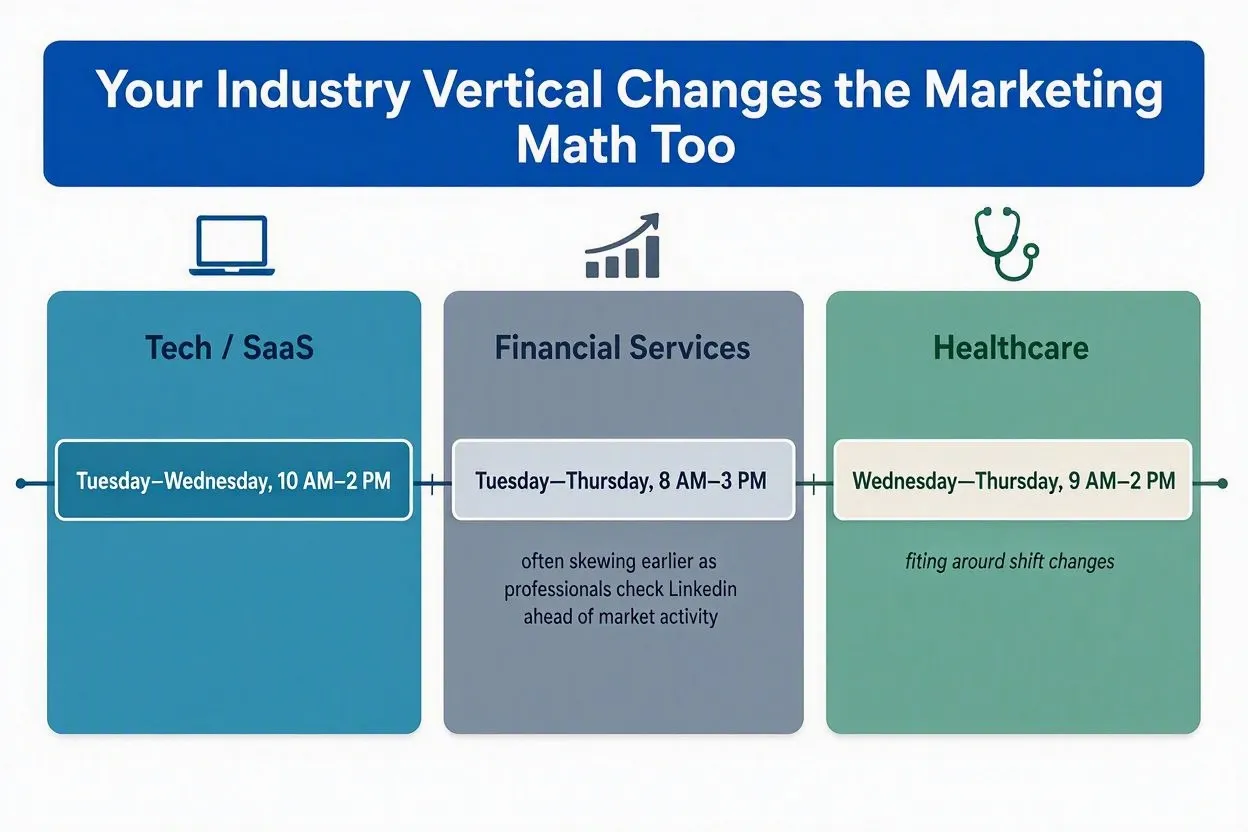
A hospital administrator and a SaaS account executive are not opening LinkedIn at the same point in their day, and any well-targeted B2B marketing campaign needs to account for that:
- Tech / SaaS: Tuesday–Wednesday, 10 AM–2 PM
- Financial Services: Tuesday–Thursday, 8 AM–3 PM, often skewing earlier as professionals check LinkedIn ahead of market activity
- Healthcare: Wednesday–Thursday, 9 AM–2 PM, fitting around shift changes and administrative gaps
- Marketing / Agencies: Wednesday–Thursday, 10 AM–noon, lining up with campaign review cycles
- Legal & Government: Thursday, 10 AM–5 PM, mapping closely to standard office hours
If you know your audience’s industry, treat that as a sharper filter than the general weekly benchmark — it’ll get you closer to the right window faster than starting from scratch.
Why Do the Studies Disagree With Each Other?
It’s worth addressing this directly, because if you’ve read more than one “best time to post” guide, you’ve probably noticed the numbers don’t match. Some studies anchor on 8–11 AM. Others point squarely at 3–5 PM. A few split the difference and land somewhere around noon.
Part of this comes down to when the data was collected — platforms like LinkedIn shift their engagement patterns gradually over the course of a year, and a study run in January won’t necessarily reflect April’s behavior.
Part of it comes down to whose posts were analyzed — a dataset weighted toward large B2B company pages will look different from one weighted toward individual creators or small agencies. And part of it is simply noise: engagement rate is a statistic, not a law, and any single dataset will have some natural variation in exactly where the peak lands.
The practical takeaway isn’t to chase the “correct” study. It’s to treat the mid-week, Tuesday-through-Thursday window as a reliable floor that nearly every dataset agrees on, then use your own analytics to find exactly where, within that window, your specific audience peaks.
A Simple Way to Find Your Own Best Time
Generic benchmarks get you in the right neighborhood. Your own data gets you the exact address. Here’s a straightforward four-step process:
- Set a baseline. Post Tuesday through Thursday at 4 PM in your primary audience’s time zone for four consecutive weeks. Keep everything else — format, length, topic style — as consistent as you can.
- Pull up your LinkedIn analytics. Go to your profile or page analytics and check follower demographics by location. If most of your audience sits in Central time, your “4 PM ET” benchmark is actually landing an hour later for them than intended.
- Change one variable at a time. Once your baseline is established, shift a single thing — say, move your Wednesday post from 4 PM to 7 AM — and run that for two weeks before comparing. Changing the time and the format in the same test tells you nothing useful.
- Judge by engagement rate, not raw impressions. A post that reaches 1,000 people and gets 80 genuine reactions is healthier than one that reaches 3,000 and gets 50 — the second number often means LinkedIn showed your post to people who weren’t actually active at that moment.
How Often Should You Actually Post?
Timing without consistency doesn’t accomplish much on its own. LinkedIn’s distribution model rewards accounts that show up on a predictable rhythm, partly because consistent posting on a clear topic helps the algorithm understand what you’re about and who to show you to.
For most B2B accounts, three to five posts per week is a sustainable sweet spot — enough to build momentum without burning out your idea pipeline. Two posts a week is a reasonable floor if you’re prioritizing quality over frequency.
Daily posting can work, but only if you can genuinely sustain content quality at that pace; a single sharp post on Wednesday will outperform five forgettable ones spread across the week, every time.
Mistakes That Quietly Undercut Good Timing
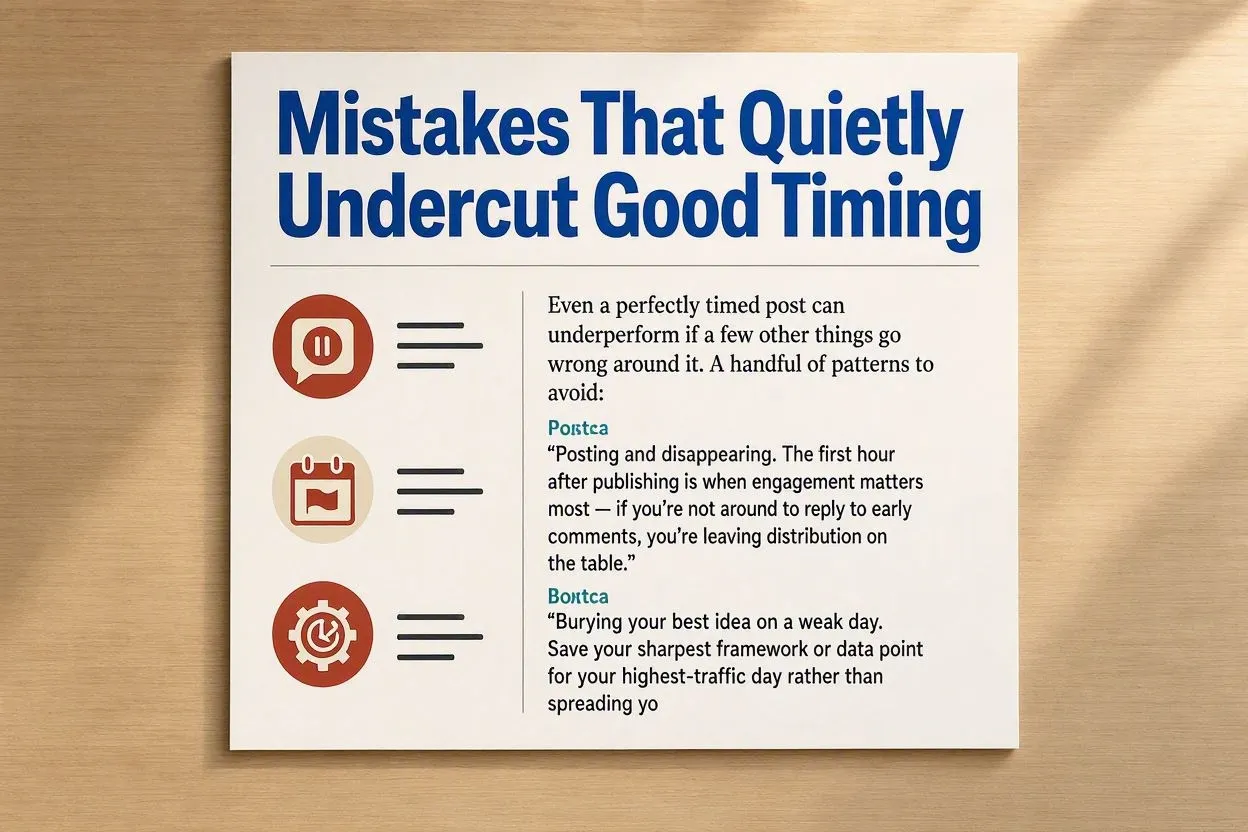
Even a perfectly timed post can underperform if a few other things go wrong around it. A handful of patterns to avoid:
- Posting and disappearing. The first hour after publishing is when engagement matters most — if you’re not around to reply to early comments, you’re leaving distribution on the table.
- Burying your best idea on a weak day. Save your sharpest framework or data point for your highest-traffic day rather than spreading your best and weakest content evenly across the week.
- Ignoring format-specific timing. A carousel posted at 8 AM and a text post at 5 PM are both fighting their format’s natural rhythm — match the content type to its best window, not just the day.
- Treating every Sunday or Saturday post the same. Weekend timing only works for personal-brand or creator-style content; B2B audiences are reliably quiet on weekends regardless of how good the post is.
Conclusion
If you only take one thing from this guide, make it this: post Tuesday through Thursday, with Wednesday at 4 PM as your anchor, then refine from there using your own analytics. The benchmark gets you into the right neighborhood. Your data gets you the exact address.
Every table and breakdown above — by day, by time zone, by format, by industry — exists to help you skip the months of trial and error most accounts go through before they find their rhythm. But none of it replaces watching your own numbers. The studies tell you where to start; your audience tells you where to land.
Start with a four-week baseline at that slot, check where your followers are actually located, and adjust one variable at a time. Consistency will do more for your reach over time than chasing a theoretically perfect moment — a solid post published every Wednesday at 4 PM will beat an occasional brilliant post squeezed in whenever you remember to hit publish.
Your next step: pick your anchor slot from the tables above, commit to it for the next four weeks, and check your analytics before you change anything. That’s the whole system — no guesswork required.