
AI digital marketing means using tools like Claude, Surfer SEO, and Ahrefs to automate the repetitive parts of agency work: content drafts, keyword research, outreach, ad bidding, so a small team can produce what used to take twice the headcount. This guide covers 8 working marketing use cases, real marketing case studies with numbers, the best AI marketing tools for 2026, a full guest-post outreach workflow, and what’s coming next in AI search visibility (AEO, GEO, and AI browsers).
What nobody tells you about AI and marketing
Picture a 3-person agency that triples its monthly guest post placements without hiring anyone new, by swapping 4 hours of daily manual outreach for a 20-minute AI workflow. That’s the kind of result agencies are reporting with this shift. [source needed if this is meant to cite a specific, named agency rather than an illustrative example]
That’s the real story of AI digital marketing in 2026. It’s not robots replacing marketers, and it’s not some distant tech future. It’s a practical shift in how agencies operate day to day, and it’s already splitting the agencies growing fast from the ones stuck at the same revenue ceiling for years.
This guide is written for marketing agencies specifically, especially ones doing content, SEO, guest posting, and link building. By the end, you’ll know which 8 workflows to change first, which AI marketing tools actually earn their subscription fee, where most agencies trip themselves up, and how AI search visibility is about to change what “ranking” even means.
What is AI digital marketing?

AI digital marketing means using AI tools to handle, speed up, and scale marketing tasks that used to need full human effort at every step.
Think about what your team does every week: research keywords, write content, send outreach emails, dig through campaign data, adjust ad bids, segment email lists. Most of that work follows patterns, and patterns are exactly what AI is good at recognizing and acting on.
Three technologies do most of the heavy lifting:
Machine learning (ML) studies past results, like which ads converted, which audiences clicked, which subject lines got opened, and predicts what’s likely to work on the next campaign. Your Google Ads account already leans on ML every time it adjusts a bid on its own.
Natural language processing (NLP) reads and writes human text. Every AI writing tool runs on it. So does Google, when it reads your article and judges whether it actually covers the topic or is just stuffed with keywords.
Predictive analytics forecasts outcomes before you spend a dollar. Which customer segment converts best this month? Which channel hits your client’s target cost-per-acquisition (CPA)? Predictive models try to answer these before the campaign even launches.
Put those three together and a small agency team can handle a workload that used to take twice the headcount. A traditional agency reacts to last month’s numbers. An AI-powered one acts on next month’s forecast.
Why your agency can’t afford to ignore AI in 2026
Here’s the uncomfortable part: agencies that adopted AI 12 months ago are now running at a cost and speed advantage that’s genuinely hard to close by hand.
The numbers back it up. A 2025 McKinsey study found 71% of consumers now expect personalized experiences, and get visibly frustrated when they don’t get them. Agencies delivering that personalization at scale are the ones using AI. Everyone else is delivering it to a fraction of their client’s audience, and calling it a day.
A few data points worth sitting with:
- 80% of marketers using generative AI report measurable ROI (eMarketer, 2025)
- 95% of organizations using AI in service operations report time and cost savings (Salesforce State of Service, 2025)
- 89% of marketers now use generative AI somewhere in their content workflow (Content Marketing Institute)
- Personalization leaders grow revenue 10 percentage points a year faster than competitors who skip it (BCG Personalization Index, 2024)
- One major European brand cut resolution time from 125 minutes to seconds using AI-assisted service (McKinsey case study)
For agencies, that translates into four fairly blunt advantages: lower cost per deliverable, faster turnaround, more output without adding headcount, and better campaign results from sharper targeting. Agencies that resisted marketing automation six years ago lost real ground to the ones who moved early. The same thing is happening now with AI, just faster.
How AI is used in digital marketing: 8 practical use cases
None of these are experimental. Every one is running on real client accounts right now.
1. Content creation at scale
An AI tool can produce a solid 1,500-word first draft in under 4 minutes. A human editor takes that draft, adds original examples, fixes the tone, and gets it to publishable quality in 25 to 30 minutes. That’s 35 minutes total instead of 4 hours.
For a content agency producing 20 articles a month per client, that shift from 80 hours of writing to 12 changes the whole economics of the service. You can take on more clients at the same margin, or give existing clients more content for the same cost.
Claude and Jasper work well for drafting, Surfer SEO handles semantic optimization, and Grammarly or Hemingway catch what’s left for readability. Each tool covers a different stage of production.
Google’s actual position on AI content: if it’s accurate, edited, and genuinely useful to readers, it’s treated the same as content a human wrote start to finish. The risk isn’t using AI. It’s publishing thin, unedited AI output that adds nothing.
2. SEO and keyword research
Keyword research used to eat a full day. With AI tools it takes about 45 minutes, and the output is usually better organized than what you’d get manually.
Semrush and Ahrefs both cluster keywords by search intent automatically. Instead of sorting 500 keywords into topic groups by hand, you get pre-built clusters with content brief suggestions already attached.
More useful still: NLP-based optimization tools read your draft roughly the way Google does. Surfer SEO compares your article against the top 10 ranking pages and flags which semantic entities, related topics, and LSI keywords are missing. You fix the gaps before publishing, not three months later while wondering why the page is stuck on page 2.
Agencies ranking consistently in 2026 aren’t chasing individual keywords anymore. They’re building topical authority, covering every related question and subtopic around a primary keyword cluster. AI is what makes mapping and actually executing an entire cluster realistic for a small team.
3. Guest post outreach automation
There’s a hard ceiling on manual guest post outreach. One person, working efficiently, sends 30 to 40 personalized emails a day. With an AI workflow, that same person sends 150 to 200 a day at the same or better quality: discovery, qualification, personalized pitches, and follow-up all running with minimal manual touch. A setup like this can scale outreach volume 4 to 5x without adding headcount or losing the personalization that actually drives replies. The full mechanics, including the exact filters and prompt structure, are in the guest post workflow section below.
4. AI backlink building strategy
AI doesn’t build backlinks by itself. What it does is make every part of the link building process faster and more precise, and that’s really what determines how many quality placements you close each month: anchor text ratios that avoid over-optimization, competitor link gap lists, link bait content that earns links passively, and niche site prospecting that used to take two days and now takes two hours. Agencies using AI across these areas report roughly 3x faster prospecting and 40 to 60% higher response rates compared to standard template campaigns. See the anchor text and link bait detail in the workflow section below.
5. Email marketing automation
AI-powered email marketing does more than schedule sends. Platforms like Klaviyo and HubSpot use machine learning to find the best send time for each subscriber, predict which subject lines will lift opens for a given segment, and trigger campaigns off real behavioral signals instead of just list membership.
HubSpot found that 95% of marketers using generative AI for email creation rate the output effective. Subject line testing runs on its own; the winning variant replaces the control and the campaign updates without anyone logging in.
For agencies managing 8 to 10 client email lists at once, AI cuts campaign build time by roughly 60% while improving results through better segmentation. Same billable output, roughly a third of the labor.
6. Paid ad targeting and bidding
Every major ad platform already runs on AI. Google Performance Max, Meta Advantage+, and programmatic DSPs all use ML to place ads, adjust bids live, and rotate creative based on real-time performance.
The agencies pulling ahead of competitors aren’t doing anything exotic. They’re feeding cleaner first-party data, email lists, purchase history, CRM records, into these platforms, often through a customer data platform (CDP) that unifies those sources into one profile per customer. Better input means the optimization has sharper signals to work with, which shows up as lower CPA and higher ROAS.
Supply path optimization using AI can cut CPM by up to 40% while holding viewability and completion rates steady. On a $50,000 monthly media budget, that’s $20,000 recaptured without touching a single creative.
7. Predictive analytics and campaign forecasting
Most agencies show clients what happened last month. The ones charging premium rates show clients what’s going to happen next month, and then deliver on it.
Google Analytics 4 already includes purchase probability, churn probability, and predictive audience segments you can push straight into Google Ads, no extra tool or budget needed. Twilio Segment reported a 57% jump in predictive traits being actively used in campaigns in 2025.
For client reporting, this changes the whole conversation. Instead of “here’s what your campaign did,” it becomes “here’s what your next campaign will do, and here’s the audience and channel mix we’re using to hit it.” Clients pay more for that kind of certainty. BCG’s Personalization Index found that agencies and brands using predictive targeting grow revenue 10 percentage points a year faster than those relying on demographics alone.
8. Chatbots and customer experience
The chatbots running in 2026 aren’t the clunky FAQ bots from three years ago. LLM-based chatbots handle multi-turn conversations, qualify leads against real criteria, book appointments directly into calendars, and only hand off to a human when the situation actually needs one.
McKinsey tracked a European bank that swapped a rules-based chatbot for a generative AI system and saw it outperform the old one by 20% within 7 weeks. One retail case study showed AI resolving 44% of incoming requests and cutting resolution time from a 40-minute average down to under 4 minutes. [source needed: name the retailer or report]
For agencies offering CRO or website audit services, deploying an AI chatbot is one of the fastest wins on the table. Build time is 3 to 5 days, and measurable impact on lead capture usually shows up within the first month.
The real benefits, with numbers
After 90 days of proper AI integration, here’s roughly what agencies are seeing:
- Faster content output. A 70 to 80% cut in production time. A 2,000-word article goes from 4 hours to 35 minutes when AI drafts and a human edits. One content manager ends up handling 3x the monthly output.
- Lower cost per deliverable. 50 to 60% cost reduction per content piece versus fully human-written work, which either goes back into margin or funds client acquisition.
- Sharper audience targeting. ML finds segments manual analysis just misses. Harley-Davidson’s NYC dealership saw leads jump 2,930% after switching to AI-powered targeting. [source needed]
- Real-time optimization. AI adjusts bids, creative, and budget as results come in, not at next week’s check-in. Shutterfly’s AI-optimized CTV campaign dropped cost per new customer from $243 to $57 in 3 months, with no creative changes. [source needed]
- Personalization at scale. One marketing manager can’t personalize content for 80,000 contacts by hand. AI does it without adding labor cost.
- Forecast-based decisions. Agency planning moves from “what happened” to “what will happen,” which usually means fewer dollars going to audiences the data already says won’t convert.
Two case studies with actual numbers
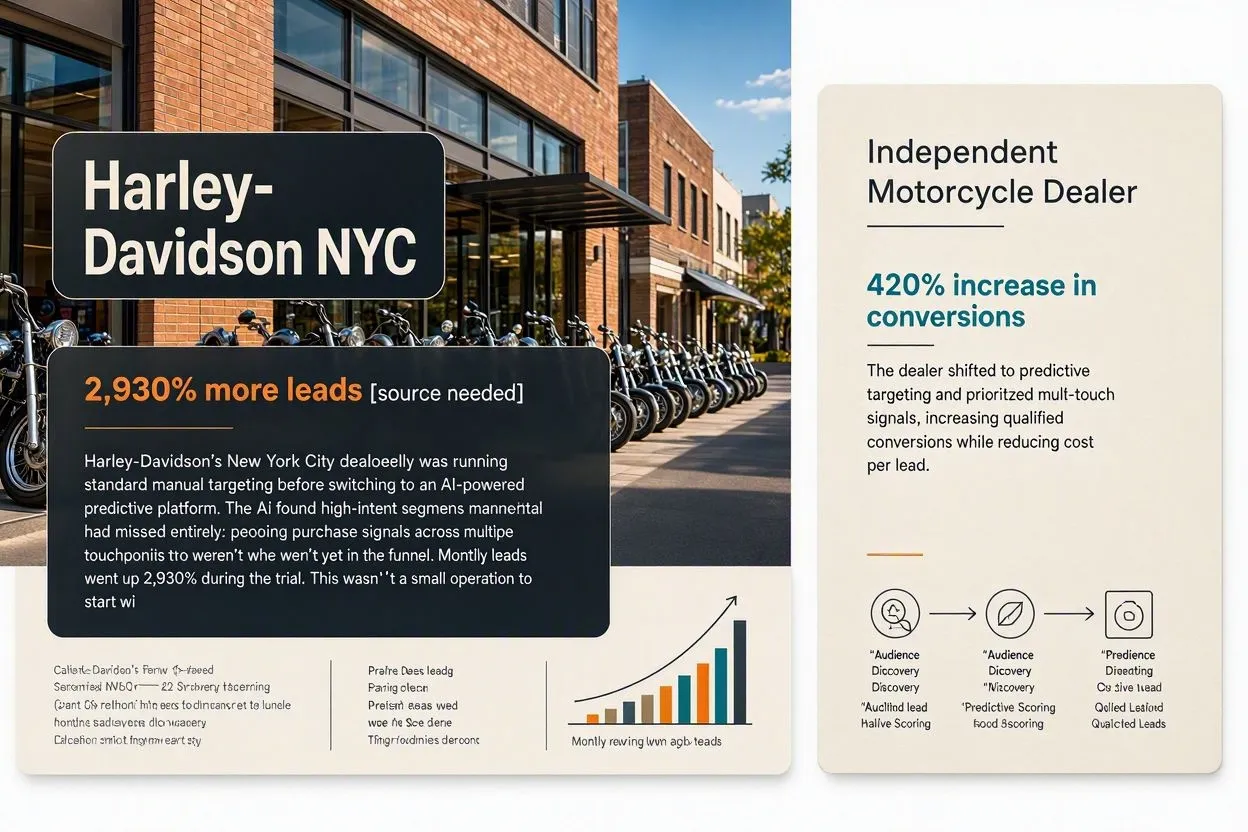
Harley-Davidson NYC: 2,930% more leads [source needed]
Harley-Davidson’s New York City dealership was running standard manual targeting before switching to an AI-powered predictive platform. The AI found high-intent segments manual targeting had missed entirely: people showing purchase signals across multiple touchpoints who weren’t yet in the funnel.
Monthly leads went up 2,930% during the trial. This wasn’t a small operation to start with, which makes a 29x jump from a targeting change alone (not a budget increase) a pretty stark example of how much potential manual targeting leaves sitting on the table. Attach the original case study or press release before publishing, or soften the number if it can’t be verified.
Shutterfly: 77% drop in cost per new customer
Shutterfly ran a connected TV campaign using an AI algorithm that reallocated media spend weekly based on live performance. It prioritized markets with high category interest but low brand awareness, a combination manual media planning rarely catches in real time.
New-customer ROAS grew from $0.31 in October to $1.49 in December. Cost per new customer dropped from $243 to $57, a 77% reduction in three months. Creative stayed the same. Budget stayed the same. The AI just changed where the money went. Attach the original case study before publishing.
A hypothetical: what a guest post workflow like this could look like
This isn’t a documented case study, it’s a composite illustration of the kind of shift a 4-person SEO agency could see by moving from manual outreach to the AI workflow described earlier: Browse AI for prospecting, Ahrefs for qualification, Claude for pitch writing, Zapier for follow-ups.
A plausible before-and-after: something like 40 emails a day and 18 placements a month manually, versus 200 emails a day and 90 placements a month with the workflow automated, assuming response rate holds steady. Treat these as directional numbers to sanity-check your own results against, not as a guarantee. If you or a client run this workflow and get real numbers, swap them in here as an actual case study.
Best AI tools for agencies in 2026
Ten tools, each filling a different gap. None of these are sponsored placements.
| Tool | Primary use | Free plan | Monthly cost | Best for |
| Claude | Content drafts, outreach emails, strategy | Yes | $20 | All-round agency work |
| Surfer SEO | On-page content optimization | No | $89 | SEO content scoring |
| Semrush | Keyword clusters, link gap analysis | Limited | $139 | SEO research and audits |
| Ahrefs | Backlink profile, competitor gaps | Limited | $129 | Link building prospecting |
| Jasper AI | Long-form content at scale | No | $49 | High-volume content |
| Gumloop | AI workflow automation | Yes | $97 | Outreach automation |
| ContentShake AI | SEO blog writing with Semrush data | Yes | $60 | Blog production |
| Browse AI | Web scraping for site prospecting | Yes | $48 | Guest post discovery |
| HubSpot AI | Email marketing and CRM | Yes | $15 | Client email campaigns |
| Zapier | Connecting tools, follow-up sequences | Yes | $29 | Workflow automation |
Prices above are approximate and change often, verify current plans before publishing or quoting them to clients.
A solid 4-tool stack for a guest post agency: Ahrefs (129)+BrowseAI(48) + Claude (20)+Zapier(29), $226 a month total. That covers the full cycle: prospecting, qualification, personalized outreach, and follow-up.
AI for guest posts and backlink building: the full workflow
Most broad AI-marketing guides skip this part entirely. Here’s the complete process, from finding target sites to closing a placement.
Phase 1: Site discovery
Finding quality guest post targets by hand takes 2 to 3 hours a day. An AI workflow takes about 20 minutes and turns up more sites in the process.
Set up a Gumloop or Browse AI workflow with these parameters: search “write for us [your niche]” for blogs actively accepting posts, and “[niche] + guest post guidelines” for editorial standards pages. Filter for DA 25 minimum, a post published in the last 60 days, and a visible contact email. Export site name, URL, contact page, and last post title straight to a Google Sheet.
A workflow like this can turn up 300 to 500 qualified raw prospects a day, against 20 to 30 on a good manual day. That’s roughly 15x the volume before outreach even begins.
Phase 2: Qualification
Raw prospect volume is useless without filtering. Connect your sheet to an Ahrefs API integration and run each URL through a DA check, spam score check, and topical relevance score automatically. Set hard filters: DA under 25 out, spam score above 15% out, nothing posted in 90 days out. What’s left is a clean list worth actually pursuing.
Phase 3: Personalized outreach
This is the step that decides your response rate. A generic pitch gets 2 to 3% replies. A personalized, site-specific one gets 10 to 15%.
A Claude prompt structure worth reusing: “Write a 100 to 120 word guest post pitch email to [editor name] at [site name]. The site covers [niche]. Their most recent post is titled [post title] and covers [brief summary]. I want to pitch an article about [your topic]. My name is [name] from [agency]. Make it direct and specific to their audience, no generic opener, no flattery, no ‘I hope this finds you well.’ Get straight to why this fits their readers.”
Done right, every email reads like a human wrote it for that specific editor, because the AI is working from real site-level information instead of a recycled template.
Phase 4: Anchor text strategy
Most link building agencies land the placement and completely ignore anchor text strategy, which is exactly how clients end up with an over-optimized profile that triggers a ranking drop.
Export the client’s current backlink profile from Ahrefs and feed the anchor data into Claude: “Analyze this anchor text distribution. Tell me the current ratio of branded, exact-match, partial-match, and generic anchors. Based on a natural link profile for [niche], what should the ratio be for the next 30 placements?” The output is a specific anchor plan for each placement, catching the over-optimization problem before it happens.
Phase 5: Link bait content that earns links passively
The strongest links come without any outreach at all. You publish something genuinely useful and other sites link to it naturally when they write about the same topic.
Three formats AI handles well: original statistics posts that pull publicly available data into one authoritative page other bloggers cite as a source, tool comparison articles (“Tool A vs Tool B for [use case]”) that pick up links from review sites and social shares, and free resource or template pages that other sites reference when recommending tools in your niche.
AI search visibility: AEO, GEO, and AI browsers
Traditional SEO optimizes for a ranked list of blue links. That’s no longer the whole picture, and this is the part most AI marketing guides either skip or mention in passing.
Generative Engine Optimization (GEO) is about getting your content cited inside an AI-generated answer, not just ranked below it. Google AI Mode, Perplexity, and ChatGPT Search all answer queries by pulling from content they judge trustworthy and well-structured. Agencies optimizing for entity coverage, structured data, and credible sourcing now will show up inside AI answers well before competitors who are still chasing position one in the old sense.
Answer Engine Optimization (AEO) is the sibling discipline: structuring content specifically to be extracted and quoted as a direct answer, clear question-and-answer formatting, concise definitions up top, and content that resolves a query in one or two sentences before going deeper. AEO and GEO overlap heavily, but AEO is more about the format (how easily an AI can lift a clean answer out of your page) while GEO is more about trust and citation (whether the AI treats your source as worth citing at all).
AI browsers are the newer wrinkle. Agent-driven browsers like OpenAI’s Atlas and Perplexity’s Comet navigate pages, click through tasks, and complete actions on a user’s behalf, rather than a person scrolling and clicking themselves. That’s already splitting the web into two versions of the same page: one built for human scrolling, one that needs to be readable and actionable by an agent. Brands and agencies that structure content with clear semantic HTML, product metadata, and schema markup for AI crawlers will have a real visibility advantage as this shift plays out; sites that don’t will simply be harder for an agent to parse and act on. [trend flagged by industry reports as of late 2025 and worth confirming against the latest AI browser adoption data before publishing]
Zero-click search is the practical consequence of all this. When an AI answer resolves a query directly in the results page, or inside a chat interface, fewer users click through to a website at all. Ranking well is no longer enough on its own; the goal shifts to being the source an AI trusts enough to cite, and building visibility that shows up even without a click.
First-party data as the underlying asset. Third-party cookies are essentially gone. Agencies with their own first-party data, email lists, loyalty programs, purchase history, feed better signals into AI systems, typically through a customer data platform (CDP) that unifies those sources into a single customer profile. Better signals mean better ML optimization across ads, personalization, and forecasting, and the data quality gap between agencies is only going to widen over the next 18 months.
Agentic AI for campaign management. AI agents that run entire marketing workflows on their own are moving out of pilot projects and into standard operations. Gartner projects 33% of enterprise software will include agentic AI by 2028. For agencies, that means prospecting, outreach, reporting, and optimization running continuously, with humans checking in at defined points instead of every single step.
Visual and voice search. Google Lens processes billions of visual searches a month [source needed for exact figure], and voice search usage isn’t going anywhere across key demographics. Strategies that ignore image metadata, structured product data, and conversational content formats are already leaking a growing share of search traffic, on top of what’s leaking to zero-click AI answers.
Challenges and risks worth managing

AI gives agencies real, measurable advantages. It also creates four risks worth taking seriously instead of ignoring.
Misreading Google’s AI content policy. Google doesn’t penalize content for being AI-generated, full stop. Its Helpful Content System targets low-quality, thin, unhelpful content regardless of who or what wrote it. An unedited AI article that adds nothing fails that test. A well-edited, accurate, genuinely useful AI-assisted one passes it. The distinction is quality, not method. Treat AI output as a first draft that needs human editing, original examples, and fact-checking before it goes live. Agencies publishing unedited AI content at volume are the ones seeing ranking drops.
Data privacy and compliance. Any AI tool touching customer data has to comply with GDPR, CCPA, and local rules. Check three things before feeding client data into a platform: where it’s stored, how long it’s retained, and whether putting customer information into a public AI model violates the client’s own data handling obligations. Simple rule: don’t feed PII into a public AI model without reading the provider’s data processing terms first.
Brand voice going generic. AI writes in the style of average content, because it was trained on average content. Without specific prompts, style guides, and human editing, every piece starts sounding the same, and clients notice when their voice disappears. The fix is front-loaded work: build a prompt library that captures each client’s tone, vocabulary, banned phrases, and example paragraphs once, and every piece after that stays on-brand.
Automating without oversight. AI handles execution, not judgment. Agencies running fully automated outreach, content, and campaigns with no human review layer end up with irrelevant emails, off-brand content, and campaigns that miss what the client actually needed. Every workflow needs at least one human checkpoint before anything reaches a client. It doesn’t need to be long. A five-minute review catches most AI errors before they become client problems.
Conclusion
AI digital marketing in 2026 isn’t a competitive edge reserved for agencies with big technology budgets. A 3-person team with a $230 monthly tool stack can now outproduce and outperform a 10-person agency still doing everything by hand.
The 8 use cases here are workflows agencies are actually running, not experiments. The case studies show what a committed AI integration can do, and the workflow-based illustration shows the kind of outcome to sanity-check your own results against. And the shift toward AEO, GEO, and AI browsers means the definition of “visibility” itself is already changing underneath the whole industry.
Pick one workflow from this guide. Run it for 30 days. Measure the difference. Then add the next one.