
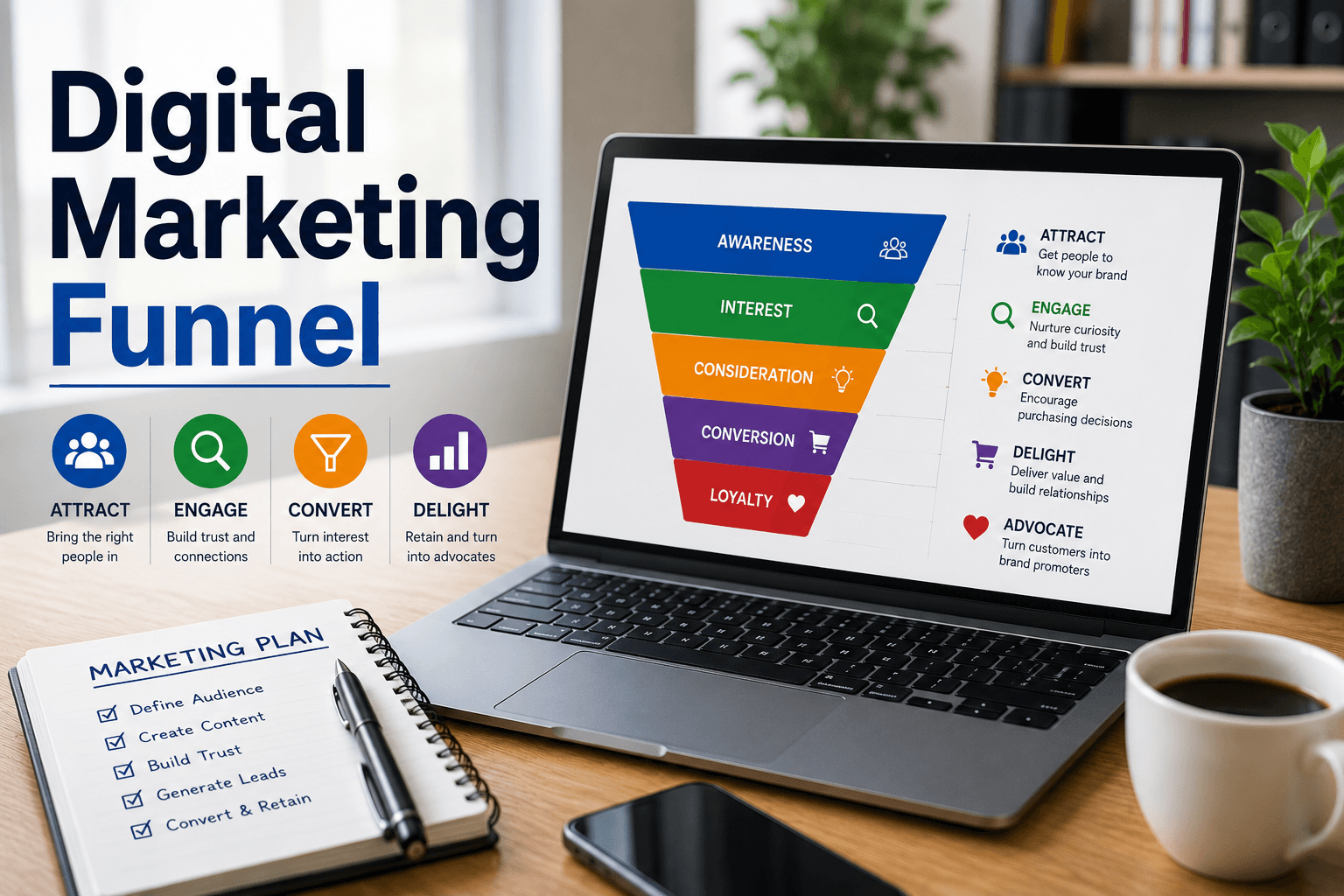
A digital marketing funnel is a core marketing strategy framework that drives customer acquisition through 5 defined stages — Awareness, Interest, Desire, Action, and Retention. If your agency is growing inconsistently, this is probably why.
Here’s what most agency owners won’t tell you: 79% of marketing leads never convert into sales. That’s not a traffic problem. That’s a funnel problem. Prospects find you, like what they see, and then disappear — because no marketing system moves them from “I found this agency online” to “I’m ready to pay.” In 2026, there’s one more complication. AI search has entered the funnel. Agencies that haven’t adapted their marketing strategy to include Generative Engine Optimization (GEO) are invisible to a growing slice of their target audience before the conversation even starts.
What Is a Digital Marketing Funnel?
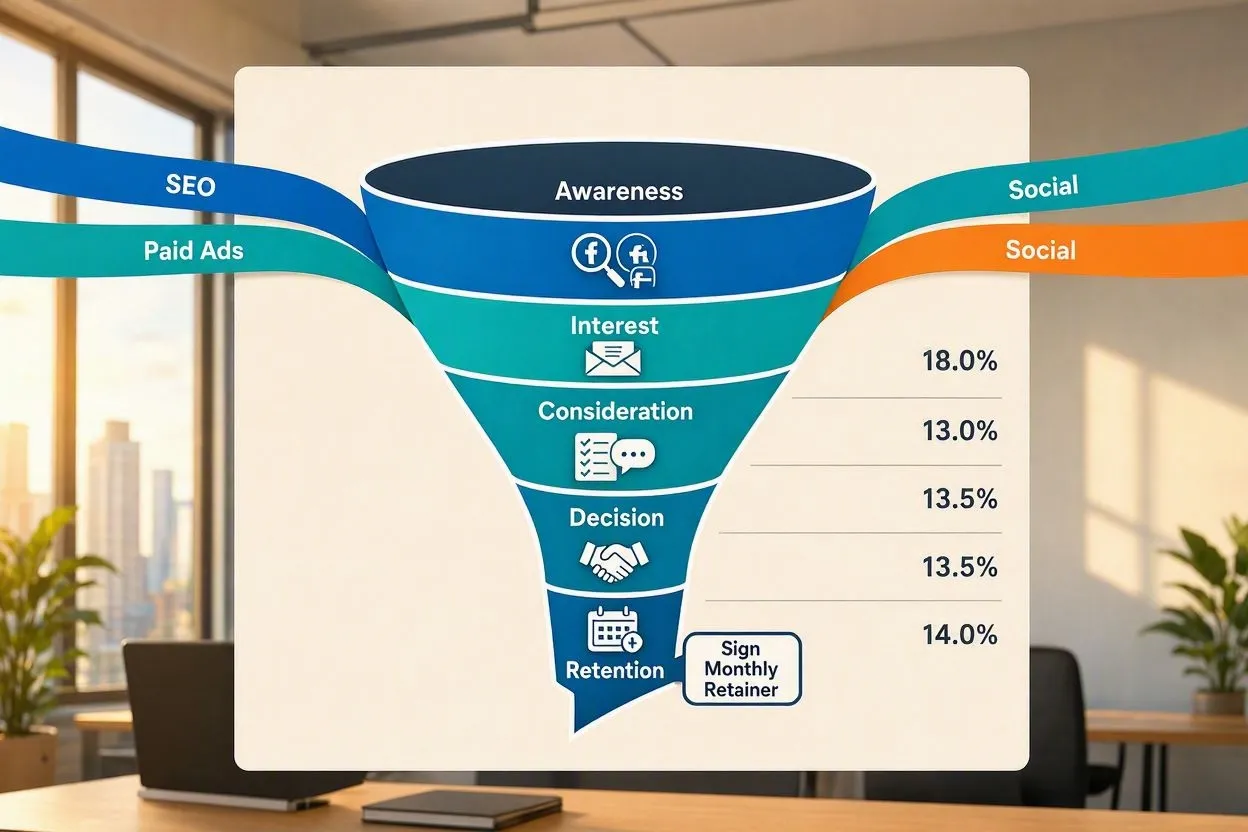
A digital marketing funnel is a structured marketing strategy — a 5-stage path that guides someone from discovering your agency through targeted marketing channels to signing a monthly retainer.
The shape matters. Wide at the top because many prospects enter through awareness marketing. Narrow at the bottom because most don’t convert. A well-built marketing funnel reduces that drop-off at every stage — right content, right channel, right moment.
For any guest posting or link building agency, the digital marketing funnel answers a single question: how does a stranger become a $1,500–$3,000/month client? Not through one lucky interaction. Through a sequence of 7–12 marketing touchpoints across multiple channels, each one building on the last.
Digital Marketing Funnel vs Traditional Marketing Funnel
| Factor | Traditional Marketing Funnel | Digital Marketing Funnel (2026) |
| Path | Linear — one direction only | Non-linear — client moves back and forth |
| Marketing channels | TV, print — one or two | 5+ digital marketing channels including AI search |
| Data | Almost none | Full marketing attribution tracking via GA4 |
| Control | Brand controls the message | Client researches independently via AI tools |
| Discovery | Brand-initiated | AI-mediated — ChatGPT, Perplexity, Google AI |
Old marketing funnels were built around the idea that buyers move in a straight line. They don’t — not anymore. A prospect reads your guest post on Monday, forgets about you, asks ChatGPT about link building agencies on Thursday, sees your brand cited in the answer, stumbles across your case study a week later, and books a call on day 19. Four marketing touchpoints. Three different channels. Zero of them planned by you. That’s the 2026 digital marketing funnel in action.
Why the Digital Marketing Funnel Is Non-Linear in 2026
Four forces changed how the marketing funnel works — and ignoring any one of them costs agencies leads every single day.
AI search is now a primary marketing discovery channel:
By mid-2025, AI search tools had 685 million monthly active users. ChatGPT processes 72 billion messages per month. When your ideal client types “best link building agency” into ChatGPT, they’re not scrolling through 10 blue links. They’re reading a synthesized answer that cites 2–7 sources. If your agency isn’t one of those sources, your marketing strategy has a blind spot.
Zero-click search is quietly killing TOFU traffic:
Google’s AI Overviews now answer informational queries directly on the results page. Prospects get their questions answered without visiting anyone’s website. Marketing content that depended on organic clicks for top-of-funnel traffic has been losing ground since late 2024. GEO-optimized content is the fix — being cited inside the answer, not just ranking below it.
Dark social is a real marketing channel nobody tracks properly:
Your guest post gets shared in a private Slack channel for agency owners. Twelve people read it. Four of them visit your site. GA4 reports all four as “direct” traffic with no source. That’s dark social — word-of-mouth marketing that happens in private, unmeasured spaces. A single share in the right community can generate more qualified leads than a week of cold outreach.
Prospects research across 5 platforms before deciding:
People under 44 use an average of 5 platforms before making a B2B purchase — Google, ChatGPT, Reddit, LinkedIn, and review sites like Clutch or G2. Your agency might be discoverable on two of them. Your competitor is on four. That gap in marketing channel coverage directly translates to lost customer acquisition opportunities.
5 Stages of the Digital Marketing Funnel (With Agency Examples)
The 5 stages are Awareness (TOFU), Interest (MOFU), Desire (MOFU), Action (BOFU), and Retention. Each stage has a different goal, different marketing content, different channels, and different metrics. Treating them all the same is the fastest way to burn marketing budget with nothing to show for it.
Stage 1 — Awareness (Top of Funnel / TOFU)
Goal: get in front of cold prospects who’ve never heard of your agency — including those searching through AI tools.
At the Awareness stage, the prospect doesn’t know you exist. In 2026, they’re looking for you in three places: Google, AI tools like ChatGPT or Perplexity, and social media. Miss any one of these marketing channels and you’re handing those prospects to competitors who show up where you don’t.
4 TOFU marketing channels that work for agencies in 2026:
- SEO + GEO content marketing : Write blog posts that rank on Google and get cited in AI answers. Structure every marketing piece with a direct answer in the first 200 words, FAQ schema, and original data that AI engines have a reason to cite
- Guest posts on DR50+ niche marketing blogs : A well-placed guest post on a DR65 SEO or marketing blog pulls in 300–500 cold visitors. It also earns an external citation that signals credibility to AI marketing systems — two customer acquisition wins from one piece of content
- LinkedIn content marketing : 3 to 5 short posts a week. Show real client results, link building wins, data from campaigns. LinkedIn content gets indexed by Google and cited by AI search engines more than most agency owners realize
- GEO citation building : Publish marketing content specifically designed to get cited when someone asks “what is link building,” “best guest posting agencies,” or “how do I build backlinks.” Agencies that earn those AI citations get brand exposure before the prospect even clicks anything
Real agency example: A guest post — “7 Link Building Mistakes That Kill Your Rankings” — lands on a DR68 SEO marketing blog. It drives 440 new visitors in 30 days. Perplexity cites it 3 times when users ask about link building. Those citations deliver another 60 visitors per month without any additional marketing effort.
TOFU marketing metrics to track:
- Organic traffic growth — target +10–15% month-over-month
- New visitor rate — target above 60% of total site visitors
- AI citation frequency — how often your brand appears in ChatGPT, Perplexity, and Google AI marketing answers
Stage 2 — Interest (Middle of Funnel / MOFU)
Goal: hold onto visitors after first contact and capture their email before they leave.
Here’s the hard truth about MOFU marketing: 97% of first-time visitors aren’t ready to buy. They’re interested. They’re looking. But they won’t hire you today. Without a system to capture that interest, they leave and the customer acquisition cost you paid to get them there is completely wasted.
3 MOFU marketing tactics that turn interest into contact:
- A marketing lead magnet worth downloading — not a generic PDF. For link building agencies: a 47-point backlink audit checklist, a guest post pitch email template, a DR improvement roadmap. Something that solves a real, specific problem the prospect has right now
- Email marketing opt-in with a clear value exchange — “Download our free Backlink Audit Checklist — the same tool we run before every client campaign.” That specificity is what converts. Vague offers don’t
- Marketing case study pages with real numbers — DR before and after, referring domains added per month, traffic percentage increase, time to first ranking improvement. Data builds trust faster than any amount of copywriting
Real agency example: Visitor lands on a link building blog post. A slide-in offer appears for the free 47-Point Backlink Audit Checklist. They enter their email. They’re now in a 7-email marketing nurture sequence running over 21 days — educating, building trust, and introducing the agency’s services without a single hard pitch.
MOFU marketing metrics to track:
- Email marketing opt-in rate — target 3–7% of landing page visitors
- Time on marketing case study pages — target 2+ minutes
- Email marketing open rate — industry benchmark 22–30%
Stage 3 — Desire (MOFU)
Goal: make the prospect want your agency specifically, not just the service category in general.
By the Desire stage, the prospect already knows they need link building or guest posting. They’re comparing 3 to 5 agencies side by side. The marketing question running through their head is simple: why you and not someone else? This is where performance marketing proof and brand positioning do the heavy lifting — or don’t.
3 marketing tactics that build Desire:
- Results-specific client testimonials — “They built 34 DR60+ links in 60 days and our organic traffic increased 180% in 4 months” creates desire. “Great agency, highly recommended” creates nothing. Numbers beat adjectives every time
- Before/after marketing case studies — show the DR score, referring domain count, traffic numbers, and keyword ranking changes. Lay it out clearly. Real marketing performance data moves people forward faster than any sales copy ever will
- Direct comparison marketing content — a page or email that answers “why our link building approach outperforms [competitor method]” speaks directly to a prospect in evaluation mode. It positions your agency as the authority and answers the exact objection sitting in their head
Real agency example: Prospect opens email 3 in the nurture sequence. It links to: “How We Took a B2B SaaS Client from DR14 to DR58 in 5 Months.” They read the whole thing, go back to the website, and visit the services page. That return visit is the Desire signal — they’ve moved from curious to actively evaluating.
Desire marketing metrics to track:
- Return visitor rate to marketing content
- Time on marketing case study pages — target 3+ minutes
- Pricing page visits
- Marketing proposal request rate
Stage 4 — Action (Bottom of Funnel / BOFU)
Goal: convert the prospect into a paying client.
The prospect is ready. They’ve read the content, opened the emails, visited the services page twice. What loses them at this point isn’t price or competition. It’s a weak call to action (CTA). Generic marketing CTAs reduce conversion rates by 30–50% compared to specific offers — that’s not an opinion, it’s a consistent finding in performance marketing testing.
3 BOFU marketing conversion tactics:
- A specific CTA with a defined offer — “Book a free 30-minute backlink strategy call — we’ll show you exactly which links your competitors have that you don’t.” Clear action, clear value, defined time commitment. That’s what converts
- Free marketing audit or gap analysis — removing the financial risk from the first step drops the barrier to conversion dramatically. “Free Backlink Gap Analysis” outperforms “Contact Us” in every customer acquisition test
- Social proof placed directly at the conversion point — put a specific client result right next to the CTA button. “We helped [Client Name] add 41 DR60+ links in 90 days” sitting beside the booking button reinforces the decision at exactly the right moment
Real agency example: The service page CTA: “Get a free backlink gap analysis — we’ll show you exactly which links your top 3 competitors have that you don’t.” That single specific offer generates a 3–6% conversion rate from qualified visitors. A generic “contact us” form on the same page? 0.5–1%.
BOFU marketing performance metrics:
- Marketing conversion rate — target 2–5% of qualified visitors
- Customer Acquisition Cost (CAC) — target below 3x the first monthly retainer
- Strategy call booking rate
- Proposal-to-close rate — target 30–50%
Stage 5 — Retention (Post-Funnel Marketing)
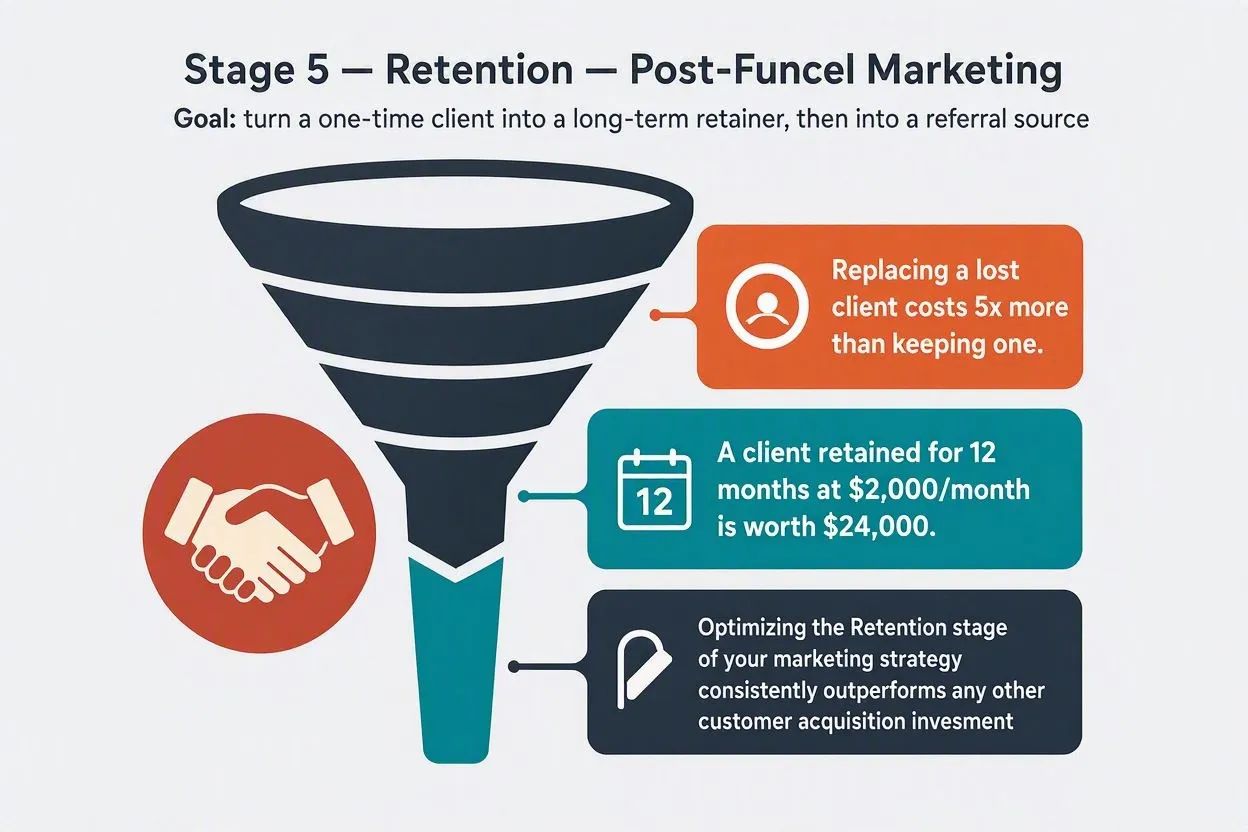
Goal: turn a one-time client into a long-term retainer, then into a referral source.
Most marketing articles stop the funnel at conversion. That’s a mistake that costs agencies real money. Replacing a lost client costs 5x more than keeping one. A client retained for 12 months at $2,000/month is worth $24,000. Optimizing the Retention stage of your marketing strategy consistently outperforms any other customer acquisition investment.
3 Retention marketing tactics for link building agencies:
- Monthly marketing performance reports — show DR progress, referring domains added, traffic percentage increase, keyword ranking improvements. Clients who see clear, measurable monthly progress stay for 12+ months. Clients who don’t see progress leave after 3
- Proactive upsell marketing sequence — don’t wait for clients to ask about next steps. When a client hits DR45, send an email within 5 days: “You’ve hit DR45 — here’s the 6-month marketing strategy to reach DR60 and start competing for featured snippets.” Proactive always outperforms reactive
- Referral marketing program — “Refer one client, get one month free.” Happy clients are the best TOFU marketing channel you have. They bring pre-sold prospects directly into your funnel at zero customer acquisition cost
Real agency example: A client on a 3-month link building package gets monthly reports showing DR moving from 22 to 37. Month 3, the account manager sends: “You’re at DR37 — here’s a 6-month marketing strategy to reach DR60 and compete for featured snippets in your niche.” Client renews for 6 months. Total contract value: $12,000. Entry point: a guest post bio link.
Retention marketing metrics:
- Customer Lifetime Value (CLV) — target above 12x monthly retainer
- Monthly churn rate — target below 5%
- Referral rate — target 15–20% of new clients from referrals within 12 months
AIDA Model vs Digital Marketing Funnel — What’s the Difference?
The AIDA model (Attention, Interest, Desire, Action) is the original 4-stage marketing framework that the modern digital marketing funnel evolved from. One key difference: AIDA ends at conversion. The digital marketing funnel continues into Retention — the stage that actually makes an agency profitable over time.
| AIDA Stage | Digital Marketing Funnel | Agency Marketing Action in 2026 |
| Attention | Awareness (TOFU) | Guest posts, GEO content marketing, LinkedIn, AI citations |
| Interest | Interest (MOFU) | Marketing lead magnets, email marketing, case study pages |
| Desire | Desire (MOFU) | Testimonials, DR case studies, comparison pages |
| Action | Action (BOFU) | Free audit CTA, strategy call, proposal |
| — not in AIDA | Retention | Monthly reports, upsells, referral marketing program |
AIDA was built for advertising — a one-time purchase decision made in a linear sequence. The 2026 digital marketing funnel covers the entire client lifecycle and the full marketing mix. For agencies running monthly retainers, the Retention stage alone is often worth 3x more than every acquisition stage combined. Building a marketing strategy that ignores it is leaving significant revenue on the table.
How GEO Changes the Digital Marketing Funnel in 2026
Generative Engine Optimization (GEO) is the practice of structuring content so AI engines — ChatGPT, Perplexity, Google AI Overviews, Claude — cite your brand when generating marketing answers. In 2026, GEO isn’t optional for agencies that want reliable TOFU traffic from their marketing strategy.
Traditional SEO marketing put your website at position 1 in a list of 10 links. GEO marketing puts your brand inside the answer — before any link is shown. When an AI engine names your agency in response to “best link building agencies,” that’s an implicit endorsement no organic marketing ranking can replicate.
3 GEO marketing tactics that directly feed the agency funnel:
Own the marketing category definitions: Definitional content gets cited most by AI engines — “What is link building?”, “What is guest posting?”, “What is domain rating?” Write the most thorough, well-structured version of these marketing definitions on your site. AI engines consistently cite the most authoritative answer they can find. Be that answer.
Structure marketing content for AI retrieval: AI engines pull specific passages from pages using Retrieval-Augmented Generation (RAG). Pages built with direct answers in the first 200 words, FAQ schema markup, clean heading structure, and original marketing data earn citations far more consistently than pages without this structure.
Build external marketing citations as a GEO signal: In GEO marketing, brand mentions in high-authority third-party marketing sources build credibility with AI systems — even without a dofollow link. Guest posts on DR60+ marketing sites do double duty: they build backlinks for traditional SEO and build brand entity authority for GEO. One marketing asset, two TOFU channels.
GEO marketing metrics to track:
- AI citation frequency — how often your brand appears in AI marketing answers for your target queries
- Brand visibility score across ChatGPT, Perplexity, and Google AI
- AI marketing share of voice compared to your top 3 competitors
Digital Marketing Funnel Strategy for Guest Post & Link Building Agencies
No marketing competitor covers this. Every other article on digital marketing funnels explains a generic framework and leaves you to figure out how it applies to your agency. This section maps the full digital marketing funnel to exactly how guest post and link building agencies win clients, build trust, and keep them paying long-term.
6-Step Agency Client Acquisition Marketing Funnel
The complete digital marketing funnel — from cold stranger to retainer client:
Step 1 : Guest post + GEO content marketing (Awareness) Two guest posts per month on DR50+ marketing or SEO blogs. Each author bio links to a specific marketing landing page — not the homepage. Alongside this, build GEO marketing content so your agency appears in AI answers when prospects search “best link building agencies” or “guest posting services.” Expected outcome: 200–500 new visitors per guest post, plus ongoing AI-driven marketing discovery that compounds month over month.
Step 2 : Marketing lead magnet download (Interest) The landing page offers one specific free resource: “Download our Guest Post Pitch Template — the exact 3-email marketing sequence we use to get published on DR60+ sites.” Visitor submits email. They’re now a Marketing Qualified Lead (MQL) in your CRM and an automated email marketing sequence starts immediately.
Step 3 : Case study marketing email (Desire) Email 3 in the nurture sequence links to: “How Our Link Building Marketing Strategy Built 47 DR60+ Links for a SaaS Client in 90 Days.” Real numbers throughout — starting DR, ending DR, links per month, traffic increase, time to first ranking improvement. Expected outcome: trust increases sharply, prospect returns to the services page.
Step 4 : Marketing strategy call CTA (Action) Email 5 offers a free 30-minute strategy call. Subject line: “Want to see your backlink gap?” CTA goes to Calendly. Expected outcome: a qualified call with a prospect who has already consumed 5 pieces of marketing content and trusts the agency before they get on the phone.
Step 5 : Custom marketing proposal (Action) The strategy call ends with a custom plan: keyword targets, DR goals, target publication sites, monthly deliverables, timeline, and 3 pricing options. Send the marketing proposal within 24 hours — while the conversation is still fresh in their mind.
Step 6 : Monthly retainer + upsell marketing path (Retention) Onboarding email sets clear expectations for month 1. Monthly performance report keeps the client engaged with real marketing data. Month 3 upsell email ties to the next DR milestone. Expected outcome: 6–12 month marketing retainer from a client who entered the funnel through a guest post bio.
How Guest Posts Work as TOFU Marketing Assets in 2026
A guest post in 2026 isn’t just a backlink. It’s a 3-in-1 digital marketing asset — it builds a link for SEO, drives referral traffic into the agency funnel, and builds brand entity authority that helps AI search engines cite your agency in marketing answers.
3 qualities of a high-converting TOFU marketing guest post in 2026:
Relevant niche placement on a DR50+ marketing site: A guest post about “link building for SaaS companies” published on a SaaS marketing blog reaches an audience actively looking for that exact service. Domain rating matters for SEO marketing. Topic relevance matters for traffic quality. Both matter for GEO — AI engines factor in the authority of the publishing site when deciding whether to cite a brand in a marketing answer.
Author bio with a specific marketing CTA: “Download [Name]’s free Guest Post Outreach Template — the exact 3-email marketing sequence that gets responses from DR60+ editors” converts bio readers into leads. “Visit [Agency Name]” doesn’t. The bio is the only space you have to promote yourself — use it with a specific, high-value marketing offer.
One contextual link to a marketing lead magnet page: Not to a services page. Not to the homepage. To a free resource page. A visitor still in research mode is more likely to download a useful marketing checklist than book a call. Meet them where they are.
Marketing Outreach Funnel — Turning Cold Prospects Into Clients
For agencies that pair content marketing with direct outreach, this 5-step marketing funnel consistently generates 3–8 new client conversations per month from a list of 50 qualified prospects.
Step 1 : Marketing prospect identification Use Ahrefs to find sites with DR30–55 that are growing organically but have a weak referring domain count relative to their top competitors. Use Hunter.io to find the decision maker’s direct email — founder, CMO, or Head of SEO. Build a list of 50 niche-specific marketing prospects per month. Niche-focused outreach converts 3x better than broad marketing outreach.
Step 2 : First marketing email — one specific observation, no pitch “I noticed you rank #9 for [keyword] — [competitor] outranks you and has 31 more referring domains on that exact page.” No pitch. No “I’d love to help with your marketing.” Just one specific, personalized data point. Open rate target: 25–35%.
Step 3 : Marketing follow-up with proof 48 hours later: “We solved this same problem for [similar company]. DR went from 18 to 52 in 4 months through our link building marketing strategy.” Link to the case study, not the services page. This email gets responses because it is proof, not a pitch.
Step 4 : Custom marketing proposal for engaged prospects One-page custom marketing plan with 3 pricing options. Anchor the middle option at your target monthly retainer. Include one client testimonial with specific performance numbers directly in the proposal document — not linked out, right there on the page.
Step 5 : Marketing onboarding sequence for signed clients 3-email sequence: welcome + kickoff call booking link, marketing strategy document + month 1 deliverables, 7-day check-in to confirm alignment. Sets expectations clearly and reduces the early churn that hits agencies hardest in months 1–3.
B2B Agency Marketing Funnel vs B2C Marketing Funnel — 4 Key Differences
A B2B agency marketing funnel differs from a B2C marketing funnel in 4 ways: longer sales cycle, multiple decision makers, ROI-driven conversion, and higher average contract value. Applying B2C marketing strategy to a B2B agency funnel is one of the most common and costly mistakes in agency growth.
| Factor | B2B Agency Marketing Funnel | B2C Marketing Funnel |
| Sales cycle | 2–8 weeks | Minutes to 3 days |
| Decision makers | 2–4 people — founder, CMO, CFO | 1 person |
| Conversion driver | ROI proof + trust + case studies | Emotion + price + urgency |
| Average deal value | $1,000–$5,000/month retainer | $10–$500 one-time |
| Touchpoints before conversion | 7–12 marketing touchpoints | 1–3 touchpoints |
What this means practically: a 3-email marketing sequence isn’t enough for a B2B agency. Build 7–10 emails over 3–4 weeks. A marketing manager might research and qualify your agency, but a founder or CFO makes the final call. Your case studies and ROI data need to speak to both — the marketer who understands domain rating, and the finance person who understands revenue impact.
7 Marketing Metrics to Track at Each Funnel Stage
These 7 marketing KPIs show exactly where your digital marketing funnel is healthy and where it’s leaking revenue. Checking them weekly takes 20 minutes. Not checking them means optimizing blind.
| Funnel Stage | Marketing KPI | 2026 Benchmark |
| TOFU | Organic marketing traffic growth | +10–15% month-over-month |
| TOFU | AI citation frequency | 3+ per week in target AI platforms |
| MOFU | Email marketing opt-in rate | 3–7% of landing page visitors |
| MOFU | Email marketing open rate | 22–30% |
| BOFU | Marketing conversion rate (CR) | 2–5% of qualified visitors |
| BOFU | Customer Acquisition Cost (CAC) | Below 3x first monthly retainer |
| Retention | Customer Lifetime Value (CLV) | Above 12x monthly retainer |
Set up marketing attribution tracking in this order: install GA4 first, connect it to Google Search Console (GSC), then set up conversion events for lead magnet downloads, strategy call bookings, and proposal requests. Add UTM parameters to every guest post bio link. Check AI marketing visibility manually each month — search your 10 target queries in ChatGPT and Perplexity and note whether your agency appears.
5 Digital Marketing Funnel Mistakes Agencies Make in 2026
Agencies don’t usually fail because they’re doing the wrong things. They fail because they’re doing the right things incompletely. These 5 marketing mistakes are where revenue disappears.
Mistake 1 : Ignoring AI search in the marketing strategy Agencies optimizing only for Google rankings are invisible to prospects who start their search in ChatGPT or Perplexity. In 2026, a prospect’s first exposure to your brand might happen inside an AI-generated marketing answer — not a Google result page. Fix: Publish 2–3 definitional content pieces structured for AI citation. Direct answers in the first 200 words, FAQ schema, clean heading structure. Do this before anything else in your GEO marketing strategy.
Mistake 2 : Treating conversion as the finish line Agencies with no Retention marketing stage lose clients in months 2–4 and pay full customer acquisition cost every time they need to replace one. Fix: Build the marketing onboarding sequence and monthly report template before you launch any acquisition campaign. The Retention stage should be ready before you have clients who need it.
Mistake 3 : Running only one TOFU marketing channel One cold outreach campaign. One SEO blog. One marketing channel = one point of failure. One algorithm update or one dry month kills the pipeline. Fix: Run at least 2 TOFU marketing channels simultaneously — SEO + guest posts, LinkedIn + GEO, or paid marketing ads + AI citation building. Redundancy in customer acquisition isn’t optional.
Mistake 4 : No lead magnet in the marketing funnel Without a MOFU marketing lead magnet, interested visitors leave without giving contact information. They compare 3 other agencies and never come back. Fix: One high-value free marketing resource — backlink audit checklist, outreach template, DR milestone tracker — placed on every high-traffic marketing page. This single change improves MOFU conversion more than any other fix.
Mistake 5 : Generic CTA on the marketing conversion page “Contact us” isn’t a CTA. It’s a request for unpaid work from the prospect. Generic marketing CTAs underperform specific offers by 30–50% in conversion rate. Fix: “Get a free backlink gap analysis” or “Book a 30-min link building marketing strategy call.” Specific offer, specific value, specific time commitment. That’s what converts.
How to Build a Digital Marketing Funnel in 6 Steps
To build a working digital marketing funnel for your agency, follow these 6 steps in order. Skipping steps doesn’t speed things up — it just creates gaps that lose leads later.
Step 1 : Define your Ideal Client Profile (ICP) Write down the specific type of client your agency serves best: industry niche (SaaS, ecommerce, local business), company revenue range, geography, monthly marketing budget ($500–$3,000), current DR range (DR10–40 clients need link building most urgently). Narrow to 1–2 ICP segments. A marketing funnel trying to serve everyone ends up converting no one.
Step 2 : Publish 2 TOFU marketing content pieces per month One blog post on your site optimized for Google and GEO. One guest post on a DR50+ marketing blog. Both pieces should target keywords your ICP searches before they know they need an agency: “how to improve domain rating,” “what is guest posting,” “link building marketing strategy for SaaS.” Every piece needs a direct answer in the first paragraph, a FAQ section, and schema markup.
Step 3 : Build one marketing lead magnet One free resource that solves a specific, immediate problem. Best options for link building agencies: 47-point backlink audit checklist, guest post pitch email sequence template, DR improvement milestone tracker. Build a dedicated landing page for it — no navigation links, no exit paths, one CTA.
Step 4 : Write a 7-email marketing nurture sequence Deliver over 21 days:
- Email 1 (Day 0): deliver lead magnet + welcome
- Email 2 (Day 2): one actionable tip from the lead magnet topic
- Email 3 (Day 5): case study with real DR and traffic numbers
- Email 4 (Day 8): common marketing mistake your ICP makes + how to fix it
- Email 5 (Day 12): a marketing insight or data point they probably haven’t seen
- Email 6 (Day 17): second case study from a different niche
- Email 7 (Day 21): CTA to book a free marketing strategy call
Step 5 : Build a BOFU marketing conversion page Service page needs: a headline stating the marketing outcome clearly (“We Build High-Quality Backlinks That Increase Your DR and Organic Traffic”), 3 client results with exact numbers, one strong testimonial, a pricing signal (starting from / package names), and one CTA button above the fold. Remove every exit link except the CTA.
Step 6 : Install full-funnel marketing attribution tracking Three GA4 conversion events: lead magnet download (MOFU), strategy call booking (BOFU), proposal request (BOFU). Connect GA4 to GSC. UTM parameters on every external link. Manual AI marketing visibility audit monthly. Review all marketing data weekly. Fix the funnel stage with the highest drop-off first — that’s always where the most revenue is hiding.
12 Marketing Tools for Each Stage of the Digital Marketing Funnel (2026)
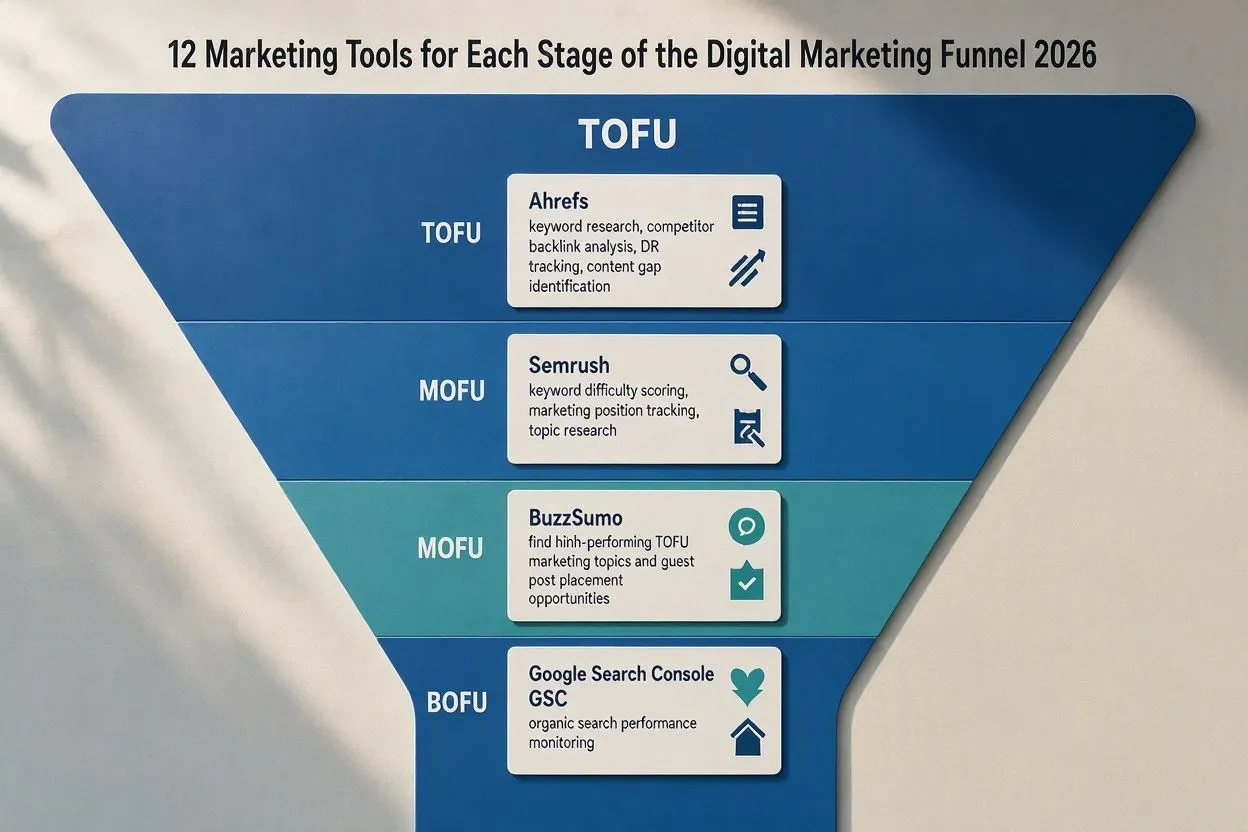
12 tools that cover every stage of the agency digital marketing funnel:
TOFU marketing tools:
- Ahrefs — keyword research, competitor backlink analysis, DR tracking, content gap identification
- Semrush — keyword difficulty scoring, marketing position tracking, topic research
- BuzzSumo — find high-performing TOFU marketing topics and guest post placement opportunities
- Google Search Console (GSC) — organic marketing impressions, clicks, and CTR for every target keyword
MOFU marketing tools:
- ConvertKit or Mailchimp — email marketing automation, open rate tracking, behavioral segmentation
- ConvertBox or Typeform — high-converting opt-in forms and slide-in popups with targeting rules
- Notion — draft and organize marketing lead magnet content before design
- Canva — design PDF lead magnets, checklist templates, and visual marketing case study documents
BOFU + Retention marketing tools:
- Calendly — automated marketing strategy call booking with calendar sync and confirmation emails
- Proposify — marketing proposal templates with e-signature, open tracking, and version history
- HubSpot CRM (free) — track marketing leads, deals, email conversations, and client status
- Stripe or Wise — international payment processing for monthly marketing retainers
Conclusion
A digital marketing funnel isn’t a tactic — it’s the system that makes agency growth predictable. Every guest post, every email, every case study works as one connected pipeline. Cold traffic becomes retainer clients who refer other clients.
In 2026, add one layer: AI search. Agencies appearing inside ChatGPT and Perplexity answers build a TOFU advantage that traditional SEO alone can’t match. AI citation authority compounds over time — start building it now.
Three actions this week: audit which of the 5 funnel stages you’re missing, build one lead magnet to capture MOFU leads before they leave, and search “best link building agencies” in ChatGPT to see if your agency appears. If it doesn’t, your GEO strategy starts today.