

Post between 9 a.m. and 1 p.m. Eastern Time (6 a.m. to 10 a.m. Pacific) on Tuesday, Wednesday, or Thursday. That’s the window where the two largest posting-time studies published in 2026 actually agree. Outside it, they contradict each other on almost every platform, which is why one guide told you Tuesday afternoon and the next one told you Thursday morning for the exact same account.
Sprout Social’s 2026 Social Media Content Strategy Report analyzed close to 2 billion engagements across roughly 307,000 profiles (data from late November 2025 through February 2026) and found a midday-to-evening peak. Buffer’s 2026 State of Social Media Engagement report looked at more than 52 million posts and landed at 9 a.m. Thursday, across four separate platforms. Neither study is wrong. Both are enormous, both are recent, and both measured something slightly different, which is the whole reason they disagree.
What is the best time to post on social media?
For most brands posting to Facebook, Instagram, LinkedIn, X, or Threads with a US audience: 9 a.m. to 1 p.m. ET, Tuesday through Thursday.
Weekday mornings and early afternoons win across those five platforms in both datasets. That’s where the agreement ends. TikTok and YouTube don’t follow the pattern at all. Buffer found Sunday at 9 a.m. was TikTok’s single strongest slot, and Sunday at 10 a.m. did the same for long-form YouTube, both well ahead of any weekday hour.
Treat 9 a.m. to 1 p.m. ET as a starting point, not gospel, until you’ve got 30 days of your own data. Brands with night-shift audiences, gamers, parents of young kids, or a heavy West Coast following often peak three to six hours off the general recommendation.
Why the two biggest studies disagree
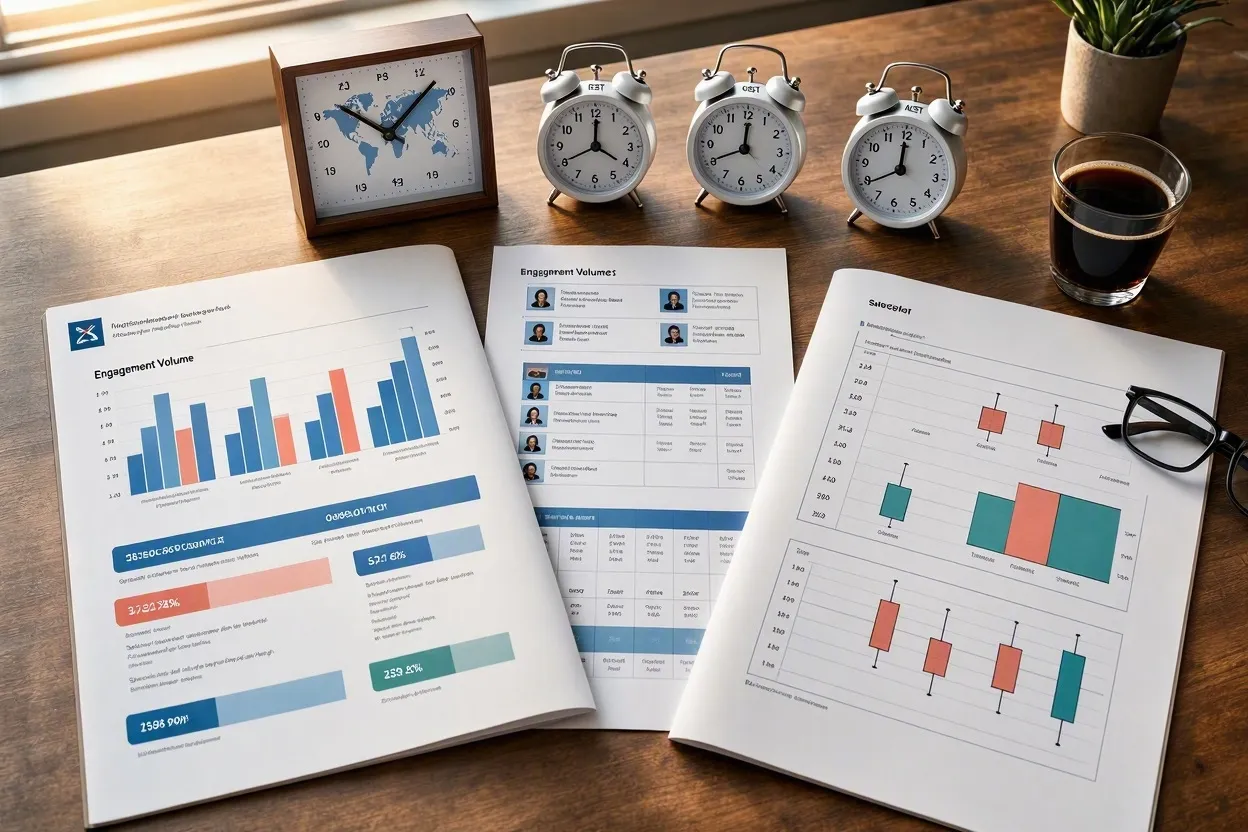
Three things: they measure different outcomes, they sample different kinds of accounts, and they convert time zones differently. None of these is a mistake on either company’s part. Each one alone can shift the recommendation by hours.
They measure different outcomes
Sprout Social counts total engagement volume, meaning reactions, comments, shares, DMs, and link clicks all added together. Buffer reports median engagement instead (and reach, not engagement, for Instagram). Volume climbs whenever more people happen to be scrolling, which pushes the peak toward midday and evening. A median rate works differently: divide engagement by the number of posts competing for attention in that window, and the peak can land in a quiet morning hour where hardly anyone else is publishing.
Facebook at 6 p.m. Tuesday might rack up more raw comments than 9 a.m. Thursday while posting a lower rate per post. Both numbers are correct at once. If you’re running an awareness push judged on gross interactions, go with Sprout’s totals. If you’re judged on per-post performance, or proving content quality to a client, go with Buffer’s rate.
They sample different kinds of accounts
Sprout draws from more than 30,000 customers, weighted toward mid-market and enterprise brands with big follower counts and full social teams. Buffer’s base is 200,000-plus creators, solo marketers, and small businesses. Those two groups don’t peak at the same hour, because enterprise-brand followers tend to check in passively on work breaks, while creator audiences run active discovery sessions at night and on weekends. If you manage a brand account above 25,000 followers with a marketing team behind the calendar, Sprout’s numbers fit you better. Under 10,000 followers, running things solo, or posting personally as a founder? Buffer.
They handle time zones differently
Both companies normalize to local time, so “9 a.m.” means 9 a.m. whether you’re in Miami or Seattle. Neither publishes exactly how they do that math.
That normalization works fine for a business selling in one market. It breaks the moment your followers span multiple US time zones, since “9 a.m. local” is really three different moments happening at once, and as of 2026, an estimated 47% of Americans live in Eastern Time versus 14% in Pacific. Publish once at 9 a.m. ET and you hit the Eastern segment right on time, but the Pacific segment sees it at 6 a.m., before most of them have even picked up a phone.
Best time to post on each platform
Each section below shows both studies side by side.
Morning posts (around 9 a.m. Thursday) win on engagement rate. Total volume peaks later, roughly noon to 8 p.m. Tuesday and Wednesday.
| Study | Best time | Best day | Worst day |
| Buffer (52M+ posts) | 9 a.m., mornings generally | Wednesday, then Thursday | Saturday |
| Sprout Social (2B engagements) | 12-8 p.m. Tue/Wed, 12-1 p.m. Mon | Monday-Thursday | Weekends |
Facebook stays active later into the evening than any other text-and-image platform in Sprout’s data, with Tuesday and Wednesday holding through 8 p.m. Morning posts still win on rate for a simple reason: fewer brands bother publishing before 10 a.m., so there’s less competing in the feed.
Reach peaks around 9 a.m. Thursday. Total engagement peaks 1 to 7 p.m. Tuesday and noon to 9 p.m. Wednesday.
| Study | Best time | Best day | Worst day |
| Buffer (nearly 10M posts) | 9 a.m. Thu, 6 p.m. most days | Wednesday | Friday |
| Sprout Social | 1-7 p.m. Tue, 12-9 p.m. Wed | Monday-Thursday | Weekends |
Buffer tracked reach here rather than engagement, which explains part of the gap against Sprout’s afternoon window. Reels and carousels land in the same peak hours; no study has turned up a meaningful timing split between the two formats.
The window has moved: 3 to 6 p.m. ET, Wednesday through Friday, is now the strongest slot, which flips the morning-and-lunch advice LinkedIn ran on for a decade.
| Study | Best time | Best day | Notable finding |
| Buffer (4.8M posts) | 4 p.m. Wed, 3-4 p.m. Fri | Wednesday, then Thursday and Friday | Saturday and Sunday now beat Monday and Tuesday |
| Sprout Social | 11 a.m.-5 p.m. Tue-Thu | Monday-Friday | Weekends remain weakest |
Buffer’s 2026 LinkedIn analysis of 4.8 million posts shows posts between 6 and 11 a.m. now underperforming afternoon posts, a reversal from Buffer’s 2025 LinkedIn findings, where engagement was still concentrated in working hours. Professional audiences seem to be catching LinkedIn on the commute and in the evening rather than at their desks.
TikTok
Sunday at 9 a.m. ET is the single best slot, with a reliable secondary window from 6 to 11 p.m. daily.
| Study | Best time | Best day | Worst day |
| Buffer (7.1M posts) | 9 a.m. Sun, 1 p.m. Mon, 6-11 p.m. daily | Saturday, then Monday | Wednesday |
| Sprout Social | 2-6 p.m. Tue-Fri, 1-8 p.m. Wed | Monday-Friday | Weekends |
TikTok is where the two studies clash hardest. Buffer calls Saturday the best day and Wednesday the worst. Sprout says the exact opposite: weekends weak, Wednesday strong. Creator-heavy accounts drive the weekend numbers; brand accounts drive the weekday numbers. Account type matters more here than on any other platform.
X (Twitter)
Tuesday at 9 a.m. ET, with weekday mornings from 8 to 11 a.m. holding up consistently.
| Study | Best time | Best day | Worst day |
| Buffer (8.7M posts) | 9 a.m. Tue, 10 a.m. Wed | Wednesday | Saturday |
| Sprout Social | 12-6 p.m. Tue-Thu | Monday-Thursday | Weekends |
Both studies agree weekdays beat weekends here by a wide margin. None of that matters during breaking news, though. A relevant post during a trending moment will outperform a perfectly timed one on a quiet Tuesday, every time.
YouTube
Shorts peak at 4 p.m. ET Friday. Long-form video peaks at 10 a.m. ET Sunday.
Treat these as two separate products. Shorts do best in weekday evenings, 6 to 11 p.m., with Friday, Saturday, and Thursday the strongest days and Tuesday the weakest. Long-form video runs on a morning schedule instead, 8 to 11 a.m., with Sunday beating every other day by a margin Buffer calls wide, and Wednesday and Thursday trailing.
Work-related video is the exception. A tutorial on spreadsheet formulas or project software does better published Tuesday morning, when the viewer actually needs the answer at their desk right then.
Threads
9 a.m. ET Thursday, inside a broader weekday window of 7 a.m. to noon.
Threads tracks Facebook, Instagram, and X almost exactly in Buffer’s 2.5-million-post Threads sample, all four peaking at that same 9 a.m. Thursday slot. Wednesday leads on total engagement, with Thursday and Tuesday close behind. Saturday, Sunday, and Monday are the weak spots, so hold announcements for the middle of the week.
10 a.m. to 1 p.m. ET, Tuesday through Thursday.
Pinterest sits outside Buffer’s dataset entirely, so Sprout is the only current source here. Peak windows run 10 a.m. to noon and 2 to 3 p.m. Monday, 10 a.m. to 1 p.m. Tuesday, 8 a.m. to 1 p.m. Wednesday, and 10 to 11 a.m. Thursday. Pins keep picking up impressions for weeks after they go live, so the exact publish hour matters less here than on any feed-based platform.
Best days to post on social media
Wednesday wins across Facebook, Instagram, LinkedIn, X, and Threads. Saturday wins for TikTok.
| Day | Strongest platforms | Weakest platforms |
| Monday | TikTok | Threads, LinkedIn |
| Tuesday | X, Facebook, Threads | YouTube Shorts |
| Wednesday | Facebook, Instagram, LinkedIn, X, Threads | TikTok, YouTube long-form |
| Thursday | Facebook, LinkedIn, YouTube Shorts | YouTube long-form |
| Friday | LinkedIn, YouTube Shorts | |
| Saturday | TikTok, YouTube Shorts | Facebook, X |
| Sunday | YouTube long-form, TikTok | Instagram, Threads |
Wednesday holds up on five of eight platforms, which makes it the safest single day if you’re only posting once a week. Video flips the pattern entirely: Wednesday is TikTok’s worst day, and it’s one of long-form YouTube’s two weakest.
Worst times to post on social media
Skip 10 p.m. to 6 a.m. ET on any platform. Skip Sunday entirely on Instagram and Threads.
| Platform | Avoid posting |
| Before 7 a.m. and after 5 p.m., especially Saturday | |
| Before 6 a.m. and after 9 p.m., especially Friday and Sunday | |
| Before 6 a.m. and after 8 p.m.; Monday and Tuesday underperform | |
| X | Before 4 a.m. and after 10 p.m., especially Saturday |
| TikTok | Weekday afternoons, 12-5 p.m. |
| Threads | Saturday, Sunday, and Monday |
| Weekends |
Posting overnight costs you more than the obvious lost reach. A 2 a.m. post picks up almost no early engagement, and on feed-ranked platforms that weak early signal keeps hurting distribution even after everyone wakes up eight hours later.
How to schedule across US time zones
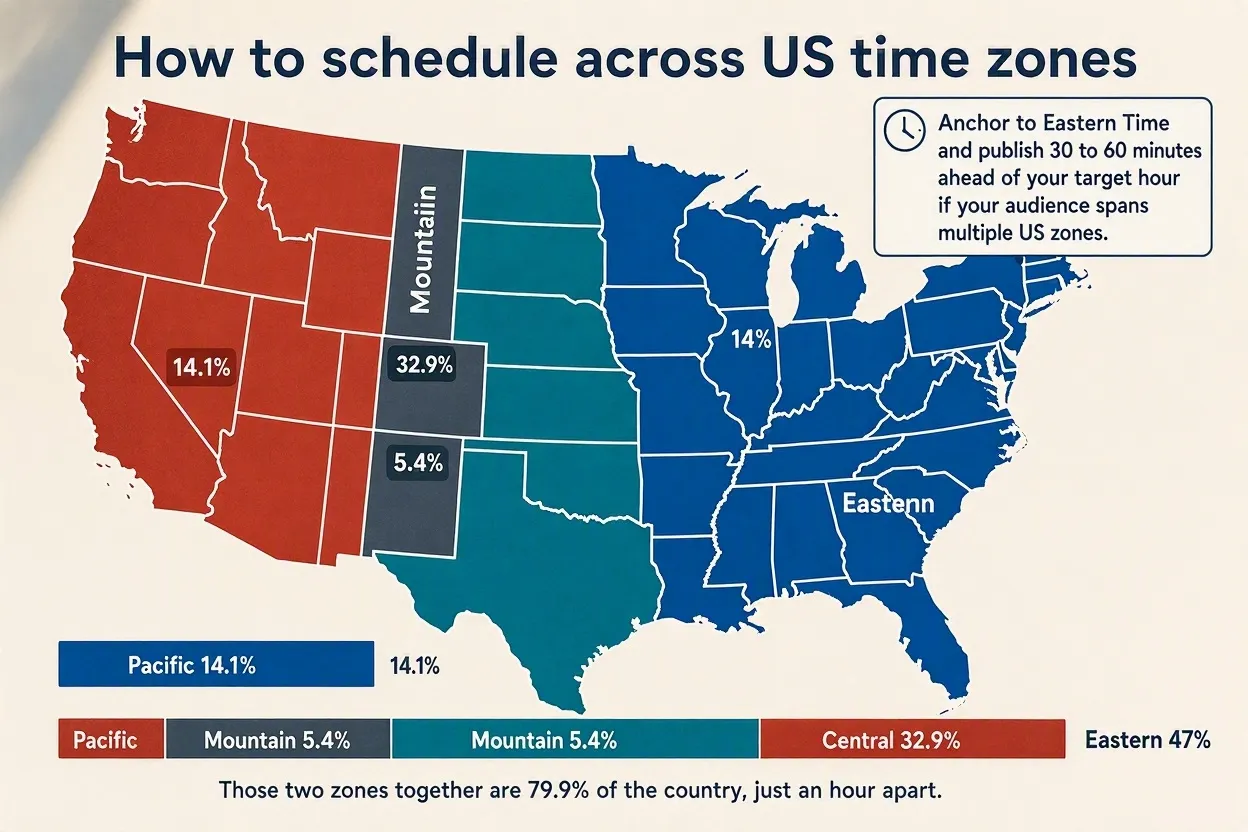
Anchor to Eastern Time and publish 30 to 60 minutes ahead of your target hour if your audience spans multiple US zones. As of 2026, Eastern holds an estimated 47% of the population and Central holds 32.9%.
Those two zones together are 79.9% of the country, just an hour apart. Mountain is 5.4%, Pacific 14.1%. That means an Eastern anchor puts four out of five Americans within an hour of their local peak, no matter which study you’re following.
| Zone | Share of US population | 9 a.m. ET arrives at |
| Eastern (ET) | 47.0% | 9:00 a.m. |
| Central (CT) | 32.9% | 8:00 a.m. |
| Mountain (MT) | 5.4% | 7:00 a.m. |
| Pacific (PT) | 14.1% | 6:00 a.m. |
If more than 25% of your followers sit in Pacific, split the schedule. Publish the main post at 9 a.m. ET for the Eastern/Central bloc, then a separate one at 9 a.m. PT (noon ET) for the West Coast. Just don’t repost the identical asset three hours apart. Instagram and LinkedIn both suppress reach on near-duplicate content, so the second slot needs different creative.
How often to post on each platform
Facebook and Instagram: once or twice a day. X: one to three times. LinkedIn: once per business day. Timing and frequency work together here. A perfectly timed post published twice a month loses to a decently timed one published four times a week.
| Platform | Recommended frequency | Notes |
| 1-2 posts per day | Once or twice each weekday, once across the weekend | |
| 1-2 Reels per day plus 1 image or carousel | Consistency outweighs volume | |
| 1 post per business day | Engagement drops sharply after the first daily post | |
| X | 1-3 posts per day | Engagement falls off after the third |
| TikTok | 1-3 posts per day | Highest tolerance for volume of any major platform |
| 3-5 pins per day | Pins earn impressions for weeks after publishing | |
| YouTube | 1-2 long-form videos per week | Shorts can run daily alongside long-form |
LinkedIn is the least forgiving of the bunch. Post twice in one day and you split your own engagement, dragging down the first post’s reach along with it. Save the second idea for tomorrow.
B2B versus B2C posting times
B2B content does best 11 a.m. to 2 p.m. ET on weekdays. B2C does best outside the standard 9-to-5.
| Audience type | X | ||
| B2B, software, nonprofit | 9 a.m.-2 p.m. Tue-Thu | 8 a.m., 10 a.m.-noon, 6 p.m. weekdays | 9 a.m.-4 p.m. Mon or Thu |
| B2C | 12 p.m. Mon-Wed | 12 p.m. weekdays | 12-1 p.m. Mon-Wed |
| Media and publishing | 8-10 a.m. and 5 p.m. weekdays | 8 a.m. weekdays | 6-7 a.m., 11 a.m., 7-10 p.m. |
Media brands spread out more than anyone else, hitting three distinct daily peaks on X: early morning, midday, and evening. That tracks how people actually read news: headlines before work, a check-in at lunch, another pass after dinner.
Daylight saving and seasonality
Recheck your schedule twice a year, in March and November, when daylight saving shifts sunrise and commute patterns by a full hour. Every major study normalizes to clock time, not daylight, so a schedule built in January is describing a different audience by April.
A few seasonal shifts worth planning around:
- Late May through August flattens weekday peaks as vacations and flexible summer hours spread activity out
- Late November through December pushes retail engagement into evenings, with Cyber Monday and the two weeks before Christmas driving the year’s highest commercial volume
- Late August into early September sharpens weekday peaks again once school schedules resume
- October and early November in even-numbered years compresses organic reach on X and Facebook as political ad spend floods US feeds
Arizona and Hawaii don’t observe daylight saving, so a business with real audience share in Phoenix or Honolulu drifts an hour out of sync with those markets for roughly eight months a year. That matters if you’re a local business. National brands can mostly ignore it.
How to find your own best time to post
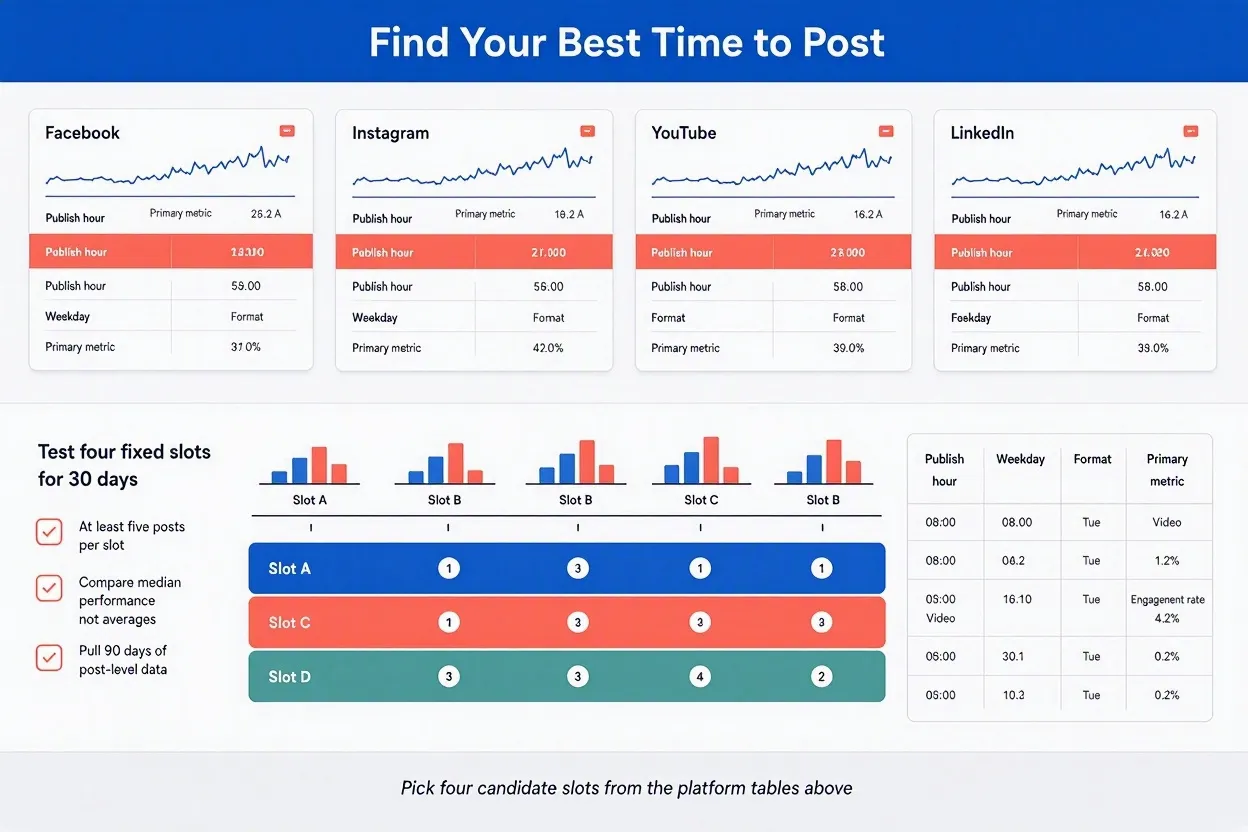
Test four fixed slots for 30 days, at least five posts per slot, then compare median performance instead of averages.
- Pull 90 days of post-level data from each platform’s native analytics: Meta Business Suite for Facebook and Instagram, YouTube Studio for video, LinkedIn page analytics for LinkedIn.
- Record publish hour, weekday, format, and your primary metric for every post.
- Pick four candidate slots from the platform tables above, spaced at least three hours apart.
- Publish at least five posts into each slot over 30 days, keeping format and topic steady.
- Compare median results, not averages. One viral post will wreck an average.
- Repeat the test every quarter. LinkedIn’s peak moved from morning to late afternoon in a single year.
Twenty posts total is about the floor for a readable result. Fewer than five per slot and the comparison ends up dominated by content quality rather than timing, and no amount of scheduling precision separates the two at that sample size.
Worth noting: native analytics answer a different question than these studies do. Meta Business Suite tells you when your followers are online. The studies tell you when posts perform. Those two rarely line up, since followers are often online exactly when feed competition is heaviest, which is when your post is most likely to lose.
Conclusion
Match the study to your account size, anchor to Eastern Time, then test your own four slots for 30 days and judge them by median engagement, not averages. Treat any schedule older than a quarter as already out of date, since LinkedIn alone moved by three hours in the space of a year.