
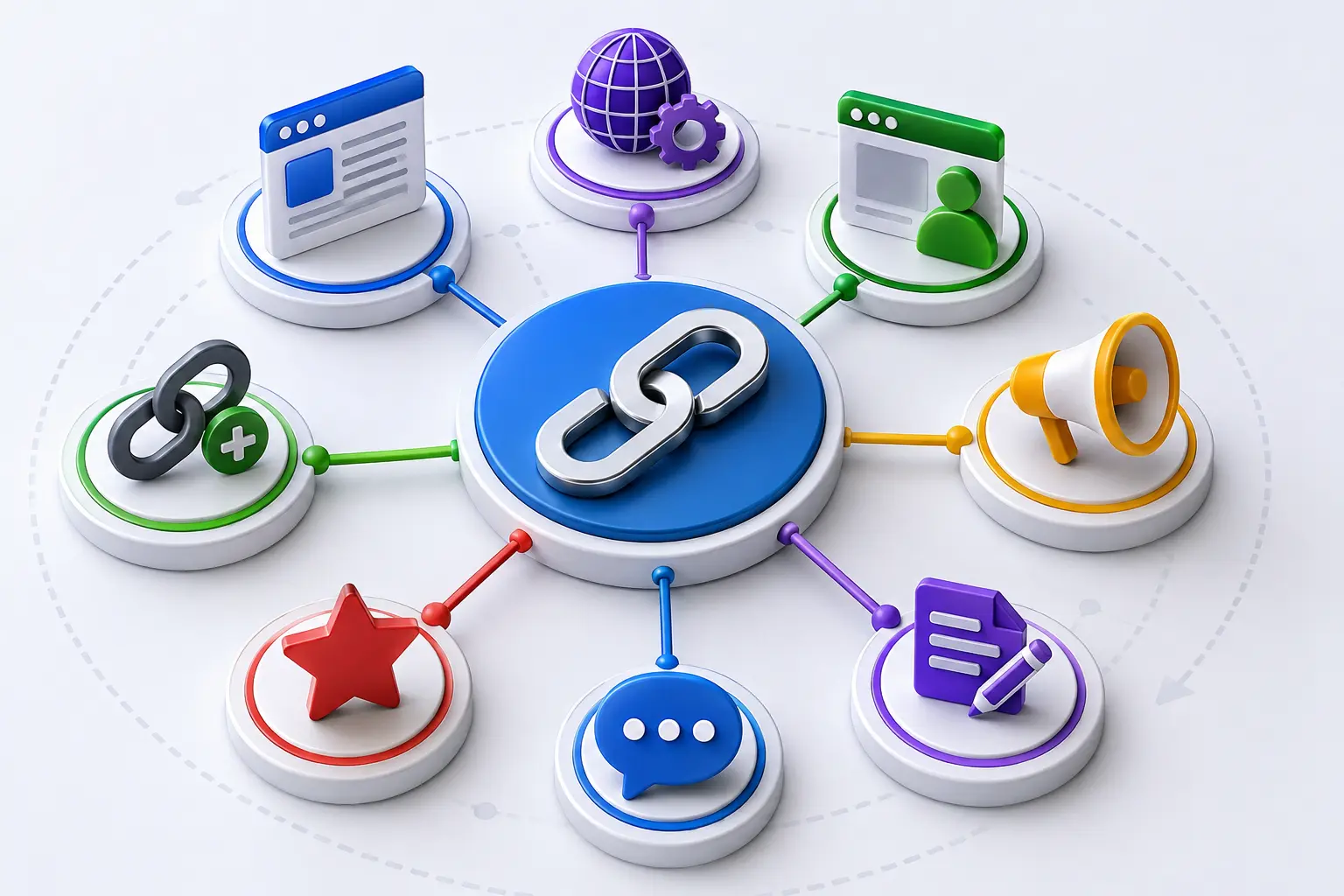
This SEO guide breaks down how backlink types shape search engine rankings, organic traffic, and digital marketing performance. A backlink is a hyperlink on one website that points to a page on a different website. In search engine marketing terms, it works like a vote of confidence that boosts a site’s search visibility. Bankrate’s mortgage calculator picked up an SEO-relevant backlink from Slate simply because the tool answered a question Slate’s writers needed answered for their own content marketing.
Not every backlink carries the same weight in an SEO strategy. A link’s marketing value shifts based on three factors: where it sits on the page, what HTML attribute it carries, and how the linking website earned its own search engine trust. This matters for any organic traffic strategy because a 2024 Semrush ranking-factors study found that domains with high-ranking pages consistently carry more backlinks than domains ranking lower for the same search terms. It’s the types of backlinks a website accumulates, not just the raw count, that determine whether that correlation turns into an actual ranking boost and stronger marketing ROI.
This guide sorts every major backlink type into four practical SEO buckets: attribute, source, placement, and risk. A fifth section covers something none of the major search engine optimization guides address directly: how these same backlink types influence citations inside AI Overviews, ChatGPT, and Perplexity, an emerging front in search engine marketing.
Types of Backlinks by Link Attribute
Link attribute refers to the HTML rel tag attached to a hyperlink. It’s the first classification search engines check before crediting a webpage with SEO authority. Four attributes exist: dofollow (the default), nofollow, sponsored, and UGC.
Dofollow Backlinks
A dofollow backlink is a standard link with no rel attribute added to its HTML. Every link on the internet defaults to dofollow unless a site owner manually inserts rel=”nofollow”, rel=”sponsored”, or rel=”ugc”. Because dofollow links pass search ranking authority and topical relevance directly, they’re the single most sought-after link type in any SEO outreach campaign. A homepage-to-product-page internal marketing link, written as <a href=”https://example.com/”>Visit ACME’s homepage</a>, is dofollow by default.
Nofollow Backlinks
A nofollow backlink carries the rel=”nofollow” attribute, which tells search engines not to pass ranking credit through that link. Google introduced the tag in 2005 to fight comment spam. Website owners still use it in their SEO and marketing practices whenever they want to link out without vouching for the destination. A gardening blog linking to a competitor’s marketing roundup post, for instance, would typically mark that link nofollow rather than hand over an unearned search engine endorsement.
Sponsored Backlinks
A sponsored backlink uses the rel=”sponsored” attribute to disclose that money or another form of compensation changed hands for the placement, a core disclosure requirement in paid digital marketing. Google introduced this attribute in 2019 specifically to separate paid marketing content from organic editorial links. Affiliate marketing links, paid guest posts, and influencer campaign links all fall under this SEO category. Search engines treat sponsored attributes as a ranking signal, not an absolute filter, so the link can still carry some indirect marketing value even though it won’t pass full search authority.
UGC Backlinks
A UGC (User-Generated Content) backlink carries the rel=”ugc” attribute and marks a link as originating from a comment, forum post, or review rather than the site owner’s own marketing efforts. Blog comment sections, Reddit threads, and Quora answers generate this SEO link type constantly. Website owners apply the UGC tag to protect their domain’s search engine standing from being blamed for spam, a random commenter added. In June 2025, 71% of backlinks across the top 100 domains tracked by Semrush were follow links, with the remaining 29% split across nofollow, sponsored, and UGC combined.
Types of Backlinks by Source
Source-based classification groups backlinks by the SEO acquisition method or marketing channel used to earn them, and this is where most competing search engine optimisation guides spend the bulk of their word count. Nine source types show up consistently across high-authority marketing and SEO content.
Editorial Backlinks
An editorial backlink is a link placed naturally by a writer or editor because the linked content added genuine value to their article. It’s the gold standard in any SEO or content marketing strategy. No request, no payment, no relationship-building outreach email. The writer simply cited a source. HubSpot’s “Ultimate List of Marketing Statistics” has generated roughly 58,000 referring links, and a meaningful share of those came in editorially because journalists needed a marketing stat to cite. If a website wants this SEO link type, publishing original research or a genuinely useful marketing tool works better than any outreach template.
Guest Post Backlinks
A guest post backlink comes from an article a contributor writes and publishes on someone else’s website as part of a content marketing and SEO outreach strategy, typically with a link back to their own site in the body or author bio. Google’s own search engine guidance discourages guest posting purely for links, but it doesn’t discourage the marketing practice itself when the content adds real value. A cybersecurity company contributing a technical breakdown to a SaaS marketing publication, with one contextual link back to a related resource, sits well inside acceptable SEO practice. A company publishing the same 300-word promotional post across 40 unrelated sites does not.
Digital PR Backlinks vs. Press Release Backlinks
Digital PR backlinks and press release backlinks aren’t the same marketing tactic, even though most SEO guides use the terms interchangeably. A press release is a formal company announcement distributed to wire services as part of a broader PR and marketing push, and Google’s John Mueller has confirmed the algorithm largely ignores links inside syndicated press releases because they’re self-published and non-editorial. Digital PR means pitching original data, a study, or a newsworthy angle directly to journalists as a targeted marketing strategy. The resulting link lands inside an editorial article the journalist chose to write, not a syndicated wire post. SE Ranking’s own research on Google’s AI Overviews earned marketing coverage through direct journalist pitches rather than wire distribution, which is why that link counted as digital PR rather than a press-release placement.
HARO Backlinks
A HARO (Help A Reporter Out) backlink comes from providing an expert quote to a journalist through a source-matching platform, then receiving a citation link in the published piece. It’s a low-cost SEO and PR marketing tactic. Connectively (the platform formerly known as HARO), Qwoted, and Help a B2B Writer all run on the same model: a journalist posts a request, an expert responds with a quote, and the published article links back to the expert’s marketing site. One marketing team secured a citation through the Help a B2B Writer platform simply by having their email marketing manager answer a request with a two-paragraph response. No negotiation required.
Directory Backlinks
A directory backlink comes from a business listing on marketing platforms such as Google Business Profile, Yelp, or Tripadvisor. These links rarely move search rankings the way editorial links do, but they strengthen local SEO by confirming NAP (Name, Address, Phone number) consistency across the web, a foundational local search marketing practice. A restaurant listed identically on Tripadvisor, Yelp, and Google Business Profile signals search engine trustworthiness even though none of those three links carries much direct SEO authority on its own.
Resource Page Backlinks
A resource page backlink comes from being added to a curated “further reading” or “helpful tools” page that a website maintains for a specific topic, a common target in link-building marketing campaigns. Getting listed requires SEO outreach, but the acquisition process differs from guest posting because no new content gets created. The site owner simply adds an existing URL to an existing marketing list. A home-improvement blog with a well-researched “renovation cost calculators” resource, once discovered by a resource-page curator, can earn a placement without a single outreach email.
Badge Backlinks
A badge backlink comes from awarding another website a digital emblem, like a “Top Rated” seal or certification badge, that includes an embedded link back to the awarding site. It’s a popular B2B marketing tactic, and review platforms and rating sites use it most often. A software directory that gives a “Best in Class 2026” badge to 50 vetted marketing vendors picks up 50 backlinks the moment those vendors embed the badge on their own websites.
Webinar, Video, and Podcast Backlinks
Webinar, video, and podcast backlinks come from being featured as a guest speaker, interviewee, or credited creator on someone else’s content marketing platform. Clearscope’s webinar page crediting a guest speaker, or a YouTube video description crediting a photographer’s Space.com feature, both generate this SEO link type. These marketing placements take more time to secure than a comment link, but they typically land on higher-authority pages and reach a more targeted marketing audience.
Types of Backlinks by Placement on the Page
Where a link sits on a webpage changes how much SEO weight search engines assign to it, independent of the link’s attribute or marketing source. Four placement categories cover nearly every case in search engine optimization.
Contextual Backlinks
A contextual backlink sits inside the body text of an article, surrounded by relevant content that explains why the link belongs there. It’s the strongest placement type in SEO strategy, because the surrounding sentences give search engines topical context the anchor text alone can’t provide. A Shopify marketing article linking to a supply-chain survey mid-paragraph, right where the data supports the writer’s point, is a textbook contextual placement.
Image Backlinks
An image backlink is attached to a linked photo, graphic, or infographic rather than to clickable marketing copy. Photo credit lines are the most common example. Space.com crediting a photographer with a linked byline sends that photographer an SEO-relevant backlink even though no anchor text exists at all. Google has stated a search engine preference for text-based links over image links, precisely because images lack the surrounding textual context that helps establish topical relevance.
Footer and Sidebar Backlinks
A footer or sidebar backlink appears outside the main content area, typically in a site-wide template element rather than inside an individual marketing article. Google’s John Mueller has recommended nofollow tags on sitewide footer links specifically because they get reused across every page on a domain, which makes them look manufactured rather than earned in the eyes of search engine algorithms. A web design agency listing “Site by [Agency Name]” in a client’s footer is a common marketing example, and it’s exactly the kind of link Google expects to see marked nofollow.
Widget Backlinks
A widget backlink comes embedded inside a small interactive marketing tool, like a calculator, weather display, or currency converter, that a website owner installs via a code snippet as part of a content marketing strategy. Google issued a direct SEO warning about hidden widget links in 2016, stating that any link a webmaster didn’t editorially choose and can’t control the anchor text on violates its search engine guidelines. A visible, nofollow-tagged credit link inside a marketing weather widget stays compliant. An invisible keyword-stuffed link buried in the same widget’s code does not.
Backlink Types That Can Hurt Search Rankings
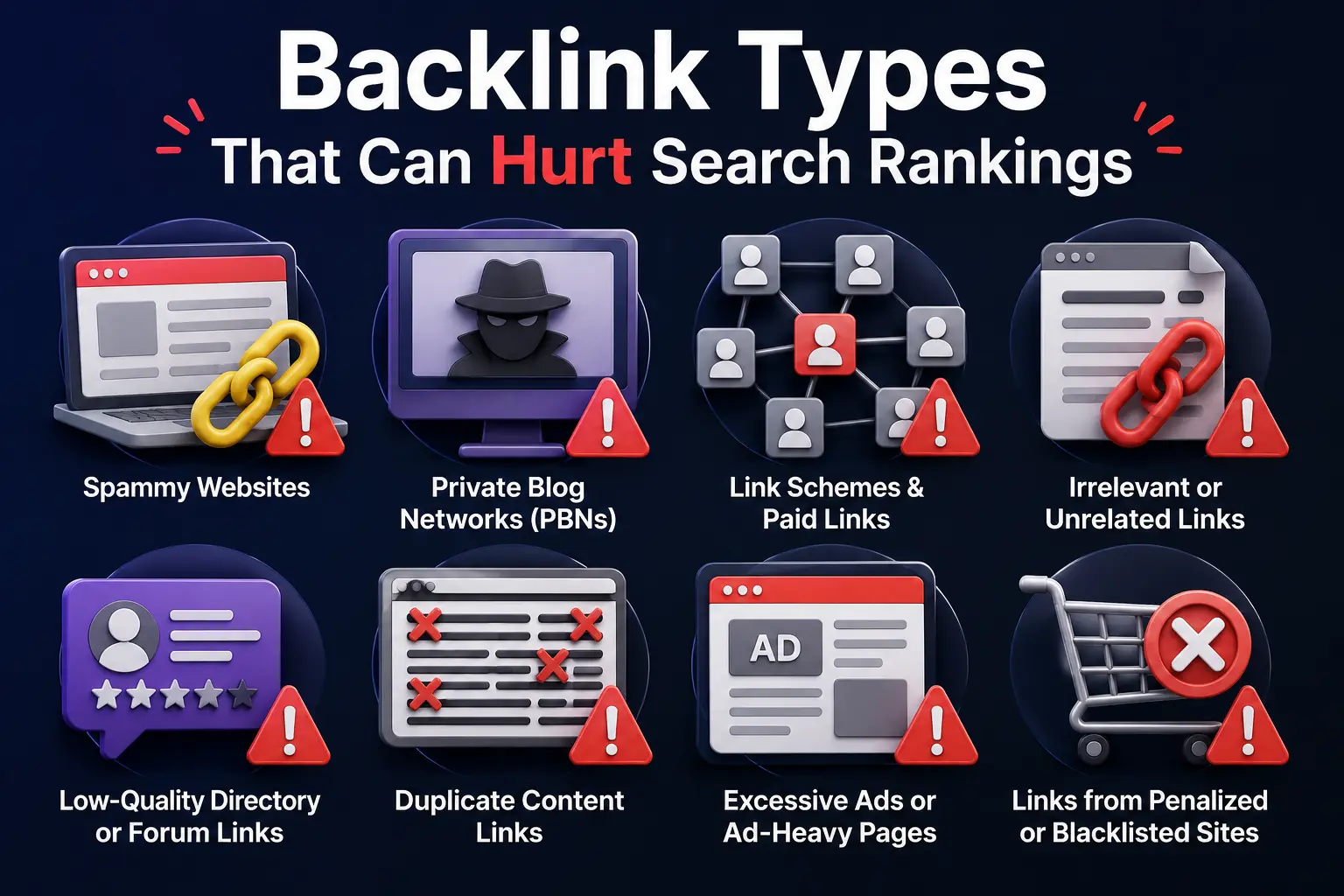
Four backlink types carry real SEO penalty risk, and search engines treat all four as manipulation attempts rather than legitimate marketing signals.
PBN Backlinks
A PBN (Private Blog Network) backlink comes from a network of websites a single entity owns and controls purely to funnel search engine authority toward one target marketing site. Google’s 2012 Penguin update specifically targeted this SEO tactic, and detection has only improved since. A company that buys 15 expired domains, republishes thin content on each, and links all 15 back to its main marketing site is running a textbook PBN, and risking a manual search engine action the moment Google’s spam team spots the pattern.
Paid Dofollow Backlinks
A paid dofollow backlink is any link purchased with money, free products, or marketing services in exchange for a follow attribute rather than a sponsored or nofollow tag. Google’s link-scheme policy explicitly bans this SEO practice, whether the payment is cash, a free product sent to a reviewer, or a discounted marketing service traded for a footer credit. A design agency offering 20% off web development in exchange for an unmarked dofollow client-site link violates the same search engine policy as a straight cash transaction.
Reciprocal Link Exchanges
A reciprocal link exchange happens when two website owners agree to link to each other purely to inflate both backlink profiles for SEO purposes. Google’s link-scheme guidelines call out “excessive link exchanges” by name as a search engine violation. One or two genuine marketing partnership links between related businesses won’t trigger a penalty, but a pattern of dozens of reciprocal swaps across unrelated marketing niches reads as manipulation to Google’s ranking algorithm.
Spammy Comment and Forum Backlinks
A spammy comment or forum backlink comes from mass-posting the same marketing link across unrelated blog comment sections or discussion boards, usually through automated SEO tools. Matt Cutts has said publicly that leaving genuinely relevant comments occasionally is fine for search engine purposes, but relying on comment links as a primary marketing strategy crosses into scheme territory. A single thoughtful comment on a topically relevant post causes no SEO harm. Two hundred identical comments dropped across unrelated forums in one week gets the domain flagged by search engines.
Does Nofollow Still Matter in 2026?
Yes, nofollow links still matter to search engine marketing performance, though their function changed fundamentally in 2019. Google now treats nofollow, sponsored, and UGC attributes as ranking hints rather than strict directives, which means the algorithm reserves the right to follow and count any of these links when contextual marketing signals suggest they’re trustworthy. A nofollow link from a major news outlet’s comment section carries more potential residual SEO value today than the same tag on a spam forum post did before 2019. Website owners still shouldn’t chase nofollow links as a primary link-building strategy, but a backlink profile made up entirely of dofollow links looks unnatural to Google’s spam filters and can itself trigger closer search engine scrutiny.
How Backlink Types Affect Citations in AI Search
Backlink types influence AI-generated marketing answers differently than they influence traditional blue-link search rankings, and none of the major competing SEO guides on this topic address that distinction. Google’s AI Overviews, ChatGPT, and Perplexity all pull from a smaller set of sources per query than a traditional search engine results page does. That means editorial backlinks and digital PR placements, the two marketing types most tied to genuine third-party trust, carry outsized weight in what gets cited. A press release syndicated across 40 wire sites rarely earns an AI citation because the marketing content is duplicated and non-original. A single data-backed article picked up editorially by three or four industry publications stands a far better chance in this emerging SEO frontier, since AI systems appear to favor sources that other trusted sites have independently chosen to reference. Directory listings, widget links, and footer credits contribute close to nothing toward AI citation likelihood, since these link types signal template placement rather than genuine marketing endorsement.
How Many of Each Backlink Type Belongs in a Healthy SEO Profile?
A healthy backlink profile mixes multiple types rather than concentrating on one. Most SEO practitioners and digital marketers target somewhere between 60% and 80% dofollow links, with the remainder split across nofollow, sponsored, and UGC. New websites often start with directory and social media marketing links because those are the easiest to acquire, then shift toward editorial and digital PR links as domain authority grows within their SEO strategy. A six-month-old site with 200 backlinks and zero nofollow links looks statistically unusual next to competitor marketing profiles, and that imbalance alone can prompt a closer algorithmic search engine review. Diversifying source types, mixing guest posts, HARO placements, and editorial mentions instead of relying on one marketing channel, also protects a site’s SEO performance if any single tactic loses effectiveness after a future algorithm update.
How to Audit Backlink Types Across an SEO Profile

Checking a link’s HTML source code reveals its attribute type in seconds, and free SEO tools handle the rest of the marketing classification automatically. Right-clicking a link and selecting “Inspect” in any browser shows whether rel=”nofollow”, rel=”sponsored”, or rel=”ugc” appears in the tag. No attribute present’ means the link is dofollow. Google Search Console’s “Links” report shows every backlink type pointing to a verified marketing property, while SEO platforms such as Semrush, Ahrefs, and SE Ranking add source classification, anchor text data, and toxicity scoring on top of the raw attribute breakdown. Running a backlink audit through any of these marketing tools takes under ten minutes for most small-to-midsize domains and immediately flags which competitor SEO links are worth pursuing versus which link types to avoid entirely in a marketing campaign.
Conclusion
Twenty-plus backlink types exist across attribute, source, placement, and risk categories, and each one sends search engines a different marketing signal about a page’s trustworthiness. A single editorial link from an industry publication with 50,000 monthly readers can outweigh 200 directory listings combined in SEO value. A backlink profile built entirely on one type, however clean, reads as manufactured rather than earned by search engine algorithms. Google’s spam team keeps refining PBN and reciprocal-link detection every year, so the safest long-term SEO and marketing strategy stays the one every guide in this space agrees on: publish content worth citing, and let the backlink types diversify on their own.