Manual link building is what happens when you skip the bots and just ask for the link. It’s outreach, research, and relationship-building aimed at sites that actually deserve to link to you, as opposed to automated tools that spray links across the internet and hope Google doesn’t notice.
Google still counts backlinks among its top three ranking factors this year, and that hasn’t changed much despite years of predictions that it would. Sites with strong link profiles from DA 40-80 domains keep beating out competitors stuck with thin or spammy links. One study looking at 11.8 million search results found that the page ranking first had, on average, 3.8x more backlinks than anything sitting in positions two through ten. That gap is hard to close without real links.
This guide walks through seven methods that actually work, the tools worth paying for, what links cost in practice, how long results take, and nine mistakes that get sites penalized. Everything here comes from real campaign data, not theory.
What Manual Link Building Actually Is
It’s an SEO technique where you earn backlinks through direct outreach rather than software. Every placement means researching a prospect site, checking its metrics, writing an email that isn’t a template, and often negotiating a bit before the link goes live.
Three things separate real manual link building from the automated kind:
- Research done by a person. You’re looking for DA 40+ sites with genuine organic traffic and actual relevance to your niche, usually using Ahrefs or SEMRush to check.
- Outreach that references something specific. A good pitch mentions an actual post on the prospect’s site. A mass template doesn’t.
- Verification before you commit. DA, DR, spam score, traffic history, content quality. Skip this and you’ll waste money on links that do nothing.
Do it right and you get editorial backlinks that move organic traffic and build authority that compounds over years, not a quick spike that disappears after the next algorithm update.
Manual vs. Automated: Where They Actually Differ
Automated tools build links faster. That’s their only real advantage, and it’s not much of one once you factor in what Google’s SpamBrain algorithm is built to catch.
| Factor | Manual | Automated |
|---|---|---|
| Link quality | DA 40-80 editorial placements | DA 5-20 spammy directories |
| Google risk | Minimal | High |
| Relevance | Niche-specific | Often random |
| Cost per link | $150-$500 | $5-$20 |
| ROI timeline | 3-6 months | Short-lived, then penalties |
Google’s March 2024 Spam Update, and the Link Spam Updates that followed, target exactly the patterns automated tools produce. Sites hit by these updates lost 30-80% of their organic traffic overnight. Manual link building mostly avoids this because every placement looks different: unique context, unique justification, no repeating footprint for an algorithm to latch onto.
Seven Methods That Work
These seven show up across SaaS, ecommerce, finance, health, and B2B campaigns. Not every method fits every business, so pick based on what you already produce.
1. Guest Posting
Pitch an editor a genuinely useful article idea, write it, and drop one or two natural links in the body. Target DA 50+ sites with real traffic (10,000+ monthly visits is a decent floor) and editors who actually care about quality. Expect 2-5 placements a month if you’re doing this consistently, usually landing around DR 45-65. Cold pitch acceptance rates run 3-8%, so plan for a lot of no’s.
2. Broken Link Building
Find dead links on relevant sites and offer your content as the replacement. Crawl target sites with Ahrefs’ broken link report, find pages where your content is a legitimate fit, reach out with the specific broken URL, then follow up in 5-7 days if you hear nothing. This converts well (5-12%) because you’re solving a real problem for the site owner, not just asking for a favor.
3. Digital PR and Expert-Source Outreach
Platforms like Connectively (the artist formerly known as HARO), Qwoted, and Help a B2B Writer connect you with journalists looking for quotes and data. Land one placement on a DA 70-90 news site and it’s often worth more than five or ten standard guest posts combined.
4. Niche Edits
Instead of creating new content, you get your link inserted into an article that’s already indexed and already ranking. Faster than guest posting because Google’s already crawled and trusts the host page. Turnaround usually runs 7-14 days, and pricing sits around $100-$400 depending on the site’s authority and traffic.
5. Resource Page Links
Universities, government sites, and industry associations often keep curated resource pages. One .edu link can genuinely outweigh ten regular blog links in terms of authority passed. Search for phrases like “[your niche] + useful resources” or “[your topic] + recommended links” to find candidates.
6. Unlinked Brand Mentions
Someone wrote about your company but didn’t link to you. Ask, and you’ll convert 15-25% of the time, the best rate of any method here, because you’re not even asking for a new mention, just a link on one that already exists. Track these with Ahrefs Content Explorer, Google Alerts, or Mention.com.
7. Competitor Backlink Replication
Run your top five competitors through Ahrefs’ backlink gap tool to find sites linking to them but not you. Export their profiles, filter for DA 40+, cut anything spammy or irrelevant, then prioritize the domains linking to two or more competitors. Those are your best bets.
What Actually Makes a Backlink Valuable
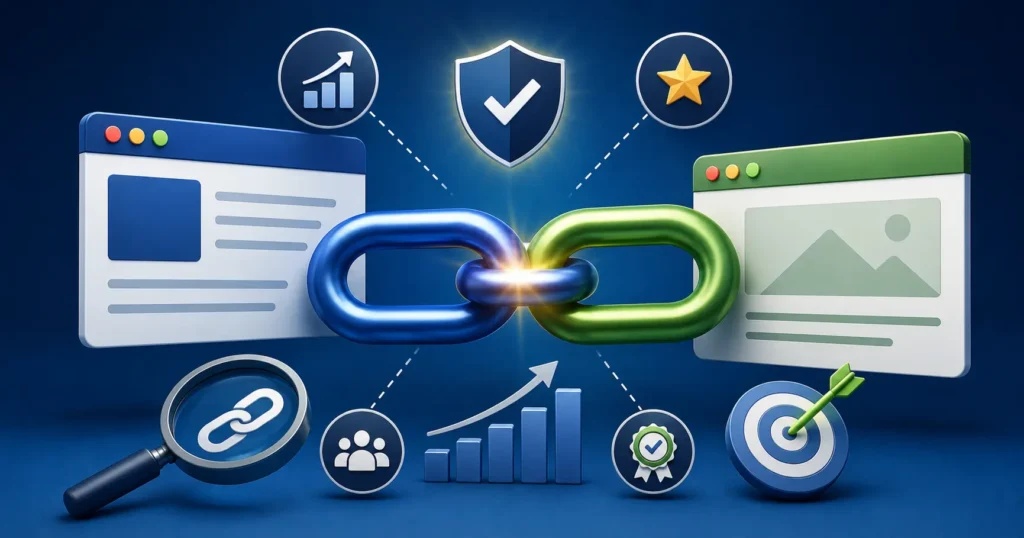
Not every link is worth the same, not even close. Google weighs a handful of things when deciding how much authority to pass through a given link.
Relevance matters more than raw authority. A fitness blog linking to a supplement company carries more weight than a random tech blog doing the same, even if the tech blog has a higher DA. Speaking of DA/DR, aim for 40+ on either scale (Moz or Ahrefs), since that’s roughly where link equity starts to matter. Organic traffic on the linking page counts too. Pages pulling 1,000+ monthly visits signal that Google already trusts that content, and referral traffic is a nice bonus on top.
Anchor text should look natural: mostly branded (“YourBrand”), some partial-match (“link building tips from YourBrand”), and a few generic ones (“read this guide”). Keep exact-match keyword anchors under 5% of your total or you’ll start looking optimized in a way that reads as manipulation. Placement matters a lot, too. A link buried in the body of an article passes 5-10x more equity than one stuck in a sidebar or author bio, and links that appear earlier in the content tend to carry more weight than ones near the bottom. Finally, check the linking domain’s traffic trend over the past year. A site in decline might be about to get hit with a penalty, and you don’t want your link tied to that when it happens.
Tools Worth Paying For
You need four categories of tools to run a real campaign, and honestly, skimping on any one of them shows up in your results.
For research, Ahrefs and SEMRush do the heavy lifting: backlink analysis, competitor research, prospect qualification. Ahrefs is better for backlink gaps and broken link discovery; SEMRush edges it out on keyword research and built-in outreach features. Budget $99-$449/month depending on the tier you need.
For finding contacts, Apollo.io and Hunter.io locate emails for site owners and editors. Apollo’s database is enormous (275M+ verified contacts) with solid filtering by role and seniority. Expect to pay $49-$99/month.
For outreach itself, Smartlead and Respona manage campaigns at scale. Smartlead rotates sending inboxes to keep your deliverability intact; Respona leans on AI for personalization while still sounding human. Budget $39-$99/month.
For monitoring, Google Search Console is free and tells you which backlinks Google has actually indexed. Ahrefs and Moz Pro track new and lost links, watch your DA over time, and flag toxic links before they become a problem. Check weekly if you can manage it.
What Quality Links Actually Cost in 2026
Expect to pay anywhere from $100 to $1,500+ per link, and the spread comes down to four things: the host site’s authority, how competitive your niche is, whether new content needs to be written, and the type of placement.
| Link Type | Cost | Typical DA/DR | Turnaround |
|---|---|---|---|
| Guest post | $150-$600 | 40-70 | 14-30 days |
| Niche edit | $100-$400 | 35-65 | 7-14 days |
| Digital PR | $300-$1,500 | 60-90 | 14-60 days |
| Resource page | $50-$200 | 30-60 | 7-21 days |
| Expert quote/HARO | $0-$300 | 50-90 | 7-30 days |
Agency retainers typically run $2,000-$10,000 a month and deliver anywhere from 8 to 25 links in that window. Higher volume usually means a lower cost per link, since the agency’s research and content costs get spread across more placements.
Average ROI on manual link building runs 300-500% over a year. Spend $5,000 a month, land 15 DA 50+ links, and you’re looking at roughly $15,000-$25,000 in equivalent organic traffic value based on typical cost-per-click benchmarks. Not guaranteed, but a reasonable ballpark if you’re executing well.
How Long Before You See Results
Realistically, 3-6 months before rankings move in a way you’d actually notice. Google needs time to crawl the new links, evaluate them, and recalculate your domain’s authority.
The first month or two is mostly acquisition and waiting for indexing. Rankings start to shift a little around months three and four. By months five and six, if things are working, you’ll typically see organic traffic up somewhere in the 50-150% range. That’s a wide band, and where you land depends heavily on how competitive your niche is and how strong your on-page SEO already was going in. Links on top of a weak site won’t do much.
Nine Mistakes That Get Sites Penalized
Google’s SpamBrain and its Link Spam Updates go after manipulative patterns specifically, and getting flagged can cost you 30-80% of your organic traffic.
Buying links from a private blog network is probably the fastest way to get caught. PBNs leave footprints: shared hosting, thin content, identical link patterns across dozens of “different” sites. Google’s gotten very good at spotting this.
Over-optimizing anchor text is another common trap. Push exact-match keyword anchors past 5% of your total and you’ll trip algorithmic filters. A healthier mix looks more like 40% branded, 25% generic, 20% partial-match, and 15% naked URLs.
Chasing authority while ignoring relevance backfires too. A DA 90 link from a site that has nothing to do with your industry does less for you than a DA 50 link from somewhere actually in your niche.
Building links too fast raises flags on its own. If a site goes from zero backlink activity to 200 new links in a week, that pattern alone signals manipulation, regardless of link quality. Keep acquisition steady month to month instead.
Skipping quality audits wastes money you didn’t need to spend. Check spam score (keep it under 5%), traffic trends, and whether the content is actually original before you commit to a placement.
Sending the same template to 500 prospects is a good way to get reported as spam and possibly blacklisted. Every email needs something specific to the site you’re pitching, even if it’s just one sentence.
Ignoring the dofollow/nofollow balance looks unnatural too. A profile that’s 100% dofollow doesn’t happen organically. Aim for something closer to 60-70% dofollow and 30-40% nofollow or sponsored.
Sending every link to your homepage is another red flag. A natural profile spreads across 15-30+ different URLs: service pages, blog posts, resource pages, not just the front door.
And finally, not disavowing toxic links leaves you exposed. Negative SEO attacks happen, and old mistakes pile up. Run a quarterly audit with Search Console and Ahrefs, and submit disavow files for anything with a spam score above 30%.
Where E-E-A-T Fits In
Google’s E-E-A-T framework (experience, expertise, authoritativeness, trustworthiness) ties directly into which links actually help you. A backlink from a site with strong E-E-A-T signals is worth more than one from a site that has none of that.
Guest posts with real author bios build experience signals. Editorial placements on industry publications validate your expertise, since it means people who know the space consider your content worth citing. Consistent placements across 50+ referring domains build authoritativeness over time. And a clean link profile, one with no spam patterns, reads as a trust signal to Google’s systems, which matters more now than it used to.
AI Overviews and What They Mean for Link Building
Google’s AI Overviews pull from pages it already considers authoritative, so a strong backlink profile now affects whether you show up in AI-generated answers, not just traditional rankings.
Three adjustments help here. First, get cited in listicle content, since AI Overviews lean heavily on “best of” and comparison articles when pulling sources. Second, build link clusters around 3-5 core topics instead of scattering links across unrelated subjects; AI systems seem to weigh topical depth pretty heavily. Third, prioritize outreach to genuinely high-E-E-A-T publications (industry press, research institutions, established media) over generic blogs that happen to have decent traffic.
DIY or Hire an Agency?
Comes down to time, budget, and how much SEO expertise you already have in-house.
DIY costs $200-$500/month in tools but eats up 20-30 hours of your time, and you’ll probably land 3-8 links a month while you’re still learning the ropes. An agency runs $2,000-$10,000/month, needs maybe 1-2 hours of your time for reviews and approvals, and typically delivers 10-25 links using processes they’ve already refined.
The math tends to favor an agency once your team’s time is worth more than about $50/hour. At 25 hours a month of DIY work, the opportunity cost alone (north of $1,250) starts closing in on agency pricing, and you’re still getting fewer, lower-quality links for the effort.
Getting Started
Manual link building is still the most reliable way to grow organic traffic and build authority that actually holds up over time. Whether you handle it yourself or bring in an agency, the seven methods above give you a real framework to work from.
A few steps to actually start:
- Audit your current backlink profile with Ahrefs or Search Console.
- Pick 3-5 competitors and run a backlink gap analysis.
- Choose 2-3 methods that fit your business type.
- Set a monthly target, 8-12 quality links is a reasonable starting point.
- Track results for 90 days in Search Console and Ahrefs before you adjust anything.
Conclusion
There’s no shortcut here, and that’s kind of the point. Manual link building takes longer than buying a package of PBN links, but it’s the difference between a backlink profile that compounds for years and one that gets wiped out the next time Google runs a spam update. Pick a couple of methods that fit how your business already creates content, budget for the tools or the agency retainer, and give it the 90 days it actually needs before judging whether it’s working. Slow and durable beats fast and fragile every time here.