

You published content. You optimized it. You waited. But the traffic never came.
Here’s the real problem: it’s not your writing. It’s not your on-page SEO. It’s the fact that your competitors are covering topics you haven’t touched — and Google is sending their traffic to those pages instead of yours.
That’s a content gap. And it’s one of the most fixable problems in SEO.
This guide shows you exactly how to find those gaps, prioritize the ones worth fixing, and fill them with content that actually ranks. You’ll get a complete free method using Google Search Console, a step-by-step paid tool workflow, and a 12-step checklist you can use today — no fluff, no theory, just the process.
What Is Content Gap Analysis?
Content gap analysis is the process of finding topics, keywords, and questions your competitors rank for — that your website does not cover.
That gap is costing you traffic right now. Someone searches for a term your competitor ranks for. Your site doesn’t show up. They click a competitor’s link instead of yours. Content gap analysis stops that from happening.
The concept is straightforward. You compare what you publish against what your competitors publish. Every topic they cover and you don’t is a gap worth evaluating. Every keyword they rank for and you don’t is a traffic opportunity sitting on the table.
In 2026, gap analysis goes deeper than keywords. Google’s algorithms — powered by BERT and MUM — evaluate entire topic clusters, entity relationships, and information depth. A page that covers a keyword but misses 6 related entities ranks below a page that treats the subject completely.
Why Content Gap Analysis Matters More in 2026
Most SEO guides treat content gap analysis as a one-time keyword exercise. That approach stopped working two years ago.
Google now uses Information Gain (IG) scoring to rank pages. IG measures how much new value your content adds compared to what already exists in search results. Pages that repeat what everyone else says get pushed down. Pages that add original data, real experience, or a unique angle get rewarded.
The March 2026 Core Update made this penalty sharper. Sites with shallow content clusters — covering a topic but missing key subtopics — lost 30–50% of their visibility overnight. Sites with complete topic coverage held their rankings.
There are 4 types of content gaps in 2026:
- Keyword gaps — search terms competitors rank for that your site doesn’t target at all
- Semantic gaps — entities and related concepts missing from your content that Google expects to see
- Format gaps — content formats competitors use (video, FAQ, comparison tables) that your pages lack
- Value gaps — topics you cover but with less depth, fewer examples, or outdated data than the ranking pages
Most businesses only fix keyword gaps. The other 3 types are where real ranking improvements come from.
How to Do Content Gap Analysis Step by Step (Free Method)
To do content gap analysis without paid tools, use Google Search Console, manual SERP review, and a simple spreadsheet. This 5-step process costs $0 and works for any website size.
Step 1: Identify Your 3 to 5 True SERP Competitors
Your SERP competitors are websites that rank for the same keywords you target. These are not always your business competitors.
A local plumber’s SERP competitors might include HomeAdvisor, Angi, and a national blog — none of which compete for customers. But all of them compete for search clicks.
To find SERP competitors: search your 5 most important keywords in Google. Write down which domains appear in positions 1–5 for each search. The domains that show up most often across all 5 searches are your true SERP competitors.
Aim for 3 to 5 competitors. More than 5 creates data overload with no added benefit.
Step 2: Extract Their Ranking Topics Manually
Open each competitor’s site. Look at their blog, resource center, or knowledge hub. Note every topic category they cover that you don’t.
Then open Google Search Console. Go to Performance → Search Results. Export your keyword list. These are the queries your site currently appears for in Google.
Now compare: what topics do competitors cover that don’t appear in your Search Console export? Each missing topic is a candidate gap.
Create a simple Google Sheet with 5 columns: Keyword, Competitor 1, Competitor 2, Competitor 3, Your Site, and Priority Score. Mark each competitor cell with a checkmark if they cover that topic. Leave your site column blank for gaps.
Step 3: Classify Each Gap by Type and Priority
Not all gaps are worth filling. A keyword with 100 monthly searches and low competition beats a keyword with 50,000 searches and 10 established competitors.
Score each gap on 3 factors:
- Search volume — use Google Keyword Planner (free) to check monthly search volume
- Competition level — check how many results Google shows and whether top pages come from high-authority domains
- Business relevance — does this topic attract your ideal customer, or just random traffic?
Gaps that score high on all 3 factors go to the top of your list. Fill these first.
Step 4: Map Gaps to Funnel Stage
Every gap belongs to one of 3 funnel stages:
- TOFU (Top of Funnel) — awareness content: “what is,” “how does,” “types of”
- MOFU (Middle of Funnel) — consideration content: “best tools for,” “how to choose,” “comparison of”
- BOFU (Bottom of Funnel) — decision content: “pricing,” “review,” “[product] vs [product]”
Most sites have too much TOFU and too little MOFU. The MOFU is where buyers compare options before purchasing. Gaps at this stage directly cost you sales, not just traffic.
Tag each gap in your spreadsheet with its funnel stage. Then prioritize BOFU gaps first for revenue impact, followed by MOFU for lead nurturing, and TOFU for long-term authority building.
Step 5: Build Your Content Gap Template
A content gap analysis template is a structured spreadsheet that tracks every gap, its priority score, the funnel stage, assigned writer, target publish date, and post-publish ranking status.
Your template columns should include:
- Target keyword
- Search volume (monthly)
- Gap type (keyword / semantic / format/value)
- Funnel stage (TOFU / MOFU / BOFU)
- Competing page URL
- Word count gap (competitor average minus your current word count)
- Missing entities (entities competitors mention that you don’t)
- Priority score (1–10)
- Status (planned / in progress / published / ranking)
This template turns gap analysis from a one-time audit into a repeatable growth system. Update it every 6 months — or every 3 months if your niche moves fast (technology, finance, health).
How to Do Content Gap Analysis With Paid Tools
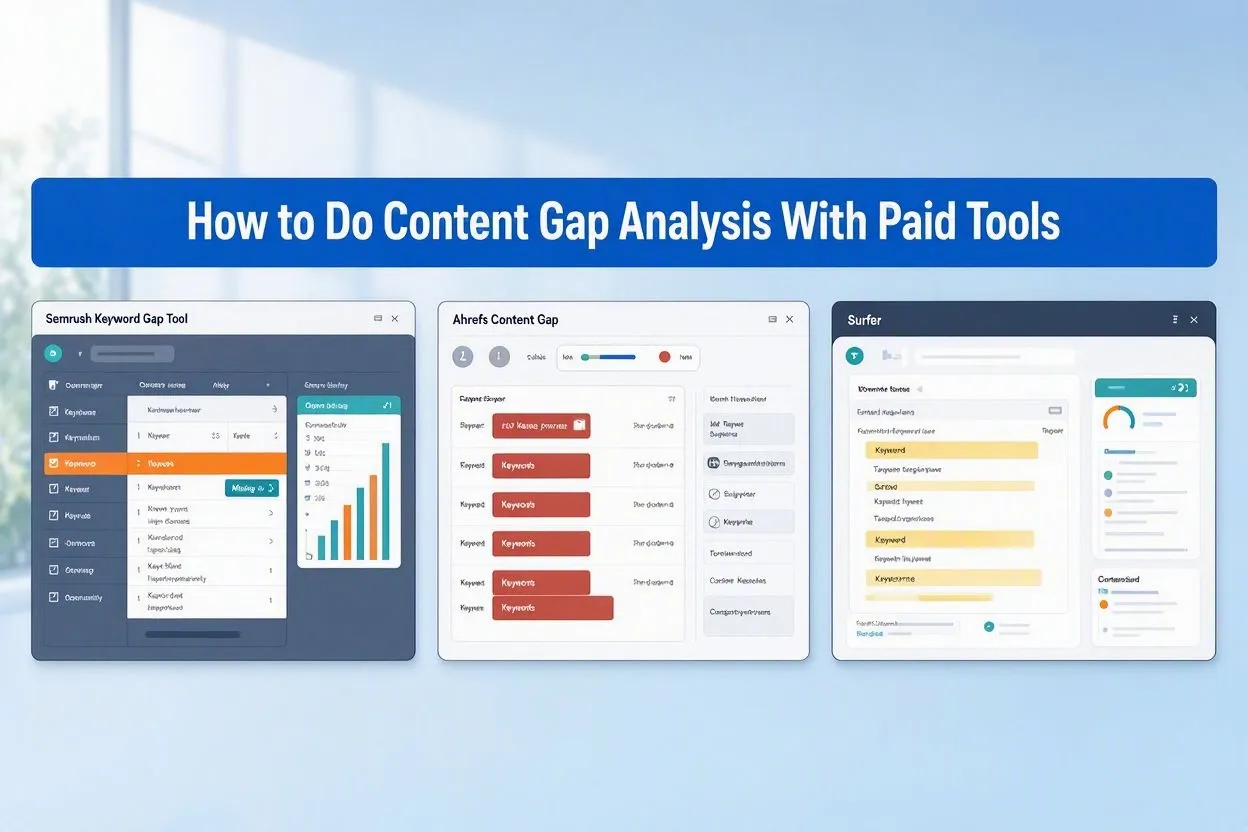
Paid tools speed up the process and surface gaps you’d miss manually. 3 tools dominate this category in 2026.
Semrush Keyword Gap Tool compares up to 5 domains simultaneously. Enter your domain and 4 competitor domains. Filter results to show “Missing” keywords — these are terms where all 4 competitors rank but you don’t. This single filter can surface 200+ high-value opportunities in under 10 minutes.
Ahrefs Content Gap works similarly. The advantage: Ahrefs shows historical ranking data. A competitor page that ranked #2 for a keyword in 2023 and now ranks #8 with outdated content signals a gap you can win with fresher, deeper content.
Surfer SEO goes further by analyzing semantic gaps. Enter a target keyword and Surfer shows which entities and NLP terms top-ranking pages include that your draft doesn’t. This directly addresses semantic gaps and entity salience — the factors Google’s Knowledge Graph uses to evaluate content completeness.
For budget-conscious teams: use Google Search Console for keyword gaps (free), Surfer’s free NLP analysis for semantic gaps (limited but functional), and manual SERP review for format gaps. This combination covers 80% of what paid tools offer at no cost.
Semantic Content Gap Analysis: The Part Everyone Skips
A semantic gap is not a missing keyword. It is a missing entity — a concept, brand, tool, or related idea that Google expects to find on a page covering your topic.
Here is the difference: a keyword gap means you don’t rank for “content audit checklist.” A semantic gap means your page about content audits never mentions internal linking, orphan pages, or thin content — 3 entities Google associates with that topic through its Knowledge Graph.
To find semantic gaps, run your top 3 competitor pages through Google’s Natural Language Processing (NLP) API. The API extracts every entity Google identifies in that content. Compare those entity lists against your own page. Every entity that appears on competitor pages but not yours is a semantic gap.
Common semantic entities missing from content gap analysis articles include:
- Entity salience scores
- Topic proximity math
- Co-occurrence patterns
- Query fan-out technique
- Answer Engine Optimization (AEO)
- Generative Engine Optimization (GEO)
Including these entities doesn’t mean stuffing them into sentences. It means covering the concepts genuinely — explaining what they are and how they connect to your main topic. Google’s BERT model reads context, not keyword frequency.
Content Gap Analysis for AI Search in 2026
Google AI Overviews (AIO) now appear at the top of search results for thousands of queries. These summaries pull content directly from web pages — and the pages they cite receive brand visibility even when users don’t click through.
Getting cited in an AI Overview is the new position zero.
To optimize content gaps for AIO visibility, use the Query Fan-Out technique. After identifying a gap keyword, ask: what are the 5 most likely follow-up questions a user asks after reading a basic answer to this query? Each follow-up question is a sub-topic your page needs to cover.
For example, the query “content gap analysis” fans out into:
- How often should I run a content gap analysis?
- What tools do I need for content gap analysis?
- What’s the difference between a keyword gap and a content gap?
- How do I prioritize which gaps to fill first?
- Can I do content gap analysis without paid tools?
A page that answers all 5 follow-up questions — not just the main query — provides the structured depth that AI systems extract and cite.
Answer Engine Optimization (AEO) formalizes this approach. AEO structures content so AI agents can extract specific facts, definitions, and step-by-step answers. Use short paragraphs, direct answers immediately after headings, and concrete numbers. A 3-sentence definition of a concept scores better in AI extraction than a 10-sentence paragraph that buries the answer.
Generative Engine Optimization (GEO) goes one step further. GEO treats the AI engine itself as the audience — structuring facts, entities, and relationships so AI systems can parse and reference the content accurately. Subject matter expert citations, original data, and counter-narrative angles are the 3 content signals that most consistently earn AI citations in 2026.
7 Content Gap Analysis Mistakes That Kill Rankings
Mistake 1: Targeting business competitors instead of SERP competitors. Your business rival and your Google rival are often different websites. Always build your competitor list from actual search results, not your sales team’s competitor list.
Mistake 2: Filling gaps with thin content. Finding a gap and publishing a 600-word article that restates what everyone else says creates no Information Gain. Google’s IG scoring actively demotes pages that add nothing new. Every gap you fill needs at least 1 original angle — your own data, a real case study, or a perspective no ranking page currently takes.
Mistake 3: Ignoring format gaps. A 2,000-word article will not outrank a competitor’s video + FAQ + comparison table combination for queries where users want visual content. Check the top 5 SERP results for your gap keyword before deciding on format. Match what Google already rewards for that query.
Mistake 4: Skipping semantic entity analysis. Filling a keyword gap without addressing entity gaps produces a page that ranks for the main term but misses dozens of long-tail variations. Entity-complete pages outrank keyword-targeted pages for 60–80% of related queries.
Mistake 5: Running gap analysis once and stopping. Competitors publish new content monthly. Google updates algorithms quarterly. A gap that didn’t exist 6 months ago might cost you 1,000 monthly visits today. Schedule gap analysis on a calendar, not as a one-time project.
Mistake 6: Ignoring your own underperforming pages. Some of your best gap opportunities are pages you already published. A page ranking in positions 8–15 for a target keyword often has semantic or value gaps compared to the pages above it. Updating that page with missing entities is faster and cheaper than creating new content from scratch.
Mistake 7: Treating all gaps as equal priority. A BOFU gap — a keyword your ideal buyer searches just before purchasing — is worth 10x more than a TOFU informational gap. Fill revenue-generating gaps before awareness-stage gaps.
Content Gap Analysis Checklist: 12 Steps
Use this checklist for every gap analysis audit. Complete all 12 steps in sequence.
- List your 3 to 5 true SERP competitors (from actual Google searches, not business rivals)
- Export your current keyword data from Google Search Console
- Review each competitor’s content hub or blog for topic categories
- Create your gap tracking spreadsheet with the 9 columns listed in Step 5 above
- List every topic competitors cover that your site doesn’t
- Classify each gap as keyword, semantic, format, or value gap
- Add search volume data for each gap keyword using Google Keyword Planner
- Map each gap to funnel stage (TOFU, MOFU, or BOFU)
- Score each gap 1–10 on search volume, competition, and business relevance
- Run top competitor pages through Google NLP API to extract missing entities
- Prioritize BOFU gaps first, MOFU second, TOFU third
- Assign each high-priority gap to a content creator with a target publish date
Start Closing Your Content Gaps Today
Every gap your competitors own is traffic, leads, and revenue that could belong to your website.
The process is repeatable: identify gaps, classify by type, prioritize by business value, fill with original content that adds real Information Gain. Run this cycle every 6 months and your content library compounds in authority over time.
Start with the free method. Build your SERP competitor list today. Export your Search Console data. Create your gap tracking spreadsheet. Pick the 3 highest-priority BOFU gaps and assign them to your content calendar this month.
The sites that win in 2026 are not the ones publishing the most content. They are the ones publishing the right content — in the right format, covering the right entities, filling the right gaps.