

Keyword gap analysis finds the search terms your competitors rank for and you don’t. Run it once a quarter, and you stop guessing what to write next.
Most SEO content explains the theory and stops there. This guide gives you the exact process, the mistakes that waste your time, and the part almost every other article skips: what changed in 2026 and why your old keyword list might already be stale.
What is keyword gap analysis
Keyword gap analysis compares your website’s ranking keywords against a competitor’s and surfaces the difference. The output is a list of search terms with traffic potential that your site currently misses.
There are three types of gaps, and treating them the same is the most common reason this process fails.
| Gap type | What it means | Priority |
| Missing keywords | Competitor ranks, you don’t rank at all | High — clearest opportunity |
| Weak keywords | You rank, but on page 2 or 3 | Medium — often quick wins |
| Untapped keywords | Nobody ranks well, low competition | High — fastest to capture |
Untapped keywords get ignored the most, and they shouldn’t. A search term with decent volume and no strong page on page one is easier to win than a term three competitors already dominate.
Why this matters more in 2026

Search results look different than they did two years ago. AI Overviews now answer a large share of informational queries directly on the results page, so some keywords that used to send clicks now send almost none.
This changes how you should read a gap analysis. A keyword with high search volume but a fully satisfied AI Overview is not worth chasing for traffic. A keyword with the same volume and no AI Overview, or one where the AI Overview cites sources, is worth far more. Check the search engine results page (SERP) for each gap keyword before adding it to your list, not after.
This single filter is missing from most keyword gap guides published before 2025. Skip it, and you’ll spend hours writing content for keywords that no longer convert into visits.
How to do a keyword gap analysis: step by step
Step 1: Pick 2 to 3 real competitors
Use sites that compete for your actual customers, not the biggest brand in your industry. A local bakery competing with a national chain’s blog learns nothing useful. Pick competitors close to your size and audience.
Step 2: Run the keyword comparison
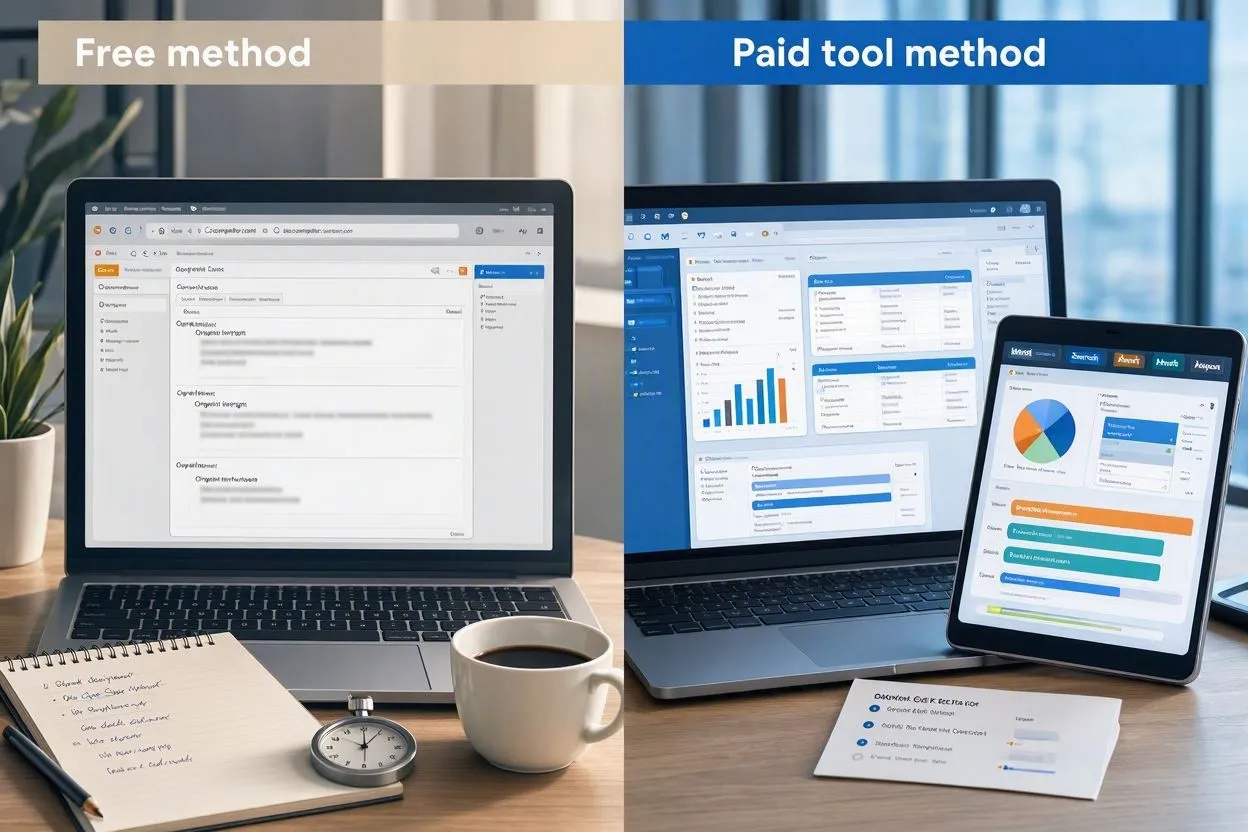
You have two paths here, and most guides only mention one.
Free method: Pull your top pages from Google Search Console. Search each competitor’s domain in Google using site:competitor.com keyword to spot-check rankings, or search your target topics directly and note which competitor pages appear. It’s slower, but it costs nothing.
Paid tool method: Tools built for this — Semrush, Ahrefs, Mangools — run the comparison in seconds and show exact keyword overlap. Worth it if you’re managing more than one site or doing this monthly.
Either way, the output you want is the same: a spreadsheet of keywords, who ranks for what, and at what position.
Step 3: Sort into the three gap types
Label every keyword as missing, weak, or untapped using the table above. This step takes ten minutes and saves hours of misdirected writing later.
Step 4: Check search intent
Group each keyword by what the searcher actually wants:
- Informational — they want an answer or explanation
- Commercial — they’re comparing options before buying
- Transactional — they’re ready to buy or sign up
- Navigational — they’re looking for a specific brand or site
A keyword can have perfect volume and zero value if you target it with the wrong content type. “Best running shoes for flat feet” wants a comparison post. “Buy running shoes online” wants a product page. Mixing these up is why some pages rank but never convert.
Step 5: Group into content clusters
Cluster related keywords under one pillar page with supporting articles linked to it. Three separate posts on three closely related keywords compete with each other for the same intent. One strong pillar page with internal links to supporting content tends to outrank all three.
Step 6: Prioritize by effort versus impact
Work in this order:
- Homepage and core service pages — highest existing authority, fastest to move
- Money pages — pages tied directly to revenue
- Top-performing blog content — update and expand what already ranks
- New content — fill the remaining gaps
This order matters because your homepage and service pages already carry domain authority. Adding a missing keyword there moves faster than starting a brand-new blog post from zero.
Common mistakes that waste a keyword gap analysis
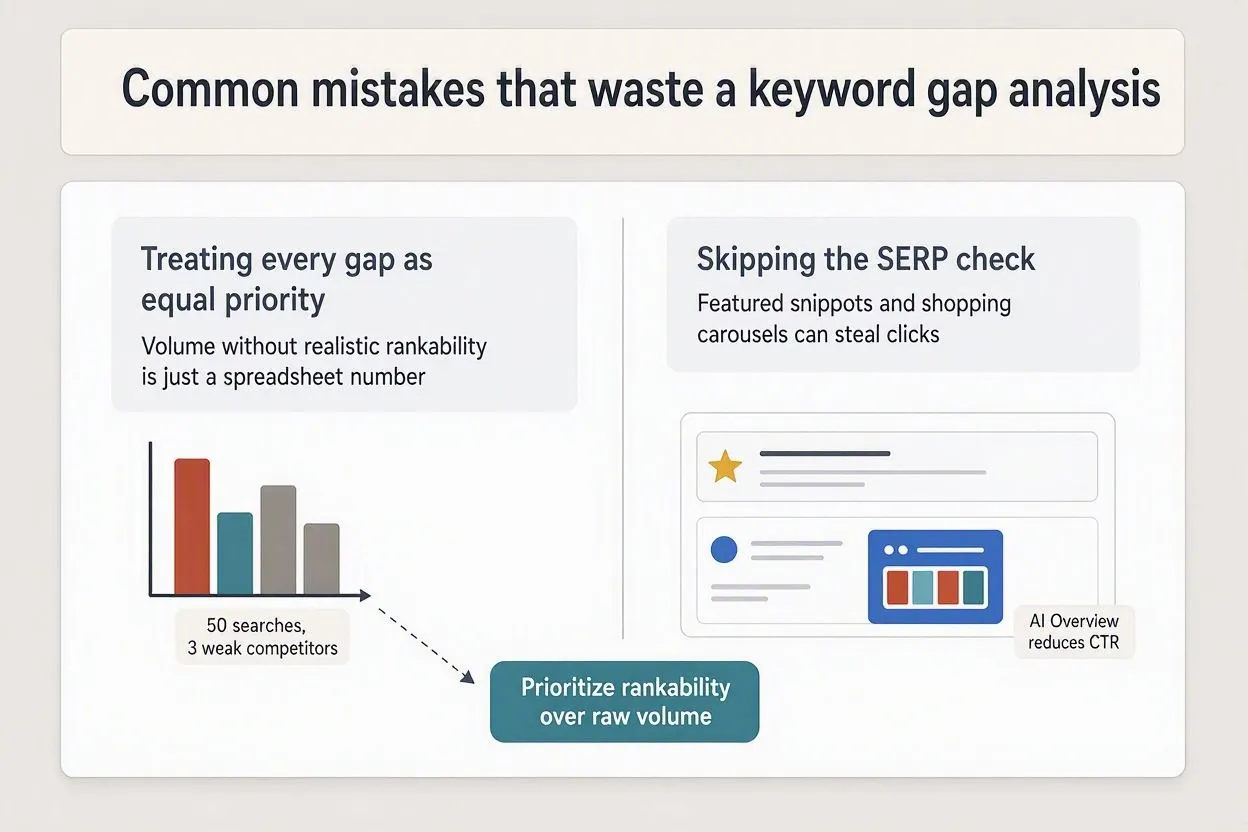
Treating every gap as equal priority. A missing keyword with 50 searches a month and three weak competitors beats a missing keyword with 5,000 searches and ten strong competitors. Volume without a realistic shot at ranking is a number on a spreadsheet, not a plan.
Skipping the SERP check. Some gap keywords trigger featured snippets, AI Overviews, or shopping carousels that eat most of the click-through rate before a tenth result ever shows. Check what’s actually on the results page before committing content to a keyword.
Ignoring search intent mismatches. Ranking for a keyword with the wrong content type rarely holds. Google reshuffles results until intent and content match.
Running the analysis once and never again. Competitor rankings shift monthly. A gap analysis from a year ago is a snapshot of a market that’s already moved.
Free tools versus paid tools
Google Search Console and manual SERP checks cost nothing and work fine for a single site checked occasionally. The tradeoff is time — expect a few hours per analysis.
Paid tools (Semrush, Ahrefs, Mangools) cut that to minutes and add data free tools don’t show, like estimated traffic value and historical ranking trends. Worth the cost if you’re running this analysis monthly or managing several domains.
Start free if budget is tight. Upgrade once the time saved is worth more than the subscription.
An untapped keyword with decent search volume and no strong page on page one. These convert into rankings fastest because there’s no entrenched competitor to outrank.
Turn your gap analysis into traffic
A spreadsheet of missing keywords does nothing sitting in a drive folder. Pick the five highest-priority gaps from your list, build one content cluster around them this month, and measure ranking movement in 60 days. That’s the entire system — repeat it quarterly and your organic traffic compounds instead of stalling.