
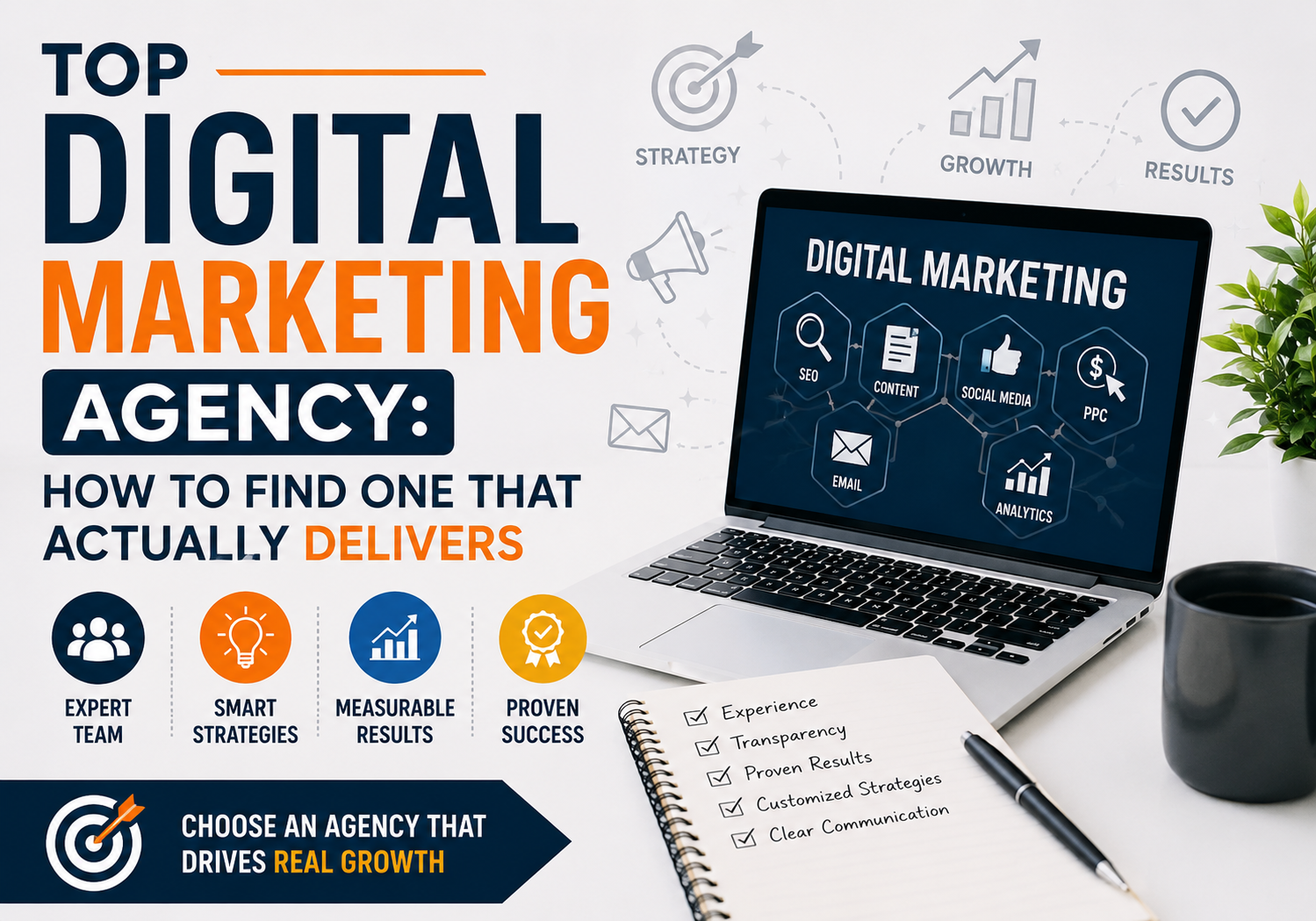
Finding the right digital marketing agency in 2026 is harder than it looks. Every agency promises page-one rankings, explosive traffic growth, and leads on autopilot. Most deliver monthly reports packed with impressive-looking numbers that do not connect to a single sale. The market is full of agencies that are good at selling themselves but poor at growing your business.
This guide cuts through the noise. It covers what a top digital marketing agency actually delivers, the 7 services worth paying for, exact pricing, and the questions that separate real agencies from expensive time-wasters. Whether you are a startup hiring your first agency or an established business ready to switch, this gives you a clear framework to decide.
What a Top Digital Marketing Agency Actually Does
A top digital marketing agency grows your business online using strategies tied to real numbers — not theories, not promises.
The best agencies in 2026 operate across search engine optimization (SEO), paid advertising, content marketing, and link building — all working under one connected strategy. SEO content drives organic traffic. Paid ads accelerate what already works organically. Link building increases domain authority (DA), which lifts every page on your site. Each channel feeds the others.
What separates a top agency from an average one is accountability. Average agencies report impressions and follower counts. Top agencies report keyword positions moved, organic traffic growth by percentage, and cost per lead reduced month over month. If an agency cannot draw a straight line from their work to your revenue, find one that can.
7 Core Services Worth Paying For
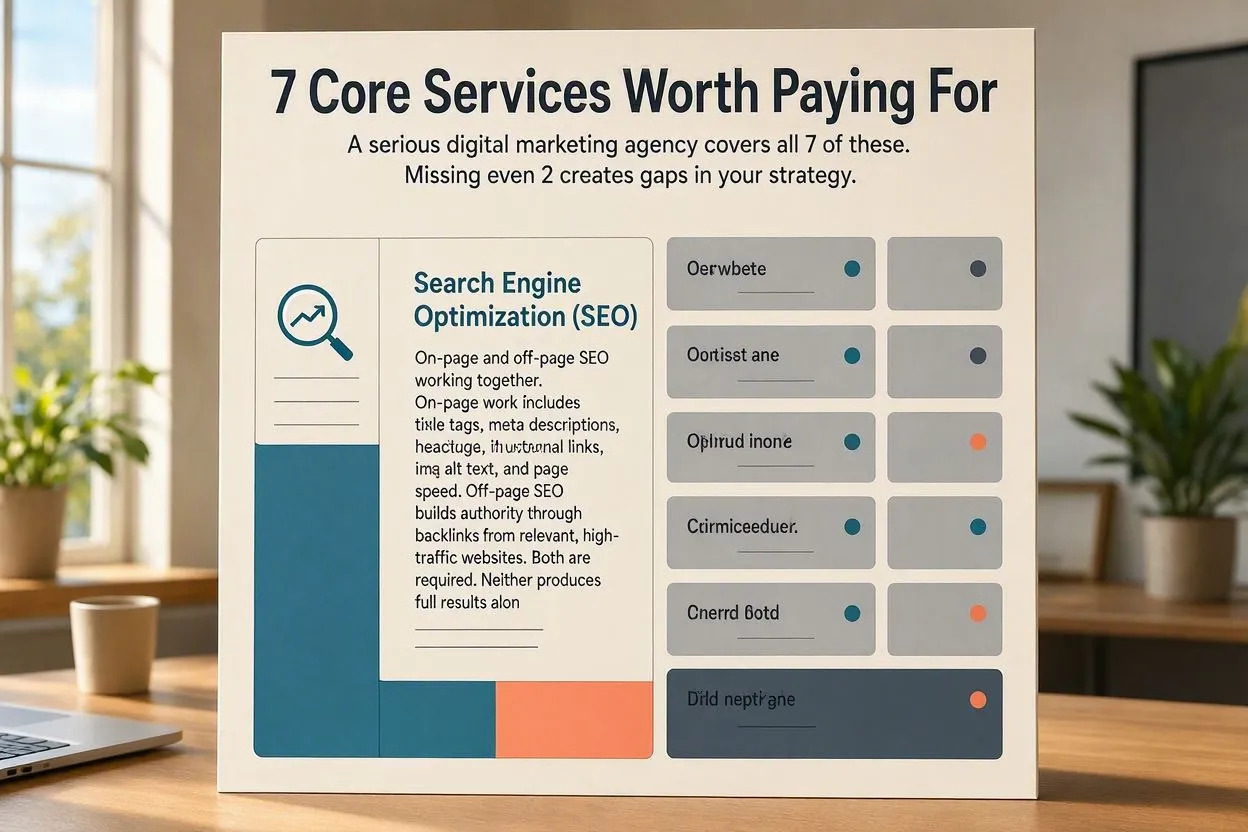
A serious digital marketing agency covers all 7 of these. Missing even 2 creates gaps in your strategy.
- Search Engine Optimization (SEO)
On-page and off-page SEO working together. On-page work includes fixing title tags, meta descriptions, heading structure, internal links, image alt text, and page speed. Off-page SEO builds authority through backlinks from relevant, high-traffic websites. Both are required. Neither produces full results alone.
- Link Building and Guest Posting
This is where most agencies either fail or fake results. Real link building means securing placements on niche-relevant websites with actual organic traffic — not paid directories, not link farms, not private blog networks (PBNs). A guest post on a DR 45+ website with 8,000 monthly visitors moves rankings. A link from a spammy directory does not.
In 2026, Google rewards quality over quantity. 5 strong links from authoritative, niche-relevant sites beat 500 links from random low-quality sources. Any agency that cannot show live URLs of links built in the past 30 days is not delivering real work.
- Content Marketing
Every piece of content should target a specific keyword, answer a specific question, and guide the reader toward a specific action. Agencies publishing content without a keyword strategy burn your budget on articles nobody finds.
Strong content marketing also builds topical authority — a cluster of related articles that signals to Google your website is an expert on a subject. This is how newer websites compete against established brands with higher domain authority.
- Pay-Per-Click (PPC) Advertising
Google Ads and Meta Ads managed with tight audience targeting, conversion-optimized landing pages, and weekly bid adjustments. A skilled PPC manager reduces cost per click (CPC) while improving conversion rate (CVR) every month. If your CPC is rising and your conversions are flat, the campaign is running — not being managed.
- Social Media Marketing
Platform selection matters more than posting frequency. A B2B software company grows on LinkedIn. A fashion brand grows on Instagram. A restaurant grows on Google Maps and Facebook. Top agencies build platform-specific strategies rather than posting identical content everywhere and calling it social media management.
- Email Marketing
Email delivers the highest return on investment (ROI) of any digital channel — $36 returned for every $1 spent according to Litmus data. Top agencies build segmented lists, write automated sequences, and run A/B tests on subject lines and CTAs. If your agency ignores email, your warmest leads are going uncontacted.
- Analytics and Transparent Reporting
Google Analytics 4 (GA4), Google Search Console, and a rank tracking tool like Ahrefs or Semrush reviewed weekly. Every decision should come from data. If your agency sends a monthly PDF with charts but no explanation of what changed and why, that is a reporting problem — not just a formatting issue.
How to Evaluate Any Agency Before You Pay
Run these 5 checks before signing anything.
Check their own website rankings. Search “digital marketing agency [their city]” on Google. If their site does not rank for their own service keyword, they cannot rank yours. This single check eliminates most weak agencies immediately.
Ask for case studies with real numbers. Not client logos. Not testimonials. Actual before/after data — keyword positions, traffic percentage increase, lead volume change. Any serious agency has this documented and ready to share within 24 hours.
Ask who handles your account daily. Many agencies close the sale with senior staff and hand the account to a junior executive on day one. Ask directly: who writes my content, who builds my backlinks, and who manages my ad campaigns?
Request a website audit before any quote. A proper audit takes 2 to 3 hours and surfaces broken links, technical SEO errors, missing meta data, page speed issues, and content gaps. If an agency quotes you without auditing your site, they are guessing at your budget.
Read the contract carefully. Month-to-month agreements show confidence in results. Long-term lock-ins with no performance clause protect the agency — not you. Ask what happens if they miss agreed targets at 90 days.
6 Red Flags That Cost You Money
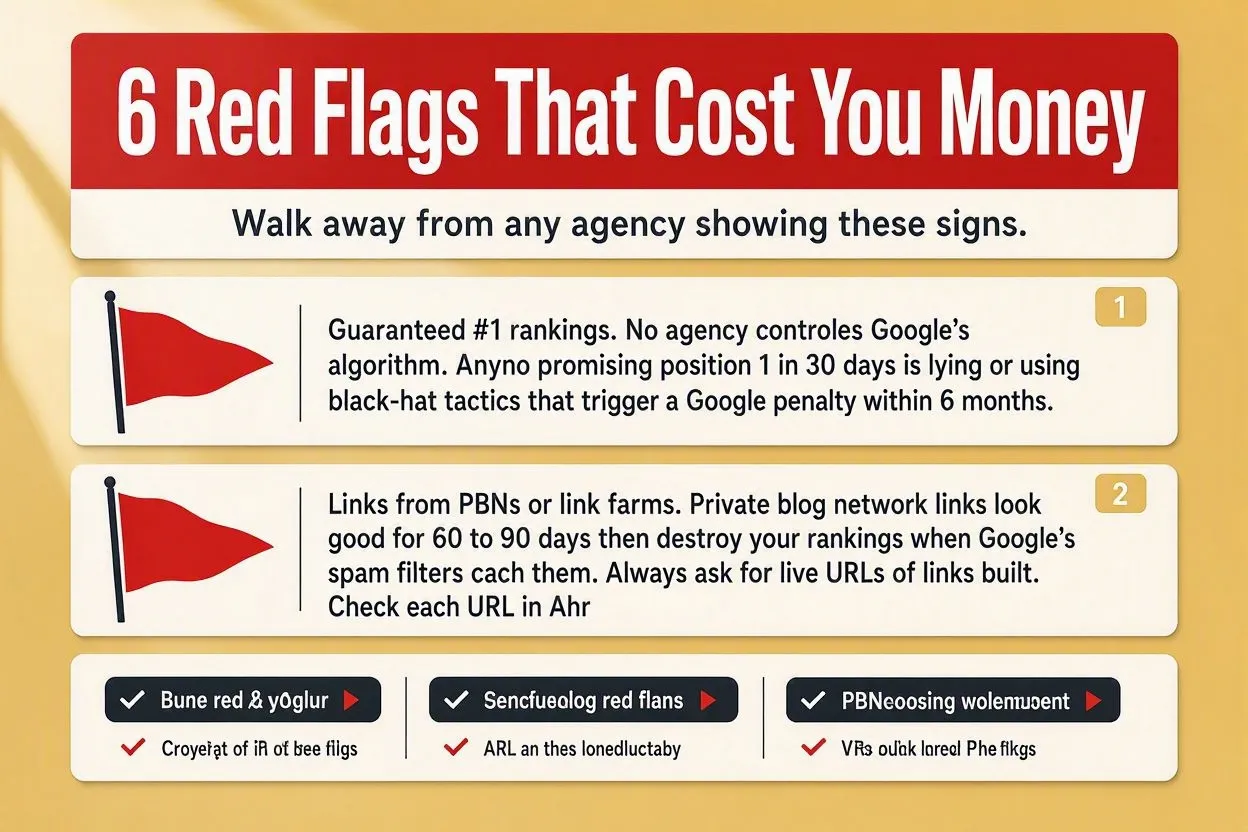
Walk away from any agency showing these signs.
Guaranteed #1 rankings. No agency controls Google’s algorithm. Anyone promising position 1 in 30 days is lying or using black-hat tactics that trigger a Google penalty within 6 months.
Links from PBNs or link farms. Private blog network links look good for 60 to 90 days then destroy your rankings when Google’s spam filters catch them. Always ask for live URLs of links built. Check each URL in Ahrefs and look for real organic traffic on the linking site — not just a high DR score.
Vanity metrics as results. “Your post got 12,000 impressions” is not a result. Impressions do not pay salaries. Measure clicks, keyword positions, leads generated, and revenue influenced — nothing else matters.
No admin access to your accounts. Your Google Analytics, Google Ads, and Search Console accounts belong to your business. Any agency refusing to give you admin access is hiding performance data.
Identical packages for every client. A local bakery and a SaaS company need completely different strategies. An agency selling the same package to both is not thinking about either client seriously.
Zero transparency on link sources. After Google’s Link Spam Updates between 2022 and 2025, spammy backlink profiles attract manual penalties. If an agency cannot show exactly where they build links, assume the work is not happening or the links are harmful.
Top Digital Marketing Agency vs Freelancer — The Honest Comparison
Freelancers cost less. Agencies deliver more consistency. Here is the real difference.
A solo freelancer typically handles 1 or 2 disciplines well — usually SEO, content writing, or paid ads. Running a full digital marketing strategy requires at least 4 to 5 specialists working together: an SEO strategist, a content writer, a link builder, a paid media manager, and an analyst. A top digital marketing agency gives you all of these under one roof with one account lead coordinating everything.
The biggest risk with freelancers is dependency. If your SEO freelancer takes on too many clients or disappears mid-campaign, your project stalls with no backup. Agencies have processes and team structures that keep work moving regardless of personnel changes.
A startup with a $400 per month budget gets more focused value from a skilled freelancer than from an agency spreading that budget too thin across 5 services. Match your choice to your current budget and growth stage — not just your ambition.
Why Link Building and Guest Posts Still Drive Results in 2026
Many agencies stopped building links after Google’s spam updates. That was the wrong move.
Links remain the strongest ranking signal in Google’s algorithm. Google’s updates did not kill link building — they killed bad link building. Spammy links, PBN links, and paid placements on zero-traffic sites get penalized. Links from real, niche-relevant websites with editorial standards still move rankings faster than any other off-page tactic.
A well-run guest posting campaign in 2026 follows 4 rules:
Niche relevance first. A backlink from a marketing blog to a marketing agency carries significantly more weight than a link from a general lifestyle website. Google measures topical relevance between the linking page and your target page.
Real traffic on the host site. DR 60 means nothing if the site has zero organic visitors. Check Ahrefs traffic before placing any link. A DR 35 site with 15,000 monthly visitors passes more real authority than a DR 60 site with 200 visitors.
Natural anchor text rotation. Using exact-match anchors on every link triggers Google’s over-optimization filters. Rotate between branded, partial match, and generic anchors across your link profile.
Editorial placement inside real content. A link inside a well-written 1,200-word article on a relevant topic carries 3 to 5 times more weight than a footer or sidebar link placed on the same site.
A campaign delivering 8 to 12 quality links per month produces measurable ranking movement within 60 to 90 days for most mid-competition keywords.
How to Pick the Right Agency for Your Niche
General experience is not enough. Pick an agency with a track record in your specific niche.
E-commerce: Needs product page SEO, Google Shopping campaign management, and conversion rate optimization (CRO). Look for agencies with hands-on Shopify or WooCommerce experience and data showing reduced cart abandonment rates.
SaaS: Needs content-led SEO targeting bottom-of-funnel keywords — “best [tool] alternative” and “[tool] vs [competitor]” drive trial signups faster than broad awareness content. LinkedIn ads and retargeting convert SaaS decision makers effectively.
Local business: Needs Google Business Profile (GBP) optimization, local citation building, and a review generation strategy. National SEO tactics waste budget for a dentist in Karachi or a restaurant in Lahore. Local intent keywords drive foot traffic and calls directly.
Healthcare businesses: Need a specialised healthcare marketing agency that understands patient behaviour, medical advertising guidelines, and trust-focused SEO strategies. Unlike general industries, healthcare marketing requires accurate medical content, strong local SEO, reputation management, and optimized treatment pages that convert visitors into booked appointments. A professional healthcare SEO agency in Dubai focuses on ranking clinics, hospitals, and healthcare providers for high-intent local searches, improving Google Business Profile visibility, and generating qualified patient leads through organic search.
B2B services: Decision makers read long-form content, check LinkedIn, and attend webinars before buying. B2B agencies need strong content marketing, LinkedIn thought leadership posts, and email nurture sequences — not viral social media campaigns.
Agencies and consultants: Need visible E-E-A-T (Experience, Expertise, Authoritativeness, Trustworthiness) signals — published case studies with named clients, author bios on every article, media mentions, and guest posts on industry publications.
What Results Look Like at 30, 60, and 90 Days
Set these expectations before signing. Any agency disagreeing with this timeline is overpromising or under-delivering.
30 days: Technical SEO audit complete with critical errors fixed. GA4 and Google Search Console properly configured. Keyword tracking active across 20 to 30 target terms. Content calendar approved. First 2 to 3 blog posts published. Link building outreach started with first prospects identified.
60 days: First batch of 4 to 6 quality backlinks live with URLs provided. Target keywords moving up 5 to 15 positions. Published content indexed and showing Search Console impressions. Google Ads campaigns running with baseline CPC and conversion data collected.
90 days: Organic traffic increased by 15% to 40% depending on starting authority and competition level. 8 to 12 total quality backlinks live. 2 to 3 keywords ranking on page 1 of Google. Email sequences active and generating first qualified leads. PPC cost-per-acquisition (CPA) trending downward from baseline.
No movement by day 90 requires an honest performance review — not a renewal pitch.
What Does a Top Digital Marketing Agency Cost in 2026?
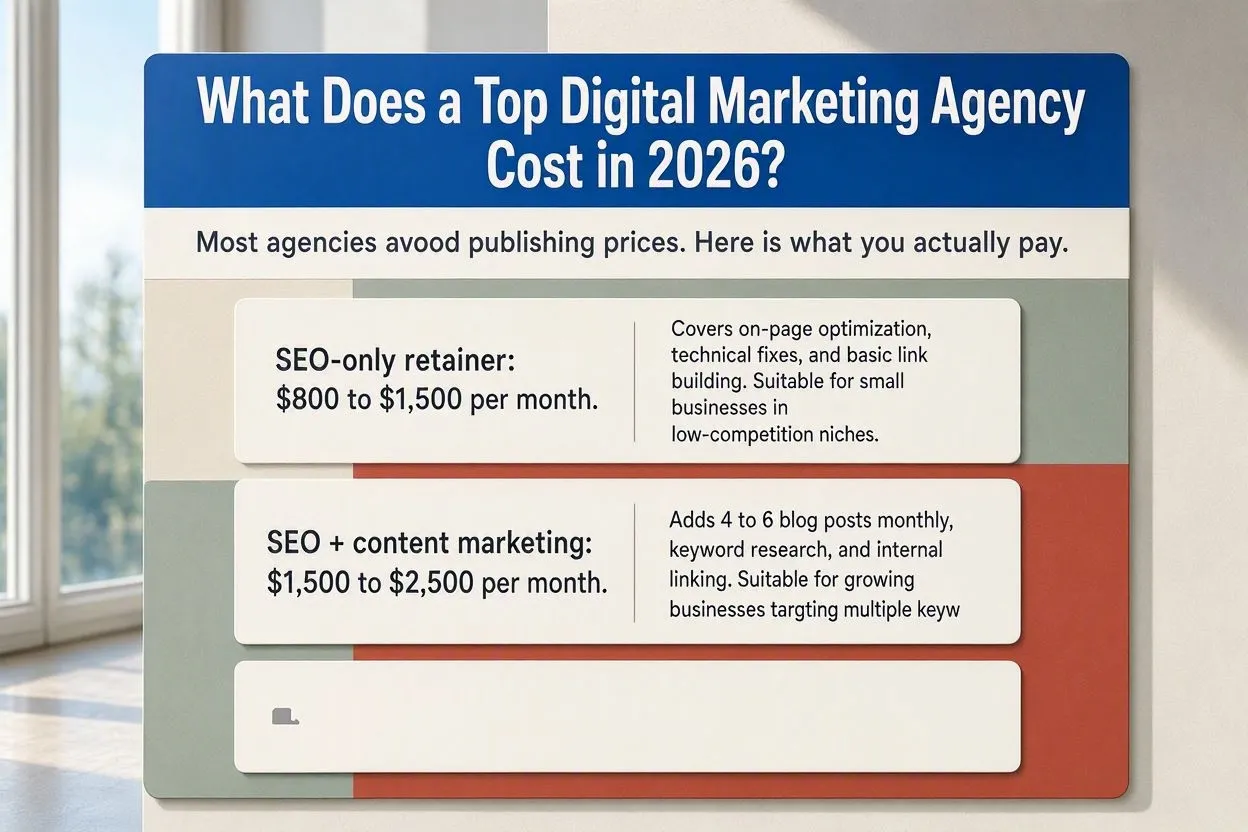
Most agencies avoid publishing prices. Here is what you actually pay.
SEO-only retainer: $800 to $1,500 per month. Covers on-page optimization, technical fixes, and basic link building. Suitable for small businesses in low-competition niches.
SEO + content marketing: $1,500 to $2,500 per month. Adds 4 to 6 blog posts monthly, keyword research, and internal linking. Suitable for growing businesses targeting multiple keywords across a content cluster.
Full-service package: $2,500 to $5,000 per month. Covers SEO, content, link building (8 to 12 links monthly), social media management, and monthly analytics reporting. Suitable for businesses competing in established markets.
Enterprise / aggressive growth: $5,000 to $15,000+ per month. Includes PPC management, digital PR, high-authority link building, CRO testing, and a dedicated account team. Suitable for e-commerce brands, SaaS companies, and B2B businesses with significant revenue targets.
Anything below $500 per month delivers surface-level work — a keyword report, a few social posts, and minimal link building that produces minimal rankings movement.
Final Verdict
The top digital marketing agency for your business is not the biggest name or the most expensive option. It is the one that understands your niche, shows real case studies with actual numbers, builds quality backlinks from real websites, and measures everything against revenue — not impressions or follower counts.
In 2026, Google rewards experience, authority, and trust. Agencies delivering all three grow their clients consistently. The ones selling vanity metrics churn accounts every 6 months and move on.
Do the audit. Ask the hard questions. Check the live link URLs. Demand the numbers. Then decide.