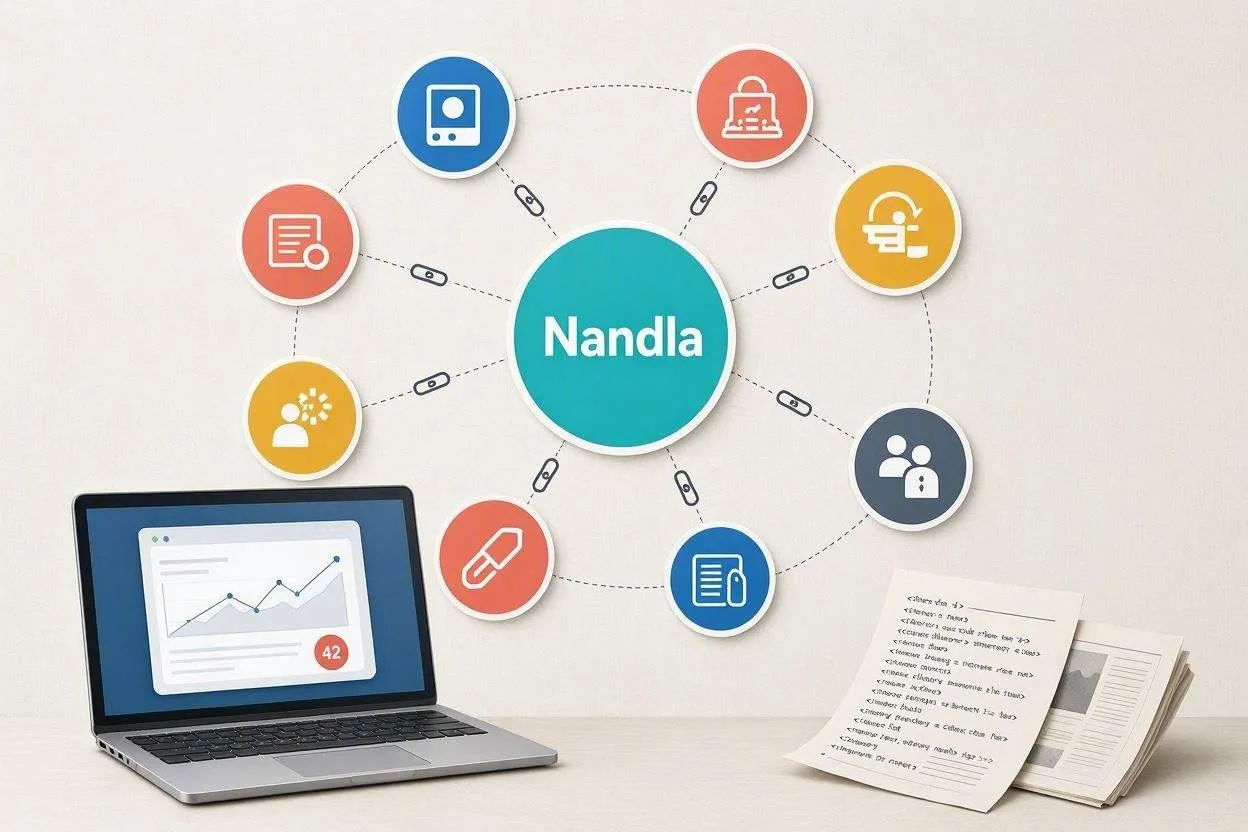
Nandla backlinks are a branded link-building tactic built around placing profile links, forum posts, and document uploads on high domain rating (DR) sites like Wikipedia, Reddit, GitHub, and Google Drive. Sellers pitch it as a shortcut to authority: place your link on sites Google already trusts, and some of that trust rubs off on your domain. The term shows up constantly on Upwork, on Fiverr-style marketplaces, and inside standalone SEO tools, usually priced between $10 and $300 depending on volume. What the marketing copy never quite explains is what separates a Nandla backlink from an ordinary profile link. In practice, not much does.
Where Did the Term “Nandla Backlinks” Originate?
The name traces back to Tanveer Nandla, a Pakistan-based SEO trainer connected to the platform iSkills. His students started calling his signature link-placement method “Nandla links,” and the label caught on across freelance marketplaces in Pakistan and India. A 2024 BlackHatWorld forum thread backs this up, with one commenter noting that Nandla is simply his surname, introduced into the SEO vocabulary by people who trained under him. Almost nothing else written about this topic names the founder directly. Most sellers use the term as if it’s an established industry category, not a rebranded version of profile link building that one person happened to popularize.
Freelance listings on Upwork and iskillspro.com reference the method by name without ever crediting where it came from, which leaves buyers with no way to judge whether they’re paying for a proven methodology or a marketing label slapped on work that already existed under other names. A $25 gig with zero backstory doesn’t give a first-time buyer much to go on.
How Do Nandla Backlinks Work?
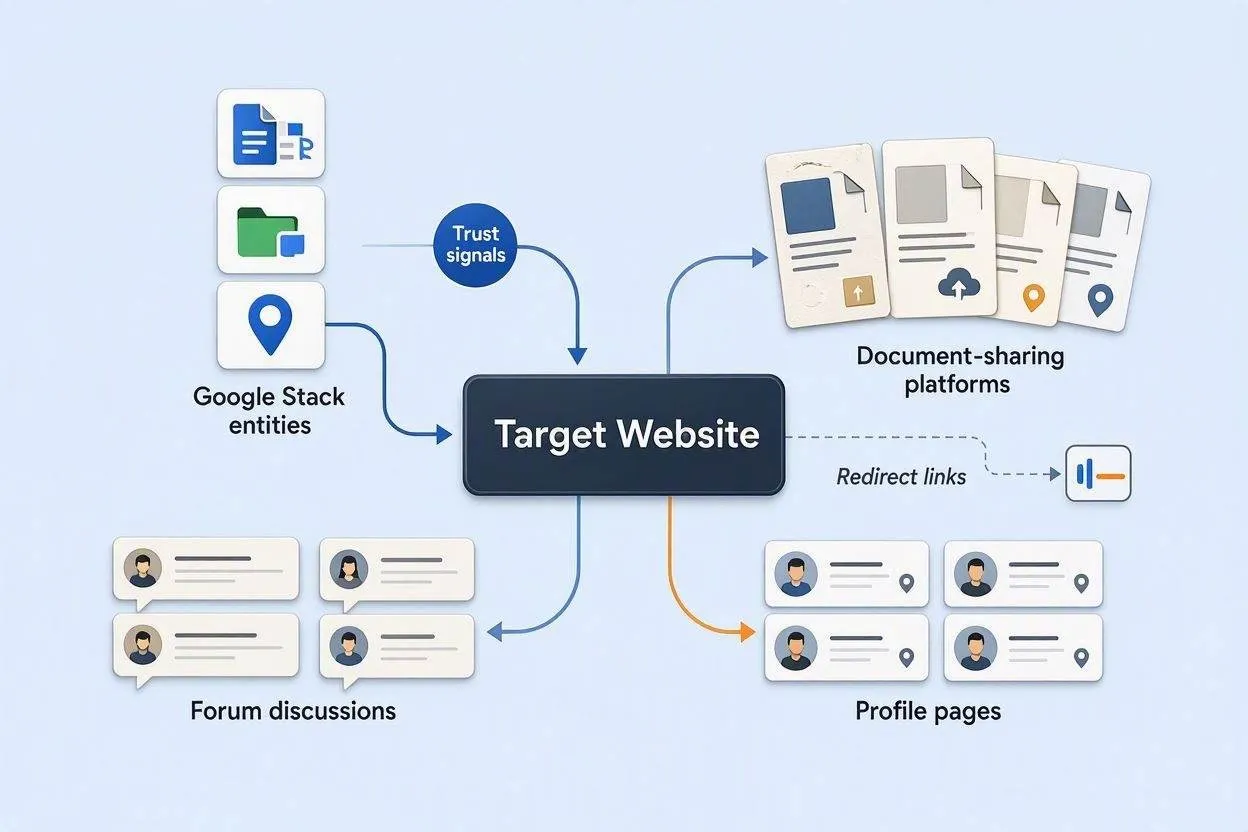
These services build a portfolio of profile citations, forum posts, redirect links, and document uploads across four categories: Google Stack entities, forum discussions, document-sharing platforms, and profile pages.
Google Stack links come from Google Drive, Docs, Sheets, and Maps, riding on the DR 100 authority of google.com to pass what sellers call “trust signals” to a linked file or listing. Forum links get dropped into threads on community sites with DR 60 or higher, often as a signature link or a bare URL buried in a reply. Document-sharing links involve uploading a branded PDF to Scribd, SlideShare, or Calaméo, then linking the target site from inside that document. Profile links round out the set: create an account on a high-authority platform, drop the target URL into the bio field, done.
A typical package on iskillspro.com promises 25, 50, or 100 links per order, delivered over five to seven days on what sellers call a “drip-feed” schedule, meant to keep spam filters from noticing. None of these four categories involves any editorial review. No human on the receiving site ever asks whether the content deserves to be there.
Delivery reports usually come as a spreadsheet listing each URL, the platform name, and a domain rating figure, matching the exact column structure seen in a Scribd-hosted document called “Nandla Strategy Links”: Platform, Engagement Type, DA, Traffic, Spam Score. That format has basically become an industry template, copied from seller to seller with barely any variation, which suggests most providers are working off a shared master list rather than sourcing placements independently.
Indexing speed depends on the category. Google Stack links tend to get crawled within 24 to 48 hours, since Google indexes its own properties fast. Forum posts and profile pages are slower and less predictable, anywhere from three days to three weeks, depending on how often the host platform gets crawled and whether the page in question carries a noindex tag.
What Types of Websites Do Nandla Backlink Providers Target?
Providers pull from a fixed list of roughly 2,700 pre-vetted domains, sorted by domain rating from DR 50 to DR 100, drawn mostly from sites that allow free account creation. Wikipedia sits at a DR of 92, Reddit at 95, Medium at 94, GitHub at 96, according to the database listed on nandla.link. Facebook, Instagram, LinkedIn, and YouTube round out the DR 98–100 tier, but a profile link on any of these carries a nofollow attribute by default. That means it passes no direct ranking signal under Google’s own linking guidelines, no matter how high the platform’s authority score reads.
Sellers rarely mention this. Someone paying for “high DA backlinks” on Facebook or Twitter is often buying a link Google’s crawler treats as a non-endorsement.
Document-sharing platforms sit in a middle tier, carrying DR scores between 90 and 96 on sites like Scribd, SlideShare, and Calaméo. These often do carry a dofollow attribute, since document platforms don’t apply the blanket nofollow policy social networks use for user-generated bio fields. That distinction matters more than the raw DR number when you’re comparing which category of link actually does anything. Forum backlinks fall into a similarly mixed bag: DR 60 and up on the linking domain itself, but individual thread or signature links frequently carry nofollow tags added by the forum software, particularly on platforms like Reddit and Quora that apply nofollow site-wide to outbound user links.
Are Nandla Backlinks Safe to Use?
No. They carry real risk under Google’s link spam policies, since the tactic matches several patterns Google names outright as manipulative. Google’s spam policies for web search define a link scheme as any link intended to manipulate PageRank or a site’s ranking, and specifically call out large-scale article marketing or guest posting campaigns with keyword-rich anchor text, along with widely distributed links in footers or site templates. Mass-produced profile and forum links fit that description closely, even when any single link looks harmless on its own.
Sites that build a visible pattern of low-context, high-volume link placement risk a manual action penalty, which can tank rankings site-wide rather than just on one page. Recovering from a manual action means filing a reconsideration request after removing or disavowing the flagged links, a process that can take weeks and offers no guaranteed reversal.
Do Nandla Backlinks Actually Improve Google Rankings?
They may raise a third-party domain rating metric without moving actual search rankings at all. Domain Rating is a proprietary Ahrefs score, not a Google ranking factor. A site can gain 30 or 40 DR points from bulk profile links while search visibility stays completely flat, because Google’s algorithm weighs link relevance, editorial context, and anchor text diversity far more heavily than raw link count.
Testimonials on nandla.link claim DR jumps from 12 to 58 in three months. None of the marketing pages reviewed for this piece published organic traffic data, keyword ranking screenshots, or any third-party verification alongside those numbers. If a site’s link profile is mostly nofollow profile citations and forum posts with no topical connection to its niche, ranking improvement is unlikely no matter how impressive the linking domains’ DR scores look. A jump in DR alongside a jump in keyword position doesn’t prove one caused the other, and no public case study in this space has actually separated the two.
How Much Do Nandla Backlink Services Cost?
Prices run from roughly $10 for a small forum-link package up to $25 a month for full database access, with agency-scale orders landing between $150 and $300 for 50 to 100 links. Nandla.link sells a “Pro Plan” at $25 a month, covering access to 2,700-plus links, 400 indexing credits, and 30-plus unlocked categories. iskillspro.com lists smaller freelance gigs starting around 2,500 PKR (about $9) for 20 links added to a base package, while Upwork listings for “Nandla Strategy” campaigns run higher, often bundled into broader off-page SEO retainers priced per project instead of per link.
Cost doesn’t tell you much about quality. A $9 gig and a $300 agency package can draw from the exact same pool of forum and profile targets. Anyone comparing providers should ask for a sample report with exact placement URLs before paying for a full order.
Subscription access, the model nandla.link uses at $25 a month, works differently from a one-time gig purchase. A subscription grants ongoing database access and monthly-renewing indexing credits, while a gig delivers a fixed batch of links and the relationship ends there. Neither model guarantees that placed links stay live. Some sellers advertise a free relink or replacement service if a link disappears within one to six months, which is worth getting in writing, since a promise on a listing page has no enforcement mechanism once the transaction closes.
Nandla Backlinks vs. Traditional White-Hat Link-Building
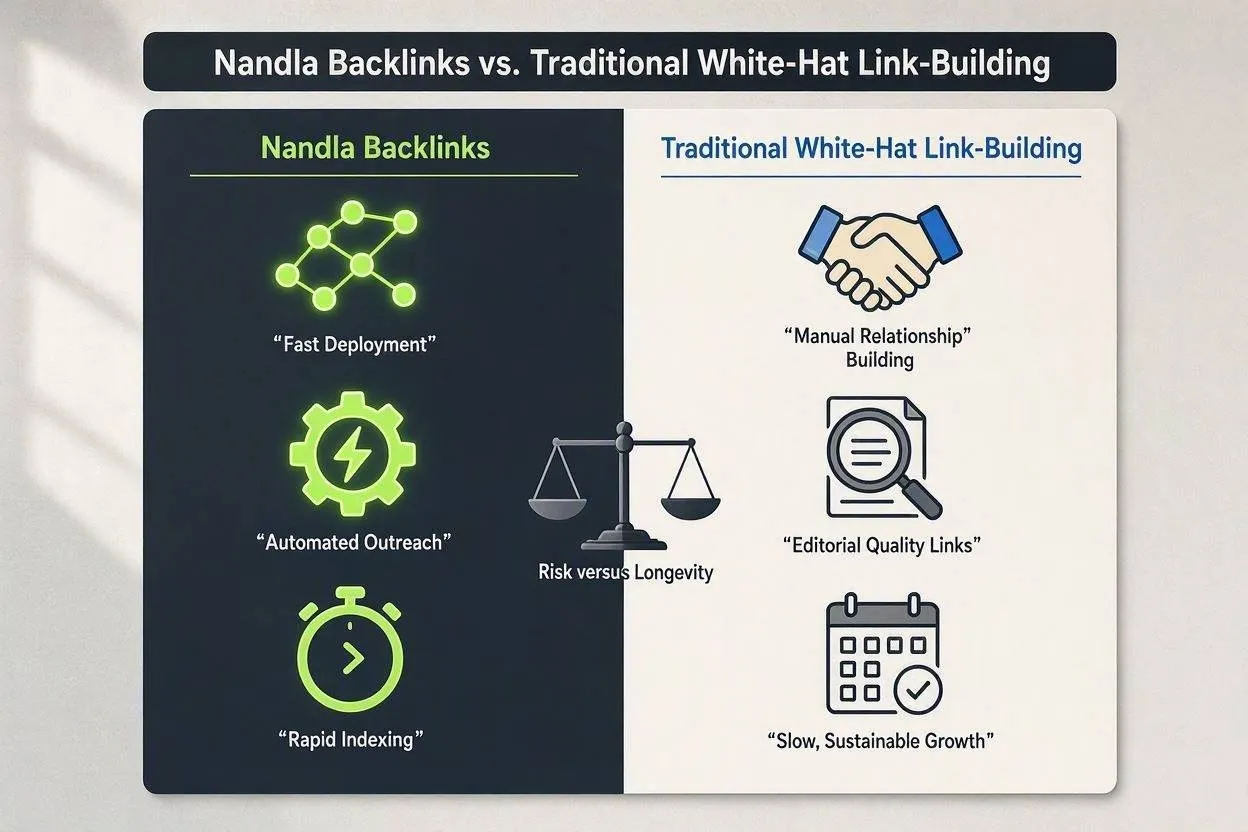
Nandla backlinks rely on automated, high-volume placement across pre-approved domains. White-hat link building depends on a human editor deciding your content is good enough to link to.
| Factor | Nandla Backlinks | White-Hat Link Building |
| Placement method | Self-created profiles, forum posts, document uploads | Editor or journalist approves content, then links to it |
| Follow attribute | Often nofollow (profile/social platforms) | Typically dofollow, contextual within body copy |
| Relevance to niche | Frequently unrelated (general forums, unrelated categories) | Matched to topic and audience |
| Google spam policy risk | High, matches named link scheme patterns | Low, links earned through content merit |
| Time to build 50 links | Five to seven days (drip-fed) | Weeks to months, depending on outreach response |
| Cost per link (approximate) | $0.20–$3 | $50–$500+ for guest posts, digital PR |
A single guest post placed through editorial review on a niche industry publication carries more ranking weight than ten forum signature links, even though the forum links are cheaper and faster. Google built its algorithm specifically to discount link volume in favor of link context. That’s the gap this table is really showing.
What Are Better Alternatives to Nandla Backlinks?
Digital PR outreach, HARO-style journalist requests, original data studies, and niche guest posting all deliver stronger long-term ranking value than bulk profile or forum links. Each one earns links through actual editorial judgment instead of automated placement, which keeps a site’s backlink profile clean under Google’s spam policies.
- Digital PR campaigns. Pitch a newsworthy story, survey, or data set to journalists covering your industry, and earn contextual dofollow links from publications with real editorial standards.
- HARO and journalist-request platforms. Respond to reporter queries with expert quotes and pick up citation links from established media sites.
- Original research or data studies. Publish proprietary survey results or industry benchmarks that other sites end up citing on their own.
- Niche guest posting. Write full articles for industry-relevant blogs with genuine audience overlap, placed through direct editor outreach rather than an automated submission tool.
- Broken-link building. Find dead links on authoritative resource pages and offer a working replacement from your own site’s content.
If budget for outreach-heavy tactics is tight, one well-executed digital PR pitch will usually outperform an entire month of forum and profile link orders. A single earned placement from a recognized publication carries more contextual weight than dozens of low-context citations combined.
How to Evaluate a Nandla Backlink Provider Before Paying
Ask for a sample report listing exact placement URLs, follow/nofollow status, and niche relevance before paying for anything. A legitimate provider will tell you which of the 2,700-plus database domains a given order will actually use, rather than promising vague “high DA” placement with no specifics.
- Ask for URL-level reporting, not just a domain rating summary.
- Check the follow attribute on each promised link. Social and profile platforms often default to nofollow.
- Confirm the linking page’s topic actually matches your industry.
- Look at the provider’s own site for E-E-A-T signals: named authors, verifiable case studies, transparent methodology.
- Search the provider’s name alongside terms like “manual action” or “penalty” to check for reported client complaints before committing budget.
If a provider won’t share sample URLs before payment, it’s usually because the links wouldn’t survive a closer look.
Common Mistakes Buyers Make With Nandla Backlink Orders
Buyers tend to lose money on these orders in three recurring ways: skipping niche relevance checks, ignoring nofollow attributes, and stacking multiple providers on the same domain pool at once.
First, buyers accept a generic package without confirming which domains will actually get used, then discover after delivery that half the links landed somewhere with zero topical connection, a gardening blog picking up cryptocurrency-forum citations, for instance. Second, buyers count nofollow social profile links toward their expected ranking outcome, not realizing that Facebook, Instagram, and Twitter pass no direct link equity under Google’s own attribute rules. Third, buyers order from two or three providers at once, unaware that most Nandla sellers pull from the same shared 2,700-domain inventory. The result is duplicate placements that create an unnaturally repetitive link pattern instead of the diversified authority they were expecting.
A site owner who orders 100 links from one provider and another 100 from a competitor can end up with near-identical link sources showing up twice within a single month. That pattern stands out immediately in any backlink audit tool, and it’s exactly the kind of red flag Google’s spam detection is built to catch.
Why Google’s E-E-A-T Standards Matter for This Tactic
Google’s Search Quality Rater Guidelines evaluate content and links through experience, expertise, authoritativeness, and trustworthiness, and Nandla-style campaigns tend to fail all four at once. A forum post inserted just to house a link shows no first-hand experience with the topic being discussed. A profile bio with a bare URL shows no subject-matter expertise. Neither placement builds authoritativeness, since no editor or peer community vetted the content before it went up, and neither builds trust, because the link exists for placement’s sake, not for the reader.
Sites that lean on this link category while neglecting on-page E-E-A-T signals (author bios, cited sources, original data) compound the risk instead of offsetting it. Google’s raters are trained to flag manipulation even without seeing the backlink profile directly, because thin, keyword-stuffed content and manipulative link patterns tend to show up together on the same low-quality sites. A site investing in both strong on-page expertise signals and a small number of earned, contextual links has a measurably better shot at sustained ranking than one leaning on volume-based Nandla-style placement alone.
Conclusion
Nandla backlinks describe a specific, traceable method: profile citations, forum posts, and document uploads built at scale across a fixed list of high-DR domains, named after Pakistan-based SEO trainer Tanveer Nandla and popularized through iSkills-affiliated freelancers. The tactic can push a Domain Rating score up within weeks, but Google’s own spam policies name the underlying pattern, mass profiles and forum links with little editorial context, as a risk factor for manual action. A single earned link from a relevant industry publication, placed through digital PR or guest post outreach, still carries more weight in Google’s ranking algorithm than a hundred nofollow citations scattered across unrelated forums.