
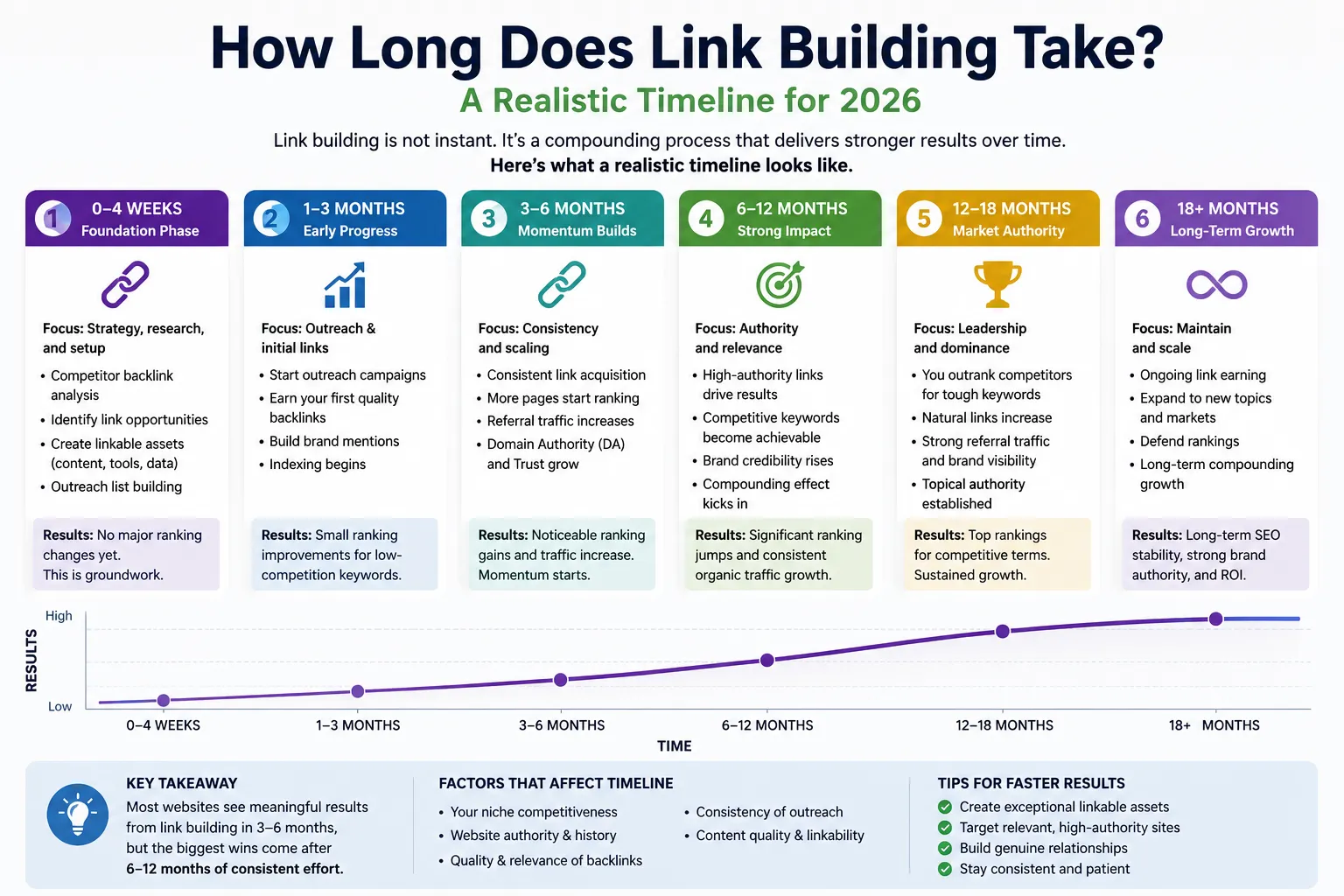
Link building is one of the most proven strategies in SEO — but it’s also one of the most misunderstood when it comes to timing. Most site owners either give up too early, expecting overnight results, or scale recklessly fast and trigger spam filters. The truth is that backlinks operate through a multi-step technical pipeline inside Google, and each step introduces its own delay. This guide gives you a data-backed picture of exactly how long link building takes at every authority level, why delays happen at each stage, and what you can do to compress the timeline without risking penalties.
How Google Crawls, Indexes, and Processes Backlinks
A backlink only influences your rankings after Google completes four sequential technical steps. Each step introduces a delay — and no step can be skipped. Understanding this pipeline is the foundation for setting realistic expectations and avoiding the frustration of waiting weeks with no visible results.
Crawling — Googlebot Discovers the Linking Page
Googlebot must first visit and download the page containing your backlink. Crawl frequency is controlled by a site’s crawl budget — the number of pages Googlebot allocates to a domain per day. High-authority sites with a DR of 60 or above are typically visited within 1–3 days of publishing. Low-authority domains may wait 3–6 weeks before Googlebot arrives. This single factor alone accounts for a large share of the delay most site owners experience after acquiring a new backlink.
Indexing — The Page Enters Google’s Index
After crawling, Google’s Caffeine indexing system processes the page and adds it to the search index. Until this happens, your backlink is completely invisible to the ranking algorithm. It passes no PageRank. It influences no position. It simply does not exist from a ranking perspective until the page clears the indexing stage.
Link Graph Update — Authority Connection Is Registered
Once indexed, Google registers the directional connection from the linking domain to your target URL. This activates PageRank transfer and is the moment your backlink technically becomes “live.” The Link Graph does not update in real time — it refreshes periodically, introducing an additional delay of days to a couple of weeks depending on the activity level of the linking domain.
Ranking Adjustment — Your Position Recalculates
With the Link Graph updated, Google’s algorithm recalculates your page’s position across relevant queries. This is when movement finally appears in rank trackers and Search Console. For high-authority domains the entire four-step process can complete in under three weeks. For new or low-authority sites the same pipeline can take three to five months.
Key insight: Tier-2 link building — building backlinks to the page that links to you — compresses steps one and two dramatically, cutting average index lag from 6 weeks to under 2 weeks on low-authority sites.
Timeline by Site Authority Level
Your current Domain Rating is the single biggest factor in how quickly new backlinks convert into ranking improvements. The table below gives realistic expectations across four authority tiers.
| Site Type | Crawl & Index | First Ranking Shift | Significant Traffic |
| High-authority (DR 60+) | 3–7 days | 2–4 weeks | 2–4 months |
| Mid-authority (DR 30–60) | 7–21 days | 4–8 weeks | 3–6 months |
| Established (DR 10–30) | 2–6 weeks | 8–12 weeks | 4–8 months |
| New website (DR under 10) | 4–12 weeks | 3–5 months | 6–12 months |
A critical distinction worth emphasising: first ranking shift and significant traffic growth are two entirely different milestones. Moving from rank 18 to rank 12 might happen in six weeks — but that movement produces almost no traffic. Meaningful organic traffic requires sustained link acquisition over three to six months, because traffic-driving positions in the top five demand significantly more authority than simply cracking the top twenty.
Timeline by Niche and Competition Level
Competition density within your vertical determines how many backlinks are needed to move rankings and how quickly those links produce measurable results. The same number of links that dominates a local service niche will barely register in a competitive SaaS or finance vertical.
| Niche | First Movement | Notes |
| Local business | 3–5 weeks | 3–5 high-relevance local links move pack rankings |
| eCommerce | 4–8 weeks | DR 40+ links from relevant shopping or review sites work fastest |
| SaaS & software | 6–10 weeks | Long-tail keywords respond faster than competitive head terms |
| Health & finance (YMYL) | 8–14 weeks | Links from .edu or medical journals carry 2–3x more PageRank weight |
For YMYL verticals — health, finance, and legal — Google applies its strictest E-E-A-T filters. A single citation from a .edu domain or an established medical journal can move rankings faster than ten commercial guest posts. This reflects how heavily Google weights authoritative entity signals in niches where inaccurate content can cause real-world harm.
What Speeds Up or Slows Down Results
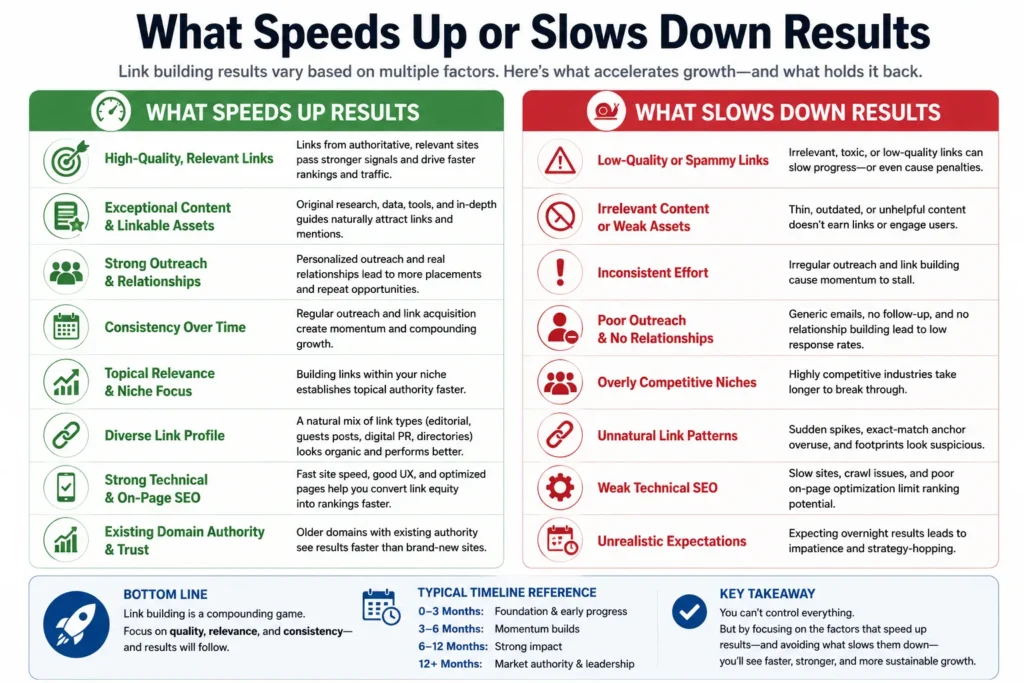
Not all backlinks are equal, and not all strategies produce movement at the same pace. Several controllable factors significantly influence how quickly your campaign delivers results.
Factors That Accelerate Timelines
The Domain Rating of your linking site is the most powerful accelerant. DR 60+ links operate on an exponentially faster timeline because high-authority sites have large crawl budgets, meaning your backlink gets discovered, indexed, and registered within days rather than weeks.
Tier-2 link building is the most underused acceleration tactic in most campaigns. By acquiring backlinks to the page that links to you, you signal demand through the Link Graph and force Googlebot to crawl that page sooner — cutting index lag from six weeks to under two weeks on average.
Topical relevance has grown significantly in importance. A DR 45 link from a site in your exact niche now routinely outperforms a DR 70 link from an unrelated domain. Google’s NLP systems understand topic clusters, and a contextually relevant link signals genuine editorial authority rather than manufactured volume.
A healthy anchor text mix is essential for keeping your profile natural. The recommended distribution is branded anchors at 40–50%, partial-match at 15–25%, exact-match kept below 15%, and naked URLs at 20–30%.
Factors That Stall Results
Indexing failure is the most common and most overlooked problem in link building campaigns. If the page linking to you is not indexed in Google, it passes zero PageRank regardless of how authoritative the domain is. Always verify new backlinks using Google’s URL Inspection Tool before assuming a link is working.
On-page SEO gaps act as a ceiling on how much incoming PageRank converts into ranking improvement. Backlinks amplify quality signals that already exist on your page. Thin content, slow Core Web Vitals, poor internal linking, and weak title tags all limit the gains that even strong backlinks can produce.
Low referring domain diversity consistently underperforms. Ten links from ten different domains outperform ten links from one domain every time, regardless of how authoritative that single domain is. Diversity signals natural, organic acquisition patterns.
Link Velocity: How Fast Should You Build Links?
Link velocity is the rate at which your site acquires new backlinks over time. Building too slowly produces no momentum. Building too fast triggers Google’s spam detection. The optimal zone is consistent, gradual growth that mirrors the natural backlink profile of a legitimately growing site at your stage.
| Site Stage | Recommended Monthly Velocity | Risk if Exceeded |
| New site (0–6 months) | 4–8 high-quality links/month | High — unnatural spike detection |
| Growing site (6–18 months) | 8–20 links/month | Medium — monitor anchor ratios carefully |
| Established site (18+ months) | 20–60+ links/month | Low — with diverse, clean sources |
A sudden spike in backlinks — especially when paired with identical anchor text or links from low-quality sources — is one of the clearest patterns Google’s spam detection looks for. Even legitimate campaigns can attract scrutiny if the velocity looks unnatural. New sites in particular should resist the temptation to purchase large link packages in a single order.
Guest Posts vs Niche Edits: Which Works Faster?
Both are white-hat editorial backlink acquisition methods, but they operate differently within Google’s pipeline and serve different strategic purposes at different stages of a campaign.
| Guest Posts | Niche Edits | |
| Indexing speed | 7–14 days | 5–10 days (40% faster) |
| Authority type | Fresh entity-rich content | Aged page with established trust |
| PageRank source | New page PageRank | Existing accumulated PageRank |
| Best use case | Long-term topical authority | Immediate ranking momentum |
Niche edits place your backlink into an already-indexed, already-trusted page with accumulated PageRank. The link activates faster and often carries more immediate ranking weight. Guest posts create new pages that need time to accumulate authority — but they build the deep topical signals that sustain rankings over the long term.
The proven strategy is to use niche edits for fast initial momentum, then stack guest posts consistently to build compound topical authority. Sites combining both link types see 3.4x faster ranking growth than single-strategy campaigns.
E-E-A-T and How Backlinks Support It
Backlinks are one of the most direct and measurable ways to build E-E-A-T signals across all four components: Experience, Expertise, Authoritativeness, and Trustworthiness. Every editorial backlink from a relevant, authoritative source is a vote of confidence that Google’s systems register as a genuine endorsement of your content’s quality and credibility.
In YMYL verticals, this effect is amplified. A single .edu or .gov citation can deliver ranking movement that would otherwise require a dozen commercial guest posts. Building a backlink profile that includes institutional and academic sources — alongside editorial placements on high-DR industry sites — creates a trust signal stack that is extremely difficult for competitors to replicate quickly.
Link Building in the AI Search Era
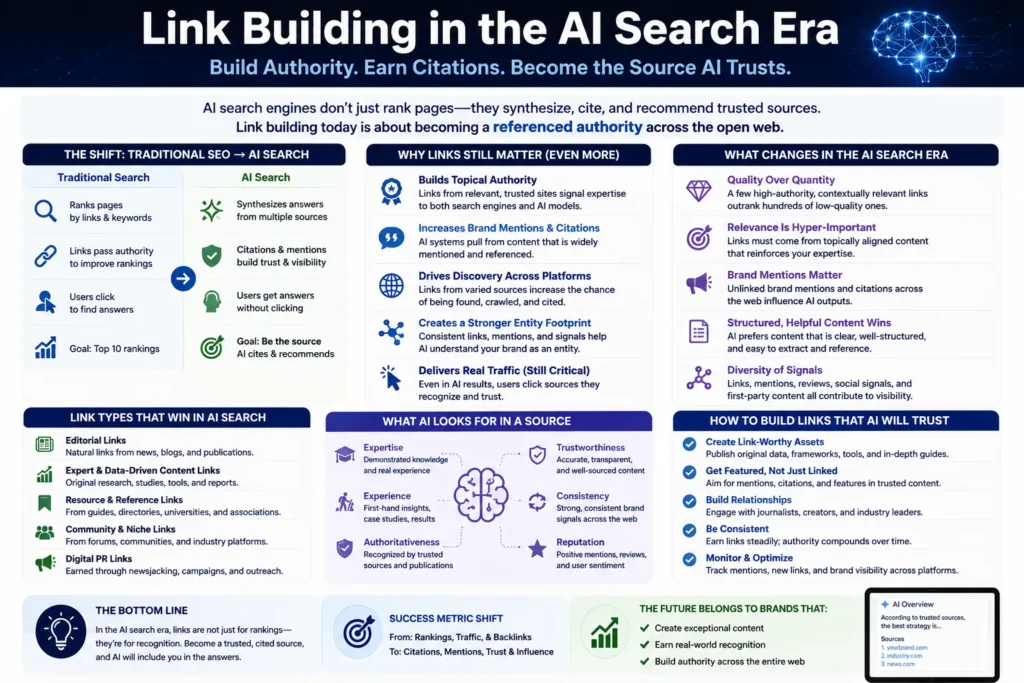
Google’s AI Overviews have fundamentally changed the value equation of backlinks in 2026. The relationship between backlinks and search visibility now extends well beyond traditional blue-link organic rankings.
Pages with 20 or more referring domains appear in AI Overviews 3x more often than pages with fewer than 5 backlinks. Sites cited in AI Overviews receive 18–25% more branded search traffic as a direct result of that citation visibility — entirely independent of their organic ranking position. A page sitting at position eight can drive significant brand awareness if it earns an AI Overview citation through strong backlink authority.
As Google’s Knowledge Graph and NLP systems continue to evolve, topical authority built through semantically relevant link acquisition is becoming more valuable than raw Domain Rating alone. A forward-looking strategy in 2026 secures both linked citations and unlinked brand mentions to maximise entity coverage across all of Google’s ranking and citation systems.
Conclusion
Link building is a long game, but a predictable one. The timeline from acquiring a backlink to seeing ranking movement follows a consistent pattern governed by Google’s four-step pipeline: crawl, index, Link Graph update, and ranking recalculation. That process takes anywhere from two weeks for a high-authority domain to three to five months for a brand-new site.
The most important variables within your control are the Domain Rating of your link sources, topical relevance, anchor text diversity, and link velocity. Combining niche edits for fast initial momentum with guest posts for long-term topical authority consistently outperforms any single-strategy campaign. Pair that with solid on-page SEO fundamentals and tier-2 link support, and you create a compounding system where every new backlink works faster than the last.
Patience and consistency are not optional — they are the strategy itself. Set a three to six month evaluation window, build at a sustainable velocity, and the rankings will follow.