
Most Rumble creators borrow a posting schedule built for YouTube or TikTok, then wonder why a video that should have done well barely got noticed. Rumble runs on a different clock. As a video-sharing platform with its own distinct online community, its algorithm rewards the first few hours after upload more than almost any other video-sharing site, and its community of viewers logs on later in the day than most social feeds assume.
The schedule below reflects that difference, drawn from how Rumble’s ranking system actually behaves and when its North America-heavy video-sharing community shows up.
Why Does Posting Time Matter on Rumble?
Rumble is a video-sharing platform first and an online community second, and that order shapes everything about timing. Unlike forums or photo-sharing communities where a post can resurface in a feed for days, Rumble’s community of creators and viewers interacts with video content in a narrow, fast-moving window right after it goes live. Rumble ranks videos on early engagement, not on a slow-building subscriber feed. A video’s fate is often decided within its first few hours online. Publish during an active viewing window and a video collects clicks, watch time, and comments fast, which signals Rumble’s system to keep pushing it toward the homepage. Upload the same video four hours earlier, before anyone’s awake to watch, and it can lose that placement before a single new viewer arrives.
Timing compounds across a channel, too, not just within a single video. A creator who consistently uploads into an active window builds enough early momentum on each video to grow subscribers faster than one posting on a random or convenient schedule. That gap widens with every upload published outside Rumble’s peak hours.
Best Times to Post on Rumble
Overall Best Time
Between 6 PM and 10 PM Eastern Time on weekdays, with Tuesday through Thursday outperforming the rest of the week. Rumble’s audience skews heavily North American, and most viewers log on after the workday ends, not during it. A political commentary video posted at 7 PM on a Wednesday typically pulls in more first-hour views than the same video posted at 9 AM, since the evening window catches viewers already settled in with time to watch.
Weekends behave differently. Saturday afternoon sees a secondary spike as viewers catch up on missed content. Sunday morning stays quiet across nearly every category. Rumble has reported average visit lengths of over 11 minutes and total watch time in the tens of billions of minutes a year, though those are 2023 figures and worth checking against Rumble’s current stats before citing them as current. Either way, that’s a viewer settling in for the evening, not someone scrolling between meetings.
| Period | Best Window (ET) | Pattern |
| Weekday evenings | 6 PM – 10 PM | Primary window; Tuesday through Thursday strongest |
| Weekday mornings/afternoons | Avoid | Audience is at work; low first-hour engagement |
| Saturday | 12 PM – 4 PM | Secondary daytime spike as viewers catch up |
| Sunday | Mostly quiet | Weakest day overall; a short evening window offers modest recovery |
The next section gets into why the platform behaves this way.
How Rumble’s Algorithm Decides When Your Video Gets Seen
Rumble ranks videos primarily on freshness and early engagement velocity. It’s not a subscriber-feed model like Facebook’s, and it’s not a deep recommendation engine like YouTube’s. A new upload typically gets its best shot at homepage and trending-tab placement within roughly the first half-day, and strong watch time, likes, and comments in that window push it toward a wider audience. Flat engagement drops a video out of placement fast, even when the content itself is strong. That’s why something uploaded at 3 AM Eastern can rack up zero early traction before the U.S. audience even wakes up.
Rumble staff also apply occasional manual boosts to trending or topical content, a layer of curation platforms like TikTok and Instagram don’t run at scale. Publish while a story is breaking and you get a second edge on top of the algorithmic freshness advantage.
Best Time by Day of the Week
| Day | Best Posting Window (ET) | Notes |
| Monday | 6 PM – 9 PM | Slower start to the week; evening still outperforms daytime |
| Tuesday | 6 PM – 10 PM | One of the two strongest weekdays |
| Wednesday | 6 PM – 10 PM | Consistently the top-performing day for news and commentary content |
| Thursday | 6 PM – 10 PM | Strong secondary peak, especially for pre-weekend content |
| Friday | 5 PM – 8 PM | Engagement starts tapering earlier in the evening |
| Saturday | 12 PM – 4 PM | Secondary daytime spike as viewers catch up on missed content |
| Sunday | 7 PM – 9 PM | Quiet for most of the day; a short evening window recovers some activity |
Wednesday tends to be the most reliable day to publish. Pair it with either Tuesday or Thursday and you get a connected block of high engagement for a twice-weekly schedule. Saturday’s activity stays confined to a narrow afternoon window, and Sunday remains the weakest day overall, so holding a major launch for Sunday morning just wastes the freshness window before anyone shows up.
Rumble Shorts
7 PM to 10 PM on weekdays, mirroring the platform’s broader evening pattern rather than following YouTube Shorts or TikTok’s daytime-heavy schedules. Rumble Shorts reportedly launched on the web in February 2026, with iOS and Android app approval following later that month, per Rumble’s own announcements. The format caps vertical videos at 90 seconds and runs them in a continuous swipeable feed on the homepage and each creator’s channel.
Because Shorts sit inside the same freshness-driven algorithm as long-form video, the first-hour rule still applies. A Short posted at 8 PM on a Thursday, when Rumble’s homepage traffic is already elevated from long-form viewing habits, has a better shot at surfacing in that swipeable feed than one posted at 6 AM. Shorts do carry one advantage: their length means viewers can watch several in a single sitting, so a creator publishing multiple Shorts across one evening window can stack visibility instead of competing against their own earlier upload.
Livestreams
7 PM to 11 PM Eastern Time, a bit later than the optimal window for pre-recorded video, because live audiences need free time to tune in and stay for the whole broadcast. Rumble’s live infrastructure can handle real scale: the platform has reported peak events drawing north of 700,000 simultaneous viewers, though it’s worth confirming the date and source of that figure before repeating it.
Livestreams live and die on real-time viewers, not the accumulated watch time a pre-recorded upload builds over several hours. A political commentator reacting live to a Tuesday evening news story draws a far bigger crowd starting at 8 PM ET than at 8 AM. Weekend streams pull a smaller audience overall, but Saturday evening still beats Saturday afternoon for Rumble Rants activity (the platform’s paid-comment feature), since tipping tracks real-time interaction rather than passive viewing.
Does Time Zone Matter on Rumble?
Yes, and significantly. Every window in this guide is built around Eastern Time, so a creator in London posting at 7 PM local time is actually publishing at 2 PM Eastern, mid-afternoon rather than evening, missing the surge entirely. 7 PM ET falls at midnight in London and 9 AM the next day in Sydney.
Non-U.S. creators should convert first, using a time zone converter or a scheduling tool with built-in conversion, and check Rumble’s own analytics dashboard for viewer geography before locking in a fixed schedule.
Rumble vs. YouTube vs. TikTok: How Posting Times Compare
Rumble’s best window, 6 PM to 10 PM Eastern on weekdays, sits closer to TikTok’s evening pattern than YouTube’s weekend-morning peak. The difference comes down to algorithm design, not audience size. TikTok and Rumble both reward same-day evening engagement, while YouTube’s recommendation engine can resurface a video days after it’s uploaded. A schedule built for YouTube just doesn’t transfer to Rumble.
| Platform | Best Posting Window | Why the Timing Differs |
| Rumble | 6 PM – 10 PM ET, weekdays | Freshness-and-velocity algorithm rewards evening engagement surges; North America-heavy, news/commentary audience |
| YouTube (long-form) | Sunday 9 AM – 10 AM | Recommendation engine resurfaces content over days; weekend morning viewing is common for longer sessions |
| TikTok | 6 PM – 11 PM daily, plus weekend mornings | Entertainment-first, younger audience checks the app throughout the day and night |
Rumble’s evening pattern behaves most like TikTok’s. YouTube can still surface a Sunday upload the following Wednesday, but Rumble’s freshness weighting closes that window within hours. Miss the first evening surge on Rumble and there’s rarely a second chance.
Personalizing Your Schedule
Find Your Own Best Time
Start with your channel’s built-in analytics dashboard at rumble.com/app, where view counts, watch time, and engagement break down by upload. The recommendations above apply broadly across the platform, but individual channels, especially niche ones covering finance, gaming, or faith-based content, can see meaningfully different peak windows.
A finance-focused Rumble channel, for instance, might find its audience skews toward retirees checking the platform mid-morning rather than after a 9-to-5 workday. That would push the channel’s optimal window several hours earlier than the platform-wide default.
Dial In From There
Beyond the general pattern, four things push posting time around: content niche, audience age, competing creators, and current events. A gaming channel’s audience skews younger and stays up later than a finance or news channel’s does. A crowded upload window filled with competing creators in the same niche splits the available viewers, even during Rumble’s peak hours. And breaking news can override the whole schedule, since a commentary video posted the moment a major story breaks often outperforms one held for the “ideal” evening slot.
Three steps narrow the gap between that general guidance and a schedule tuned to your own channel. First, audit the last 10 uploads: compare publish time against 24-hour and 7-day view counts to spot a pattern rather than leaning on one outlier. Second, test one variable at a time by publishing two similar videos a week apart, one inside the 6 PM to 10 PM window and one outside it, holding length and topic constant. Third, track engagement velocity rather than total views. A video that reaches 500 views and 40 comments in its first 3 hours signals stronger algorithmic momentum than one that reaches 2,000 views over 3 days, since Rumble’s system weighs speed of engagement more heavily than the eventual total.
Common Mistakes That Waste Rumble’s Peak Posting Windows
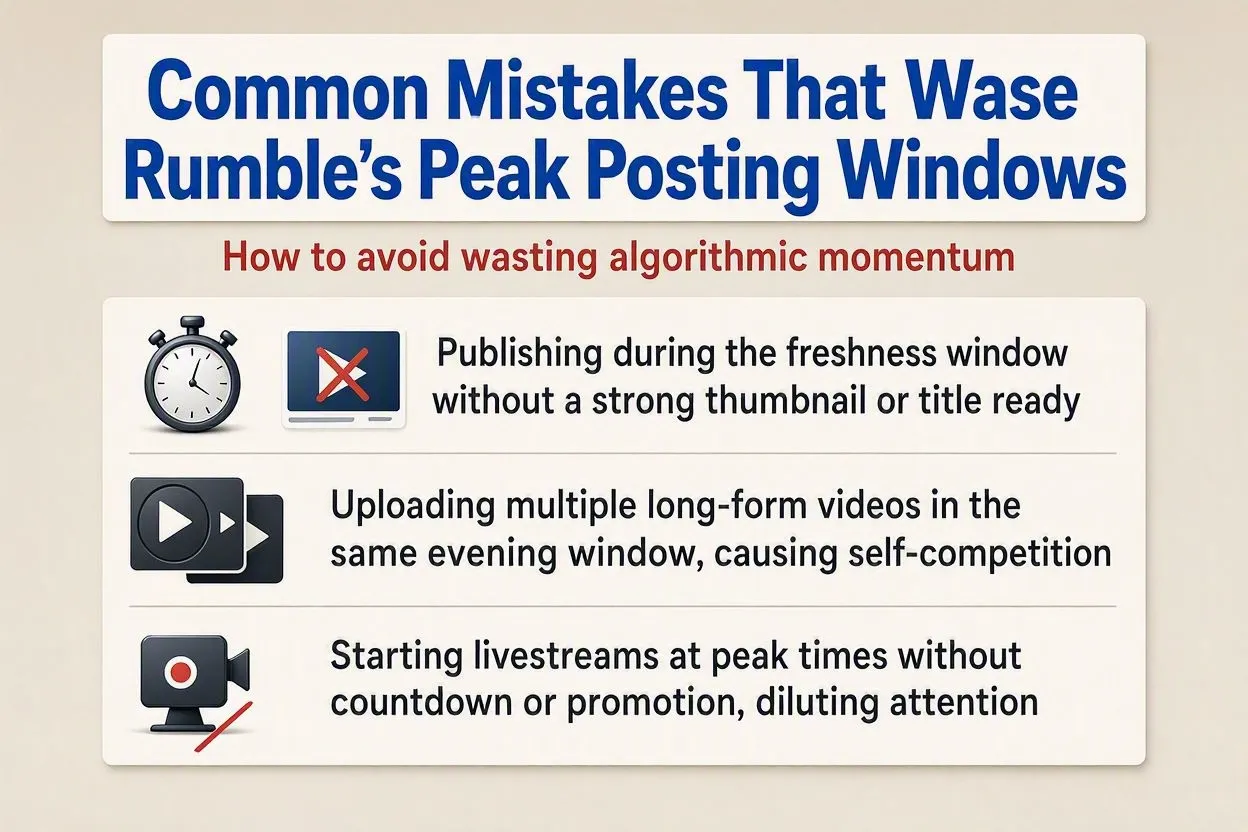
The most common one: publishing during Rumble’s freshness window without a strong thumbnail and title ready, which wastes the algorithmic boost before viewers ever click. A second mistake is uploading multiple long-form videos within the same evening window, forcing a channel’s own content to compete against itself. Spacing uploads at least 48 hours apart avoids this. A third shows up with livestreams: starting at the same time as a competing creator’s scheduled event splits the audience, so it’s worth checking Rumble’s live schedule first.
Conclusion
Rumble rewards creators who treat the first few hours after publishing as the entire game, not just the opening move. Six PM to ten PM Eastern on Tuesday through Thursday remains the strongest general window for reaching Rumble’s video-sharing community. Livestreams need that same evening traffic surge to hit meaningful concurrent-viewer numbers, and Sunday stays the one day worth avoiding for anything beyond a short evening upload. Still, individual channels need to confirm these patterns against their own rumble.com/app dashboard, since niche audiences in finance, faith, or daytime-skewing categories can shift the ideal window by several hours in either direction across this video-sharing community.