

An AI visibility tracker is a tool that monitors how often your brand appears in answers generated by AI search engines — including ChatGPT, Perplexity, Gemini, Claude, Microsoft Copilot, and Google AI Overviews.
Think of it as rank tracking, but for AI-generated answers instead of Google’s blue links. Instead of checking keyword positions, you check whether AI platforms mention or cite your brand when buyers ask questions related to your product or service.
The term “AI visibility” covers two distinct signals:
- Brand mentions — when an AI platform directly names or recommends your brand in a response
- Brand citations — when an AI platform links to or references your website as a source
Both matter. A mention without a citation builds awareness. A citation without a mention drives traffic. The best AI visibility trackers measure both — and show you which competitors are winning the spots you are missing.
How Does an AI Visibility Tracker Work?
An AI visibility tracker works by running a set of prompts across multiple AI platforms and recording whether your brand appears in the responses.
Here is the 4-step process every tool follows:
- Prompt input — You give the tool a list of prompts, such as “best CRM for small business” or “top project management tools for remote teams”
- Platform querying — The tool queries ChatGPT, Perplexity, Gemini, and other AI engines using those prompts
- Response analysis — The tool scans each AI-generated answer for brand mentions, citations, sentiment, and competitor appearances
- Reporting — Results are displayed as a visibility score, share of voice (SOV), citation rate, and sentiment breakdown
Most tools collect data through UI scraping — simulating real user interactions with AI platforms — rather than pulling raw API data. UI scraping produces more accurate results because it captures what actual users see, including retrieval-augmented generation (RAG) data that API calls often miss.
The biggest limitation across all tools: you need to supply the prompts yourself. Unlike Google Search Console, no AI platform currently shares real user query data. You are making educated guesses about what your buyers are asking — which means prompt selection is the most important skill in AI visibility tracking.
5 Things to Look for Before You Buy
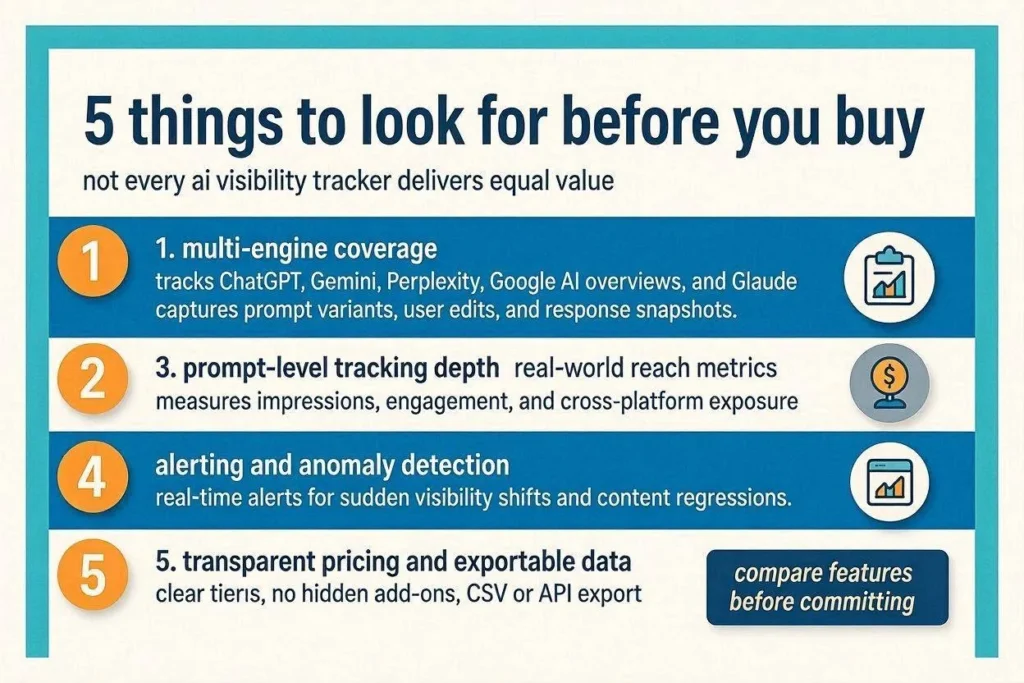
Not every AI visibility tracker delivers equal value. Before spending $89 to $500 per month, evaluate each tool on these 5 criteria:
- Multi-engine coverage Your buyers use different AI platforms. A tool that only tracks ChatGPT misses the 750 million monthly users on Gemini and the growing audience on Perplexity. Look for tools that cover at least ChatGPT, Perplexity, Gemini, Google AI Overviews, and Claude.
- Prompt-level tracking depth A visibility score is useful. Seeing exactly which prompt triggered a mention — and what the full AI response said — is far more useful. Prompt-level detail lets you diagnose gaps precisely instead of guessing what went wrong.
- Competitor share of voice (SOV) AI visibility is relative. Your brand showing up in 40% of responses means nothing if your top competitor appears in 80%. SOV benchmarking turns raw numbers into actionable competitive intelligence.
- Sentiment and context analysis A mention is not always a win. AI platforms sometimes describe brands inaccurately or frame them negatively. Sentiment analysis flags these cases so you can address them with updated content or outreach.
- A path from insight to action Most tools stop at reporting. The strongest ones connect tracking data to content workflows, outreach opportunities, and GEO (Generative Engine Optimization) recommendations. If a tool only tells you that you dropped out of an answer without showing you how to fix it, you are paying for a dashboard — not a solution.
The 10 Best AI Visibility Tracker Tools in 2026
Quick Comparison Table
| Tool | Best For | Engines Covered | Starting Price (USD) |
| Frase | Monitor + fix in one workflow | ChatGPT, Perplexity, Claude, Gemini, Google AI | $39/month |
| Semrush AI Toolkit | Teams already using Semrush | ChatGPT, Perplexity, Gemini, Copilot, AI Mode | $299/month |
| Profound | Enterprise-level depth | Multi-engine, broad coverage | $499/month |
| Peec AI | Agencies, citation analysis | ChatGPT, Perplexity, AI Overviews + add-ons | $89/month |
| Scrunch AI | Actionable GEO insights | ChatGPT, Perplexity, Gemini, AI Mode, Claude | $250/month |
| Hall | Free plan, AI referral tracking | ChatGPT, Perplexity, AI Overviews (free tier) | Free / $199/month |
| OtterlyAI | Budget GEO audit | ChatGPT, AI Overviews, Perplexity, Copilot | $25/month |
| AthenaHQ | Growth-stage SaaS teams | Multi-engine, broad coverage | $295/month |
| Writesonic | Content optimization + tracking | ChatGPT, Gemini, Perplexity, AI Mode, Claude | $199/month |
| Trackerly | Multi-country localization | AI Mode, AI Overviews, ChatGPT, Gemini, Claude | $27/month |
1. Frase — Best for Teams Who Want to Track and Fix in One Place
Frase is the strongest all-in-one AI visibility tracker for US content and SEO teams. It does not just show you where your brand is missing — it gives you the tools to fix the gap inside the same platform.
3 key features:
- Daily tracking across ChatGPT, Perplexity, Claude, Gemini, and Google AI with prompt-level SOV data
- GEO optimization tools that score your content for AI citation potential alongside traditional SEO scoring
- Content Guard — monitors published pages for ranking decay and suggests fixes before traffic drops
Pricing: From $39/month (billed annually). 7-day free trial, no credit card required.
Best for: In-house SEO teams and content agencies who want tracking, writing, optimization, and publishing under one roof.
Limitation: Teams who only need lightweight mention monitoring will pay for content features they will not use.
2. Semrush AI Toolkit — Best for Teams Already Inside Semrush
If your team runs keyword research, backlink analysis, and site audits inside Semrush, the AI Toolkit extends that workflow into AI visibility without adding a separate login.
3 key features:
- Tracks brand mentions, citations, sentiment, and SOV across ChatGPT, Perplexity, Gemini, Copilot, and Google AI Mode
- 261 million AI prompts in the database — the largest data foundation in this category
- AI-ready site audit flags technical issues that block AI crawlers from indexing your pages
Pricing: $299/month (Pro+ plan). Requires an existing Semrush subscription.
Best for: Established SEO teams standardized on Semrush who want integrated AI visibility data.
Limitation: The entry price is significantly higher than standalone AI trackers, and the broader platform has a steep learning curve for new users.
3. Profound — Best for Enterprise Depth
Profound was one of the first dedicated AI visibility platforms to gain serious traction, and it remains the strongest pure-monitoring tool for large brands. The Conversation Explorer feature surfaces relevant AI discussions your brand appears in — similar to how Ahrefs surfaces keywords, but for LLM answers.
3 key features:
- Deep multi-engine tracking with crawler-level data and front-end UI snapshots
- Conversation Explorer — surfaces prompts and discussions you did not know to track
- Multi-client management views for agencies handling enterprise accounts
Pricing: From $499/month (Profound Lite). Enterprise pricing is custom.
Best for: Large US brands and enterprise agencies that need maximum tracking depth and compliance-level reporting.
Limitation: The self-serve onboarding is slow. Smaller teams will find both the price and the feature set excessive for their needs.
4. Peec AI — Best for Agencies and Citation Analysis
Peec AI stands out for the quality of its citation intelligence. The Sources report shows exactly which domains and page types AI platforms cite most often for each prompt — giving agencies a clear map of where to earn placements for clients.
3 key features:
- Citation source classification by page type — homepage, listicle, how-to guide, comparison page, product page
- Multi-client project management with pitch project support for new business proposals
- Bulk prompt upload, clustering, and multi-country support for international campaigns
Pricing: From $89/month (Starter, 25 prompts). Pro is $199/month (100 prompts).
Best for: SEO agencies tracking AI visibility for multiple clients and building citation gap analyses into their reporting.
Limitation: Tracking additional AI engines beyond the base 3 (ChatGPT, Perplexity, AI Overviews) costs extra per model.
5. Scrunch AI — Best for Actionable GEO Recommendations
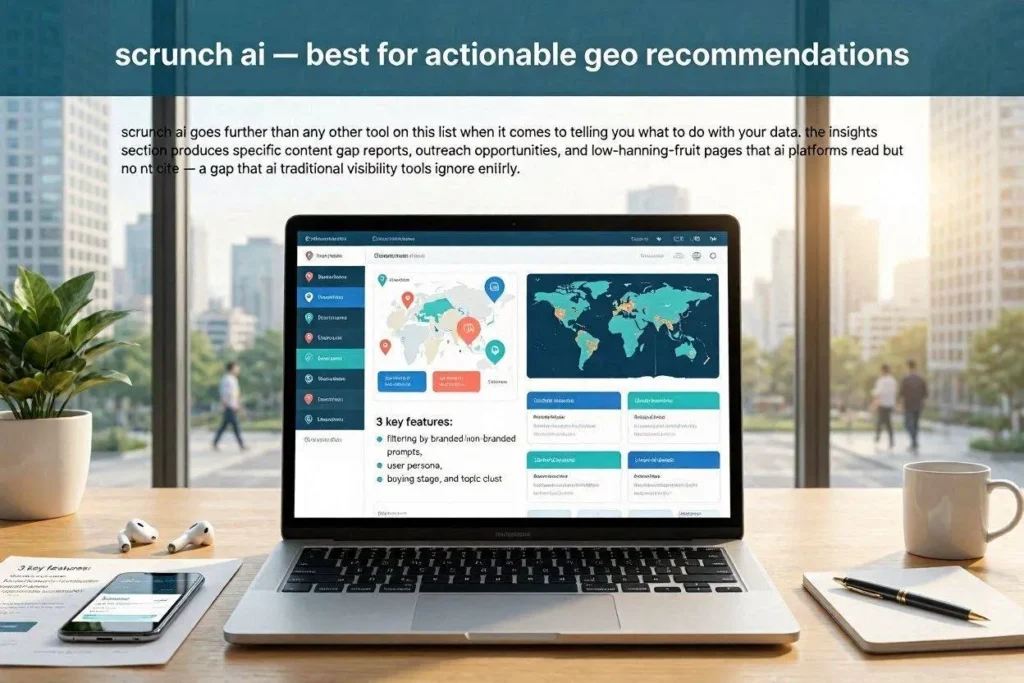
Scrunch AI goes further than any other tool on this list when it comes to telling you what to do with your data. The Insights section produces specific content gap reports, outreach opportunities, and low-hanging-fruit pages that AI platforms read but do not cite — a gap that traditional visibility tools ignore entirely.
3 key features:
- Filtering by branded/non-branded prompts, user persona, buying stage, and topic cluster
- Technical page audit that flags crawlability issues preventing AI bots from reading your content
- Google Analytics 4 (GA4) integration showing which AI platforms drive real traffic and conversions
Pricing: From $250/month (Starter, 350 prompts). Growth is $417/month.
Best for: Growth-stage US brands and agencies that want GEO recommendations alongside visibility data.
Limitation: The reporting depth can feel overwhelming. Finding specific insights requires navigating multiple dashboards.
6. Hall — Best Free AI Visibility Tracker
Hall offers the most generous free plan in this category — 25 tracked prompts, 300 analyzed answers per month, across ChatGPT, Perplexity, and AI Overviews, with no time limit and no credit card required. For US startups and small business owners testing AI visibility for the first time, Hall is the logical starting point.
3 key features:
- AI referral traffic reporting — shows which AI platforms send real visitors to your site
- AI agent activity tracking — monitors how AI crawlers access and index your content
- Weekly performance email updates with visibility score breakdowns by topic, region, and platform
Pricing: Free (25 prompts, 3 platforms). Paid plans start at $199/month.
Best for: Small US businesses and startups testing AI visibility before committing to a paid tool.
Limitation: The app experienced crashes during testing. Sentiment scoring and average position data are missing from the free tier.
7. OtterlyAI — Best Budget GEO Audit Tool
At $25/month, OtterlyAI is the most affordable paid AI visibility tracker with a genuine feature set. The standout capability is the GEO audit — a page-level check that tells you whether a specific URL is AI-friendly and flags technical issues blocking LLM citation.
3 key features:
- Actual AI chatbot screenshots included in every prompt report — you see exactly what users see
- AI keyword research converts your existing SEO keywords into AI-ready prompt variants
- Intent volume scoring — assigns a real numerical score to each prompt, similar to keyword search volume
Pricing: From $25/month (Lite, 15 prompts). Standard is $160/month (100 prompts).
Best for: US freelancers, solopreneurs, and small businesses that need GEO auditing without enterprise pricing.
Limitation: Some UI inconsistencies and occasional data conflicts between the main dashboard and individual prompt reports.
8. AthenaHQ — Best for Growth-Stage SaaS
AthenaHQ pairs AI visibility tracking with conversion analytics — showing not just where your brand appears, but how those appearances connect to real website traffic and revenue. The platform includes unlimited seats on all plans, making it cost-effective for growing SaaS teams with multiple stakeholders.
3 key features:
- GEO analytics with traffic and ROI views connecting AI citations to actual conversions
- Action center with next-step recommendations based on visibility gaps
- Prompt suggestions generated automatically during setup based on your website’s content
Pricing: From $295/month (Starter, 3,500 credits).
Best for: Growth-stage US SaaS companies that need AI visibility data tied to revenue metrics.
Limitation: Credit-based pricing can burn through a budget quickly on broad query sets.
9. Writesonic — Best for Content Optimization and Tracking Together
Writesonic tracks AI visibility and gives you an Action Center that turns that data into specific content and optimization tasks. The platform also includes built-in content creation tools — so you can identify a citation gap and write the page that closes it without switching tools.
3 key features:
- Prompt analysis showing exactly which queries trigger brand mentions and which do not
- Citation and source tracking with competitor SOV benchmarking
- Integrated content creation with fact-checking and internal linking built into the optimization workflow
Pricing: From $199/month (Professional plan).
Best for: US content teams and digital marketing agencies that want AI tracking connected to a content production workflow.
Limitation: Advanced analytics and broader engine coverage are gated behind higher-tier plans.
10. Trackerly — Best for Multi-Country Tracking
Trackerly is the most accurate data provider on this list and the only tool with dedicated multi-country prompt grouping. US brands serving international markets — or agencies with clients across multiple regions — get geographic granularity no other tool in this category provides.
3 key features:
- Country-specific prompt groups — track English queries for the US, Spanish queries for Mexico, and so on, separately
- Full transparency on which AI model version generated each response
- Coverage across AI Mode, AI Overviews, ChatGPT, Perplexity, Gemini, Claude, and DeepSeek on all plans
Pricing: From $27/month (Lite, 4,500 credits).
Best for: US agencies managing international AI visibility campaigns and global brands tracking performance across multiple markets.
Limitation: No prompt-level breakdown without manual review. Missing GEO recommendations and URL audit features found in higher-priced competitors.
Free vs. Paid — Which One Is Right for You?
Yes — free AI visibility tracking is worth starting with, but only as a temporary baseline. Here is how to decide:
Use free tools if:
- Your monthly marketing budget is under $500
- You are testing AI visibility for the first time
- You need directional data, not daily precision monitoring
3 free methods that work right now:
- Hall’s free plan — 25 prompts, 3 platforms, weekly updates, zero cost
- GA4 LLM filter — Add a regex filter in Google Analytics 4 (GA4) to see referral traffic from ChatGPT, Perplexity, and Gemini broken down by page
- Manual ChatGPT testing — Run your 10 most important buyer prompts in an incognito window weekly and note which competitors appear
Move to a paid tool when:
- You need daily monitoring across 5+ AI engines
- Competitor SOV data is required for client reporting
- Citation source data is needed to build a GEO content strategy
For most US small businesses, OtterlyAI at $25/month or Trackerly at $27/month provides enough data to build a real AI visibility strategy without enterprise-level spend.
How to Track Your Brand in AI Search — Step by Step

To track your brand in AI search, follow these 4 steps:
Step 1: Build a prompt library of 10 to 20 prompts Write the exact questions your buyers ask before purchasing. Use 3 categories: awareness prompts (“what is the best [category]”), comparison prompts (“best [your product] vs [competitor]”), and problem prompts (“how do I fix [problem your product solves]”).
Step 2: Set up tracking in one tool Pick one tool based on your budget — Hall (free), OtterlyAI ($25/month), or Trackerly ($27/month) for smaller teams. Enter your prompts, add 3 to 5 competitors, and let the tool run its first analysis.
Step 3: Review SOV weekly Check your share of voice (SOV) against competitors every Monday. Note which prompts your brand wins, which prompts competitors win, and which prompts show neither brand — those are your fastest content opportunities.
Step 4: Fix citation gaps with content or outreach For prompts where competitors are cited and you are not, check which domains AI platforms cite. If those domains are publications or directories, reach out for inclusion. If those domains are competitors’ own pages, create a better version of that content on your site.
AI Visibility vs. SEO — 3 Key Differences
US SEO teams often ask whether AI visibility tracking replaces traditional SEO. No — AI visibility tracking and SEO measure different things and both are necessary in 2026.
| Factor | Traditional SEO | AI Visibility Tracking |
| What it measures | Keyword rankings in Google’s blue links | Brand mentions and citations in AI-generated answers |
| Primary metric | Position 1–10 on a results page | Share of voice across AI platforms |
| Traffic type | Click-through from search results | Direct AI referral traffic + brand awareness in zero-click searches |
The two strategies reinforce each other. Strong Google rankings increase the probability of AI citation because most major AI platforms pull from web-indexed content. But ranking on Google no longer guarantees AI visibility — AI platforms apply their own relevance filters that favor authoritative, well-structured, factual content regardless of traditional rank position.
Conclusion
The best AI visibility tracker for most US teams in 2026 is Frase — it tracks and fixes in one workflow. For enterprise depth, choose Profound. For budget-conscious teams, OtterlyAI at $25/month or Hall’s free plan covers the essentials.
Start with 10 to 15 prompts, track weekly, and fix citation gaps as they appear. AI search is not replacing SEO — it is adding a second visibility layer that most competitors have not figured out yet. Getting in now, while the market is still learning, is your advantage.