
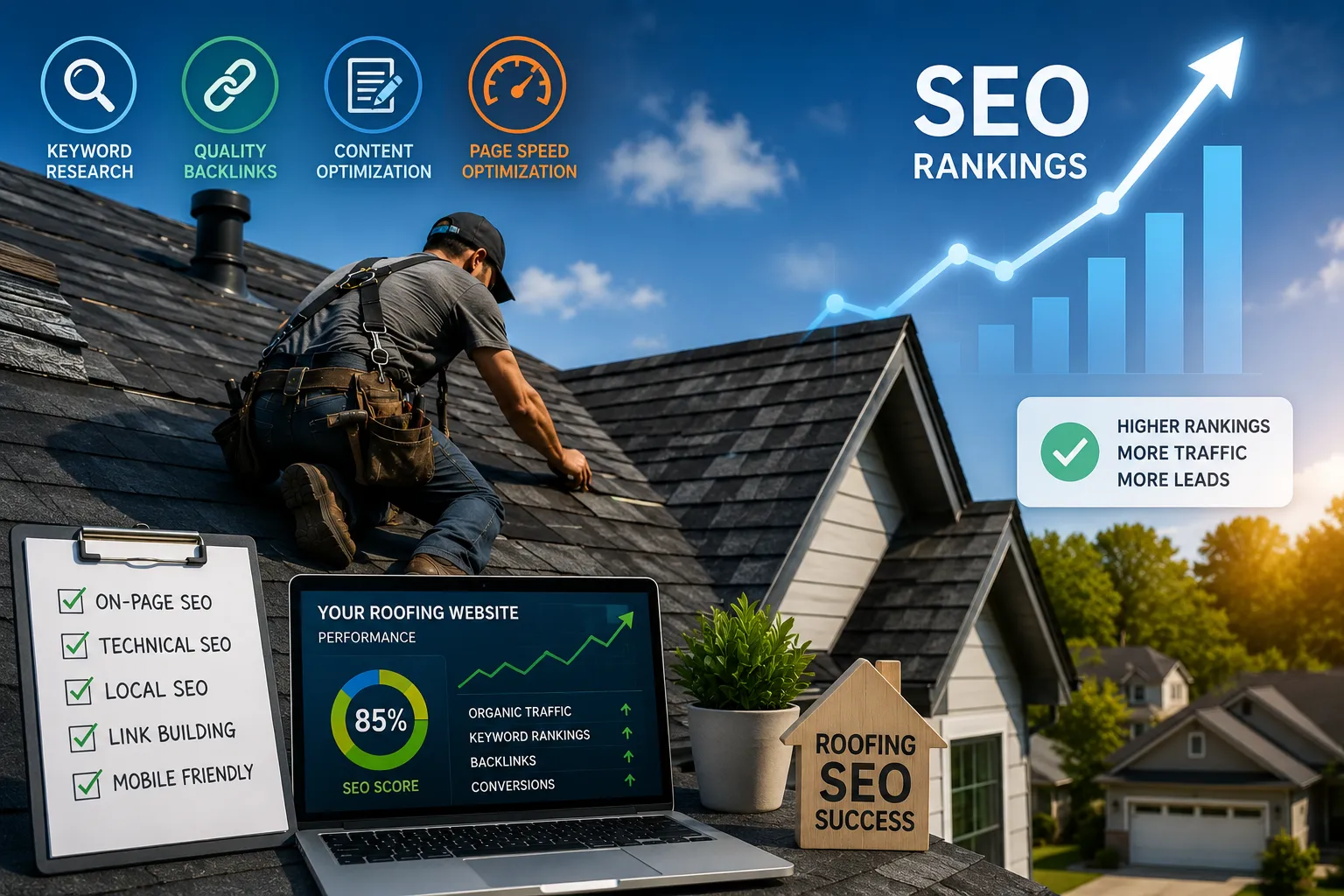
Roofing SEO is the process of optimizing your website, Google Business Profile, and content so homeowners find your roofing company first when they search for roof repair or replacement. It works through 5 connected pillars: local foundation, website optimization, content authority, link building, and conversion tracking.
This guide breaks down each pillar with exact steps, real timelines, and the keyword categories that separate booked jobs from wasted traffic.
What Is Roofing SEO and Why Does It Work Differently?
Roofing SEO differs from general local SEO because it relies on emergency intent, storm-driven demand spikes, and high-stakes trust decisions. A homeowner does not browse roofing contractors the way they browse running shoes — they search with a leak, a missing shingle, or storm damage already in progress.
To rank for roofing searches, your site needs 3 things general local SEO guides rarely emphasize: emergency-ready pages that load fast on mobile, location-specific content that proves you know the area’s weather patterns, and trust signals strong enough to justify a $10,000–$20,000 purchase decision.
Google reads roofing searches as high-intent local queries. A search for “roof repair near me” triggers the Map Pack first, organic listings second. Winning both placements requires treating your Google Business Profile and your website as one connected system, not two separate projects.
How to Build a Roofing Keyword Strategy
To build a roofing keyword strategy, map 4 keyword categories to 4 different page types on your site.
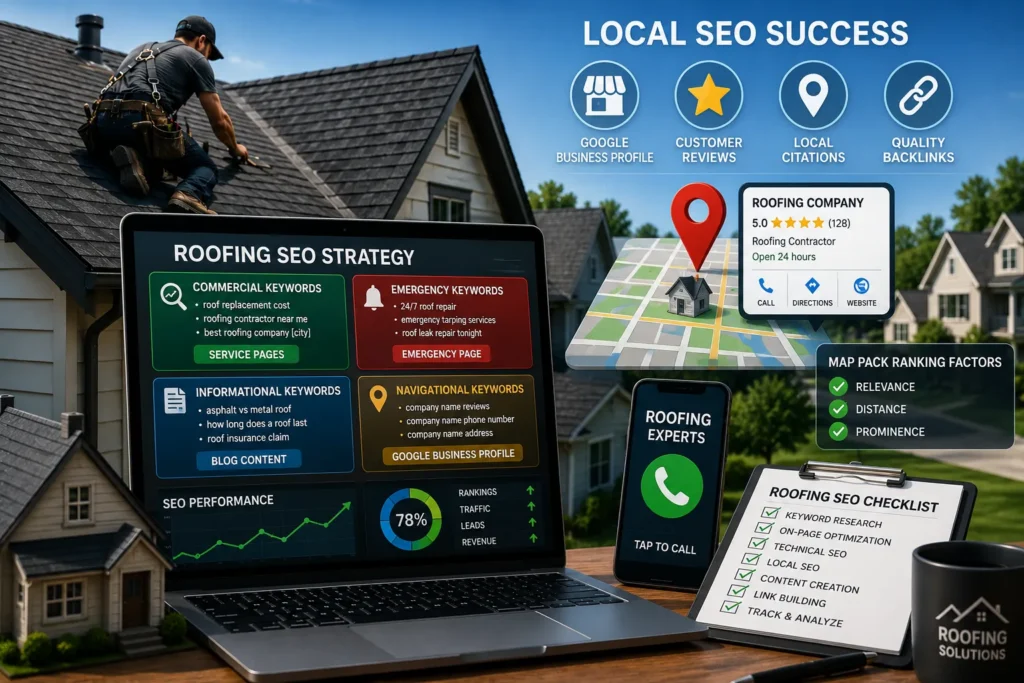
- Commercial keywords signal buying intent: “roof replacement cost,” “best roofing contractor [city],” “roofing company near me.” Map these to your homepage and core service pages.
- Emergency keywords signal urgent need: “24/7 roof repair,” “emergency tarping services,” “roof leak repair tonight.” Map these to a dedicated emergency-service page with a visible phone number.
- Informational keywords signal research mode: “asphalt vs metal roof,” “how long does a roof last,” “how to file a roof insurance claim.” Map these to blog content that builds topical authority.
- Navigational keywords signal brand recall: “[Company Name] reviews,” “[Company Name] phone number.” These rank automatically once your NAP (name, address, phone) stays consistent across the web.
Assign one primary keyword per page. A roof repair page targets “roof repair in [city].” A separate replacement page targets “roof replacement in [city].” Splitting intent this way prevents 2 pages from competing against each other in the same search results.
How to Optimize Your Roofing Website for Conversions
Your website exists to convert local visibility into phone calls and estimate requests. To optimize a roofing website, build dedicated service pages, location pages, and mobile-first calls to action.
Build a separate page for every core service: roof replacement, storm damage repair, commercial roofing, and roof inspections. Build a separate location page for every city or ZIP code you serve, since a single “service area” page cannot rank for 10 different cities at once.
Write title tags that combine service and city: “Roof Repair in [City] | [Company Name].” Use H1 and H2 headers to break each page into clear sections — the service itself, common problems it solves, your process, and a short FAQ.
Add alt text to every project photo using descriptive, keyword-relevant phrases: “asphalt shingle roof replacement in [city].” Keep your call-to-action visible on every page — a tap-to-call button matters more on a roofing site than almost any other industry, since 82% of roofing searches happen on mobile devices, often during an active leak or storm.
How to Rank in the Local Map Pack
To rank in Google’s Local Map Pack, optimize your Google Business Profile across 3 signals: relevance, distance, and prominence.
Relevance means your profile matches what the searcher typed — choose “Roofing Contractor” as your primary category, not a broader category like “Construction Company.” Distance is fixed by your verified address. Prominence comes from review volume, citation consistency, and total online authority.
To strengthen your Google Business Profile:
- Use your real business name with no keyword stuffing in the name field
- List every service you offer, matching the exact terms homeowners search
- Upload photos after every completed job — profiles with 100+ photos consistently earn more calls than profiles with fewer images
- Request a review within 24 hours of job completion, then respond to every review within 48 hours
- Keep your name, address, and phone number identical across your website, GBP, and every directory listing
Google Local Services Ads (LSAs) work alongside your GBP, not against it. LSAs place your business above both paid and organic results, and qualifying for the Google Guaranteed badge increases click-through rate on high-intent emergency searches. Run LSAs and organic GBP optimization as one coordinated system — matching service lists and business details between both increases lead quality on each channel.
What Content Actually Builds Roofing Authority?
Google ranks roofing sites that act as complete knowledge hubs above sites with thin, sales-only pages.
To build topical authority, publish content that documents real experience, not generic roofing advice available on every competitor site.
Case studies outperform generic blog posts. A strong case study includes the original problem, your inspection findings, the solution you recommended, and the final result with photos. This format gives Google concrete evidence of expertise and gives homeowners proof you solve problems like theirs.
Before-and-after photos reduce buyer skepticism faster than written testimonials. Pair every major project with a photo set, and use specific roofing terminology in your captions and copy — flashing, underlayment, ridge vent, modified bitumen — since these terms signal genuine expertise to both readers and search engines.
Educational content fills the gap between “I have a problem” and “I’m ready to call.” Cover storm damage assessment, insurance claim navigation, and local building code requirements. Tie this content to your specific region: reference the weather patterns, common roof issues, and codes that apply to your actual service area, not generic national advice.
How to Use Seasonal and Storm-Driven Content
Roofing searches spike around weather events, not on a steady calendar.
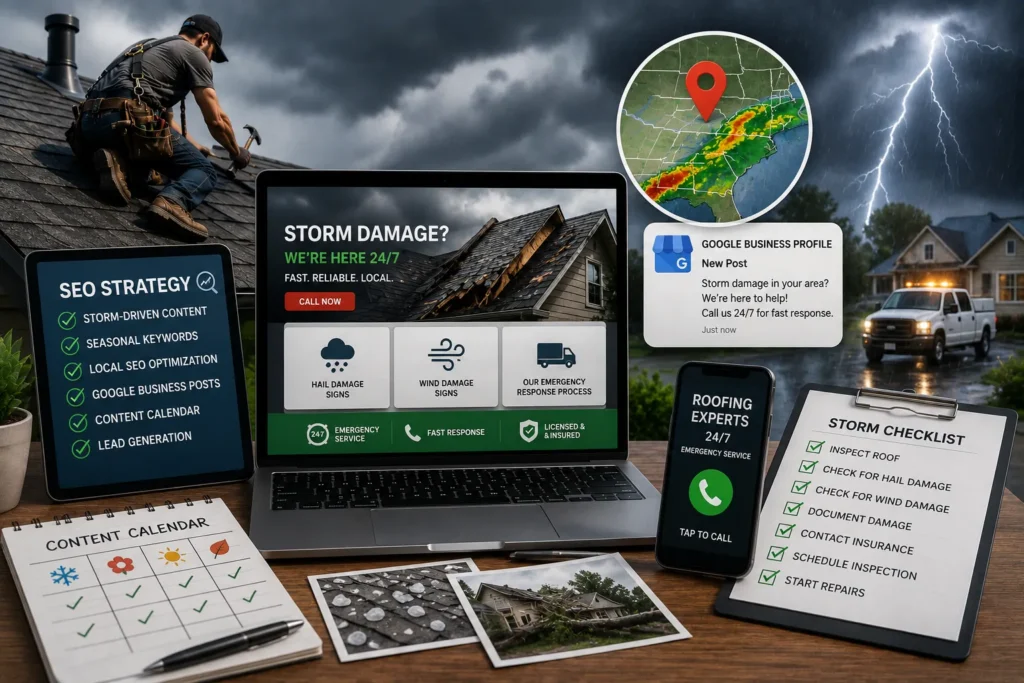
To capture storm-driven demand, build emergency content before the storm hits, not after.
Pre-build a “storm damage” landing page that covers hail damage signs, wind damage signs, and your emergency response process. When a storm hits your service area, this page is already indexed and ready to capture the search spike — building it reactively after the storm means competitors with existing pages capture those searches first.
Track regional patterns in your search data. Cold-climate markets see spikes around ice dams, post-snow leaks, and attic condensation. Storm-heavy regions see spikes around hail and wind damage after major weather events. Build a content calendar around these patterns instead of publishing on a generic monthly schedule unrelated to actual demand.
Update your Google Business Profile immediately after major local storms. Add a post mentioning your storm response availability — this signals activity to Google and gives homeowners searching during the event a reason to call you specifically.
How to Build Links for a Roofing Company
To build links for a roofing company, prioritize 5 local and industry-specific sources over generic outreach.
- Supplier links. Manufacturers like GAF and Owens Corning list certified installers on their own websites — apply for certification programs that include a directory listing.
- Local sponsorships. Sponsoring a youth sports team or local charity event often earns a link from the organization’s website alongside genuine community goodwill.
- Digital PR. Local news sites cover community involvement, storm response stories, and notable local projects — pitch these angles directly to local reporters.
- Guest posting. Home improvement blogs and local lifestyle sites accept expert contributions on roofing topics, especially when the content avoids overt sales pitches.
- Resource page placement. Many cities maintain “trusted local contractor” resource pages through chambers of commerce or homeowner associations — request inclusion directly.
A link building services approach built around editorial placements compounds faster than scattered, one-off outreach. Each placement on a relevant, trusted site adds more authority than 10 placements on unrelated directories, because Google weighs topical relevance alongside raw link count.
Guest posting services extend this further by securing bylined articles on home improvement and local publications — content that builds both the backlink and direct referral traffic from readers actively researching roofing decisions.
Roofing SEO Cost and Timeline: What to Expect
Roofing SEO costs fall into 3 tiers based on market competition and growth goals.
| Investment Tier | Monthly Cost | What’s Included | Best Fit |
| Basic | $1,500–$2,500 | Technical fixes, GBP setup, basic maintenance | New sites, low-competition markets |
| Growth | $3,000–$5,000 | Content creation, link building, local dominance | Established roofers scaling leads |
| Market Leader | $6,000+ | Multi-city domination, competitive commercial keywords | Regional or multi-location roofing companies |
Results follow a 3-phase timeline. Months 1–3 cover technical audits, GBP verification, and fixing indexing errors — traffic often stays flat during this phase. Months 4–6 bring ranking improvements for long-tail keywords, with leads starting to trickle in. Months 7–12 deliver page-1 rankings for primary keywords like “roofing [city],” with lead flow becoming consistent and predictable.
Quick Reference: Roofing SEO Tasks by Priority
| Task | Best Method | Timing | Difficulty |
| Rank in the Map Pack | Google Business Profile optimization | 2–8 weeks | Low |
| Generate steady organic leads | Service + location pages + content | 6–12 months | Medium |
| Win competitive city keywords | Link building + topical authority content | 6–9 months | High |
| Fix mobile conversion issues | Core Web Vitals + tap-to-call CTAs | 1–2 weeks | Low |
| Build long-term domain authority | Supplier links, digital PR, guest posts | Ongoing | Medium |
| Capture storm-driven demand | Emergency-intent pages + LSAs | 1–4 weeks | Low |
5 Mistakes That Waste a Roofing SEO Budget
To avoid wasting budget, fix these 5 mistakes before scaling any roofing SEO campaign.
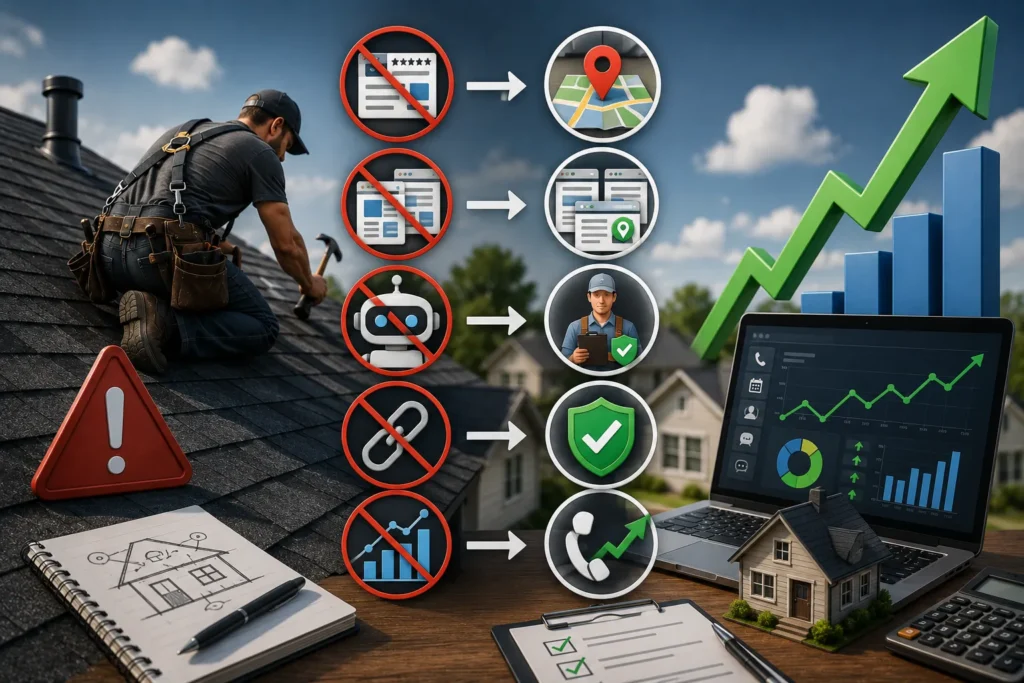
- Keyword stuffing your business name. Adding “Roofing Company Best [City]” to your GBP name field violates Google’s guidelines and risks profile suspension.
- Using one generic service page for every city. A single “service area” page cannot rank for 10 different city searches — each city needs its own page.
- Publishing thin AI-generated content. Raw, unedited AI text produces generic pages that fail to demonstrate E-E-A-T (Experience, Expertise, Authoritativeness, Trustworthiness) and rarely outranks competitors with documented real projects.
- Buying cheap, irrelevant backlinks. Toxic links from unrelated spam sites trigger algorithmic penalties instead of building authority.
- Tracking traffic instead of revenue. A page generating 10,000 visits for “DIY roof patch” produces 0 booked jobs — track calls and estimate requests, not raw visitor counts.
DIY vs. Hiring a Roofing SEO Agency
Choose DIY when you have weekly time to manage listings, content, and tracking, and your market has lower competitive pressure. Choose an agency when you want predictable lead flow without the ongoing time investment, especially in competitive metro markets.
| Factor | DIY | Roofing SEO Agency |
| Time required | Ongoing weekly commitment | Limited after onboarding |
| Local SEO expertise | Self-taught, trial and error | Dedicated specialists |
| Content and case studies | Requires internal documentation effort | Structured, search-informed content strategy |
| Link building | Hard to scale without outreach experience | Established processes and relationships |
| Tracking | Often limited to basic traffic | Conversion tracking tied to calls and revenue |
| Cost tradeoff | Lower direct cost, higher time cost | Higher monthly cost, lower labor burden |
Turn Roofing Visibility Into Booked Jobs
Roofing SEO rewards companies that treat local search as a complete system — Google Business Profile, website, content, and links working together, not as separate checkboxes. Homeowners searching during a storm or after finding a leak pick the first trustworthy option they see, which makes consistent visibility worth more than any single tactic on this list.
If your roofing site needs the editorial backlinks and local authority signals that move rankings fastest, our link building services team builds the exact placements covered in this guide. Book a free strategy call and get a roofing-specific SEO plan built around your service area.