
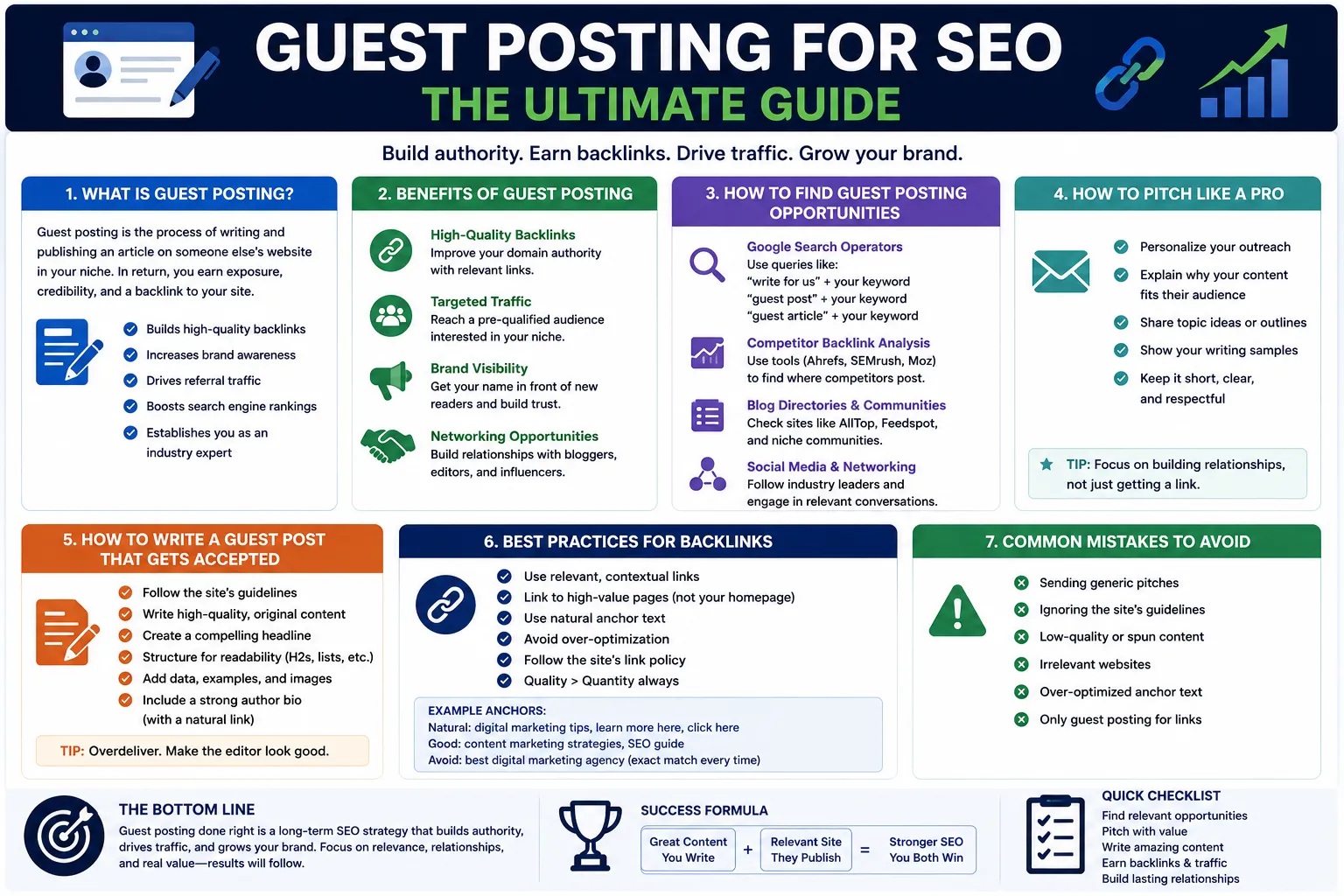
Guest posting SEO builds high-quality backlinks, increases Domain Authority (DA), and grows organic traffic — making it the most effective white-hat link building strategy for bloggers, marketing agencies, and SEO professionals in 2026.
This guide covers the complete guest blogging process: finding niche-relevant sites, writing pitches editors accept, creating content that ranks, and tracking business results. Every technique targets real SEO outcomes — not vanity metrics.
What is Guest Posting?
Guest posting is writing and publishing an article on another website or blog to earn a backlink, reach a new audience, and build authority in your niche.
The host blog gets free, high-quality content. You get 3 direct business results:
- A backlink that passes PageRank and increases your DA
- Referral traffic from readers who click your author bio link
- Brand authority that builds trust with new audiences across your industry
Guest posting sits at the intersection of content marketing, SEO strategy, and online community building. A single well-placed guest post on a DR60 blog delivers more SEO value than 50 low-quality directory links — and keeps delivering referral traffic for months.
In 2026, guest posting adds a fourth benefit no competitor’s guide covers: AI search visibility. Brand mentions on high-DA blogs appear in ChatGPT, Perplexity, and Google AI Overviews — generating traffic from AI platforms alongside traditional organic search.
Why is Guest Posting Important for SEO?
Guest posting is important for SEO because editorial backlinks from niche-relevant, high-DA websites directly increase SERP rankings — and Google treats each backlink as a verified trust signal from one site to another.
Ahrefs’ study of 1 billion pages confirms a direct correlation between the number of unique referring domains and organic search traffic. ahrefs Guest posting is the fastest white-hat method to build those referring domains consistently.
Google’s 2024 Link Spam Update made quality non-negotiable. Backlinks from link farms, PBNs (Private Blog Networks), or undisclosed paid placements now trigger manual penalties. Editorial guest posts on real, trafficked, editorially reviewed sites remain 100% Google-compliant and carry full link equity.
Demonstrates Your Expertise in Your Industry
Guest posting demonstrates industry expertise by placing your byline on authoritative publications your target audience already reads and trusts.
Google’s E-E-A-T (Experience, Expertise, Authoritativeness, Trustworthiness) framework rewards content from verifiable experts. A guest post published on a DR65 industry blog proves authorship credibility to Google far more effectively than a self-published article on a new domain.
YMYL (Your Money Your Life) niches — finance, health, legal, and SaaS — benefit most from this signal. Google scrutinizes author credentials heavily in these categories. Consistent guest bylines on trusted industry publications tell Google: this person has real, demonstrated experience in this field.
3 ways guest posting develops E-E-A-T signals faster than any other content strategy:
- Named authorship on established blogs links your identity to your topic
- Editor validation — a real editorial team approved your content as accurate and valuable
- Community recognition — readers, other bloggers, and industry forums reference your published work
Attracts Higher-Quality Traffic
Guest posting attracts higher-quality traffic because readers arrive pre-qualified — they read your article on a trusted blog, chose to click through, and arrived at your site already interested in what you offer.
This referral traffic converts at 3–5× the rate of cold organic traffic. A visitor from a guest post on a niche-relevant DR60 blog has lower bounce rates, longer session durations, and higher purchase intent than traffic from paid ads or social media.
Dana Nicole published a guest post on Buffer and received nearly 400 new email subscribers in 11 months from that single placement. semrush One strategically placed guest post on the right blog delivers compounding returns — the article keeps ranking, the link keeps passing authority, and the referral traffic keeps arriving.
Benefits of Guest Posting
Guest posting delivers 7 direct SEO and business benefits — each compounds over time as your backlink profile, DA, and brand authority grow together.
- Builds high-quality backlinks — editorial links from DR30+ sites pass real PageRank to your domain, increasing rankings for target keywords
- Increases organic traffic — each new unique referring domain improves SERP positions within 6–12 weeks of publication
- Improves Domain Authority — consistent guest posting on 10+ unique domains develops DA by 5–15 points over 6 months
- Generates referral traffic — average guest post delivers 50 referral visits monthly; high-DA placements on active blogs deliver 200–500+
- Builds E-E-A-T signals — named author bylines on authoritative sites prove expertise to Google’s quality raters
- Increases AI search visibility — brand mentions on high-DA blogs appear in ChatGPT, Perplexity, and Google AI Overview responses
- Creates business networking opportunities — editor relationships lead to repeat placements, podcast invitations, joint ventures, and speaking opportunities
How to Find Guest Post Opportunities
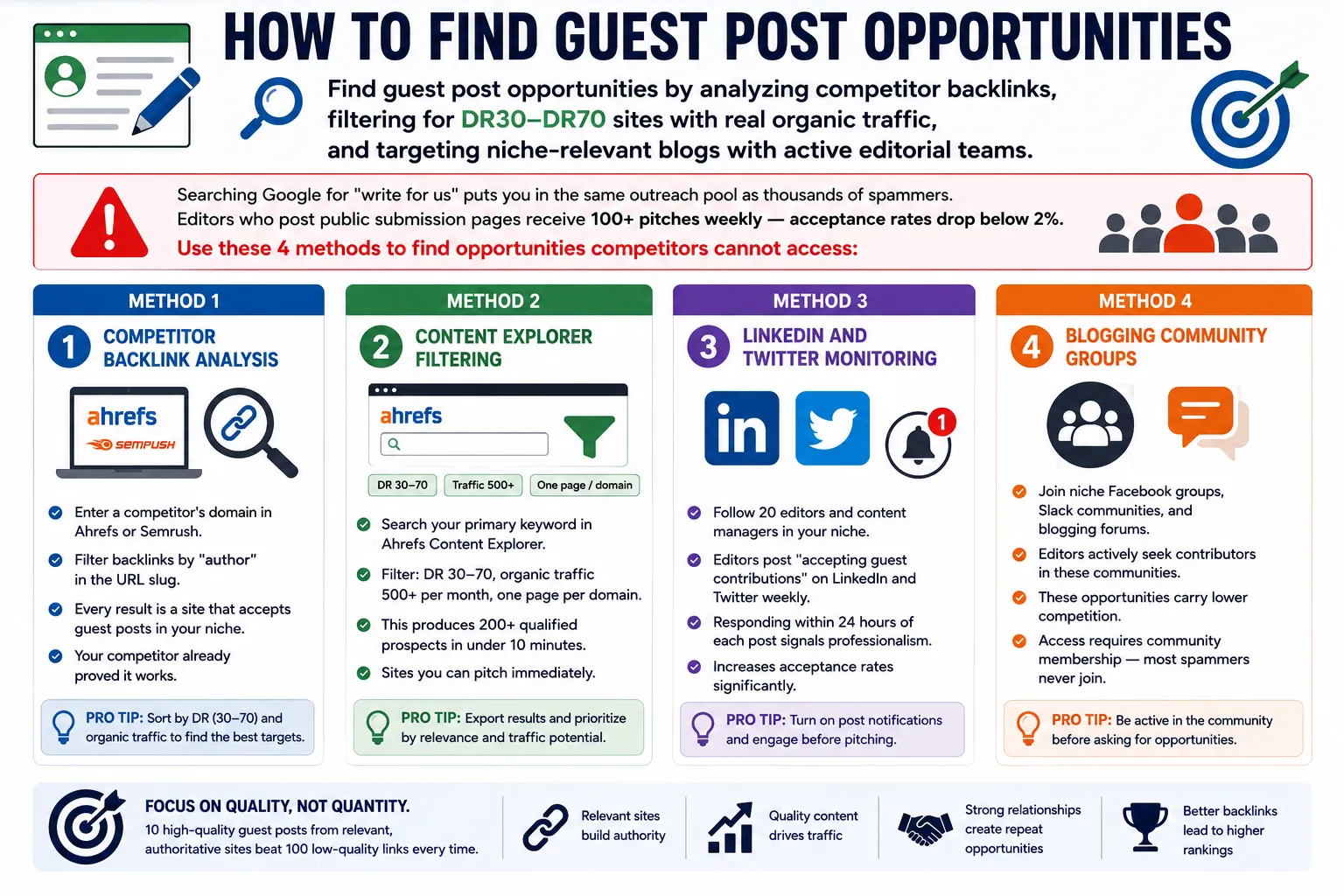
Find guest post opportunities by analyzing competitor backlinks, filtering for DR30–DR70 sites with real organic traffic, and targeting niche-relevant blogs with active editorial teams.
Searching Google for “write for us” puts you in the same outreach pool as thousands of spammers. Editors who post public submission pages receive 100+ pitches weekly — acceptance rates drop below 2%. Use these 4 methods to find opportunities competitors cannot access:
Method 1 — Competitor Backlink Analysis Enter a competitor’s domain in Ahrefs or Semrush. Filter backlinks by “author” in the URL slug. Every result is a site that accepts guest posts in your niche — your competitor already proved it works.
Method 2 — Content Explorer Filtering Search your primary keyword in Ahrefs Content Explorer. Filter: DR 30–70, organic traffic 500+ per month, one page per domain. This produces 200+ qualified prospects in under 10 minutes — sites you can pitch immediately.
Method 3 — LinkedIn and Twitter Monitoring Follow 20 editors and content managers in your niche. Editors post “accepting guest contributions” on LinkedIn and Twitter weekly. Responding within 24 hours of each post signals professionalism and increases acceptance rates significantly.
Method 4 — Blogging Community Groups Join niche Facebook groups, Slack communities, and blogging forums where editors actively seek contributors. These opportunities carry lower competition because access requires community membership — most spammers never join.
Quality Verification Checklist — Check Every Site Before Pitching:
- DA or DR above 30 (verify in Ahrefs, Semrush, or free Moz Bar)
- Consistent or growing organic traffic — not declining month-over-month
- Real editorial review — recent articles are well-written, original, and accurate
- Real author bios with verifiable LinkedIn profiles
- Published content within the last 30 days — active blogs only
Poor Guest Post Opportunities to Avoid
Reject any guest post site showing 3 or more of these 8 warning signs — a bad backlink placement actively damages your domain’s trust signals.
- Spam score above 30% — check free Moz Bar on every candidate site
- Zero organic traffic — verify in Semrush or Ahrefs before pitching
- 5+ guest posts published per day — direct signal of a link farm operation
- “Sponsored” or “Advertorial” labels on every post — Google downgrades these links in PageRank calculations
- No real author bios — fake names with no verifiable social media presence
- Exact-match anchor text on every outbound link — manual Google penalty risk for both sites
- Accepts every niche — a travel blog linking to a crypto exchange is topically irrelevant
- DR dropped 10+ points in 6 months — site losing Google trust rapidly; link equity is declining
How to Choose Guest Post Topics
Choose guest post topics by identifying keywords the target blog does not rank for — but competing blogs do. This gives editors a concrete, data-backed reason to accept your pitch immediately.
Every blog owner wants more search traffic. Every blog has more topics to cover than time to write. Your guest post solves both problems simultaneously — and editors say yes when they see the traffic opportunity clearly presented.
Step-by-step topic selection process:
- Enter the target blog’s domain in Ahrefs Competitive Analysis or Semrush Keyword Gap
- Add 3–4 competitor blogs in the same niche
- Click “Missing” — keywords all competitors rank for but the target site does not
- Filter: Keyword Difficulty (KD) below 30, search volume above 500 per month
- Select topics you can write about with real firsthand experience and original data
Low-KD, high-volume keywords give your guest post the best chance of ranking in SERPs — which benefits the host blog long-term and keeps your backlink visible and active.
Develop Guest Post Ideas
Develop guest post ideas using 5 proven techniques — each produces original angles editors have not seen in their pitch inbox before.
Copycat Technique
Find topics competing blogs rank for that your target blog does not — pitch those exact topics as ready-to-publish articles.
Open Ahrefs Competitive Analysis. Enter the target blog as “Target.” Add 3 competitor blogs. The “Missing” tab shows every keyword the target blog is losing traffic on right now. Pick topics within your expertise, prepare an outline, and pitch with the keyword data attached. Editors accept these immediately — the traffic opportunity is proven and visible.
Refresh Technique
Find articles on the target blog that lost organic traffic in the past 12 months — offer to update, expand, and republish them with 2026 data.
Open Ahrefs Site Explorer. Enter the target blog’s domain. Go to Top Pages. Set the Compare filter to “Previous Year.” Sort by Traffic Change, lowest to highest. Pages with the largest traffic drops need refreshing. Pitch an update that adds current statistics, removes outdated sections, and expands thin content. Editors welcome this — it solves an active SEO problem without using their own writing resources.
Robin Hood Technique
Take top-performing topics from large authority blogs and pitch those same topics — with a unique angle — to smaller niche-relevant blogs.
Large authority blogs — Ahrefs, Semrush, HubSpot — publish content that drives thousands of monthly visitors. Smaller niche blogs cannot compete for those topics yet but would benefit from proven-demand content. Find a top-performing article using Ahrefs Site Explorer (Top Pages report), develop a unique angle or add more current data, and pitch a version of that topic to a DR30–50 blog. The smaller blog gets proven-demand content. You get the backlink from a niche-relevant domain.
Splintering Technique
Break one comprehensive guide into 6–8 standalone articles — each becomes a separate guest post pitch to a different blog.
A single 3,000-word “Complete Guide to Link Building” covers 8 distinct subtopics: guest posting, niche edits, Digital PR, broken link building, resource page links, competitor backlink analysis, anchor text strategy, and internal linking. Each subtopic stands alone as a full guest post. One research investment produces 8 pitches to 8 different blogs — 8 backlinks from 8 unique referring domains in a single content cycle.
Perspective Technique
Cover the same topic from a different audience perspective — each perspective becomes a unique pitch to a different publication.
“Guest Posting for Beginners” becomes 4 separate pitches: “Guest Posting for SaaS Companies,” “Guest Posting for E-commerce Brands,” “Guest Posting for Local Businesses,” and “Guest Posting for Freelance Writers.” The core research stays identical. The examples, data points, and recommendations change to match each audience. Editors see a tailored, relevant article — not recycled content.
How to Write Effective Guest Post Pitches
Write a 100–150 word pitch that leads with a specific topic, proves your expertise in 2 sentences, and shows the editor the exact SEO value the post delivers to their blog.
Editors at DR50+ publications receive 50–100 pitches weekly. Generic “I’m a huge fan of your blog” emails go straight to trash — editors recognize mass outreach templates immediately. A winning pitch is specific, brief, and editor-focused — every sentence answers the editor’s unspoken question: “What does this do for my blog?”
Read the Guest Posting Guidelines
Read the target blog’s guest posting guidelines before writing a single word of your pitch — pitches that ignore guidelines signal inexperience and get rejected before editors finish the first paragraph.
Most blogs with “Write for Us” pages publish detailed submission requirements: minimum word count, topic restrictions, formatting preferences, number of links allowed, bio length limits, and image specifications. Following every guideline precisely demonstrates the professionalism that separates accepted contributors from the daily spam pile.
Check these 5 guideline elements before writing any pitch:
- Minimum and maximum word count
- Number of outbound and self-promotional links allowed
- Required formatting — H2/H3 structure, bullet points, numbered lists
- Tone — formal, conversational, technical, or beginner-friendly
- Image requirements — original screenshots, stock photos, or no images
Find the Correct Email
Find the editor’s direct email address — not a generic “contact@” or “info@” address — because pitches sent to the right person receive 3× more responses than contact form submissions.
Visit the blog’s “About” or “Team” page to identify the managing editor, head of content, or blog owner. Search LinkedIn for “[Blog Name] content manager” or “[Blog Name] editor.” Use Hunter.io — enter the person’s name and blog domain to get a verified email address in seconds.
Avoid contact forms for guest post pitches. Forms route to general inboxes, create delays, and reduce response rates significantly. Direct email to the decision-maker is always faster and more effective.
Write an Amazing Outreach Email
Write a personalized outreach email under 150 words with a benefit-driven subject line, a specific reference to one recent article, a clear topic pitch with 3 subtopics, and 2 published writing samples.
Subject line formula: “[Topic Idea] — Content Pitch for [Blog Name]”
Winning pitch template:
Hi [First Name],
Your article on [specific topic] — the section covering [specific point] — answered something I’ve been testing with clients this quarter.
I’d like to contribute: “[Article Title]” covering [subtopic 1], [subtopic 2], and [subtopic 3]. Your competitors rank for “[target keyword]” — this piece closes that gap and brings your readers a complete answer they’re currently finding elsewhere.
2 recent pieces in this niche: [Link 1] / [Link 2]
I’ll share this with my [X] email subscribers and [X] LinkedIn followers on publish day.
Interested? [Your Name]
This pitch works because it names a specific content gap the editor cares about, proves the writer can execute at quality, and offers promotional value that benefits the host blog directly.
How to Write Guest Posts That Get Published
Write guest posts that get published by delivering original data, following editorial guidelines exactly, optimizing for target keywords, and responding to revision requests within 48 hours.
A guest post that stays published long-term does 3 things consistently: serves the host blog’s audience first, follows every editorial standard, and makes the editor’s workflow easier — not harder. Posts that prioritize the writer’s backlink over the reader’s experience get rejected before publication or quietly deleted 6 months after.
Maintain Quality Standards
Maintain quality by including firsthand experience, original data, and specific examples — the 3 content elements Google’s 2024 Helpful Content System rewards that AI-generated content cannot replicate.
5 quality standards every guest post must meet before submission:
- Original value — include a real result, a client case study, or a test you ran with specific numbers: “This outreach sequence generated 23 replies from 100 emails — a 23% response rate”
- Audience-specific advice — write for the host blog’s exact reader profile, not a generic SEO audience
- Complexity matching — give step-by-step instructions to beginners; give advanced tactics with tool-specific screenshots to experts
- Verified claims — support every claim with data, screenshots, or published research — not opinions
- Human experience — describe specific successes, failures, and lessons learned; this content is what AI tools cannot write and what editors value most
Meet the Website’s Content Guidelines
Meet every content guideline before submitting — deviating from a blog’s established standards signals that you did not read the guidelines and triggers immediate rejection.
6 technical requirements to check before submitting any draft:
- Internal linking — most blogs require 3–5 links to existing site content; add these during writing, not as an afterthought
- Media specifications — confirm accepted file formats, minimum image dimensions, and stock photo policies
- Bio word limit — most blogs allow 50–75 words with 1 link; exceeding this gets your bio edited or removed entirely
- Tone of voice — read 10 recent articles on the blog before writing; match sentence length, vocabulary level, and heading style exactly
- Word count — check the average length of 10 recent posts; submit within 10% of that average
- Anchor text rules — use branded or natural descriptive anchors, never exact-match keyword anchors; many blogs prohibit exact-match anchors explicitly
Accept Feedback and Implement Revisions
Accept every revision request within 48 hours — editors work on tight content schedules and delayed responses push articles to the back of the publishing queue or cancel them entirely.
Expect at least 1 full round of revisions on every guest post. This is standard editorial practice — not rejection. Editors revise to match their audience’s needs and their blog’s content standards.
4 common revision requests and the correct response to each:
- “Add more specific examples” — add 2 concrete examples with company names, dates, or measurable numbers
- “This section needs more depth” — add original data, a step-by-step process, or a real case study with results
- “The tone doesn’t match our style” — re-read 5 recent articles and rewrite flagged sections to match their voice precisely
- “Cut the promotional content” — remove all self-promotion except the author bio; editors flag this in every draft that includes it
Push back only when an editor asks you to change a factual claim. Politely cite your source and explain the reasoning — most editors respect a well-supported disagreement.
Crafting a Guest Blogger Bio
Write a 50–75 word author bio that states your expertise in 1 sentence, includes 1 clickable link to your site or a relevant service page, and lists your LinkedIn or Twitter handle.
Your author bio is the only section of a guest post where self-promotion is acceptable — maximize it without exceeding the blog’s stated limit.
4 bio best practices:
- State your role and expertise clearly — “Sarah runs [Agency Name], a guest posting agency that builds DR30–70 backlinks for SaaS and e-commerce businesses”
- Include 1 strategic link — link to your homepage, a high-converting service page, or a lead magnet — not a generic social profile
- Add 1 specific social proof claim — “helped 150+ clients increase organic traffic by 40–120% in 6 months”
- Add your LinkedIn or Twitter — editors and readers verify real contributors; a social handle builds immediate credibility
Write the bio in third person unless the host blog specifies first person. Prepare the bio before submitting the draft — some editors read the bio first to verify author credibility before reading the article itself.
Post-Publication
Promote your guest post across 5 owned channels within 24 hours of publication — early traffic signals tell Google the article is valuable, improve its SERP ranking, and protect the placement’s long-term value.
Publication is not the end of the process. Guest posts that drive consistent traffic benefit both the host blog and your backlink’s authority. A post sitting at zero traffic gets removed. A post driving 500 monthly visits gets kept, updated, and linked to by other authors — compounding your backlink’s value indefinitely.
Promote Your Published Guest Post
Promote every guest post on 5 channels immediately after publication to maximize traffic, protect the placement, and build the editor relationship that leads to future contributions.
- Email list — send a dedicated email to subscribers with a direct link and a 1-sentence reason to read it
- LinkedIn — publish a native post sharing 3 key takeaways from the article; tag the host blog and editor by name
- Twitter/X — tweet with the host blog’s handle tagged; add 2–3 niche-specific hashtags
- Blogging communities — share in Facebook groups, Slack channels, Reddit communities, and niche forums where the topic is directly relevant; answer every comment within 24 hours
- Your own site — add an internal link to the guest post from a relevant existing page; this passes additional link equity to the host article and shows editors you actively support the partnership
Email the editor after publication to say thank you. This single step — which 95% of guest bloggers skip — positions you as a preferred contributor and opens doors to repeat placements without cold pitching again.
Guest Blogging Tips
Apply these 2 advanced guest blogging tactics to increase monthly placement volume and build a penalty-proof, diverse backlink profile.
Pitch More Blogs Than You Can Handle
Pitch the same topic idea to 5–10 blogs simultaneously — offer the full article to whichever editor responds first.
Rejection and non-response are built into guest posting outreach. Even high-quality pitches get ignored because editors are managing multiple competing priorities. Pitching 10 blogs with 1 topic produces 1–3 acceptances from a single outreach round — guaranteed momentum regardless of individual rejections.
If 2 editors respond simultaneously, tell the second editor honestly: “Another publication moved quickly on this — I’ll pitch you my next idea this week.” Editors respect directness, and the follow-up keeps the relationship active for future placements.
Write for Blogs That Have Never Linked to You Before
Target blogs with zero existing links to your domain — each new site adds a unique referring domain, which carries more SEO value than a second or third link from a site already linking to you.
A strong correlation exists between organic traffic and the number of backlinks from unique websites — confirming that 1 link from 10 different domains outperforms 10 links from 1 domain. ahrefs
In Ahrefs Content Explorer, use the “Highlight Unlinked” filter and enter your domain. The tool flags every qualifying site that has never linked to you. Prioritize these sites in every outreach campaign to maximize referring domain diversity and DA growth speed.
Track Your Guest Posts’ Performance
Track guest posting SEO results using 4 metrics: referring domain count, DA/DR growth, organic traffic increase, and target keyword ranking movement.
Set up baseline measurements before the first guest post publishes. Without a baseline, monthly progress is invisible — you cannot prove ROI to clients or optimize the strategy based on actual data.
4 Metrics — What to Track and Where:
| Metric | Tool | Monthly Target |
| Referring domains | Ahrefs Site Explorer | +5–10 new unique domains |
| Domain Rating (DR) | Ahrefs / Semrush | +5–15 points over 6 months |
| Organic traffic | Google Analytics 4 (GA4) | Visible increase from month 3 |
| Keyword rankings | Semrush Position Tracking | Target keywords move 5–20 positions in 6–12 weeks |
Track referral traffic separately in GA4 under Acquisition → Traffic Acquisition → Referral. This shows exactly which guest posts drive the most visitors. Replicate the top 20% of placements in every new campaign.
Monthly reporting template:
- Guest posts published: X
- New referring domains earned: X
- Current DR: X (change from last month: +X)
- Organic sessions: X (change: +X%)
- Top keyword movement: [keyword] moved from position X to X
Guest Blogging Tools
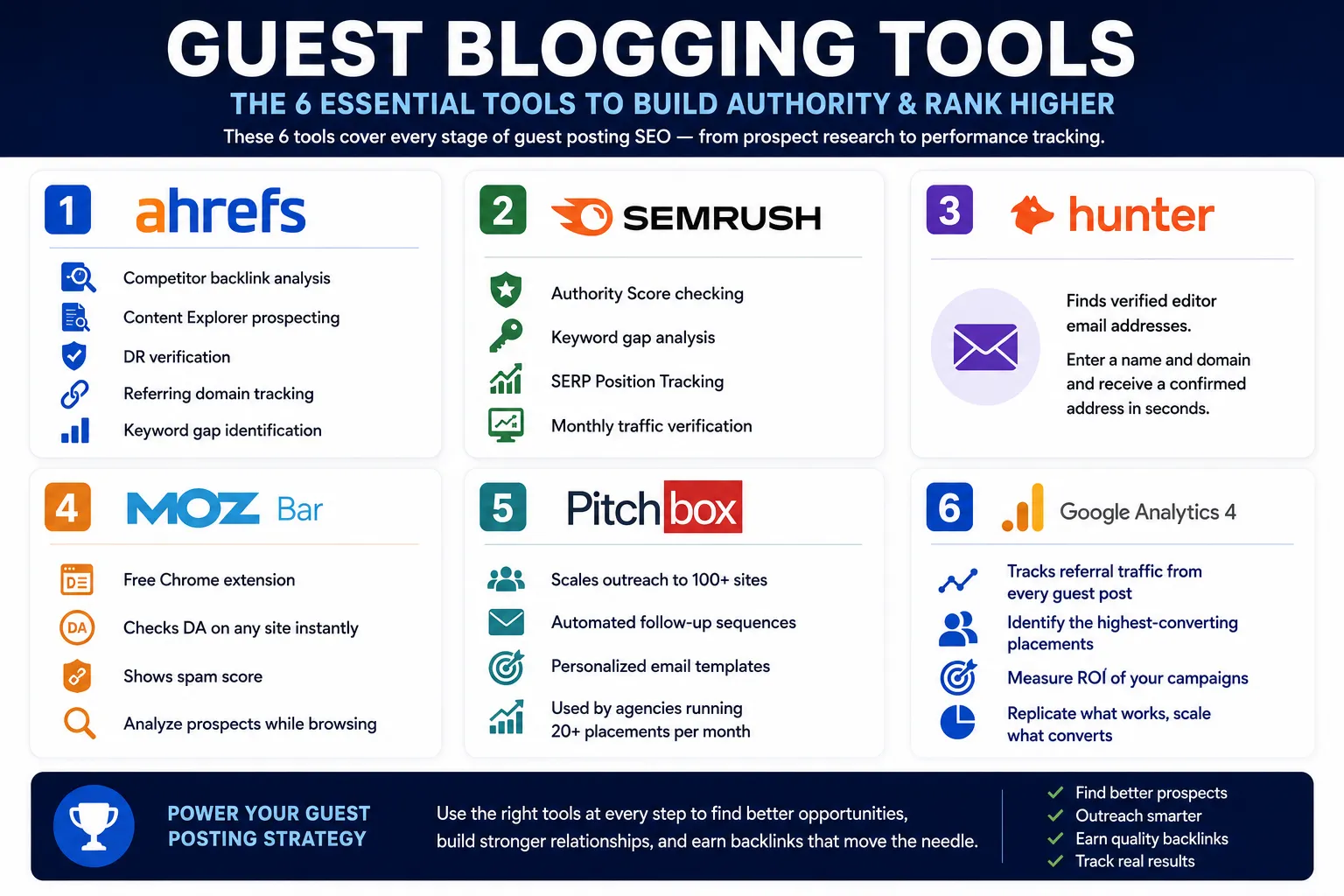
These 6 tools cover every stage of guest posting SEO — from prospect research to performance tracking.
- Ahrefs — competitor backlink analysis, Content Explorer prospecting, DR verification, referring domain tracking, and keyword gap identification
- Semrush — Authority Score checking, keyword gap analysis, SERP Position Tracking, and monthly traffic verification
- Hunter.io — finds verified editor email addresses; enter a name and domain and receive a confirmed address in seconds
- Moz Bar — free Chrome extension; checks DA and spam score on any site instantly while browsing prospects
- Pitchbox — scales outreach to 100+ sites with automated follow-up sequences; used by agencies running 20+ placements per month
- Google Analytics 4 (GA4) — tracks referral traffic from every guest post; identifies the highest-converting placements for campaign replication
Conclusion
Guest posting SEO is the most reliable white-hat method to build high-quality backlinks, increase DA, and grow organic traffic in 2026 — for bloggers, marketing agencies, and SEO professionals targeting sustainable long-term rankings.
The strategy works when 3 conditions are met: you publish on niche-relevant DR30+ sites with real organic traffic; you write genuinely useful content that serves the host blog’s audience first; and you track 4 core metrics monthly to identify which placements move rankings fastest.
Start with 4–8 guest posts per month. Use the 5 topic development techniques to generate ideas editors accept immediately. Follow every editorial guideline before submitting. Promote every published post across 5 channels within 24 hours.
Agencies outranking competitors in 2026 are not doing more guest posting — they’re doing better guest posting on the right sites, with the right content, tracked to the right metrics.