
Submitting a backlink is only half the job. Getting Google to notice it is the part most campaigns get wrong. The tool above handles that second half, pushing your URLs through the submission and crawl-trigger process so links start counting toward your rankings instead of sitting unindexed. The sections below cover what happens behind that process, why some links index faster than others, and how to judge whether a link indexer is doing its job.
What a Link Indexer Does
A link indexer is a tool that submits backlink Uniform Resource Locators (URLs) to Google and other search engines so those links get crawled, stored in the index, and counted toward a site’s ranking signals. A backlink carries zero ranking value until a search engine finds the page it sits on. Google has to crawl that page and decide it deserves a spot in the index before the link does anything at all.
Site owners often assume a backlink starts working the day it goes live. That assumption fails more often than most people expect. Millions of pages never clear the bar for indexing, and a backlink built on one of those pages contributes nothing to a campaign no matter how strong the linking domain looks on paper.
A link indexer closes this gap by pushing the URL toward crawlers through pinging, secondary submissions, or direct requests to a search engine’s application programming interface (API). The tool doesn’t create authority out of nothing. It speeds up the discovery a link would eventually get anyway, if the page ever attracted enough crawl attention on its own.
Why Backlinks Sit Unindexed
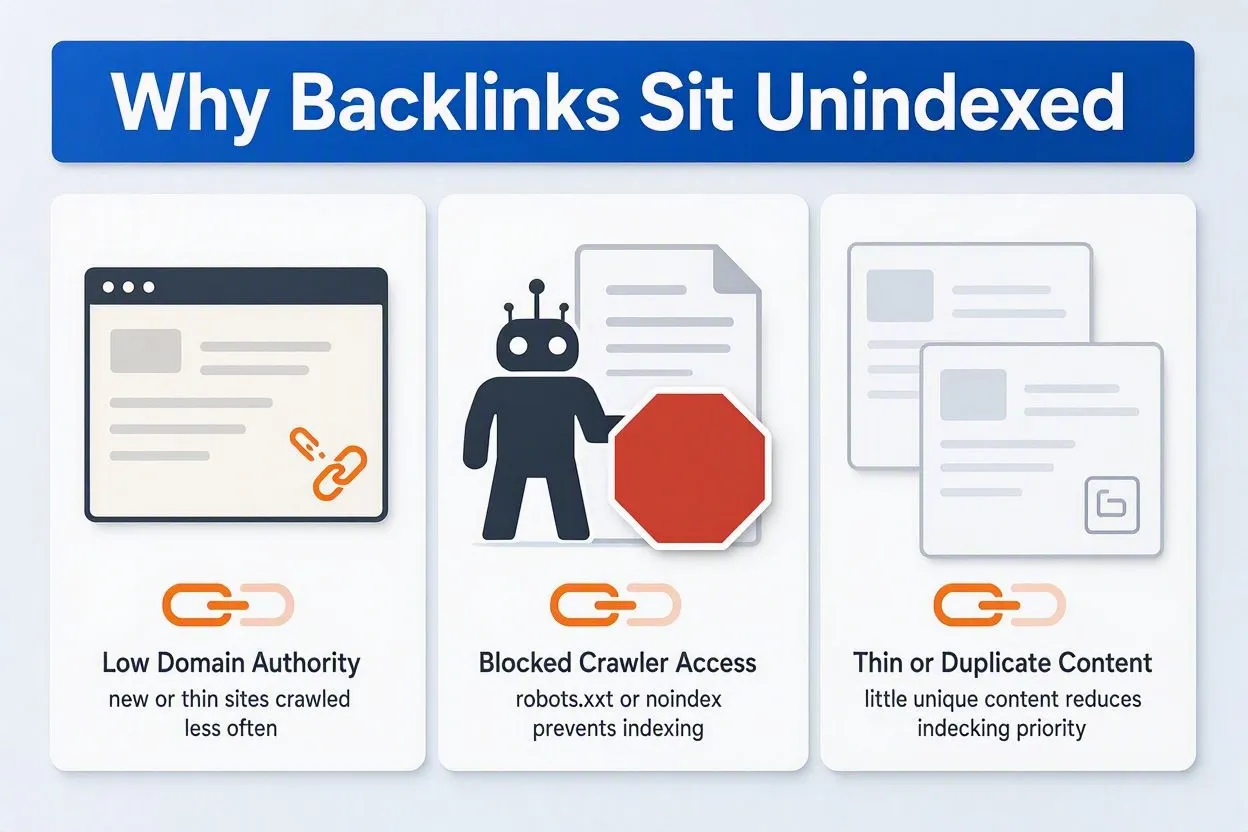
Backlinks stay unindexed because Google never crawls the page, or crawls it and chooses not to store it. Several conditions cause this pattern to repeat across campaigns.
- Low Domain Authority (DA): new or thin sites get crawled less often, so links placed on them wait longer for discovery.
- Blocked crawler access: a robots.txt file or a noindex meta tag stops Googlebot before it reaches the page.
- Thin or duplicate content: pages with little unique text get deprioritized during crawl budget allocation.
- Orphan pages: a page with no internal or external links pointing to it gives Googlebot no path to find it.
- Broken canonical tags: a canonical pointing to a different URL tells Google to ignore the page entirely.
A guest post published on a five-year-old site with strong DA can get indexed within hours. The same article posted on a brand-new blog with no other backlinks might sit unindexed for months.
How a Link Indexer Works, Step by Step
A link indexer runs through four stages: submission, pre-check, discovery push, and verification.
- Submission—URLs get pasted manually or uploaded through a Comma-Separated Values (CSV) or TXT file, often in batches of hundreds or thousands.
- Pre-check—Some tools scan each URL for HyperText Transfer Protocol (HTTP) status code, robots.txt restrictions, and canonical conflicts before spending a credit on it.
- Discovery push—The tool pings the URL, submits it to secondary networks such as Web 2.0 platforms or RSS aggregators, or calls a direct submission API.
- Verification—The tool checks index status over a set window, usually 3 to 10 days, then reports which URLs made it in and which didn’t.
A campaign submitting 500 backlinks might see 350 indexed within 72 hours, another 80 indexed by day 7, and the remaining 70 flagged as non-indexed and eligible for a refund, depending on the provider’s policy.
Manual Methods vs. Automated Tools
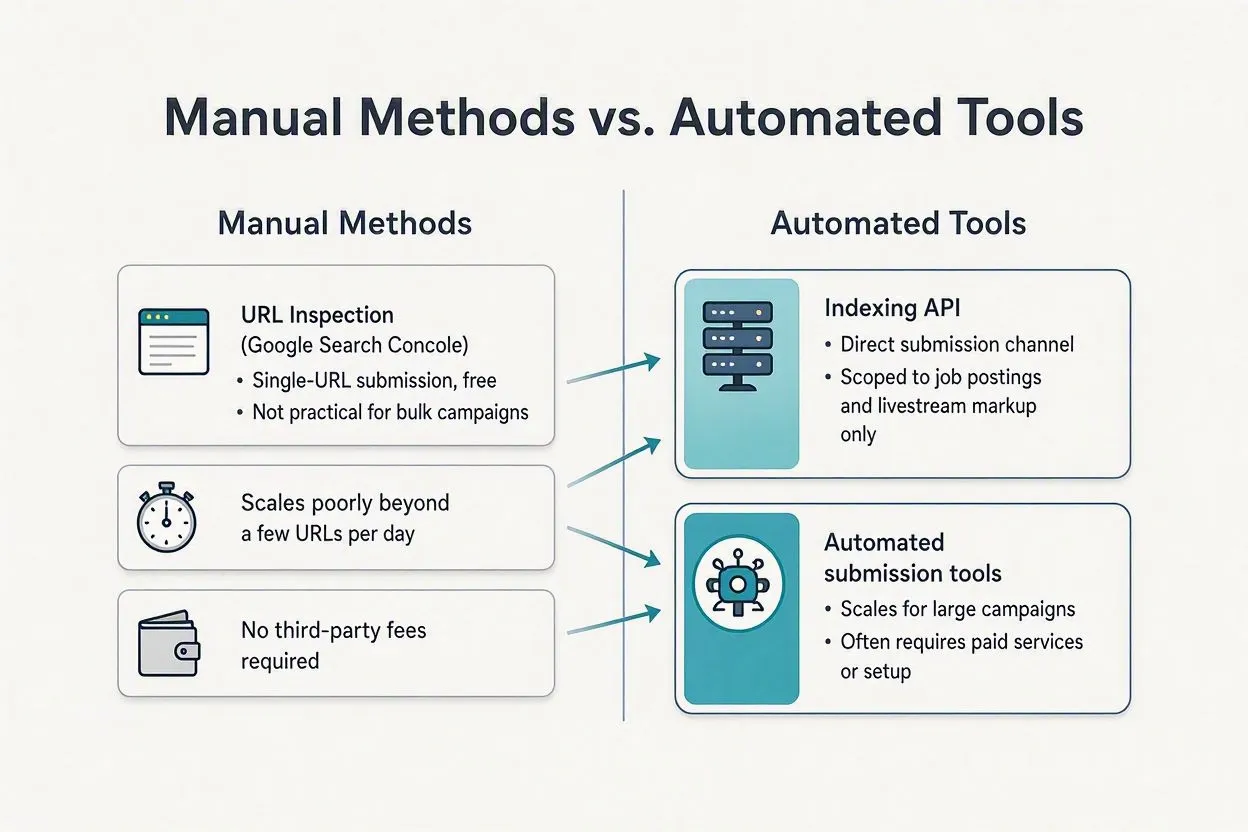
Manual indexing works without paying for a third-party service, but it doesn’t scale past a handful of URLs per day. The main manual options include the URL Inspection tool inside Google Search Console (GSC), which submits one URL at a time for free but turns impractical fast for bulk campaigns. Google’s Indexing API offers a direct submission channel, though Google currently scopes it to job postings and livestream markup only, not general backlinks. IndexNow, a protocol backed by Bing and Yandex, pushes URL updates instantly, but Google doesn’t participate in it as of 2026.
Internal linking rounds out the free options: placing links to a new page from already-indexed pages on the same site speeds up discovery without any external tool.
Manual submission holds up fine for a site owner handling fewer than 20 URLs a month. Past that volume, a link indexer becomes the practical choice, since bulk CSV uploads and automated pinging save hours of repetitive manual work.
Index Rates by Backlink Type
Index rates depend on the type and quality of the backlink far more than on which tool submits it. Guest posts on established, high-DA sites index at the strongest rates, often above 70%, since the host domain already gets crawled frequently. Web 2.0 properties such as WordPress.com, Blogger, and Medium index reliably in most cases, because the parent platforms carry existing authority.
Social media profile links index inconsistently. Platforms like X and LinkedIn get crawled often, but individual profile pages compete against billions of others for the same crawl attention. Directory and citation listings vary widely by directory quality—an established local directory outperforms a mass-produced, spammy one by a wide margin. Forum and blog comment links show the lowest and least predictable index rates, since many carry nofollow tags or get deprioritized by Google outright.
A campaign built entirely on forum comments will underperform one built on guest posts and Web 2.0 placements, even when both run through identical tools and identical budgets.
How to Check If a Backlink Is Indexed
Checking index status costs nothing and works through Google’s own search operators or the Search Console URL Inspection tool. Typing site:example.com/page-url” into Google’s search bar shows whether that exact URL appears in the index. Google Search Console confirms indexing status directly and shows the last crawl date from Google’s own data.
Bulk index checker tools check hundreds or thousands of URLs in one batch and export results as indexed or not indexed. Checking 5,000 backlinks manually through the site: the operator would take hours; a bulk checker finishes the same task in minutes and flags de-indexed URLs that need replacing.
What to Look for in a Link Indexer
A reliable link indexer publishes clear success-rate data, offers refunds for non-indexed URLs, and skips spammy submission tactics that risk site penalties. Check whether the tool shows indexed and not-indexed status per URL with timestamps, rather than a single vague percentage. Confirm the provider returns credits for URLs that never get indexed within a stated window, and ask whether the submission method gets disclosed rather than treated as a black box.
A tool that automatically refunds credits after 10 days for non-indexed URLs gives buyers a built-in accuracy check. A tool claiming a flat 100% success rate with no per-URL reporting deserves skepticism.
Risks of Aggressive Indexing

Aggressive indexing of low-quality backlinks can trigger de-indexing of the linked page, even though the indexing tool itself causes no direct penalty. Google doesn’t penalize a site for requesting indexing. Risk comes from what gets submitted, not from the act of submitting it.
Pushing thousands of spam-generated forum comments through an indexer puts low-value content in front of Google’s quality systems, which can lower trust across the entire linked domain. Experienced technical SEOs manage this risk by reviewing server log files to confirm which pages Googlebot actually crawls, rather than relying only on third-party reports. Log file analysis shows real crawler behavior—user-agent strings, request frequency, and response codesdata no indexing tool can substitute for.
Sites pairing link indexing with strong on-page content and legitimate backlink sources see the most durable ranking gains. Sites chasing volume through low-quality links risk losing pages from the index entirely, regardless of how fast those links got submitted.
FAQs