

A brand mention in ChatGPT is when your company name appears directly inside an AI-generated answer — not as a link, not as a search result, but woven into the response itself.
When someone asks “What are the best SEO tools for small businesses?” and ChatGPT responds with “Ahrefs, Semrush, and Moz are widely used options,” those three names are brand mentions.
Brand mentions appear in 3 forms:
- Inline mentions — your brand name appears inside the answer text
- Recommendations — ChatGPT suggests your brand as a solution to a problem
- Comparison inclusions — your brand appears in a head-to-head comparison with competitors
Brand Mentions vs Citations — They Are Not the Same Thing
This distinction matters because the fix for each is completely different.
A citation is a URL that ChatGPT links to as a source when it answers a question. A brand mention is your company name appearing in the answer itself — with or without a citation attached.
You can have a citation without a mention (ChatGPT cites your blog post but never names your brand). You can also have a mention without a citation (ChatGPT recommends your product by name but links to a competitor’s review of it).
Fix missing mentions by expanding your brand’s presence across authoritative third-party content. Fix missing citations by improving your own content’s structure and Bing ranking — covered in Section 5.
Why ChatGPT Brand Mentions Differ From Google Rankings
Google gives you position data, session counts, and click-through rates. ChatGPT gives you nothing by default.
Here’s the full breakdown of what makes AI brand monitoring a completely separate analytics discipline from traditional SEO:
| Factor | Traditional SEO (Google) | ChatGPT Brand Visibility |
| Data source | Search Console, GA4, rank trackers | Manual prompts, dedicated AI analytics tools |
| Visibility signal | Position 1–10 on SERPs | Included in answer or completely absent |
| User action | Click to your website, tracked as organic session | Read the answer, may never visit your site |
| Response consistency | Same query = same results | Same query = different answer every time |
| Measurement metric | Rankings, impressions, CTR, bounce rate | Share of voice, sentiment score, mention rate |
| Traffic attribution | UTM parameters, referral data in GA4 | Dark traffic — arrives as direct with no source data |
| Update frequency | Real-time index updates | Training data cutoffs + live RAG analytics layer |
The biggest shift: there is no “position 2” in ChatGPT. Your brand either gets mentioned or it doesn’t. This binary nature is why tracking requires a completely different web analytics approach — one built on mention frequency and share of voice rather than rank position and click data.
ChatGPT also pulls from 2 separate data sources — its training data (everything it learned before its knowledge cutoff) and live web search through Retrieval Augmented Generation (RAG). Each source requires a different monitoring and analytics strategy, covered in Section 6.
Method 1 — Free Manual Tracking With Incognito Prompts
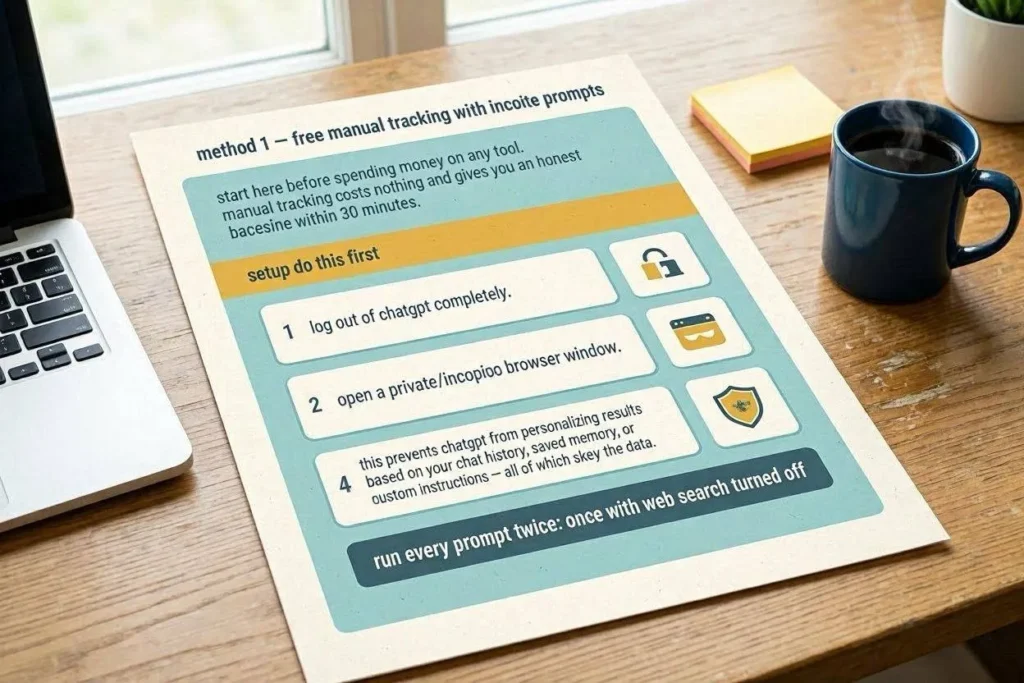
Start here before spending money on any tool. Manual tracking costs nothing and gives you an honest baseline within 30 minutes.
Setup (Do This First)
Log out of ChatGPT completely. Open a private/incognito browser window. This prevents ChatGPT from personalizing results based on your chat history, saved memory, or custom instructions — all of which skew the data.
Run every prompt twice: once with web search turned OFF and once with web search turned ON. The difference tells you whether your brand gap is a training data problem or a live content problem. More on that in Section 6.
20 Ready-to-Use Prompt Templates
Copy these directly. Replace [YOUR BRAND] and [YOUR CATEGORY] with your actual details.
Brand Awareness Prompts (run with search OFF)
- “What is [YOUR BRAND] and what is it used for?”
- “Who should use [YOUR BRAND]?”
- “What are [YOUR BRAND]’s main features?”
- “Is [YOUR BRAND] a trusted company?”
- “What do customers say about [YOUR BRAND]?”
Competitor Comparison Prompts
- “How does [YOUR BRAND] compare to [COMPETITOR]?”
- “Which is better — [YOUR BRAND] or [COMPETITOR]?”
- “What are the main differences between [YOUR BRAND] and [COMPETITOR]?”
- “[YOUR BRAND] vs [COMPETITOR] — which should I choose for [USE CASE]?”
- “Is [YOUR BRAND] better than [COMPETITOR] for small businesses?”
Category/Buying Decision Prompts (run with search ON)
- “What are the best tools for [YOUR CATEGORY] in 2026?”
- “What should I look for in a [YOUR PRODUCT TYPE]?”
- “What is the best [YOUR CATEGORY] for [SPECIFIC USE CASE]?”
- “Give me a shortlist of [YOUR CATEGORY] options under $100/month.”
- “Which [YOUR CATEGORY] tools do professionals recommend?”
Reputation Check Prompts
- “What are the downsides of [YOUR BRAND]?”
- “Is [YOUR BRAND] worth the price?”
- “What problems do people have with [YOUR BRAND]?”
- “Has [YOUR BRAND] had any controversies or issues?”
- “Would you recommend [YOUR BRAND] to a startup?”
What to Record in Your Spreadsheet
Create a Google Sheet with these 7 columns — this becomes your free AI web analytics tracker:
- Prompt — exact text used
- Web search ON/OFF — which mode tested
- Brand mentioned? (Y/N) — did your brand appear
- Position — first, middle, or last in the list
- Sentiment — positive, neutral, or negative framing
- Competitors mentioned — who appeared when you didn’t
- Citation URL — which page ChatGPT linked to, if any
Run this audit monthly. After 3 months, patterns emerge that show exactly which topic areas your brand owns and which ones competitors dominate. Add a monthly summary row tracking total mention rate percentage — this is your free AI visibility score without a paid analytics platform.
Method 2 — Paid AI Monitoring Tools (2026 Comparison)
Manual tracking works for baselines. Paid tools work for scale, automation, and trend tracking across weeks and months.
These 7 tools cover the full range from budget-friendly to enterprise:
| Tool | Best For | Starting Price | Free Option |
| Ahrefs Brand Radar | Full AI visibility + competitor gaps | Paid plan | No |
| Semrush AI Toolkit | Existing Semrush users | $99/month | 7-day trial |
| Otterly.ai | SMBs on a tight budget | $29/month | Limited free tier |
| Peec AI | Quick visibility snapshots | €89/month | No |
| WorkDuo | Agencies managing multiple brands | $33/project/month | Yes |
| Profound | Enterprise teams needing governance | $99/month | Yes |
| Keyword.com | Rank tracking + AI visibility combined | Custom | 14-day trial |
4 Metrics Every Tool Must Track
Before buying any tool, confirm it tracks all 4 of these. Tools that only track mentions without context are not worth the spend:
AI Visibility Score measures how often your brand appears in ChatGPT responses for a tracked set of prompts, expressed as a percentage. A score of 40% means your brand appeared in 40 out of 100 tested prompts.
Share of Voice (SoV) shows what percentage of total brand mentions in your category belong to you versus competitors. If ChatGPT mentioned 10 brands across 100 prompts and your brand appeared 30 times, your SoV is 30%.
Sentiment Score classifies whether ChatGPT frames your brand positively, neutrally, or negatively. Neutral is acceptable. Negative framing in buying-decision prompts is a problem that needs immediate content action.
Citation Source reveals which URLs ChatGPT actually cites when mentioning your brand. These citations directly show which third-party sites carry the most influence over how ChatGPT represents you.
Which Tool Fits Your Budget
- $0 budget — manual prompt audit (Section 3) + Google Alerts for web mentions
- Under $50/month — Otterly.ai handles basic prompt tracking and citation checks
- $99/month — Semrush AI Toolkit if you already use Semrush; Profound if you need deeper analytics
- Agency or multi-brand — WorkDuo at $33/project gives the best value at scale
- Enterprise — Profound or Ahrefs Brand Radar for governance, API access, and competitor intelligence
The 87% Bing Rule Nobody Talks About
87% of ChatGPT’s top citations match Bing’s top search results. This single statistic from Seer Interactive changes everything about how to approach ChatGPT visibility.
ChatGPT with web search enabled doesn’t use Google. It queries Bing. That means your Google rankings have limited impact on whether ChatGPT cites your content — but your Bing rankings have direct impact.
Most brands ignore Bing entirely. That’s your opportunity.
4 Actions to Increase Bing Rankings (and ChatGPT Citations)
Submit your sitemap to Bing Webmaster Tools. Go to bing.com/webmasters, add your site, and submit your XML sitemap. Many websites have never done this. Bing can’t index pages it doesn’t know exist, so ChatGPT can’t cite them either.
Optimize title tags for question-style queries. ChatGPT answers conversational questions. Pages with titles like “How to [solve specific problem]” or “What is [specific term]” match those queries more precisely than generic category titles.
Build backlinks from domains Bing trusts. High-authority domains — industry publications, news sites, established directories — carry strong trust signals in Bing’s ranking algorithm. A single mention on a respected industry site can push a page into Bing’s top results and directly into ChatGPT’s citation pool.
Add FAQ schema and structured data markup. Schema.org FAQ markup helps Bing understand your content’s structure. Pages with FAQ schema get parsed more accurately, which increases the chance ChatGPT extracts and cites specific answers from those pages.
RAG vs Training Data — Two Problems, Two Fixes
When ChatGPT gets your brand wrong — or ignores it completely — the cause is one of 2 things. Identifying which one determines your entire fix strategy.
Test 1 — Web search OFF: Run your prompts with ChatGPT’s web search disabled. The model draws entirely from its training data. If your brand doesn’t appear or appears inaccurately here, the problem is a training data gap. Your brand isn’t well-represented in the sources ChatGPT was trained on.
Test 2 — Web search ON: Run the same prompts with web search enabled. ChatGPT now queries Bing and pulls live content through RAG. If your brand appears correctly with search ON but not with search OFF, the problem is your live content — not your historical brand presence.
Fix for Training Data Gaps
Training data gaps take longer to fix because they require building presence in sources that feed future LLM training cycles:
- Create or expand your Wikipedia entry with accurate, sourced information
- Build an active presence on Reddit in subreddits relevant to your industry
- Collect reviews on G2, Trustpilot, and Capterra — review platforms are heavily weighted in training data
- Update your Crunchbase and LinkedIn company page with current, precise descriptions
- Earn coverage in industry publications that regularly get scraped for training datasets
Fix for RAG/Content Gaps
RAG gaps fix faster because they involve your current web content:
- Publish content that directly answers the exact prompts ChatGPT receives — structure pages as explicit Q&A
- Ensure your key pages are indexed in Bing (check Bing Webmaster Tools)
- Update any page with outdated pricing, features, or positioning — ChatGPT surfaces whatever Bing currently indexes
- Add direct, specific claims to your About and product pages — vague copy doesn’t extract well from RAG
What to Do When ChatGPT Gets Your Brand Wrong
This is the most overlooked problem in AI brand monitoring — and none of your competitors have documented a fix for it.
ChatGPT misrepresents brands in 4 specific ways:
- Wrong pricing — lists an old price tier that no longer exists
- Discontinued features — describes a feature you removed months ago
- Wrong audience — positions your enterprise tool as a beginner product (or vice versa)
- Competitor attribution — assigns a competitor’s feature to your brand
5-Step Reputation Repair Playbook
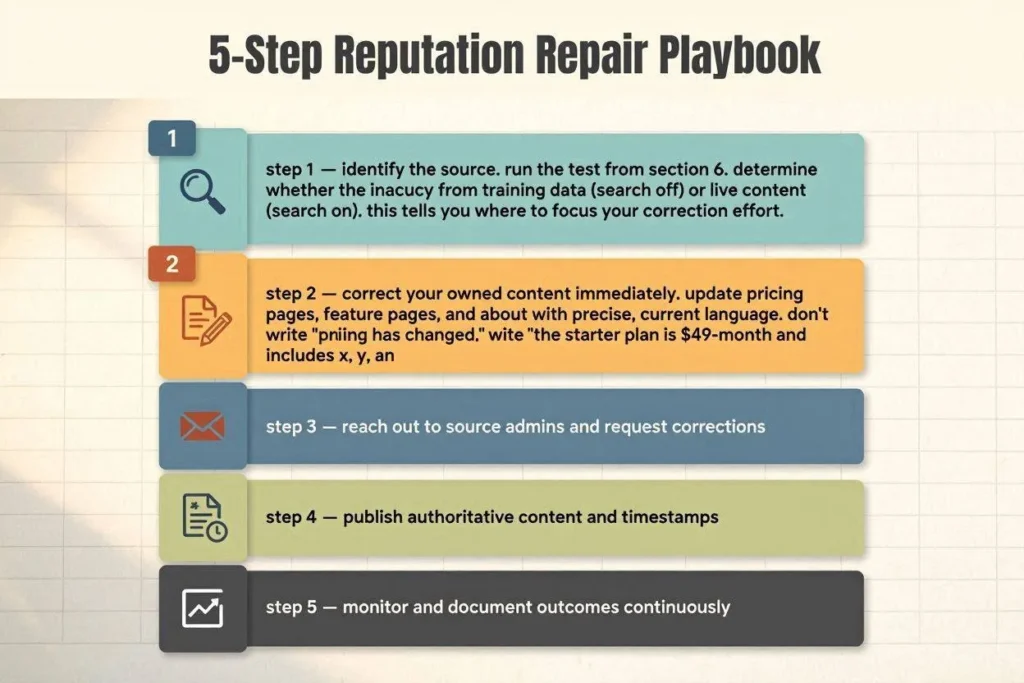
Step 1 — Identify the source. Run the test from Section 6. Determine whether the inaccuracy comes from training data (search OFF) or live content (search ON). This tells you where to focus your correction effort.
Step 2 — Correct your owned content immediately. Update pricing pages, feature pages, and your About page with precise, current language. Don’t write “pricing has changed.” Write “The Starter plan is $49/month and includes X, Y, and Z.” Specific language extracts better through RAG.
Step 3 — Update third-party sources. Log into G2, Capterra, Trustpilot, and Crunchbase. Update your company description, product categories, and feature lists. These platforms carry heavy weight in both training data and RAG.
Step 4 — Publish a correction-oriented press release. A press release picked up by PR Newswire or Business Wire gets indexed across hundreds of news sites. If ChatGPT’s web search surfaces those articles, the corrected information directly overrides the old narrative.
Step 5 — Monitor weekly for 60 days. Run your brand reputation prompts from Section 3 every week after making corrections. ChatGPT’s RAG layer updates faster than training data — expect to see content-based fixes within 2–4 weeks. Training data fixes take longer, often 3–6 months, depending on the next model update cycle.
How to Measure ROI From ChatGPT Brand Mentions
ChatGPT sends zero UTM data. Every click that originates from a ChatGPT answer arrives as direct traffic in GA4 — no source, no medium, no campaign tag. This is called dark traffic, and web analytics platforms cannot differentiate it from users who type your URL directly into a browser.
Dark traffic is growing fast. As AI search usage increases, the gap between actual brand-driven visits and attributable organic sessions widens. Standard web stats reports undercount AI-driven traffic by a significant margin.
That doesn’t make ChatGPT-driven revenue unmeasurable. These 3 web analytics methods give real attribution signals without relying on UTM data that ChatGPT never sends:
Method 1 — Direct Traffic Spike Correlation
In GA4, open the Traffic Acquisition report and filter by the Direct channel. Set your date range to the last 6 months and view data week by week. Cross-reference direct traffic spikes with weeks where your AI monitoring tool shows increased ChatGPT mention frequency. Consistent correlation across 3+ months is strong evidence that ChatGPT visibility drives measurable direct sessions.
Export both datasets — GA4 direct traffic by week and AI visibility score by week — into a spreadsheet. Calculate the Pearson correlation coefficient. A correlation above 0.6 confirms the relationship is statistically meaningful, not coincidental.
Method 2 — Brand Search Volume Increase
When ChatGPT recommends your brand, a large percentage of users immediately open Google and search your company name to find your website. This creates a branded search signal that Google Search Console (GSC) tracks precisely.
In GSC, go to Performance → Search Results → filter by your brand name as a query. Track branded keyword impressions and clicks month over month. Rising branded search volume alongside rising ChatGPT share of voice is a reliable indirect attribution signal — one that connects AI visibility directly to measurable web traffic data.
Method 3 — UTM Testing via ChatGPT Plus Browsing
Create a dedicated landing page with a unique UTM parameter: ?utm_source=chatgpt&utm_medium=ai-citation&utm_campaign=brand-tracking. Ask ChatGPT Plus with browsing enabled to answer a question your page directly addresses. If ChatGPT cites that URL, any sessions arriving via that tagged link appear in GA4 as a trackable source — definitively attributed to ChatGPT, not grouped into direct traffic.
This method works for testing citation behavior on specific content pieces and building a calibrated dataset of ChatGPT-driven sessions over time.
Monthly Web Analytics KPI Table
Track these 6 metrics every month to measure ChatGPT visibility progress alongside standard web performance data:
| KPI | Analytics Tool | What It Measures |
| AI Visibility Score | Ahrefs Brand Radar / Semrush / Otterly | ChatGPT mention frequency across tracked prompts |
| Share of Voice % | WorkDuo / Profound | Your brand mentions vs competitor mentions in AI responses |
| Sentiment ratio | Any AI monitoring platform | % positive vs neutral vs negative brand framing |
| Direct traffic volume | GA4 — Traffic Acquisition report | Potential ChatGPT-driven sessions arriving as direct |
| Branded search impressions | Google Search Console | Indirect brand lift signal from AI-driven awareness |
| New citation sources | Ahrefs Brand Radar — Cited Domains | New URLs ChatGPT started citing for your category |
Monthly Brand Monitoring Workflow
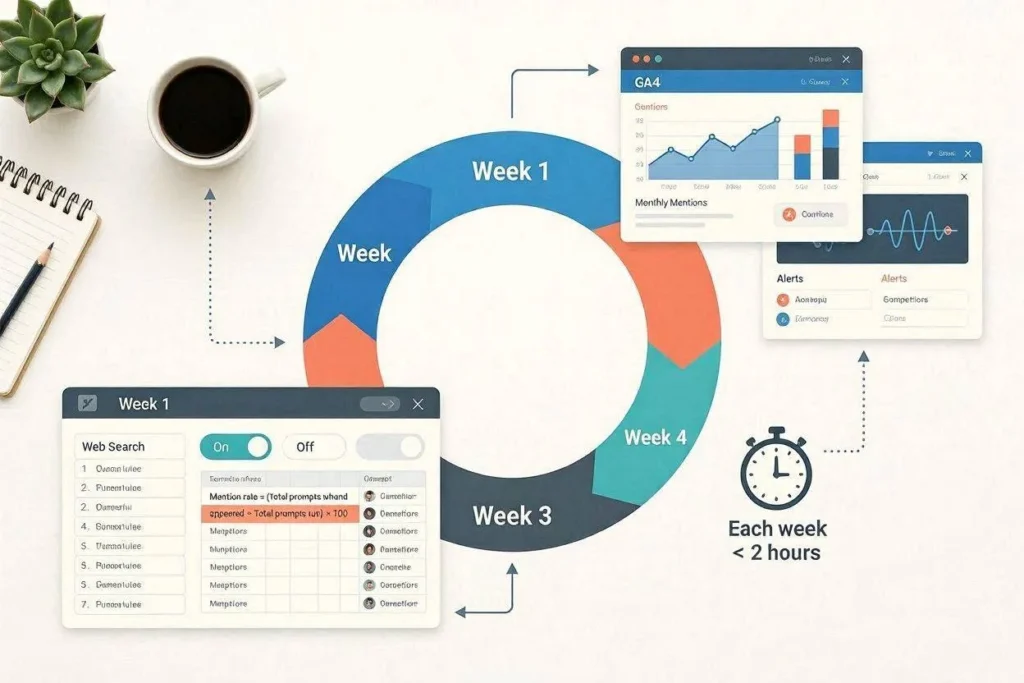
Run this 4-week cycle every month. Each week takes under 2 hours. Track all outputs in your GA4 dashboard alongside your AI monitoring tool to build a unified analytics view.
Week 1 — Manual Audit Run all 20 prompts from Section 3 in incognito mode with web search both ON and OFF. Record every result in your spreadsheet. Calculate this month’s mention rate: total prompts where brand appeared ÷ total prompts run × 100. Note which competitors appear in prompts where your brand doesn’t.
Week 2 — Tool Dashboard Review Log into your AI monitoring tool. Export the list of prompts where competitors gained visibility that you lost. Check your citation sources — identify any new domains ChatGPT started citing for your category. Compare your AI Visibility Score and Share of Voice against the previous month’s data.
Week 3 — Content Action Pick the 3 biggest visibility gaps from Week 2. Either update an existing page to address those prompt topics directly, or create a new Q&A-format piece that targets the exact query. Submit updated pages to Bing Webmaster Tools for reindexing. Tag any new pages with tracking parameters for GA4 attribution.
Week 4 — Analytics Report Compare this month’s AI Visibility Score and Share of Voice against last month. Check GA4 for direct traffic trends and GSC for branded search impression changes. Record the delta on all 6 KPIs from the table in Section 8. Document 1 win and 1 remaining gap to carry into next month’s cycle.
After 3 months of consistent execution, patterns become clear. You’ll know exactly which content types move your ChatGPT share of voice and which competitor topics to prioritize next.
Final Thoughts
ChatGPT brand monitoring is not optional in 2026. Millions of users ask ChatGPT for buying recommendations every day — and every answer either includes your brand or hands that customer to a competitor.
Start with the free manual audit this week. Set up 20 prompts, record the results, and identify your 3 biggest visibility gaps. That baseline tells you whether your problem is a training data issue, a content issue, or a Bing indexing issue — and each one has a clear fix documented in this guide.
The brands that build systematic ChatGPT monitoring now will have a 12-month head start on every competitor that waits.