A brand mention tool is a brand management system that tracks how your company is perceived across news sites, social platforms, forums, and AI chatbots, then reports sentiment and reputation trends in real time. Strong brand management depends on knowing exactly how your brand identity holds up in public conversation, not just counting how many times your name appears.
Brand perception shifts fast in 2026. ChatGPT, Gemini, and Perplexity now answer product questions directly, shaping brand positioning before a buyer ever reaches a search engine. A brand left out of that conversation loses ground on reputation and recall, not just traffic. Strong brand governance means catching that gap early and correcting the narrative.
This guide covers 9 tools that support brand management this year, how brand teams choose between them, and how to set up brand health tracking in under an hour.
What Is Brand Management
Brand management is the ongoing practice of shaping how the public perceives a company’s identity, reputation, and values across every channel where that brand gets discussed. It covers brand positioning, brand voice consistency, brand equity protection, and reputation response, not just visibility tracking.
A brand manager’s job differs from a marketer’s job in one key way: marketing measures campaign performance, while brand management measures perception over time. Brand guidelines define how a company wants to be seen. Brand monitoring tools tell a brand team whether that perception actually matches reality.
Brand Management vs Brand Monitoring
Brand management is the strategy. Brand monitoring is the data that informs it. A brand management plan sets the tone, voice, and positioning a company wants associated with its name. Brand monitoring tools then measure whether the public, press, and AI platforms reflect that intended brand identity back accurately.
A mismatch between intended brand positioning and actual brand perception signals a brand management problem, not a marketing problem. Closing that gap requires consistent reputation tracking, fast response to perception shifts, and a clear brand voice across every reply.
What Counts as a Brand Mention
A brand mention is any online reference to your company that shapes brand perception, whether it links to your site or not. Three types exist, and each one carries different brand equity value.
- Linked mentions send referral traffic and pass SEO value through the backlink.
- Unlinked mentions build brand awareness and reinforce brand identity as a recognized entity, even without a click-through path.
- AI mentions appear when a chatbot names your brand inside a generated answer, shaping brand positioning at the exact moment a buyer forms an opinion.
Unlinked mentions used to get dismissed as low value. That view is outdated. Search engines and AI models both treat repeated, consistent unlinked mentions as a brand trust signal that builds brand equity independent of any single link.
Why Brand Management Matters in 2026
Buyers form opinions about a brand differently than they did in 2023. A large share of brand discovery now happens inside AI chat interfaces instead of a search results page. If an AI model recommends three competitors and skips your brand, your brand identity loses ground in that buyer’s mind before any sales conversation starts. Brand management in 2026 means protecting brand perception across human and AI audiences at the same time.
Three brand outcomes depend directly on active brand management:
- Reputation control. A brand team catches a negative review or a factual error within hours instead of weeks, protecting brand equity before damage compounds.
- Backlink recovery. Every unlinked mention is a brand visibility opportunity a team can convert with one outreach email.
- Brand positioning in AI search. A brand team learns whether ChatGPT, Gemini, and Perplexity describe the brand accurately, and whether competitors are winning the recommendation instead.
How to Choose a Brand Mention Tool

Match the tool to your channel mix, not the other way around. Four questions narrow the list fast.
Do you need AI search tracking? If buyers in your category research through ChatGPT or Perplexity, pick a tool that monitors AI answers specifically. Most legacy tools, including Brandwatch, Mention, and Sprout Social, skip this entirely.
What’s your monthly budget? Tools range from free (Google Alerts) to $9,000+ per year (Talkwalker, Meltwater). Set a number before you start comparing features, or you’ll end up paying for capacity you don’t use.
Does your team need social publishing too? Pick an all-in-one platform like Sprout Social or Hootsuite if the same team also schedules posts. Pick a dedicated mention tool if monitoring and publishing sit with different people.
How many mentions do you generate per month? A startup with under 50 monthly mentions gets full value from a free or $10/month tool. An enterprise brand with thousands of daily mentions needs a platform built for volume and team routing.
9 Best Brand Mention Tools in 2026
| Tool | Best For | AI Search Tracking | Starting Price |
| Brand24 | Small to mid-size teams | No | $79/month |
| Mention | Solo founders and small teams | No | $41/month |
| BrandMentions | Web and social monitoring | No | Custom |
| Alertmouse | Simple email alerts | No | $10/month |
| Ahrefs Brand Radar | Enterprise AI tracking | Yes | $199/month add-on |
| Peec AI | Affordable AI search tracking | Yes | $95/month |
| Shadow | Communications and PR teams | Yes | From $50/report |
| Sprout Social | Social media teams | No | $79/seat/month |
| Google Alerts | Zero-budget baseline | No | Free |
1. Brand24
Brand24 tracks mentions across social media, news, blogs, podcasts, forums, and review sites in real time. Its Reputation Score compresses mention volume, sentiment, and reach into one number, so you don’t need to read a dashboard full of charts to know if your brand health is trending up or down.
Best for: small to mid-size marketing teams that want a clean interface without an enterprise price tag.
Limitation: no AI search monitoring, and sentiment accuracy drops in highly technical or niche industries.
2. Mention
Mention runs on Boolean search logic, so you can build precise queries that exclude noise like job postings or spam accounts. Real-time alerts arrive the moment a new mention matches your query.
Best for: solo founders and small teams that want affordable, accurate alerts without a steep learning curve.
Limitation: smaller source database than enterprise platforms, and no AI search coverage.
3. BrandMentions
BrandMentions covers web, social, news, and forums from one dashboard. The standout feature is competitor spying: you can pull up a rival’s mention history and see exactly where their coverage comes from.
Best for: teams that want competitor intelligence built into the same tool as brand tracking.
Limitation: pricing isn’t published upfront, and you’ll need a sales call to get a number.
4. Alertmouse
Built by Moz founder Rand Fishkin, Alertmouse positions itself as a more reliable Google Alerts replacement. You enter an exact phrase, set inclusion or exclusion rules, and get a clean email report whenever a match appears.
Best for: journalists, authors, and PR professionals who just need accurate alerts without a full dashboard.
Limitation: the free plan caps out at 10 mentions per day, which fills up fast for an active brand.
5. Ahrefs Brand Radar
Brand Radar tracks brand mentions across ChatGPT, Perplexity, Gemini, Microsoft Copilot, and Google AI Overviews, pulling from a database of over 150 million tracked queries. It’s an add-on inside the existing Ahrefs platform, so SEO and AI visibility data live in one place.
Best for: enterprise teams that already use Ahrefs and need AI visibility without adding a separate vendor.
Limitation: the add-on starts at $199/month on top of a base Ahrefs plan, pushing total cost past $300/month minimum.
6. Peec AI
Peec AI tracks the same AI platforms as Brand Radar at roughly half the cost. You set up prompts you care about, and the tool reports whether your brand shows up in ChatGPT, Perplexity, and AI Overviews, plus which competitors appear alongside you.
Best for: mid-size teams that want AI search tracking without the enterprise price.
Limitation: smaller query database than Brand Radar, so coverage on niche topics can be thinner.
7. Shadow
Shadow is built specifically for communications and PR teams rather than marketers. It tracks news from over 200,000 sources, social platforms including Reddit and LinkedIn, search rankings, and AI-generated responses across ChatGPT, Claude, Gemini, and Perplexity, all in one report.
Best for: PR and communications teams that need cross-channel narrative tracking, not just a mention count.
Limitation: no Instagram or TikTok coverage, and it’s not built for scheduling social posts.
8. Sprout Social
Sprout Social is a full social media management platform with a listening feature layered on top. Beyond mentions, you get post scheduling, a unified inbox, and competitor benchmarking templates for campaigns, industry trends, and events.
Best for: social teams that need mention tracking bundled with publishing and engagement tools.
Limitation: monitoring is social-only, with no news, search, or AI coverage, and pricing is per seat, which adds up fast for larger teams.
9. Google Alerts
Google Alerts remains the free baseline every brand should run, even alongside a paid tool. Enter your brand name, common misspellings, and product names, and you’ll get an email whenever new content matching those terms appears in Google’s index.
Best for: startups and solo practitioners with zero monitoring budget.
Limitation: it misses social platforms, forums, and AI-generated answers entirely, and alerts often arrive days after the mention actually goes live.
Brand Mention Tools by Budget
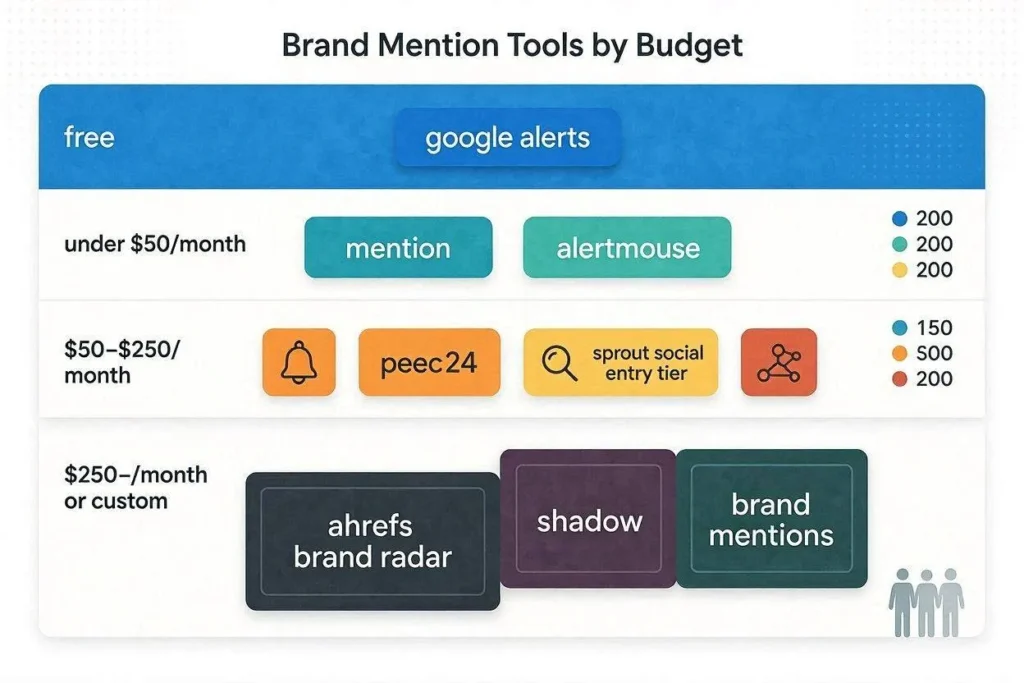
Budget decides more than any feature list. Here’s how the 9 tools split by monthly spend.
Free: Google Alerts. Use it as a baseline even if you upgrade later.
Under $50/month: Mention and Alertmouse. Both cover the basics without a contract.
$50–$250/month: Brand24, Peec AI, and Sprout Social entry tier. This range covers most small and mid-size businesses.
$250+/month or custom: Ahrefs Brand Radar, Shadow, and BrandMentions. Pick this tier once mention volume or AI tracking needs outgrow a lighter tool.
How to Set Up Brand Mention Tracking in 4 Steps
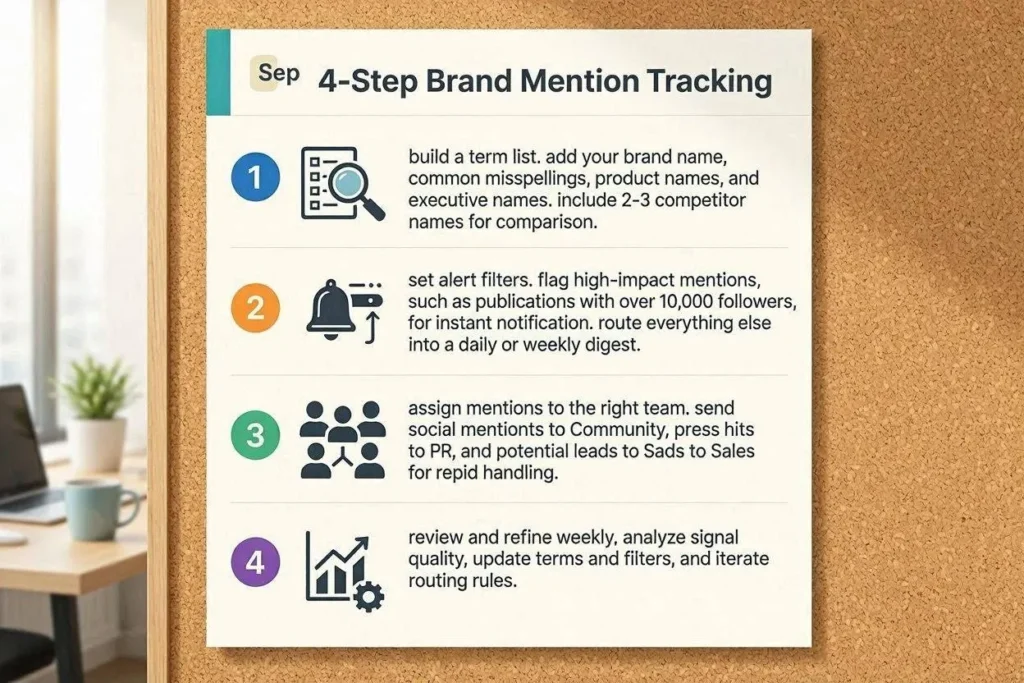
To start tracking mentions correctly, follow these four steps in order.
- Build a term list. Add your brand name, common misspellings, product names, and executive names. Include 2-3 competitor names for comparison.
- Set alert filters. Flag high-impact mentions, such as publications with over 10,000 followers, for instant notification. Route everything else into a daily or weekly digest.
- Assign mentions to the right team. Send social mentions to community management, press coverage to the brand or PR lead, and unlinked mentions with link potential to whoever owns outreach.
- Write a response playbook. Define when to engage, when to escalate to leadership, and when to ignore noise like spam or bot activity.
How to Turn Unlinked Mentions Into Brand Equity
Not every mention needs outreach. Focus only on mentions from sites where a link strengthens both referral value and brand credibility, typically active blogs, news sites, and industry publications.
Send a short email: thank the writer for the mention, explain how a link helps their readers connect with your brand directly, and include the exact URL you want linked. Follow up once after a week if you don’t hear back. Most writers say yes when the ask takes less than 30 seconds to act on.
Conclusion
The right brand mention tool turns scattered online chatter into a clear brand management system you can act on every week. Free tools like Google Alerts work as a starting baseline, mid-tier tools like Brand24 and Mention fit most growing teams, and platforms like Shadow or Ahrefs Brand Radar serve teams that need AI search coverage alongside traditional brand monitoring.
Brand reputation builds slowly and breaks fast. A tool only delivers value if a team checks it weekly, assigns mentions to the right owner, and responds before a small perception issue turns into a brand crisis. Match the tool to your channel mix and budget first, then build the habit around it.